风险提示:本网站所有内容不构成投资建议,且无任何带单、引导交易服务;根据央行等十部委发布《关于进一步防范和处置虚拟货币交易炒作风险的通知》请读者提高风险意识。联系我们 / [email protected] 琼ICP备2022009338号

登录/ 注册
ETH Gas
Gwei
恐惧
风险提示:本网站所有内容不构成投资建议,且无任何带单、引导交易服务;根据央行等十部委发布《关于进一步防范和处置虚拟货币交易炒作风险的通知》请读者提高风险意识。联系我们 / [email protected] 琼ICP备2022009338号
About TownStoryGalaxy
TownStory Galaxy is a F2P free Web3 social simulation game developed by exZyngaStudio who made FarmVille.
Users can build their own towns in the game and interact with players from all over the world and trade NFTs in the open world. Players will earn governance tokens through social interactions with their friends.
Currently in the CBT phase, the participation and enthusiasm of internal testing users are very high, and it is expected to be officially launched in 2024.
TownStory Galaxy will be developed into a Web3 version of "Animal Crossing" and grow into a great social game user platform. It is a social product suitable for Mass Adoption and targeting Web2 white-collar users. Currently, TownStory Galaxy has been deployed on Arbitrum Nova/Meter/Klaytn/EOS/TON and other public chains.
Key Highlights:
Diverse and Highly Expandable Gameplay:
The game is built on Layer2 EVM, offering gameplay that combines
"dress-up + social + simulation" elements.
It can be described as an encrypted version of "Animal Crossing + small town + dark forest."
Its easy adaptability to the TON blockchain on the EVM layer enhances its versatility.
Play2Own:
Players can mint NFTs for free, making it easy for them to join the game without any barriers. They can earn NFT items and other cryptographic assets by playing the game and transfer them to their own wallets.
Strong Social Aspect:
Users can share NFTs with in-game friends through platforms like Twitter/IM, creating a social graph on DID/SBT platforms that can be used by other web3 applications. The Web2.5-based OAT mechanism allows users to invite their web2 friends to join web3 games, fostering a strong social community within the game.
Product Overview:
TownStory Galaxy is a web3 social simulation game built on the TON blockchain.
In this game, users can create their own town and interact with players from around the world in an open world setting. They can engage in trade of in-game items.
The 1.0 version of TownStory is envisioned as a web3 version of "Animal Crossing" and will continue to evolve, ultimately becoming a social-centric metaverse platform integrating various infrastructure components such as trading, DeFi, entertainment, and more.
Game Background:
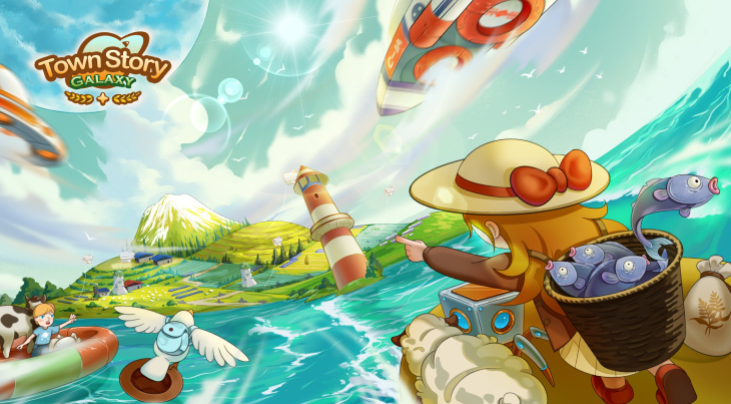
In the year 3000 AD, environmental issues led to a stagnation in economic development, and the world was on the brink of collapse.
Humanity discovered many Earth-like planets in the Centaurus star system.
After careful selection, a fortunate group of individuals obtained interstellar travel permits issued by the new government of the Centaurus star system. They became the first interstellar immigrants, carrying with them the hope of humanity as they embarked on a journey to Centaurus to build a new life base called "StarTown."
Before officially entering the Centaurus star system, interstellar travelers need to undergo survival training in the open world. Only by accumulating enough resources can they pass the examiner's review and start their interstellar journey. In StarTown, new residents can purchase land, build factories and houses, invite friends to play together, cultivate crops, accept and complete orders, earn governance tokens as rewards, and continue to manage and prosper the human civilization.
Game Settings:
Global Theme:
Simulation-based games have the broadest player base and have been proven profitable in the web2 era.
Notable titles like Nintendo's "Animal Crossing," where players create and manage their open-world islands, and Playrix's mobile management game "Township," which has accumulated over 1 billion USD in revenue by 2020, exemplify this.
Next-Generation CryptoGame Mechanisms:
(1) Combining a strict decentralized design and community governance spirit with innovative gameplay that blends "dress-up social + simulation management," providing genuine playability. Apart from buying NFTs for entry, the game introduces Free-to-Play with limited microtransactions to activate social interactions and attract more web2 users.
(2) Utilizes a "Dual Token + NFT" mechanism, with the game currency acting as a governance token to enhance the in-game economy's stability. Employs decentralized identity (DID) to map social relationships through in-game contributions, sharing, and behavior, offering more targeted services and gameplay based on this social graph.