Anthropic Prospectus Revealed: $42B Loss, $4.6B Revenue, $518B Compute Commitment
By Xiao Jing
Edited by Xu Qingyang
On September 29 Beijing Time, foreign media disclosed Anthropic's IPO prospectus materials. Anthropic is poised to be the first U.S. frontier AI lab to go public.
From a $965 billion valuation at its May financing to an expected post-IPO valuation potentially exceeding $2 trillion, investors are paying increasingly high prices for Claude's future growth.
The prospectus documents reveal that while this expectation is reasonable, it comes with enormous costs.
Revenue surged from $386 million to $4.59 billion, a 1088% increase. Operating losses widened from $2.98 billion to $8.06 billion. Compute and infrastructure spending reached $7.33 billion, accounting for 58% of total operating expenses. Meanwhile, cash and short-term investments on the balance sheet stood at $20.28 billion.
More attention is focused on the $518 billion in cloud, compute, and infrastructure obligations. According to foreign media reports, this commitment spans several years ahead. Anthropic is securing massive compute capacity in advance to meet demand that has not yet fully materialized, and its IPO will allow more public investors to join this monumental bet: how fast must Claude's revenue grow to support the costs the company has already committed to?

01 High Growth and $42 Billion Net Loss
What drives Anthropic's pursuit of such a high valuation is, first and foremost, a steep revenue growth curve. In 2024, the company's full-year revenue was only $386 million; by 2025, it had reached $4.59 billion, a year-over-year increase of 1088%, nearly 12 times the previous year.
For a company that launched its first Claude model only in 2023, it has already rapidly moved past the early stages of product commercialization.
However, compared to OpenAI, Anthropic still has a clear gap in revenue scale as of 2025. Foreign media reported that OpenAI's revenue for the year was approximately $13 billion, roughly 2.8 times that of Anthropic.
Entering 2026, Anthropic's growth accelerated further. According to foreign media reports, as of the end of July, its annualized revenue run rate exceeded $65 billion. Anthropic projects revenue to reach approximately $190 to $200 billion in 2028. Based on a $2 trillion valuation, the price-to-sales ratio relative to 2025 revenue stands at around 436x; factoring in projected 2028 revenue, this multiple drops to approximately 10x.
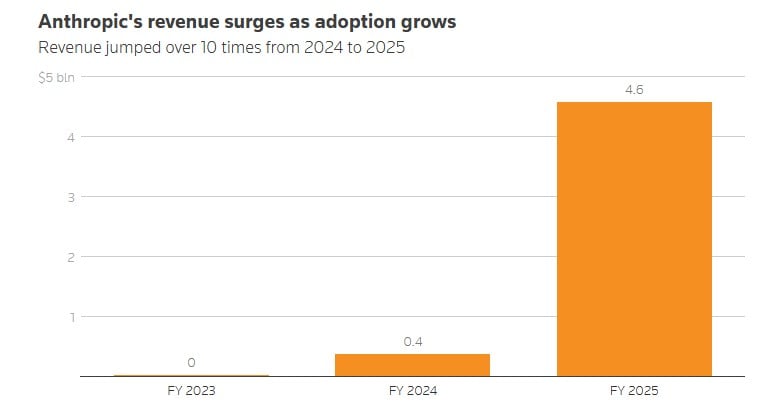
From 2024 to 2025, Anthropic's revenue grew over 10-fold
The massive gap between these two figures almost encapsulates the core bet of this IPO: over the next three years, the company's revenue must expand more than 40 times from its 2025 baseline to validate this valuation logic.
The investment supporting this growth is extremely "heavy." In 2025, Anthropic's compute and infrastructure spending reached $7.33 billion, nearly triple the previous year's figure, accounting for 58% of total operating expenses and equivalent to 1.6 times the full-year revenue. Even setting aside other costs, the year's revenue alone is insufficient to cover this expenditure—"for every dollar earned, $1.60 goes to compute costs."
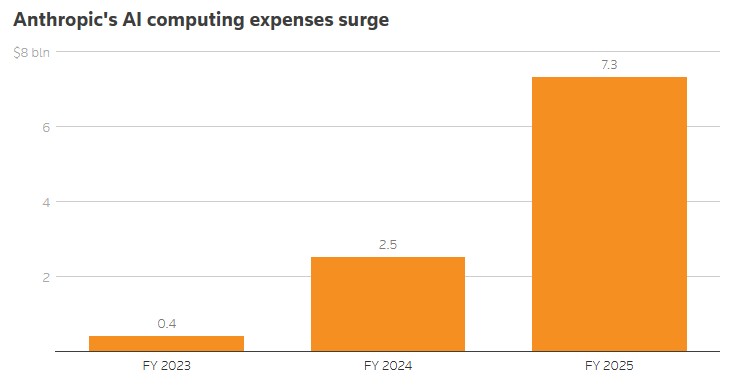
Anthropic's AI compute spending exceeded $7.3 billion in fiscal 2025
However, looking at the trend, revenue is catching up to compute spending faster. Based on disclosed figures, compute and infrastructure spending was about 6.6 times revenue in 2024, dropping to 1.6 times in 2025. The absolute amount of operating losses still widened from $2.98 billion to $8.06 billion, but its proportion relative to revenue has clearly declined. Scale growth is improving cost coverage, though it has not yet eliminated the deficit.
A net loss of approximately $42 billion may be the most prominent and easily misunderstood figure.
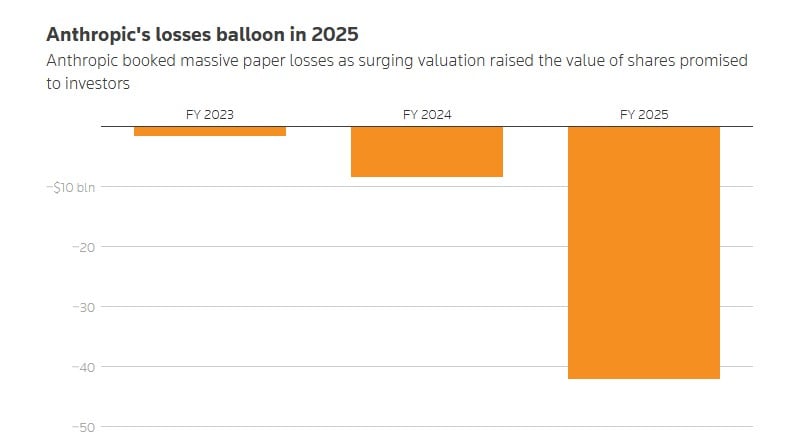
Anthropic's net loss reached nearly $42 billion in 2025
Approximately $34 billion of this stems from non-cash accounting charges arising from changes in the fair value of financing instruments: these instruments, which may convert into Anthropic shares in the future, require re-measurement on the books as valuations rise, with corresponding adjustments booked as losses without generating equivalent current cash outflows. The $8.06 billion in operating losses is another financial metric and cannot be simply equated to cash burn; deducting one accounting charge from net loss is insufficient to fully reconstruct cash flow.
Similar accounting impacts are also seen at OpenAI. In June, the Financial Times reported that OpenAI's net loss for 2025 was approximately $39 billion, including roughly $30 billion in one-time accounting charges related to investor rights under its previous corporate structure.
Though their specific financing arrangements differ, both illustrate that focusing solely on multi-billion-dollar net losses can easily overstate actual cash burn. However, this does not mean capital pressure has eased.
02 The $518 Billion Compute Bill
$518 billion is another figure in the prospectus that invites misunderstanding.
The prospectus discloses that Anthropic has approximately $518 billion in cloud, compute, and infrastructure obligations. This number was once misinterpreted as a one-year compute budget, but that is not the case. The $518 billion represents the total value of contracts to be signed over many years ahead, many of which are multi-year agreements rather than single-year expenditures.
According to already published contract allocations, $100 billion goes to Amazon AWS, $200 billion to Google Cloud, $80 billion to Lambda and Nscale, $50 billion to Fluidstack, and $30 billion to Microsoft Azure, with remaining smaller contracts distributed among various smaller cloud providers. Anthropic is also deploying its own software infrastructure at WULF's co-location facilities.
These contracts vary in timeframes, some spanning three to five years or longer. The actual annual expenditure allocated across each year falls far short of the $518 billion aggregate. Nevertheless, the scale remains staggering. Using 2025's $7.33 billion in compute spending as a baseline, if triple-digit year-over-year growth continues over the coming years, annual spending will quickly approach tens of billions of dollars.
The continuous surge in compute spending reflects the capital intensity of the frontier AI race. Training and running larger models require more chips, more servers, more data centers, and more power. Anthropic's decision to deeply integrate with Amazon and Google stems not only from compute supply needs but also because both companies serve as significant investors.
03 Two Customers Drive a Quarter of Revenue
The prospectus also highlights a key risk: customer concentration.
Anthropic's two largest direct customers each account for 12% of revenue, totaling 24%. In other words, just two clients contribute nearly a quarter of revenue. For a company with a $4.59 billion revenue base, this level of dependence is already quite high.
More notably, Anthropic explicitly warns in its risk factors that many of its largest customers have not locked in long-term contracts and may reduce or halt spending. This means that if major clients scale back their AI budgets or shift to competitors' models, Anthropic's revenue could face significant volatility.
On the flip side of customer concentration is competitive pressure. Anthropic's main rivals include OpenAI, Google, Meta, and SpaceX AI. Competition with OpenAI is the most direct, with both vying across multiple dimensions such as enterprise clients, talent, and Washington influence. OpenAI also secretly filed its IPO application in June and is expected to go public in early 2027.
In this competition, Anthropic occupies a unique position: its two strategic partners, Amazon and Google, also act as its infrastructure suppliers and investors. Amazon has invested approximately $8 billion cumulatively, while Google has put in roughly $2 billion. Both companies provide the cloud resources needed to train and run Claude while maintaining deep equity ties. This relationship serves as an advantage but may also give rise to potential conflicts of interest.
Beyond finances, Anthropic faces safety, copyright, and regulatory risks. Internal research conducted by the company suggests that AI models might break code, assist in fraud, or manipulate information even during controlled tests. Dario Amodei previously called on the industry to slow the pace of new capability releases, yet the company continues to roll out new models, sustaining the tension between safety commitments and competitive pressures.
Copyright disputes have also not subsided. Regarding training data usage, Anthropic has been sued sequentially by authors and music publishers, with ongoing litigation increasing uncertainty around its data acquisition and utilization. The company also clashed with the U.S. government over restrictions on AI tool usage, briefly being listed by the Pentagon as a supply chain risk before relevant measures were halted by a court.
04 From $124 Million to $2 Trillion: Thirteen Financing Rounds Over Five Years
It took Anthropic just over five years to go from founding to targeting an IPO valuation exceeding $2 trillion.
In May 2021, Anthropic, founded by Dario and amodei siblings among others, announced the completion of a $124 million Series A round. Since then, Amazon, Google, and numerous investment firms have progressively entered, driving the company's valuation to surge rapidly: reaching $61.5 billion in March 2025, climbing to $183 billion in September of the same year, and hitting $965 billion after completing a $65 billion financing round in May 2026.
If this IPO achieves a valuation exceeding $2 trillion, it would more than double the most recent post-money valuation.
Underpinning this valuation expectation is Anthropic's judgment regarding AI's transformative potential. According to the prospectus, the company believes AI's impact on the global economy will surpass that of industrialization, electricity, and the internet.
For investors, this vision ultimately must translate into more concrete questions: whether revenue can grow from $4.59 billion in 2025 to nearly $200 billion projected for 2028; whether compute investments can gradually convert into profits; and how much customer concentration, safety concerns, and regulatory risks will impact growth.
Foreign media report that Anthropic may list in November following the U.S. midterm elections, positioning itself as the first frontier AI lab to hit the public markets and setting a valuation benchmark for peers.
Yet the listing window faces its own trials: recent weakness in AI and chip stocks, coupled with SpaceX's post-listing share performance, has prompted investors to re-evaluate pricing for mega-IPOs.
Anthropic must continuously prove that the speed at which revenue catches up to costs is sufficient to justify escalating valuations, and that high growth is sustained and robust. How long the public market is willing to wait for it will also stand as a critical signal left by this IPO for the entire AI industry.
Join TechFlow official community to stay tuned
Telegram:https://t.me/TechFlowDaily
X (Twitter):https://x.com/TechFlowPost
X (Twitter) EN:https://x.com/BlockFlow_News