Alea Insights: A Single PMI Reading Pushes Up Market Pricing for a Second Rate Hike—Who Pays for More Expensive Money?
Author: Alea Research
Compiled by: TechFlow
TechFlow Summary: A week ago, markets still treated the Fed's second rate hike this year as a coin flip; on Wednesday, PMI data and Governor Barr's speech pushed the probability of an October hike from ~53.5% to 69.5% within an hour. The 10-year Treasury hit its highest close since 2007, while the S&P managed to close higher only thanks to a few giants like Meta, leaving equal-weight indices, long-term bonds, and gold to pick up the tab—in crypto, spot BTC ETFs bought nearly $1 billion before the impact even arrived.
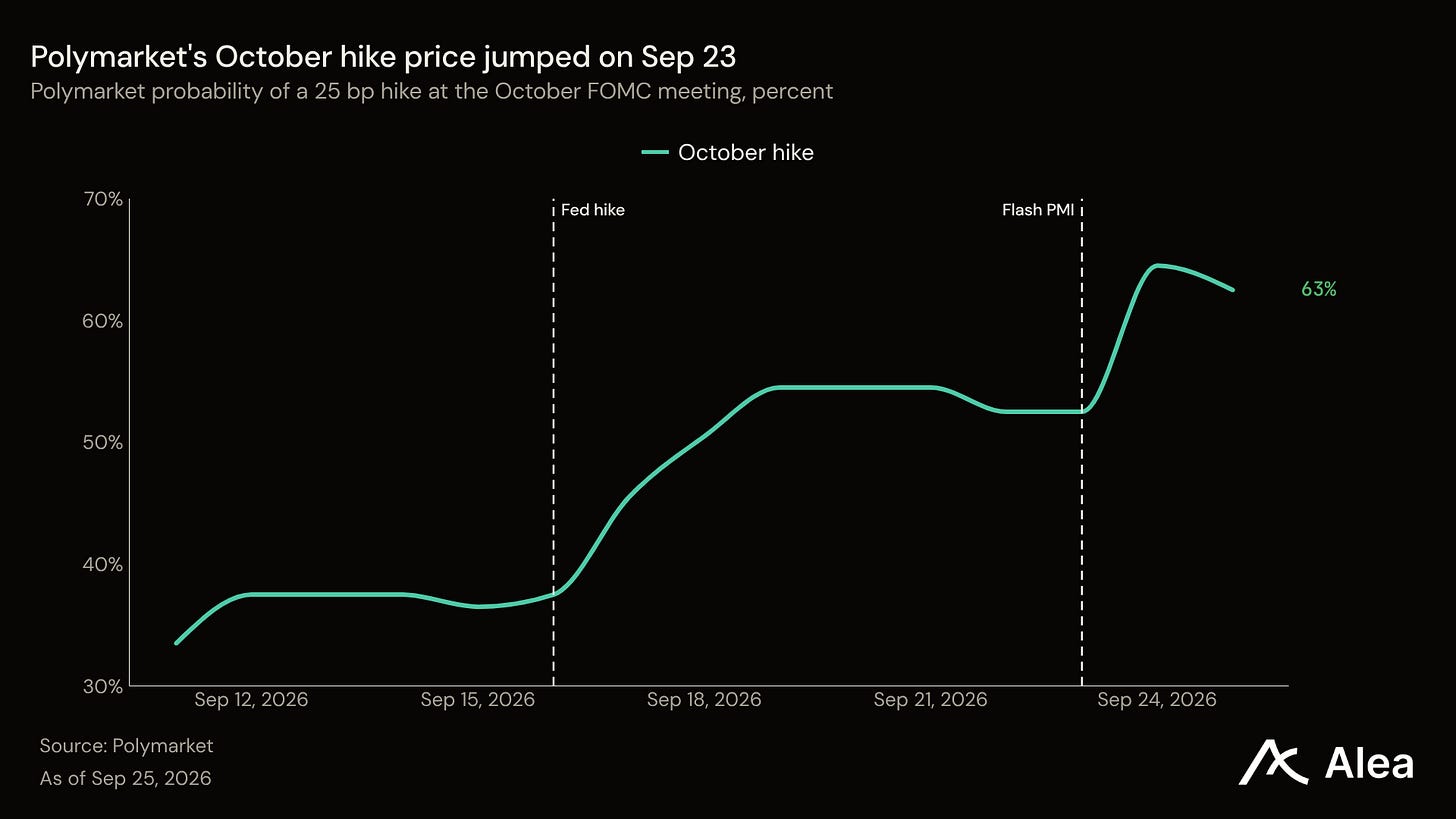
A week ago, markets still viewed the Fed's second rate hike as a coin toss. Wednesday rewrote pricing in just one hour. Between the flash PMI survey release and Governor Barr's speech 20 minutes later, the price of an October hike on Polymarket climbed from 53.5% to 69.5%. On Thursday, the 10-year Treasury closed at 5.18%, its highest since July 2007. The S&P 500 still closed higher for the week, propped up by Meta and a handful of other giants; meanwhile, the average stock declined.
Wednesday was the worst day for rate-sensitive assets as the market repriced an October hike on the day.

Key Takeaways
Markets have turned to betting on a second Fed rate hike. By Friday close, Polymarket priced an October hike at 62.5%, up from 54.5% a week ago. Of the 18 officials who submitted September dot plots, 16 had penciled in at least one more hike.
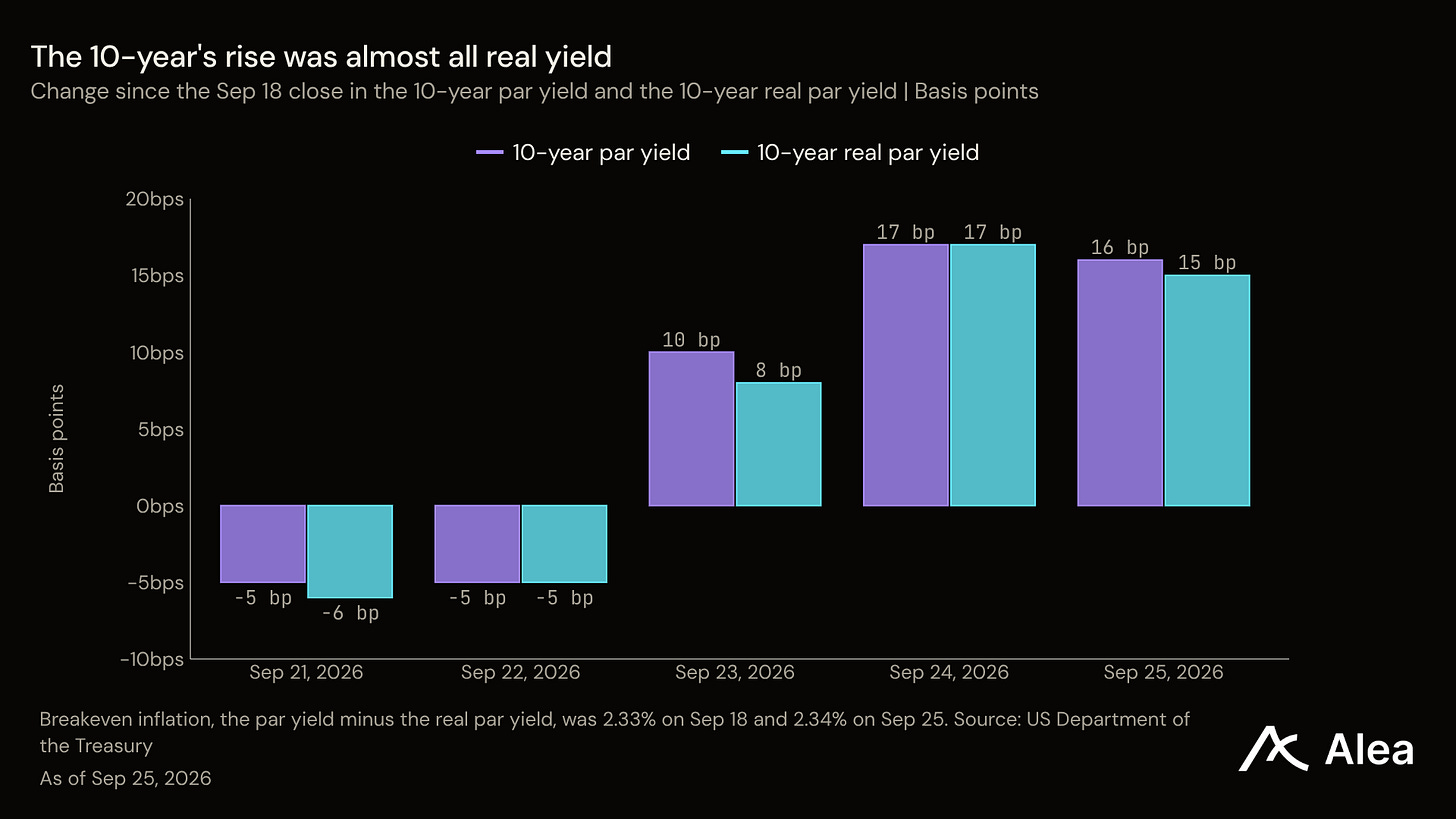
Money got more expensive, but inflation expectations did not. The 10-year rose 16 basis points relative to the Sept 18 close, with 15 of those basis points coming from real rates.
The index masked who was picking up the tab. The S&P 500 closed up 1.21% backed by a few large-cap members, led by Meta; the equal-weight S&P fund closed down 0.56%.
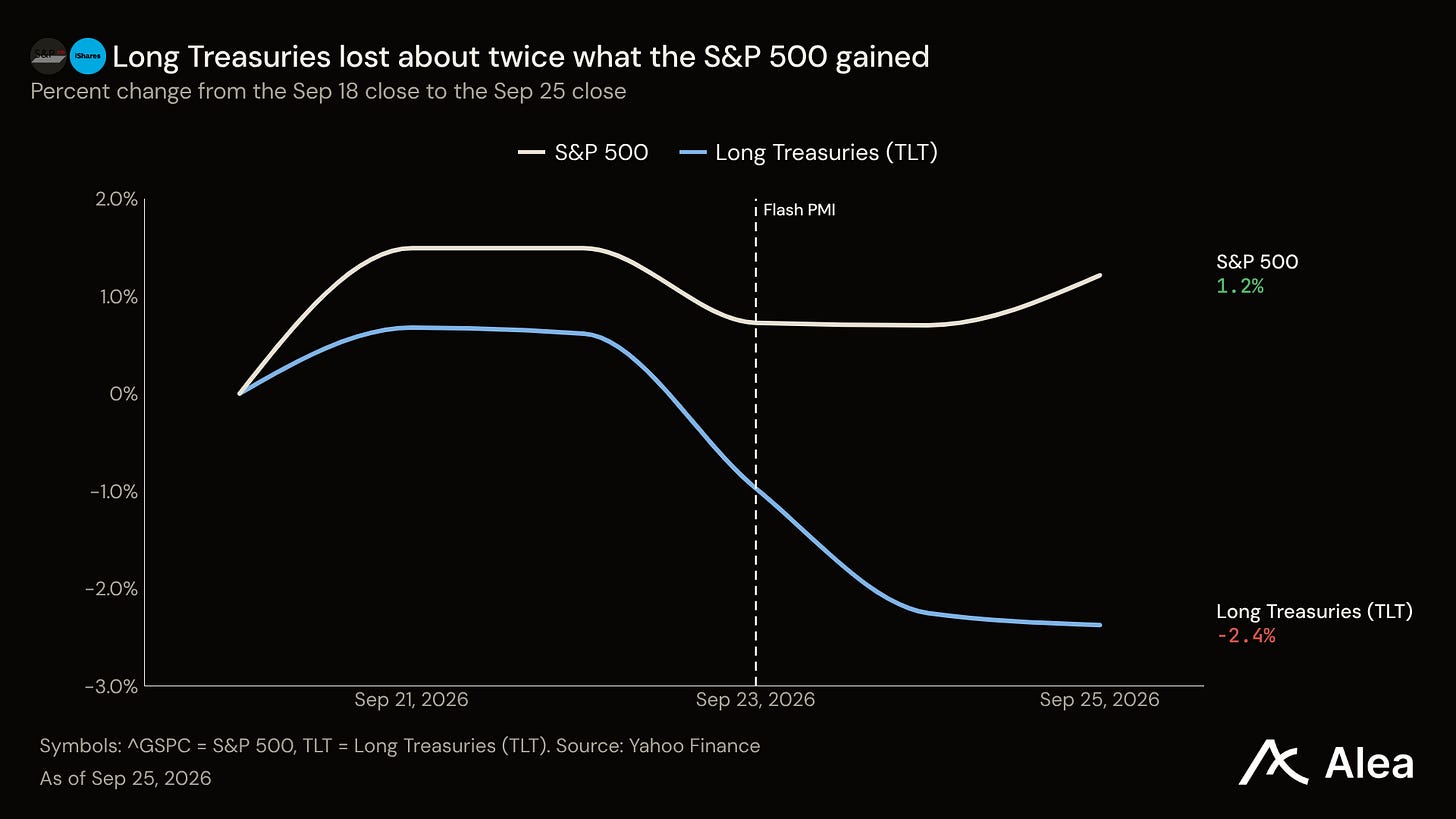
Long bonds and gold paid the bill. Long-dated Treasuries fell 2.38% for the week, and December gold dropped 2.36%—since equity indices didn't retrace this week, the drop that bonds were supposed to hedge against never materialized.
Crypto buyers arrived ahead of the investigation. Spot BTC ETFs saw a net inflow of $999 million on Monday, the largest single-day figure since Oct 6, 2025; Bitcoin still logged a 3.51% weekly gain, weathering Wednesday's rate shock and Thursday's Bitget hot wallet incident.
Cross-Asset Markets: Bonds Pay the Tab for a Calm Stock Week
In a balanced portfolio, bond positions that are supposed to cushion declines instead lost money during a week where there was no decline to hedge. The dollar index rose 0.81% alongside rising yields.
Options priced a calm week for both stocks and Bitcoin, which both stayed within those ranges. At the close on Sept 18, VIX implied a one-standard-deviation range of roughly ±2.1% for the S&P over the next five trading days, while the index actually used slightly more than half of that space; the Deribit volatility index priced a seven-day move of about 4.9% for Bitcoin, which utilized roughly 70%. The real noise came from the bond market: the 10-year jumped 15 basis points on Wednesday alone.
Last Week’s View: Inflation Call Held Up
Last week we wrote that this round of rate increases is no longer primarily about inflation, with the 10-year failing to hold steady above 5%. The inflation call was confirmed by the Treasury's real yield curve—the 10-year real yield stood at 2.83%, up from 2.68% a week prior; break-even inflation shifted from 2.33% to 2.34%. The market repriced borrowing costs again but barely touched headline prices themselves. Still, the 10-year closed above 5% on Wednesday, Thursday, and Friday, with Thursday’s 5.18% marking the highest close since July 6, 2007.
Macro: Markets Catch Up to the Dot Plot
In September, the Fed projected another rate hike this year. It took the market a week to believe it. Of the 18 officials who submitted forecasts on Sept 16, 16 penciled in a higher year-end policy rate, yet on Sept 18 Polymarket still only priced an October hike at 54.5%.
Two events spaced 20 minutes apart pushed it higher. S&P Global’s flash composite PMI for September came in at 58.4, above the previous 56.0, marking the fastest growth since July 2021, with input cost inflation accelerating at the fastest pace since October 2022. The October hike price climbed from 53.5% to 60.5% within 11 minutes of the release. Subsequently, Barr stated her base case included further tightening “to ensure inflation returns to target in a timely manner,” pushing prices to 69.5% within an hour. On Thursday, Philadelphia Fed President Paulson endorsed a September hike and pointed to moderate further tightening.
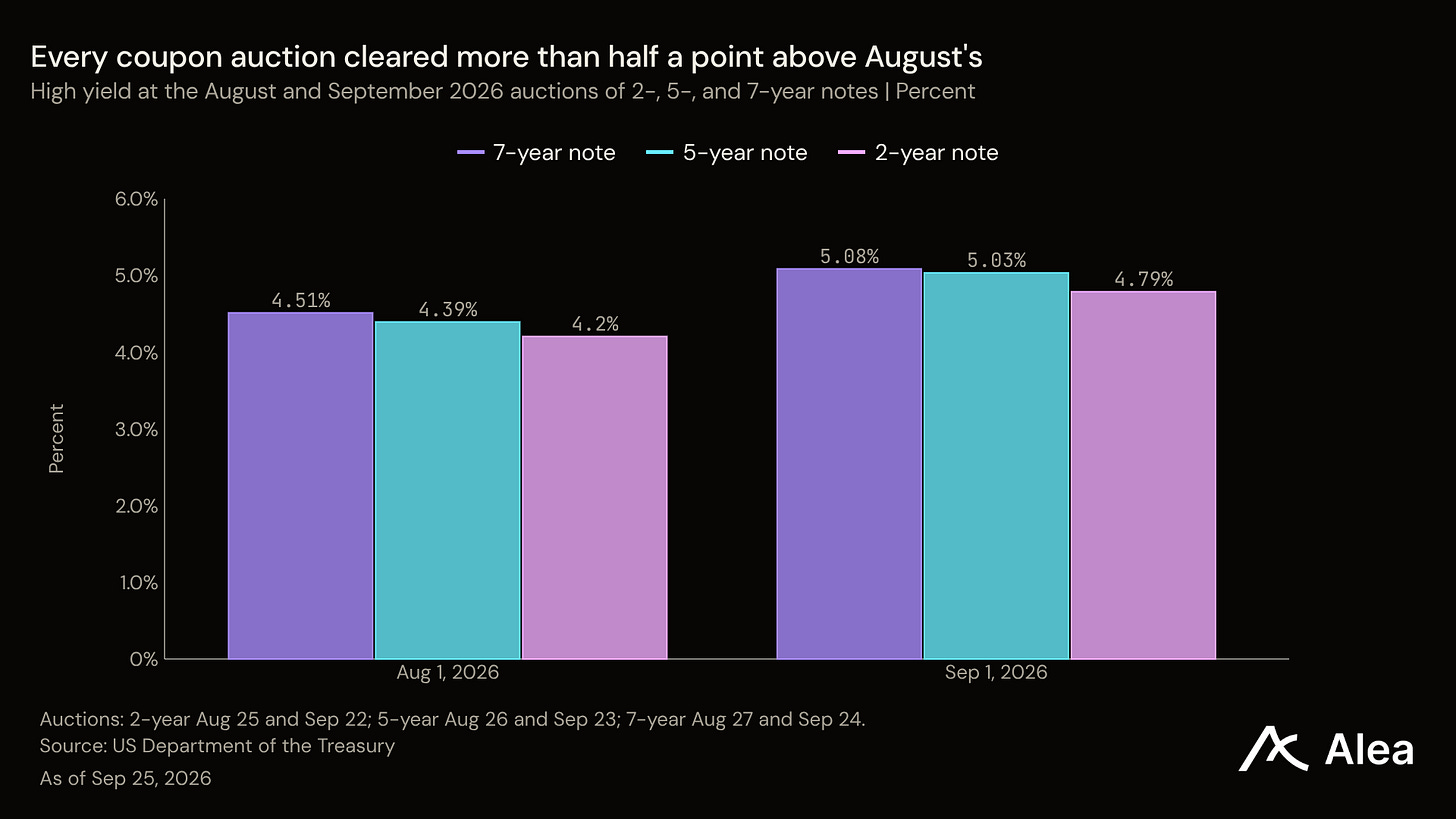
Meanwhile, lenders to the government demanded higher prices. The Treasury auctioned $70 billion in five-year notes on Wednesday, clearing at a yield of 5.033%, the highest for five-year auctions since June 28, 2006; on Thursday, $44 billion in seven-year notes cleared at 5.085%, the highest for this series since its restart in 2009. Clearing yields for the two-, five-, and seven-year auctions all exceeded August levels by more than half a percentage point.
Crypto: ETF Buyers Beat the Investigation
Last week we described the crypto rally as a short squeeze rather than conviction. That assessment was weakened this week as buying flowed through spot ETFs. Buyers appeared on Monday, two days ahead of the rate shock. Spot BTC ETFs saw a net inflow of $999 million that day, the largest single-day influx since Oct 6, 2025; ETH ETFs added $270 million. Clocking U.S. stock market closes, Bitcoin surged 6.6% on Monday.
Bitcoin gave back part of its gains following the investigation. It fell 2.0% on Wednesday, the same day yields spiked and long-dated Treasuries sold off. Shortly after, at 18:31 UTC on Thursday, Bitget discovered unauthorized withdrawals from its hot wallet totaling approximately $351.6 million. Bitcoin’s closing price during Thursday’s U.S. stock session was nearly flat compared to Wednesday (a difference of less than 0.2%), still finishing the week up 3.51% from the Sept 18 close; Ethereum gained 2.22% for the week.
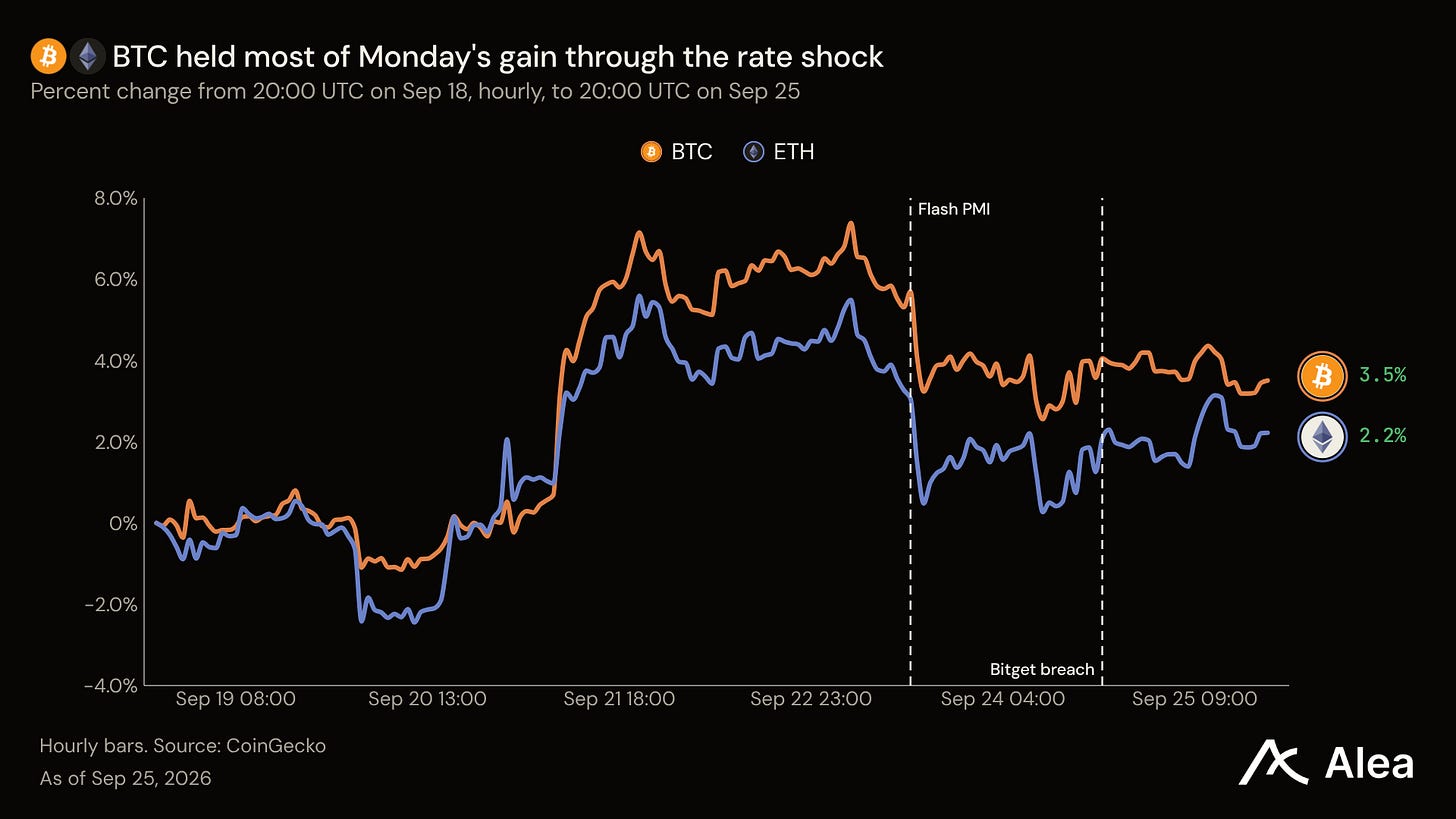
Bulls aren't paying a premium to hold positions. On Hyperliquid, Bitcoin's funding rate hovered at the exchange's default level—10.95% annualized—for 139 out of 168 hours. Spot BTC ETF buying continued through Thursday, raking in a combined $2.25 billion over four days.
Stocks: Indices Rose, Average Stock Dropped
A handful of giants propped up the S&P 500, with the Nasdaq 100 gaining 3.25% for the week. Meta led the way, surging 12.90% week-over-week; most of that came on Monday—Sensor Tower data showed Meta's personal AI agent Muse, launched on Sept 8, had already surpassed 2.5 million downloads.
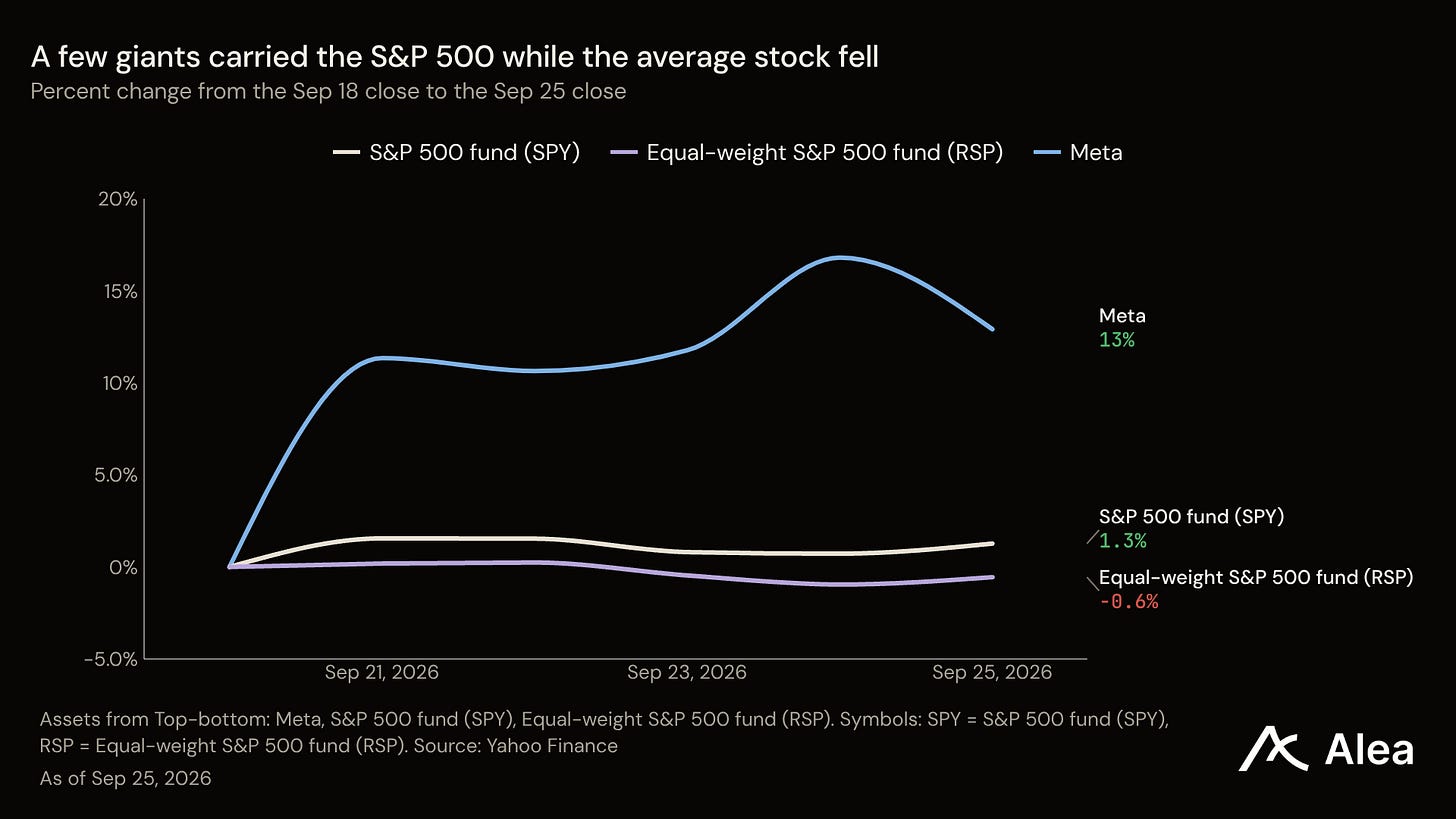
The average company took a different path. The equal-weight S&P fund fell 0.56%, and the Russell 2000 dropped 0.80%, both hitting their worst day on Wednesday. Another giant, Alphabet, fell 3.8% that same day.
Commodities: One Strait, Two Oil Prices
Crude traders are pricing the Strait of Hormuz simultaneously in two ways. November Brent rose 0.48%, while November WTI fell 3.79%. On Wednesday, the Brent-to-WTI spot premium reached approximately $24 per barrel. Oil shipping fund BWET plunged 18.2% on Tuesday, following reports that Iran proposed reopening the strait; a senior Iranian official stated on Wednesday that Tehran could reopen it within a week if the U.S. lifts its blockade. Domestically, U.S. commercial crude inventories increased by 3 million barrels for the week ended Sept 18.
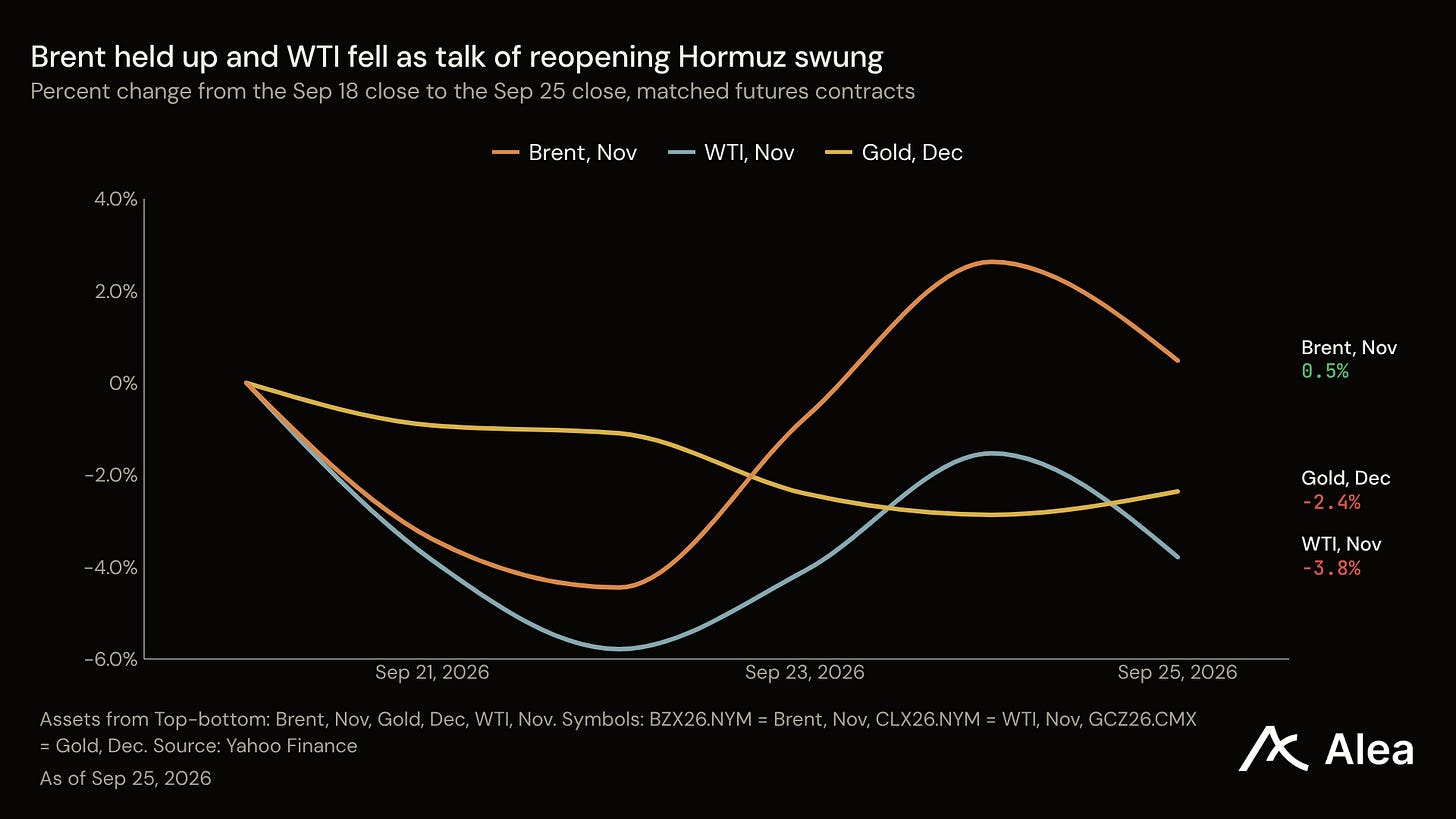
Gold directly paid for higher rates. December gold fell 2.36% as the 10-year real yield climbed to 2.83%. The interest-free metal lost out to bonds now offering higher coupon payments.
Conclusion: Money Got More Expensive, Indices Didn’t Notice
Odds now favor a second hike. The Polymarket October rate contract closed Friday at 62.5%, a price that must survive two more data releases before the policymaker meeting: August PCE inflation drops on Sept 30, September NFP arrives on Oct 2, and the Fed makes its decision on Oct 28.
The market has largely caught up to the Fed, signaling via higher borrowing costs. Of the 16 basis points the 10-year gained, 15 were in real yields. This tab falls on long-dated Treasuries, gold, and the average stock. Indices can still finish higher only because a few largest components rallied—Meta leading the charge on its own news.
Join TechFlow official community to stay tuned
Telegram:https://t.me/TechFlowDaily
X (Twitter):https://x.com/TechFlowPost
X (Twitter) EN:https://x.com/BlockFlow_News
 @AleaResearch