Huobi Expert Talk Vol. 7: From Washington to Oil Prices, Decoding Crypto's New Pricing Logic

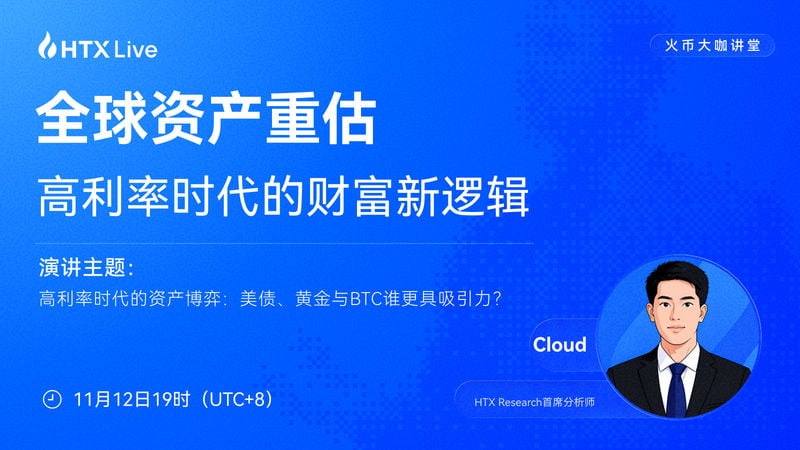
On September 23, the seventh episode of Huobi Expert Lecture, "Regulation, Oil, and Ballots: Crypto's New Cycle," premiered. HTX Research asset analyst WZ delivered a talk themed "From Washington to Oil Prices: The New Pricing Logic for Crypto," analyzing key variables affecting crypto asset prices around US crypto regulation, geopolitics and energy prices, macro liquidity, and capital rotation. The session also addressed market concerns regarding safe-haven attributes, news-driven trading, and altcoin market trends.
WZ believes that as crypto assets further integrate into the mainstream financial system, industry-specific metrics such as halving events, on-chain data, leverage, and funding rates remain important. However, understanding market trends requires incorporating regulatory rules, crude oil, US Treasuries, and the US dollar into a unified analytical framework. The timing of regulatory clarity, how liquidity shifts, and which channels funds use to enter the market are collectively shaping crypto pricing.
Regulatory Progress Shapes Market Expectations; The Timing of Rule Implementation Is Equally Important
Regarding US crypto regulation, WZ cited the CLARITY Act as an example, pointing out that a systematic regulatory framework determines the classification of digital assets, regulatory jurisdictions, compliance requirements for trading platforms, and conditions for institutional participation. For the market, both the content of regulations and their implementation timelines will influence expectations for project operations and capital allocation.
On September 15, the CLARITY Act was not advanced following a procedural vote in the US Senate. WZ analyzed that the legislative process is influenced by cross-party negotiations, interest distribution, and election schedules. As the legislative window narrows, the market must reassess the timeline for regulatory certainty and the pace of institutional participation and business expansion.
Meanwhile, specific regulatory arrangements for particular businesses continue to advance. On September 17, the SEC issued an "innovation exemption" targeting tokenized NMS equity trading, granting certain regulatory exemptions to qualifying venues and related liquidity providers. WZ noted that such developments indicate that monitoring US crypto regulation requires tracking both congressional legislation and regulatory agency actions simultaneously, rather than inferring the policy direction for the entire industry based solely on the progress of a single bill.
Oil Prices Transmit to Crypto Asset Pricing Through Inflation and Interest Rate Expectations
“How does a barrel of oil translate into the price of BTC?” Addressing this question, WZ broke down the pathway through which geopolitics impacts the crypto market: regional conflicts and shipping risks alter crude oil supply expectations, driving changes in risk premiums, which then flow through energy costs, inflation expectations, and monetary policy expectations to affect the risk appetite of the US dollar, US Treasuries, and global capital.
In his view, oil prices embed the market's judgment on future supply stability. Even if actual production has not significantly changed, the risk of disruptions to key shipping routes may already be priced in. As energy prices continue to rise, inflation pressures and interest rate expectations shift accordingly, potentially putting pressure on the capital environment for high-volatility assets. Conversely, easing geopolitical tensions and falling oil prices could create conditions for the restoration of risk appetite.
WZ also pointed out that Bitcoin's round-the-clock trading nature allows it to reflect macro news ahead of traditional markets during their closure periods. When capital enters early and prices break through key levels, trading structural factors such as short covering can further amplify gains. Therefore, analyzing short-term trends requires distinguishing between directional shifts driven by macro expectations and volatility acceleration caused by leverage liquidations.
The Key to Whether BTC Gains Spread Lies in the Source and Flow of Capital
Regarding the market-familiar pattern of “BTC rises first, followed by altcoins,” WZ believes this historical experience needs to be re-examined in light of current capital structures. An increase in Bitcoin's price does not mean other crypto assets will benefit simultaneously, and past sector rotation cannot be directly taken as a guarantee of a new broad-based rally.
Specifically, capital flowing through ETF channels follows different circulation paths compared to internal crypto market funds. Funds allocated to Bitcoin via ETFs do not necessarily rotate into other crypto assets upon exit, whereas stablecoin inflows and on-exchange reallocation may provide fresh buying pressure across different sectors. Therefore, determining whether a rally will spread requires continued tracking of where capital enters, whether it remains within the crypto market, and whether actual sector rotation materializes.
Meanwhile, new technologies, applications, and narratives can also drive localized market rallies. WZ reminded market participants to monitor overall liquidity while discerning why specific assets gain attention, avoiding the mistake of extrapolating performance across all assets solely based on cyclical experience.
From Chasing News to Understanding Transmission: Building a Sustainable and Verifiable Research Framework
During the Q&A session, addressing the phenomenon of Bitcoin sometimes rising with gold and sometimes falling with US equities, WZ suggested that one should first determine whether the market is facing safety-seeking demand or cash and liquidity pressure at the time. Under different scenarios, Bitcoin's trading characteristics can shift, making it inappropriate to explain all market movements with a fixed “safe-haven asset” label.
Regarding the common frustration of “seeing the news only to find prices have already moved,” he emphasized that the key lies in judging whether the information has been fully digested by the market and whether any subsequent developments could still alter expectations. News hype does not always align with sustained price drivers. Understanding the pricing phase in which a message resides helps reduce emotion-driven trading.
Looking ahead, WZ proposed four groups of variables for continuous observation: regulatory progress, geopolitical situations and oil prices, the macro environment reflected by the US dollar and Treasuries, and capital flows and leverage structures within the crypto market. Cross-referencing these variables aids in identifying the drivers of market trends and the conditions for their sustainability.
Huobi Expert Lecture is a long-term educational program created by Huobi Academy, inviting scholars, industry researchers, and frontline practitioners to share insights on the crypto industry, artificial intelligence, Web3, and cutting-edge technology. This episode combines macro research with user Q&A to help users understand the transmission process from policy changes to asset prices. In the future, the program will continue to facilitate exchanges around market hotspots and industry development, providing support for users to establish independent and systematic research frameworks.
Join TechFlow official community to stay tuned
Telegram:https://t.me/TechFlowDaily
X (Twitter):https://x.com/TechFlowPost
X (Twitter) EN:https://x.com/BlockFlow_News
 @HTX_Global