When Collateralizing Bitcoin for a Loan, Do You Really Still Own Your BTC?
Written by: Andjela Radmilac
Translated by: Saoirse, Foresight News
Bitcoin holders needing cash do not necessarily have to sell their BTC; they can choose to collateralize their Bitcoin to borrow funds. This approach allows them to retain price exposure to Bitcoin while using its value as loan collateral.
The issue, however, is that many lending services are deployed on other blockchain networks. Numerous blockchain lending applications run on Ethereum, which independently records on-chain asset ownership. Meanwhile, users' Bitcoin is recorded on the Bitcoin mainnet, meaning Ethereum-based apps cannot directly utilize assets from the Bitcoin network as collateral.
One solution involves users entrusting their Bitcoin to a custodian in exchange for an on-chain token recognizable by lending applications. The original Bitcoin is held by the custodian, while the newly generated token represents this Bitcoin asset on another chain.
While this model does enable borrowing without selling Bitcoin, it fundamentally shifts the holder's dependency. Borrowers now rely on the custodian to safely hold the Bitcoin, adhere to redemption rules, maintain the token's pegged value, and ensure the lending protocol operates correctly.
Coinbase, Circle, and WBTC all offer similar services, creating direct competition. On September 4, Circle released the product specifications for cirBTC, officially entering a market already dominated by cbBTC and the veteran WBTC. All three products share the same underlying logic: Bitcoin is entrusted to custody to issue transferable wrapped tokens.
The core competitive focus among them is: the practical utility of the token, and whether the entire mechanism remains reliable when users wish to redeem it back into native Bitcoin.
An Enhanced Warehouse Receipt
The principle behind custodial wrapped Bitcoin tokens can be compared to a negotiable warehouse receipt: goods are stored in a warehouse, but the receipt itself can be transferred. The custodian holds the underlying Bitcoin, while the token circulates between users; product agreement terms define who has the right to redeem the token for actual Bitcoin.
The deposit process works as follows: once the deposit is confirmed, another chain mints an equivalent amount of corresponding tokens, a process known as minting. Redemption is the reverse operation: circulating tokens are burned, and the service provider releases native Bitcoin according to the procedure. BitGo has outlined WBTC's deposit-redemption mechanism: audited partner merchants interface with the custodian to complete exchanges, charging a fee.
Retail investors can also purchase existing wrapped tokens directly on the secondary market. These transactions only involve transferring token ownership, with no new Bitcoin needed to enter the custody pool. The underlying assets remain the original batch of Bitcoin and corresponding tokens; the wrapping process does not create new coin types on the Bitcoin mainnet.
Each wrapped token is theoretically equivalent to 1 Bitcoin, meaning wrapped tokens do not help holders hedge against Bitcoin's price decline. Even if your tradable asset becomes a token on another chain, its price movements and P&L remain entirely tied to Bitcoin.
The redemption mechanism helps keep the token's price aligned with Bitcoin. If the wrapped token trades below its underlying asset value, eligible traders can buy the token, redeem it for native Bitcoin, and profit from the spread after costs. This buying pressure narrows the discount. However, redemption restrictions and processing delays can undermine this arbitrage mechanism. Knowing the underlying Bitcoin exists doesn't mean you can smoothly redeem and claim it.
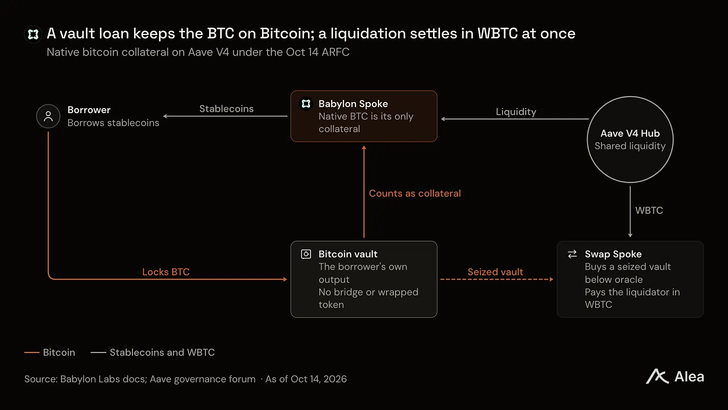
Once deposited into a lending application, borrowers can initiate loans. Smart contracts, which are programs that automatically execute rules on the blockchain, accept wrapped Bitcoin as collateral, allowing users to borrow USD-pegged stablecoins. While carrying debt, users retain their exposure to Bitcoin's price fluctuations.
Borrowers must provide collateral worth more than the loan. During the period before the loan is settled, Bitcoin's price may fall. If the price drops too severely, exhausting the collateral safety margin, the application will liquidate the collateral assets to cover the debt.
Ultimately, this leads to the exact scenario users sought to avoid: losing a portion of their Bitcoin position without having actively sold.
In the liquidation process, other market participants can pay off part of the debt in exchange for the collateral, and platforms set incentives to attract liquidators.
Wrapped tokens themselves do not generate interest. To earn yield, holders must take additional steps, such as re-lending the tokens. All returns come from subsequent operations, simultaneously introducing extra risks beyond merely holding the token.
The Same Bitcoin, Different Redemption Channels
Even if a token is fully backed by Bitcoin, it is useless to borrowers if lending protocols do not accept it. Some token ecosystems enjoy high adoption, yet ordinary users face significant hurdles redeeming native Bitcoin. Despite service providers claiming identical underlying assets, the actual user experience varies dramatically.
WBTC relies on its merchant network to streamline minting and redemption pathways, connecting major exchanges and institutions. Most retail users purchase WBTC through exchanges. Lending protocols that already support WBTC provide users with collateralized borrowing scenarios, while merchants handle the interaction with the Bitcoin in the custody pool. Mature tokens derive their value from this cooperative ecosystem, making it difficult for new entrants to quickly replicate the same conditions.
Coinbase integrates the redemption feature directly into exchange accounts. Eligible users withdrawing Bitcoin from their account can select supported networks to instantly receive on-chain cbBTC; when users send cbBTC back to Coinbase's designated deposit channel, native Bitcoin is credited to their account. While cbBTC redemption rules have geographic restrictions, for qualified users, the entire process is nearly identical to a standard transfer.
Circle's cirBTC primarily targets institutional clients, including dealers and lending protocols, deeply integrating with Circle's existing operations and USDC. Circle states that the underlying Bitcoin is risk-segregated from the company's own assets, with reserve addresses published, while also integrating Chainlink oracles so on-chain software can read reserve-related data.
For borrowers, the competition among these products directly determines which platforms accept your Bitcoin as collateral and how difficult it is to swap the token back into BTC.
The business logic is clear: first make it convenient for existing customers to use the wrapped token, then persuade external DeFi applications to adopt the asset. But for the latter, brand reputation and proof of reserves alone are far from enough.
Lending protocols must assess the lendable value of each collateral asset. Protocols must guarantee that collateral can be smoothly sold if a borrower gets liquidated. Liquidity means collateral assets can be rapidly disposed of without crashing the market price. Regardless of how abundant the token reserves are, if there are few buyers on the target chain's market, it still holds no practical value.
This explains why veteran wrapped tokens with high trading activity are more easily selected as collateral. More lending scenarios, in turn, attract more holders and traders. New tokens face a dilemma: convincing lending protocols to accept an asset with low user adoption, while simultaneously persuading users to hold a token with limited protocol support.
WBTC directly allows partner merchants to earn conversion fees. More broadly, a highly functional wrapped token can drive traffic for the service provider, though actual profits depend on the business model. Unlike Treasury-backed assets behind some USD stablecoins, Bitcoin in the custody pool does not automatically generate interest. Commercial value stems from various downstream businesses generated by users utilizing the token.
Holding Tokens ≠ Holding Bitcoin
For ordinary users, verifying Bitcoin reserves is just the first step. Coinbase provides a cbBTC reserve dashboard, allowing users to easily compare the circulating token supply with disclosed custodied Bitcoin.
Yet, publicly disclosing reserve assets does not explain how assets would be handled in the event of a service provider's bankruptcy or failure, nor does it guarantee that every token holder can redeem instantly. Product agreement terms define who holds redemption rights, and the redemption service itself must possess the ability to honor payouts. Knowing Bitcoin exists doesn't mean you can get your coins back.
This point is easily overlooked when tokens are stored in a personal wallet: while you control the private key to transfer the token, the private key for the underlying native Bitcoin is held by the custodian. Even if the token sits in your own wallet, the underlying asset remains under the custodial responsibility of a third party.
Using tokens for lending requires additional reliance on lending protocol software. Protocols need to accurately execute business logic and obtain reliable price data to assess collateral value. Even if the wrapped token issuer's Bitcoin reserves are intact down to the satoshi, users can still suffer losses due to software vulnerabilities.
For holders who simply want cash without selling Bitcoin, using wrapped tokens involves a trade-off. It enables Bitcoin to access DeFi applications that originally did not support BTC; the cost lies in fees, plus the necessity to trust multiple third-party custodians and smart contracts. Whether it is worth it depends on the value the application brings and the risks users are willing to assume.
This also explains why multiple companies are racing to create wrapped tokens for the same Bitcoin asset. The very foundation of a wrapped token is opening doors to lending or other financial services for users.
The starting point for lending might be Bitcoin, but ultimately, the most critical factor is: can the holder actually get their Bitcoin back?
Join TechFlow official community to stay tuned
Telegram:https://t.me/TechFlowDaily
X (Twitter):https://x.com/TechFlowPost
X (Twitter) EN:https://x.com/BlockFlow_News
 @CryptoSlate