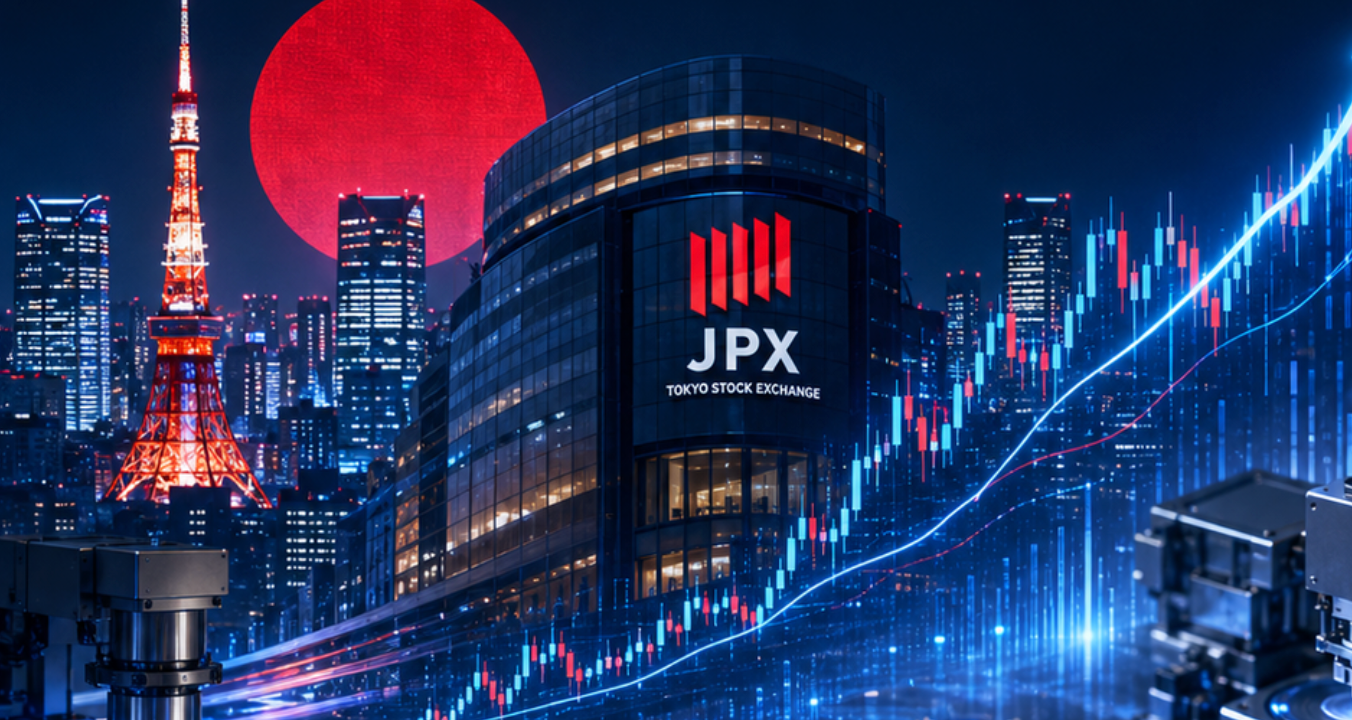
Japan’s Stock Market Surges: Upstream Raw Material Suppliers as the “Shovel Sellers” in the AI Gold Rush
TechFlow Selected TechFlow Selected
Japan’s Stock Market Surges: Upstream Raw Material Suppliers as the “Shovel Sellers” in the AI Gold Rush
Who’s Selling Shovels in the AI Era, and Why Is the Japanese Stock Market Soaring?
 Navigating Web3 tides with focused insights
By: Xiao Bing, TechFlow Research
While global investors fixate on NVIDIA’s earnings reports, TSMC’s capacity expansion, and Samsung’s HBM yield rates, a quiet surge is unfolding on the Tokyo Stock Exchange.
On June 3, 2026, the Nikkei 225 Index broke above 68,000 points for the first time—up nearly 33% year-to-date, triple the S&P 500’s gain and more than double the Nasdaq’s.
This is no balanced bull market. Capital inflows are highly concentrated: the AI semiconductor supply chain. On that day alone, Tokyo Electron and Advantest together lifted the Nikkei by approximately 840 points.
Even more staggering is Kioxia Holdings (285A), a NAND flash memory manufacturer that listed in Tokyo in December 2024. Its share price surged from an IPO price of ¥1,455 to over ¥78,000—a gain exceeding 3,500% in less than 18 months. At its peak, its market capitalization briefly surpassed Toyota Motor’s, making it Japan’s second-most-valuable company.
Beneath these numbers lies an often-overlooked industrial reality: on AI—the world’s most crowded race—Japan neither designs nor manufactures chips, yet controls virtually everything required to manufacture them.
Equipment, materials, wafers, passive components, power systems, cooling solutions, optical fiber cables—from the first silicon wafer slice to the final fiber connection in data centers—Japanese firms dominate the upstream positions of the AI value chain. To borrow an old but precise analogy: in the AI gold rush, Japan sells the shovels, dynamite, and miner’s lamps.
We break this value chain into six layers and examine Japanese companies’ strategic positioning, financial performance, and investment logic layer by layer.
Layer One: Semiconductor Manufacturing Equipment
Chip manufacturing is, at its core, about using extremely precise equipment to etch circuits onto silicon wafers, layer by layer. The more advanced the process node of AI chips (GPUs, ASICs, HBM), the greater the number of fabrication steps—and the higher the precision demanded at each step. This makes semiconductor equipment the highest-barrier, highest-margin, and most predictable segment across the entire AI value chain.
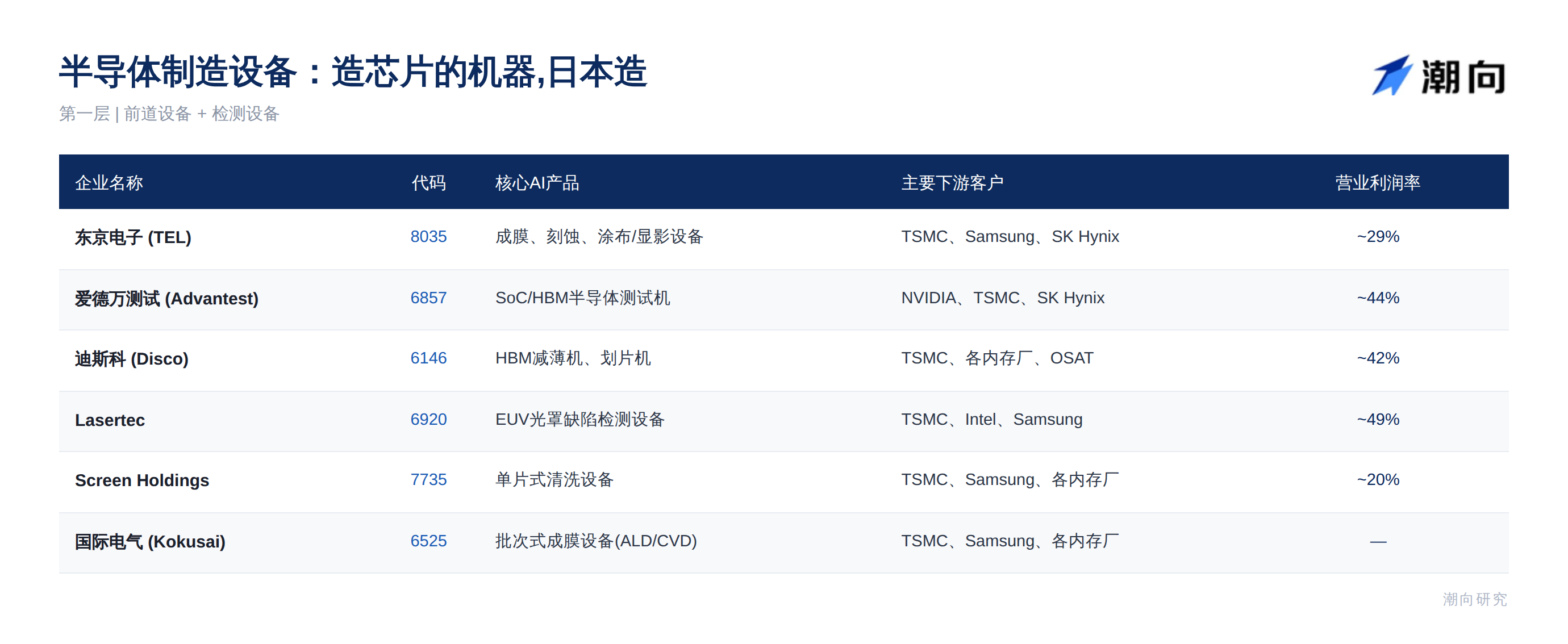
Japan ranks second only to ASML (Netherlands) and Applied Materials (U.S.) in this field. Six core firms each guard critical gateways at different process nodes.
Tokyo Electron (8035): Integrated Front-End Equipment Giant
Tokyo Electron is the world’s third-largest semiconductor equipment supplier, ranking among the top two globally in four key segments: coating/developing (nearly 90% global share), etching, cleaning, and thin-film deposition. No leading foundry—including TSMC, Samsung, or Intel—can build advanced-node fabs without it.
In FY2026 (ended March 2026), revenue hit ¥2.44 trillion and net profit ¥574.45 billion—both record highs—with an operating margin of ~29%. Its 52-week price range was ¥19,870–¥61,420, reflecting a ~76% gain over the past year.
As AI chips migrate toward 2nm and beyond, more wafer processing steps are required—and equipment consumption rises accordingly. This creates an “advanced node = higher equipment value” growth dynamic. Of 22 analysts covering the stock, 17 issue Buy ratings; none recommend Sell.
Advantest (6857): The Final Gate Before Every AI Chip Ships
The more complex the AI chip, the more critical testing becomes. Advantest commands ~50% global share in SoC testers and holds a near-monopoly in memory testers. Every NVIDIA GPU and every HBM chip undergoes testing on its machines before leaving the factory.
In FY2025 (ended March 2026), revenue soared 44.7% YoY to ¥1.1286 trillion; operating profit reached ¥499.1 billion, with an industry-leading operating margin of 44% and gross margin consistently between 55%–58%. Its market cap rose over 309% in the past year; share price gained ~145% YTD.
A single AI tester sells for hundreds of millions of yen, requires lengthy test cycles, and delivers strong leverage on capacity ramp-up. Advantest has raised its FY2026 forecast to ¥1.42 trillion in revenue and ¥627.5 billion in operating profit.
DISCO (6146): Sole Global Monopolist in HBM Ultra-Thin Grinding Machines
HBM (High-Bandwidth Memory) stacks multiple DRAM dies vertically—each requiring grinding down to extreme thinness. DISCO dominates this ultra-thin grinding machine market with ~70%–80% global share.
In FY2025 (ended March 2025), revenue totaled ~¥385 billion (+25% YoY), with operating margin exceeding 40% and estimated gross margin around 60%. Its business model features a powerful “equipment + high-consumption consumables (dicing blades, grinding wheels)” structure—every machine sold generates recurring cash flow from blade and wheel replacements.
LASERTREC (6920): 100% Global Monopoly in EUV Photomask Inspection
Producing cutting-edge AI chips requires EUV (Extreme Ultraviolet) lithography. And detecting defects on EUV photomasks? Only one company can do it worldwide: LASERTREC—100% market share, no competitors.
In FY2025 (ended June 2025), revenue was ¥251.4 billion, operating profit ¥122.8 billion, and operating margin 48.8%—the highest in the global semiconductor equipment industry. Its latest ACTIS A300 system supports High-NA EUV processes and integrates its proprietary EUV light source URASHIMA.
This is a pure technology-driven monopoly model with an exceptionally high entry barrier.
SCREEN Holdings (7735) and Kokusai Electric (6525)
SCREEN Holdings leads globally in single-wafer cleaning equipment. As chip complexity grows, cleaning steps increase geometrically—keeping its operating margin above 20%. Kokusai Electric excels in batch-type thin-film deposition (ALD/CVD) tools, with robust orders for advanced film processes essential for 3D stacking and HBM.
Layer Two: Semiconductor Materials & Silicon Wafers
Every chip begins with an ultra-high-purity monocrystalline silicon wafer. AI chips demand far stricter flatness and defect-density specifications than consumer chips. And the photoresists, slurries, and packaging materials needed to produce those wafers are almost entirely supplied by Japanese firms.
Shin-Etsu Chemical (4063) & SUMCO (3436): Silicon Wafer Duopoly
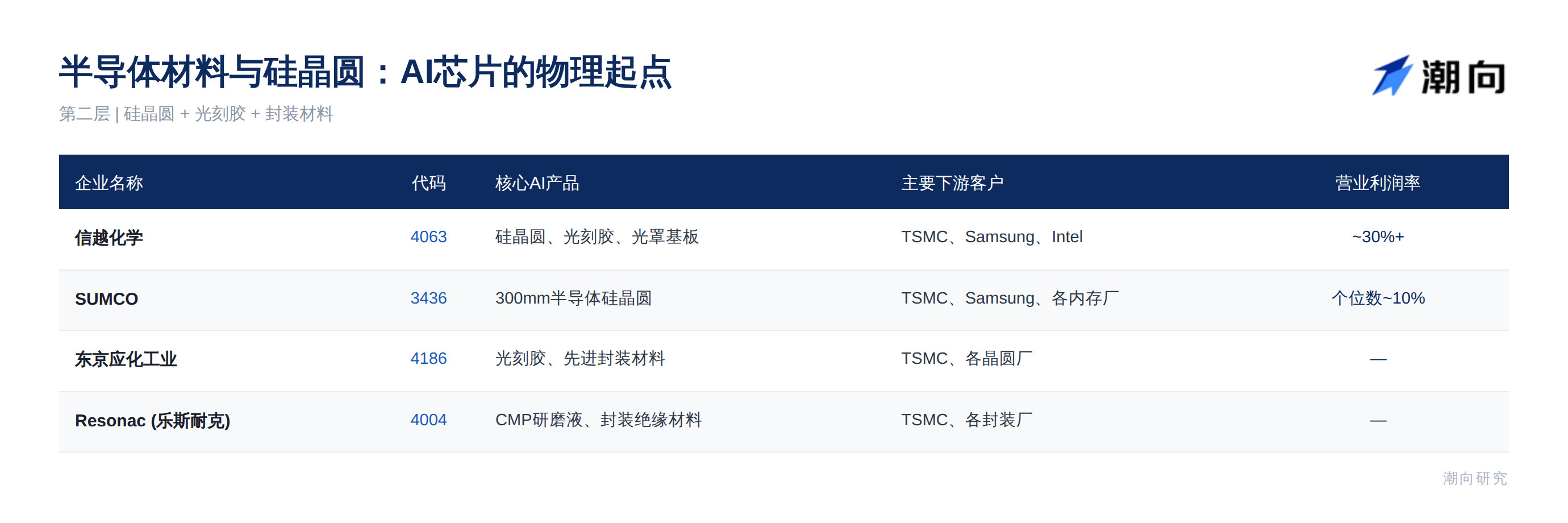
Shin-Etsu and SUMCO jointly control over 50% of global 300mm silicon wafer capacity. Together with GlobalWafers (Taiwan), Siltronic (Germany), and SK Siltron (Korea), the top five suppliers account for ~80% of the overall market—and an even higher share in the premium wafers required for advanced nodes.
Shin-Etsu’s semiconductor wafer business maintains an operating margin consistently above 30%; group-wide margins hover around 30%. It supplies not only wafers but also one of the world’s largest volumes of photoresist raw materials, plus epoxy resins for chip packaging and rare-earth magnets—spanning multiple critical nodes along the semiconductor materials chain and diversifying cyclical risk.
SUMCO, as a pure-play silicon wafer producer, is more sensitive to memory market supply-demand swings—currently posting single-digit to low-double-digit operating margins. But AI-driven premium pricing for advanced wafers will be its core profit catalyst.
Both firms follow a “restrained expansion” strategy. Lessons from prior silicon wafer overcapacity have dampened aggressive capex appetite. Shin-Etsu is building new plants domestically and overseas, targeting >20% additional capacity by end-2026.
TOKYO OHKA KOGYO (4186) & Resonac (4004): The Invisible Chemical Materials Powerhouse
Beyond silicon wafers, AI chip fabrication consumes vast quantities of specialty chemicals: photoresists (determining line-width precision), CMP slurries (for wafer surface polishing), advanced packaging materials, and thermal interface materials.
TOKYO OHKA KOGYO (4186) and Resonac (formerly Showa Denko, 4004) lead globally in these fields. Their products may lack the visibility of equipment—but they’re equally irreplaceable. Rising process steps for AI chips directly boost chemical consumption per wafer.
Layer Three: Memory Chips
AI training and inference are massively data-intensive tasks. Loading large language model weights and reading/writing KV caches drive exponential growth in demand for high-speed memory. NAND flash—the core medium for data center SSDs—is now entering an AI-powered supercycle.
Kioxia Holdings (285A): The NAND Cycle King
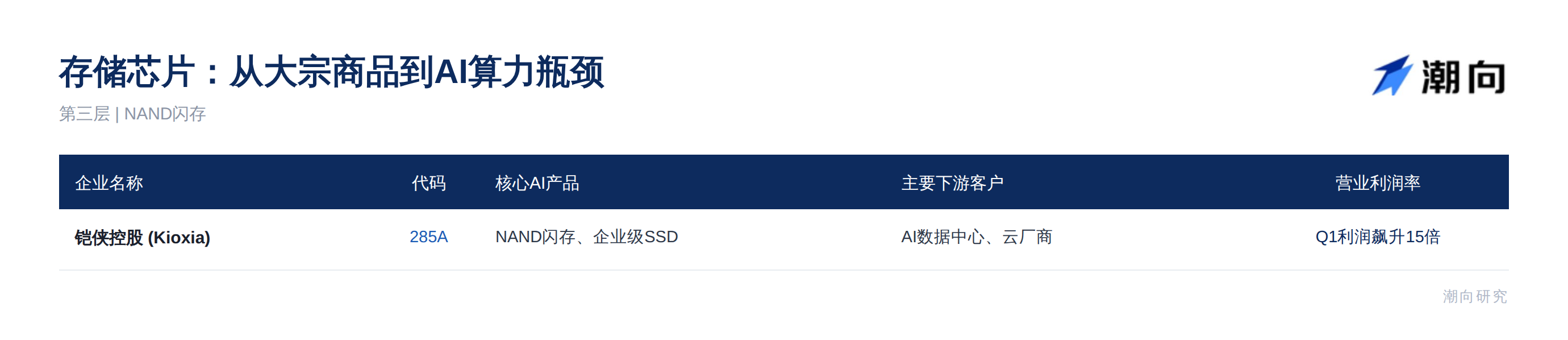
Kioxia is the most explosive stock in this Japanese AI rally—and there is no close second.
From its December 2024 IPO through mid-2026, its share price surged over 3,500%. Its 52-week range was ¥1,950–¥83,140—an extraordinary swing rarely seen among large-cap stocks in developed markets. In FY2026 (ended March 2026), revenue rose 37% YoY to ¥2.34 trillion; net profit doubled to ¥554.49 billion. Q1 FY2026 was even more dramatic: revenue jumped 189% YoY to ¥1.0029 trillion; operating profit surged 15-fold to ¥59.68 billion—the highest quarterly result ever. NAND average selling prices (in USD) doubled during that quarter.
The driver? A historic supply-demand mismatch: explosive AI data center demand colliding with supply constrained until new capacity comes online in late 2027. Goldman Sachs upgraded Kioxia to Buy in June 2026, raising its target price from ¥48,000 to ¥93,000. Kioxia has announced dividend initiation starting FY2027 and plans to issue ADRs in the U.S.
Risk is explicit: NAND’s inherent cyclicality. Its trailing P/E sits near 77x, while forward P/E stands at ~8.8x—a huge gap reflecting market bets on sustained profit explosion. Should AI capex slow or new capacity flood the market, price corrections could be severe.
Layer Four: Passive Components & Packaging Substrates
An AI server’s hardware architecture differs fundamentally from traditional servers. GPU motherboards require massive arrays of passive components—especially MLCCs—to stabilize current, and ultra-high-spec multilayer packaging substrates to host GPU dies. A single AI GPU accelerator card may contain thousands—or even up to 20,000—MLCCs, representing an order-of-magnitude jump over smartphones or PCs.
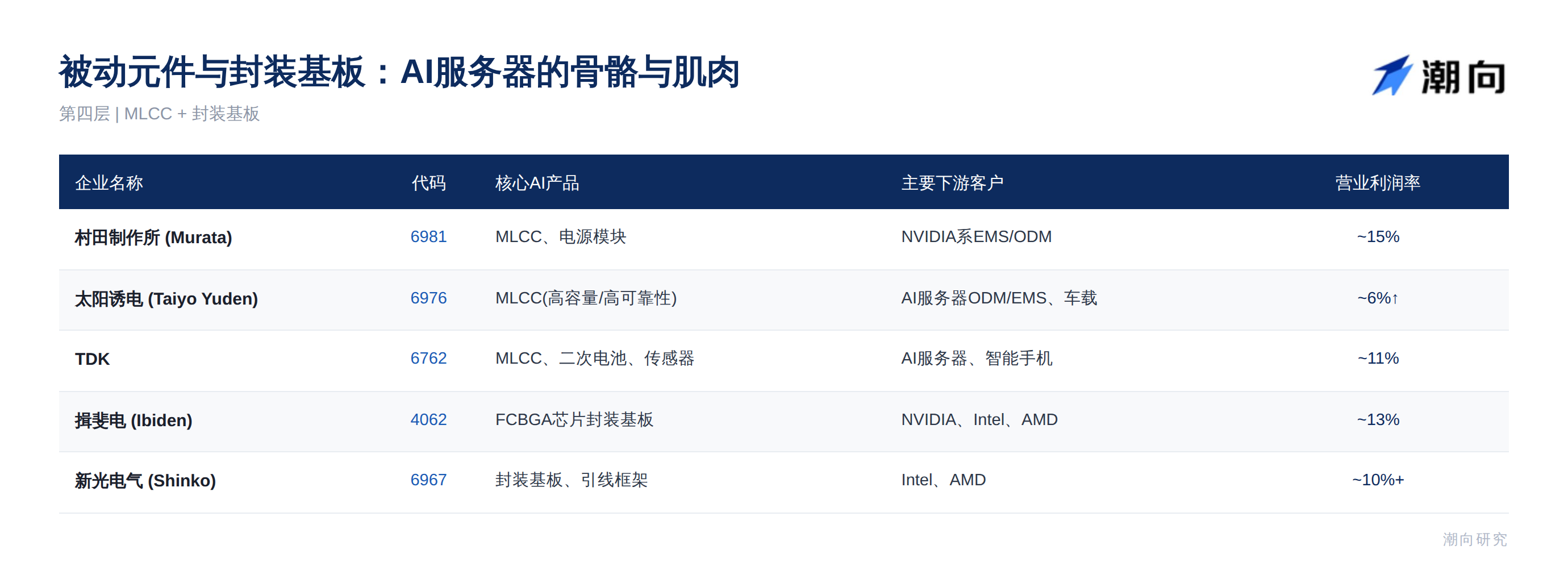
Murata Manufacturing (6981): Absolute Global MLCC Leader
Murata commands ~40% global MLCC market share—the undisputed leader. AI servers demand high-voltage, high-capacity, ultra-reliable MLCCs—and Murata possesses the deepest technical moat in this premium segment.
In FY2025 (ended March 2026), revenue hit ¥1.8309 trillion (a record high); operating profit was ¥281.8 billion, with a 15.4% margin. Sales to data centers surged ~70% YoY. Murata explicitly stated: demand for high-end data center capacitors has already reached double its current production capacity—and extreme supply tightness is expected to persist for 1–2 years.
On May 29, 2026, Murata rose over 96% in one month.
Sunlord Electronics (6976): Most AI-Elastic MLCC Stock
Sunlord ranks third globally in MLCCs, with MLCCs accounting for 64% of its revenue—making it far more sensitive to AI server demand than Murata.
In FY2025, net profit surged 5.4x YoY to ¥14.8 billion. Orders for Jan–Mar 2026 exceeded ¥100 billion for the first time; its book-to-bill ratio remained above 1.25. Sunlord has already raised prices for mid-to-low-capacity MLCCs by 6%–13%. CEO Katsuya Sase described current demand to Bloomberg as “scary.”
Goldman Sachs forecasts AI server MLCC demand will grow at least 4x by 2030, while industry-wide capacity expands only ~10% annually. Sunlord surged 163% in one month and internally projects FY2027 operating profit to rise 50% to ¥30 billion.
TDK (6762): Multi-Product Player Beyond MLCCs
TDK operates across aluminum electrolytic capacitors, thin-film inductors, optical transceiver components, HDD heads, and secondary batteries for AI data centers.
It expects FY2026 revenue of ¥2.5048 trillion and operating profit of ¥272.4 billion (11% margin). It targets annual AI market sales growth of 25%–30% through FY2031, with AI data center passive component sales aiming for a 10x increase. However, since battery-related energy applications still dominate its top line, AI’s profit elasticity remains comparatively moderate among the three major component makers.
Ibiden (4062): Monopolistic Dominance in GPU Packaging Substrates
Ibiden’s FC-BGA (Flip-Chip Ball Grid Array) packaging substrates serve as the foundational carriers for NVIDIA GPUs and data center CPUs. Its estimated market share in high-end AI server packaging substrates reaches 70%–80%. An industry adage states: “Without Ibiden and Kyocera, high-performance server processors simply cannot be built worldwide.”
It forecasts FY2026 revenue of ¥415 billion and operating profit of ¥61 billion (13% margin). Over the next three years, it plans ¥500 billion in mega-scale capex—focused on expanding its Ono and Kawara factories—to permanently secure its position as the global leader in high-end AI packaging substrates.
In April 2026, it ranked as the top-performing foreign IT stock YTD. In February, it completed a ¥52.47 billion equity offering—fully allocated to capacity expansion.
Kyocera (6967): The Second Pillar of Japan’s High-End Packaging Substrate Duo
Kyocera and Ibiden form Japan’s “high-end packaging substrate duopoly,” jointly commanding 70%–80% of the global high-end substrate market. Core customers include Intel and AMD. Operating margin remains stably above 10%. Note: Parent Fujitsu is coordinating with JICC and other consortia on Kyocera’s privatization (TOB tender offer); investors should monitor related announcements.
Layer Five: Power & Cooling
Single-rack power draw in AI data centers is several times higher than in traditional ones. This creates three new bottlenecks: ultra-high-capacity power distribution and uninterruptible power supplies (UPS); power semiconductors for high-frequency power conversion; and liquid-cooling systems and precision air conditioning for servers and chips. Roughly 30%–40% of a data center’s electricity powers cooling—making power and cooling the ultimate chokepoints for scaling AI compute.
This layer is frequently overlooked—but another area where Japanese firms benefit deeply.
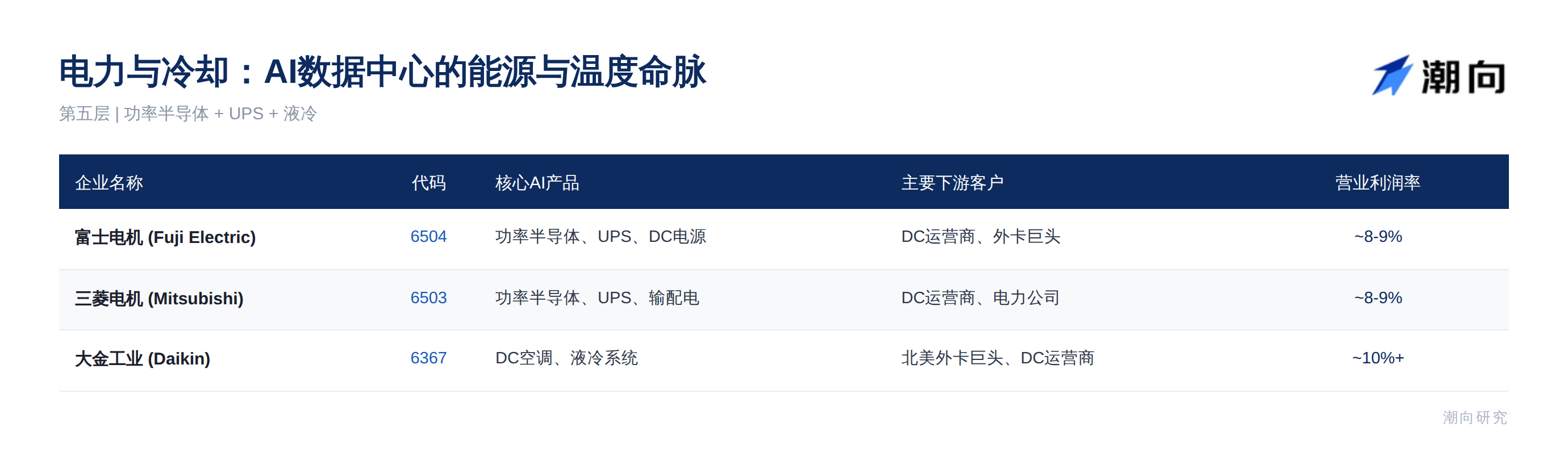
Fujitsu Electric (6504): Integrator of DC Power, UPS & Power Semiconductors
Fujitsu Electric offers high-power UPS, data-center-specific high/low-voltage power distribution systems, and core power semiconductors (IGBT/SiC modules) for power conversion. Its latest report shows 8% YoY operating profit growth for Apr–Dec 2025—its fifth consecutive year of record highs. Its Infrastructure & Power Systems division saw dual revenue and profit growth driven by surging data center orders. It’s expanding data center power capacity to 1.7x current levels, maintaining consolidated operating margins of 8%–9%.
Mitsubishi Electric (6503): National Champion in Heavy Electrical Equipment
Mitsubishi Electric dominates high-voltage power semiconductors (IGBT/SiC) and large-scale industrial UPS systems. Its overseas UPS business is enjoying long-cycle tailwinds, with its products fully integrated across AI data center power chains. Consolidated revenue totals ¥5.5 trillion; operating margin stands at 8%–9%.
Daikin Industries (6367): Global AC Leader Enters Data Center Liquid Cooling
Daikin—the world’s largest air conditioner maker—is transferring its core technologies into data center cooling. Its chip-level direct liquid cooling system uses unique negative-pressure circulation technology—making leakage extremely unlikely even if pipes are damaged, offering exceptional protection for server hardware. In 2025, it acquired U.S.-based DDC Solutions and Chil-Dyne, fully integrating North American AI data center cooling capabilities.
Data center cooling revenues surged from ¥23 billion in 2023 to ~¥100 billion in 2025, targeting ¥300 billion by 2030. The North American data center cooling market is projected to expand from ~¥1.1 trillion in 2025 to ¥2.7 trillion by 2030; Daikin already holds ~12% share—ranking third nationwide. Group-wide operating margin exceeds 10%.
Layer Six: Optical Fiber Cables & Interconnect
AI data centers require ultra-high-speed, ultra-low-latency interconnectivity across tens of thousands of servers—sparking explosive demand for high-spec optical fibers, high-density optical patch panels, and optical communication devices. Japan’s “Big Three Wire & Cable Makers”—Fujikura, Furukawa Electric, and Sumitomo Electric—have successfully shifted resources from low-margin traditional wiring businesses to high-value optical communications and data center applications. Their share prices and earnings have become the brightest stars of this AI rally.
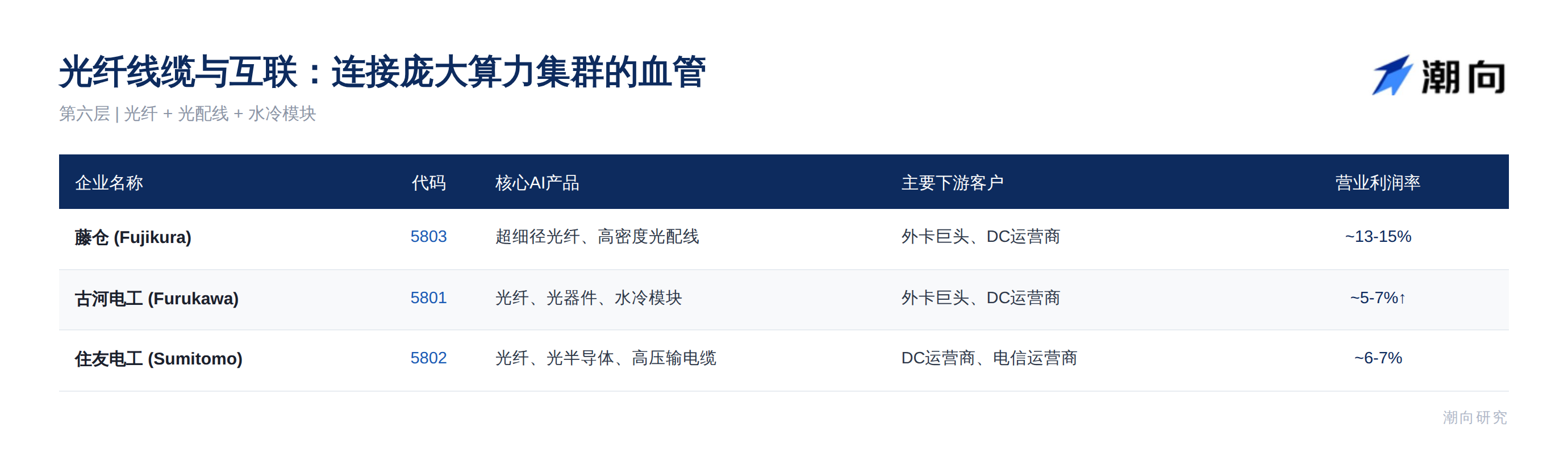
Fujikura (5803): Superstar of the Nikkei 225
Founded 139 years ago, its shares rose 1,400% in two years. Fujikura’s ultra-fine, high-density optical fiber cables (Spider Web Ribbon technology) perfectly meet AI data centers’ extreme spatial and routing constraints—Apple is among its core customers.
In FY2026 (ended March 2026), it posted record-high results, with data center sales 2.3x higher than last year—and repeatedly raised earnings guidance. Group ROE stands at ~32.5%; consolidated operating margin climbed to 13%–15%.
Demand growth vastly outpaces capacity. CEO Naoki Okada publicly acknowledged “supply shortages.” Fujikura is investing ¥40 billion in a new production line at its Sakura factory and establishing Fujikura Optical Cable Systems LLC in the U.S. On May 12, 2026, its share price surged 11.6% to a record high of ¥7,624.
Furukawa Electric (5801): Triple Play in Optical Fiber + Optical Devices + Liquid Cooling Modules
Furukawa Electric uniquely benefits from two cutting-edge trends: high-density optical interconnects and chip-level liquid cooling modules for data centers.
Its earnings exploded. FY2025 revenue was ¥1.1459 trillion; FY2026 official guidance was sharply raised to ¥1.3 trillion in revenue and ¥65 billion in operating profit. Its liquid cooling module business is projected to surge from ¥6 billion in FY2026 to ¥25 billion in FY2027. It aims to lift data center-specific operating profit to ¥200 billion by FY2031—8.5x its prior-year level. Current operating margin is 5%–7%, firmly in a steep upward trajectory.
Sumitomo Electric (5802): Integrated Giant in Optical Fiber, Opto-Semiconductors & Power Grid Cables
Sumitomo Electric covers ultra-high-core-count optical fiber cables, ultra-high-speed optical transceiver semiconductors, ultra-high-voltage transmission cables (for cross-regional data center power delivery), and third-generation compound semiconductor substrates (GaN/InP).
Group operating margin stands at 6%–7%. As Japan’s undisputed wire-and-cable leader, its share price has delivered over 90% excess returns amid surging dual demand from data centers and optical communications.
Why Now?
Japanese semiconductor firms weren’t suddenly strong—they’ve been industry stalwarts for decades. Tokyo Electron, Shin-Etsu Chemical, and Murata have commanded respect for years. Yet the Nikkei 225 remained trapped in the shadow of Japan’s 1990s bubble collapse—until finally breaking its 1989 all-time high in 2024. So why now—why such fierce capital inflows into Japan?
The convergence of three forces:
First, certainty in AI capex. In 2026, global tech giants are projected to spend ~$800 billion on AI-related capital expenditures. Alphabet (Google’s parent) announced on June 2 a $80 billion equity offering to fund its $180–190 billion 2026 capex plan. That money ultimately translates into orders for chip-making equipment, silicon wafers, MLCCs, fiber optic cables, UPS systems, and cooling infrastructure—and a substantial portion flows straight to Japanese firms.
Second, the amplifying effect of yen depreciation. In June 2026, USD/JPY briefly breached 160. Japanese equipment and materials firms earn heavily in dollars but incur costs in yen—weak yen acts as an implicit subsidy for exporters.
Third, corporate governance reform dividends. One legacy of Abenomics was pushing Japanese firms to improve shareholder returns. Kioxia’s dividend announcement and Fujikura’s RSU program—once unimaginable in Japan—are now reality. The Tokyo Stock Exchange continues pressuring listed firms to improve ROE, and foreign investor interest in Japan is structurally rebounding.
The Japanese government is adding momentum too. Its March 2026 semiconductor strategy targets ¥40 trillion ($250 billion) in domestic chip output by 2040—eight times the ¥5 trillion level in 2020. Rapidus is building a 2nm fab, targeting mass production in 2027. TSMC is also expanding advanced-node capacity in Japan.
Risks Not to Ignore
The Nikkei’s 33% YTD gain already far exceeds the most optimistic early-year forecasts. UBS’s year-end 2026 target was 54,000—already surpassed by over 20%.
Concentration Risk. On June 3—the day of its record high—Tokyo Electron and Advantest alone contributed ~1,100 points, or two-thirds of the day’s total gain. Any crack in the AI narrative would trigger sharp pullbacks in these high-weight stocks—directly dragging down the index.
Valuation Stretch. Tokyo Electron trades at ~48x P/E; Advantest at over 60x; Kioxia’s trailing P/E nears 77x; Fujikura and Sunlord have seen short-term price surges fueled by extreme sentiment. Any earnings miss could trigger violent valuation corrections.
Yen Reversal. With expectations of further BOJ rate hikes in 2026—and real wages rising for four consecutive months—yen appreciation could compress exporters’ profit elasticity.
Cyclical AI Capex. Once global tech giants enter a phase of capex consolidation, high-beta semiconductor equipment and upstream component orders face sharp cyclical correction. History shows every major wave of IT infrastructure investment—from fiber optics during the dot-com era to servers in early cloud computing—follows a boom-to-digestion cycle.
TechFlow Insight
The essence of Japan’s AI semiconductor rally is a revaluation of “deep infrastructure.”
Over the past two years, markets priced AI around its most visible links: NVIDIA (chip design), TSMC (chip manufacturing), and ASML (the “shovel”). But the AI value chain is far longer and deeper. From silicon wafers to photoresists, from test equipment to MLCCs, from UPS systems to liquid cooling, from optical fibers to packaging substrates—every link faces bottlenecks, and every bottleneck confers pricing power. Japanese firms sit precisely at the upstream apex—occupying the hardest-to-replace positions.
From an investment certainty perspective, the highest tier comprises “technology monopolists”: LASERTREC (100% EUV inspection monopoly), DISCO (near-monopoly in HBM grinding), Advantest (dominant AI tester share), and Ibiden/Kyocera (high-end packaging substrate duopoly). These firms are virtually irreplaceable in their value chains and possess genuine global pricing power. Demand for MLCCs, wires/cables, and precision air conditioners is also surging—but faces stronger competition and greater sensitivity to supply-demand dynamics and capex timing.
Kioxia’s 3,500% surge reflects more than just NAND price spikes—it signals market recognition that memory has become one of AI compute’s critical supply bottlenecks. Murata and Sunlord’s rallies reflect a hard truth: an AI server needs multiples more MLCCs than a traditional server—and global capacity growth lags far behind demand.
For investors, Japan’s AI semiconductor sector offers a fundamentally different way to participate—distinct from U.S. tech stocks. You need not bet on which AI company wins. You only need believe one thing: whoever wins the AI race must use Japanese equipment, materials, and components to compete.
A 33% annual gain won’t recur every year. But viewed through the lens of industrial cycles, AI infrastructure build-out is far from over—and Japan’s structural role in the global semiconductor supply chain won’t shift meaningfully anytime soon.
Who controls the “means of production” in the AI era? Japan remains firmly at the table.
Disclaimer: This article is for informational and research purposes only and does not constitute investment advice. Securities markets involve risk; investments should be made with caution. Mentioned stocks are cited solely for industry analysis—not as buy/sell recommendations. Data sources include company financial reports, Yahoo Finance, Investing.com, StockAnalysis, Bloomberg, and other public information. TechFlow Research strives for accuracy but does not guarantee completeness. Please refer to official exchange data for authoritative figures.
Join TechFlow official community to stay tuned
Telegram:https://t.me/TechFlowDaily
X (Twitter):https://x.com/TechFlowPost
X (Twitter) EN:https://x.com/BlockFlow_News
 @BlockFlow_News