Bitget UEX Daily Report | COMPUTEX to Open Soon; Jensen Huang’s AI Speech Draws Wide Attention; U.S.-Iran Peace Talks Enter Critical Phase as Trump Revises Multiple Agreement Terms
I. Top News
Bitget UEX Daily Report | Fed Maintains High Rates Amid Caution; U.S.-Iran Talks Intensify; PMI Expansion Slows (June 1, 2026)
I. Top News
Federal Reserve Updates The Fed maintains its cautious hawkish stance, further dampening market expectations for near-term rate cuts.
- Minutes from the April FOMC meeting indicate that a majority of officials believe additional rate hikes may be warranted if ongoing Iran-related conflict continues to fuel inflation; the federal funds rate target range remains unchanged at 3.5%–3.75%.
- The probability of a rate cut at the June 16–17 FOMC meeting has fallen to approximately 3–4%, with no signals indicating a major policy shift. Market impact: This steady posture supports a resilient U.S. Dollar Index while capping excessive upside in risk assets; investors are pivoting toward monitoring evolving inflation and geopolitical data.
International Commodities Precious metals and crude oil exhibit divergent price action: spot gold fluctuates amid geopolitical tensions, while silver follows suit.
- On crude oil: latest developments in U.S.-Iran negotiations directly influence supply expectations; the Trump administration has introduced stricter conditions.
- Institutions continue tracking AI-driven demand for industrial metals—e.g., pricing momentum for MLCC components. Market impact: easing geopolitical risks suppress gold’s safe-haven premium, while AI infrastructure expansion continues supporting select industrial metals.
Macroeconomic Policy U.S. manufacturing PMI holds steady at 52.7; non-manufacturing PMI declines to 53.6—still within expansion territory but showing slower growth.
- The Trump administration proposes revisions to the Iran nuclear deal, pushing negotiations into a more complex phase centered on the Strait of Hormuz and highly enriched uranium handling. Market impact: broadly stable economic data sends positive signals for supply chains, yet persistent geopolitical uncertainty continues injecting volatility into commodity prices.
II. Market Recap
Commodities & FX Performance
- Spot Gold: –0.4%, trading at ~$4,542/oz.
- Spot Silver: +0.3%, trading at ~$75.50/oz.
- WTI Crude Oil: +2.37%, trading at ~$89.40/bbl.
- Brent Crude Oil: +2.09%, trading at ~$92.90/bbl.
- U.S. Dollar Index: +0.13%, at 99.047—supported by Fed policy expectations.
Cryptocurrency Performance
- BTC: –0.51%, at ~$73,708.
- ETH: –0.85%, at ~$2,010.
- Total Crypto Market Cap: –0.3%, at $2.53 trillion.
- 24-Hour Liquidations: ~$192 million total; short liquidations account for $110 million.
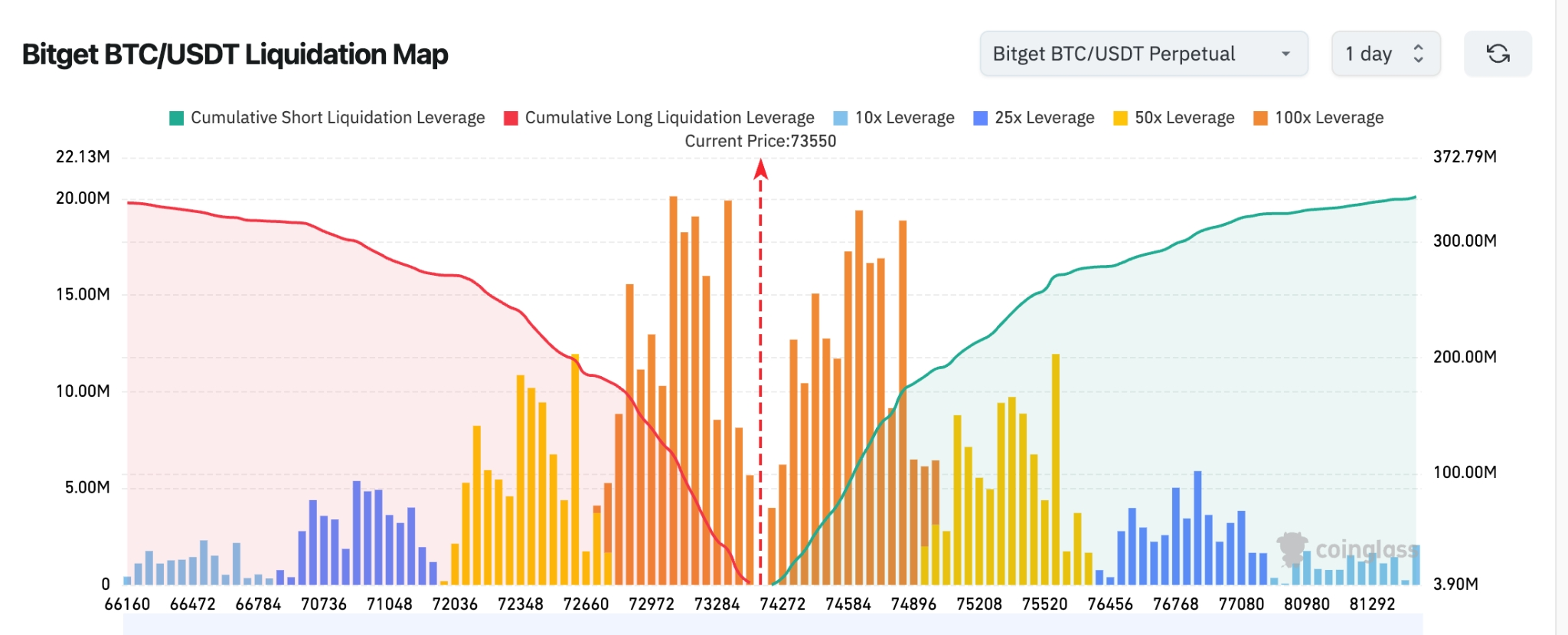
- Bitget BTC/USDT Liquidation Map: Current BTC price hovers near $73,550; the nearest dense cluster of short liquidations lies between $74,500–$75,000—very close to the current price—making upward sweeps of short liquidity more likely in the near term. A thicker concentration of long liquidations exists between $72,800–$73,300; should support near $73,000 break, it could trigger cascading long stop-losses, accelerating downside momentum relative to upside moves.
- Spot ETF Net Flows: As of last Friday’s close, BTC spot ETFs recorded net outflows of $125 million—marking ten consecutive days of outflows.
U.S. Equity Index Performance
As of last Friday’s close:
- Dow Jones Industrial Average: +0.72%, at 51,032.46—reaching new all-time highs.
- S&P 500: +0.22%, at 7,580.06—setting a new record high.
- Nasdaq Composite: +0.2%, at 26,972.62—driven notably by technology stocks.
Tech Giants’ Updates
- NVIDIA (NVDA): –1.45%, at ~$211—robust AI demand countered by short-term profit-taking.
- Microsoft (MSFT): +5.45%, at ~$450—cloud and AI businesses deliver standout performance.
- Apple (AAPL): –0.14%, at ~$312—consumer electronics demand remains stable.
- Alphabet (GOOG): –2.51%, at ~$376—advertising business faces headwinds.
- Amazon (AMZN): –1.23%, at ~$270—AWS growth remains solid.
- Meta (META): Slight decline—balancing ad revenue and metaverse investments.
- Tesla (TSLA): –1.43%, with focus on EV and autonomous driving progress. Core driver: AI remains the dominant theme; some stocks see profit-taking, yet tech as a whole retains strong investor interest.
Sector-Specific Observations
Software & AI-Related Stocks Up >6%
- Key names: Palantir (PLTR) +9.21% to $156.54; ServiceNow (NOW) +12–14%.
- Catalysts: surging demand for AI infrastructure and enterprise applications; Dell’s better-than-expected hardware earnings generated strong spillover effects; optimistic market expectations around full-stack AI innovation at COMPUTEX further lifted software valuations—reflecting growing investor confidence in AI’s penetration from hardware into application layers.
Commercial Space Sector Pullback
- Key name: AST SpaceMobile (ASTS) –14.79% to $113.41.
- Catalysts: Blue Origin’s New Glenn rocket exploded during a static fire test, damaging the launch pad and related facilities; market concerns over potential short-term delays to ASTS satellite deployment triggered broad-based risk aversion in the sector. However, the company has filed multiple backup launch options—including SpaceX Falcon 9—making long-term mission objectives still viable, though near-term sentiment has been noticeably impacted.
III. In-Depth U.S. Equity Analysis
1. Dell Technologies – Surge in AI Server Demand: Event Summary: On May 29, Dell reported Q1 FY2026 results with revenue of $43.84 billion—up 88% YoY and significantly exceeding consensus. AI server revenue reached $16.1 billion, up 757% YoY; AI order backlog totaled $24.4 billion, pushing total AI backlog to $51.3 billion. Dell also substantially raised full-year guidance, lifting its FY2027 AI server revenue forecast from $50 billion to ~$60 billion and total revenue guidance to $165–169 billion. This strength stems from accelerated global AI infrastructure builds by hyperscalers and enterprises, with NVIDIA-powered servers serving as the core growth engine. Market Interpretation: Multiple institutions view Dell as precisely capturing the AI capex cycle—AI server revenue has now surpassed traditional PC revenue, signaling rapid AI data center expansion spreading from cloud providers to enterprises. Goldman Sachs and others have upgraded price targets, emphasizing Dell’s competitive advantages in supply chain execution and custom server solutions. Investment Implications: The long-term AI hardware thesis remains robust, but investors should closely monitor progress in resolving supply-chain bottlenecks and valuation expansion risks. Subsequent order fulfillment should serve as a key validation signal.
2. Micron Technology – Upgraded Memory Market Forecast: Event Summary: Institutions including TrendForce have recently significantly upgraded their 2026–2027 global memory market size forecasts, driven primarily by explosive AI demand for HBM, DRAM, and NAND. As a key supplier, Micron benefits directly—its HBM capacity is nearly sold out, and AI-related memory demand is expected to account for over 50% of the industry’s total addressable market (TAM) this year. Concurrently, Micron is ramping capital expenditures—FY2026 CapEx is projected to exceed $25 billion—to expand new fabs in the U.S. and globally, addressing persistent supply-demand imbalances expected through 2027–2028. Market Interpretation: Goldman Sachs notes memory has become the third-largest cost component in AI servers; the shipment timing of next-gen products like HBM4 will determine whether the supply chain remains in tight balance. Analysts broadly expect Micron to maintain strong pricing power and revenue growth through 2026–2027, with some forecasting peak EPS levels. Investment Implications: The memory cycle recovery provides substantial growth runway for Micron, though capacity ramp-up pace and geopolitical supply-chain risks remain critical variables. Monitoring 2027 supply normalization will be essential to assess cycle peak timing.
3. NVIDIA – COMPUTEX Preview: Event Summary: Today, June 1, Jensen Huang will deliver the keynote at Taipei Music Center for COMPUTEX, focusing on the Vera Rubin next-generation AI architecture, Grace Blackwell platform updates, and potentially unveiling the N1/N1X—the first Arm-based laptop SoC. This chip is expected to integrate Blackwell GPU cores, delivering performance comparable to an RTX 4070, enabling local AI compute and potentially ushering in a new era of “Windows on Arm,” developed in deep collaboration with Microsoft, MediaTek, and others. Market Interpretation: Institutions widely recognize NVIDIA’s unrivaled leadership across the full AI stack—from data centers to edge computing, and from training to inference—further reinforcing its moat. Morgan Stanley and others view this keynote as a key catalyst for AI hardware valuation re-rating. Investment Implications: Short-term event-driven volatility is likely to ripple across the supply chain; long-term growth still hinges on actual AI capex deployment and competitive landscape evolution. Investors are advised to maintain balanced allocations and track commercialization progress of new products.
IV. Cryptocurrency Project Updates
1. NYDIG analysis indicates that last week’s $1.26 billion block trade in BlackRock’s IBIT ETF was more likely a large investor rapidly exiting Bitcoin exposure—not a typical hedge fund basis trade unwind. Executed on May 26 at $43.16 per share—a 2.3% discount to the then-market price of $44.17—the transaction incurred an estimated execution cost of $29.5 million.
2. According to JIN10, Federal Reserve Governor Christopher Waller stated during a panel discussion at the 32nd Dubrovnik Economic Conference that the global adoption of stablecoins could amplify the reach of Fed monetary policy: “For countries adopting stablecoins, it’s akin to operating under a fixed exchange rate regime… You effectively import U.S. monetary costs, so in countries where stablecoin usage is widespread, U.S. monetary policy influence expands in practice.”
3. Yesterday, Michael Saylor, founder of Bitcoin treasury firm Strategy, again shared information about the Bitcoin Tracker. Consistent with prior patterns, Strategy typically discloses Bitcoin purchases the day after releasing related announcements.
4. According to Cointelegraph, Bitcoin trading is undergoing structural change: Starting May 29, 2026, CME Bitcoin futures will operate 24/7, eliminating weekend halts and the resulting “CME Gap”—a classic short-term technical indicator that will cease to exist. Markets have recently completed the most recent CME gap fill, and current price action oscillates within the remaining gap zone. This structural shift implies a fundamental reconfiguration of traditional short-term technical analysis frameworks. Currently, large traders’ short positions continue declining, reducing near-term bearish pressure—but bullish positioning has yet to form a clear trend—suggesting continued Bitcoin price consolidation in the near term.
5. Token Unlocks data shows major token unlocks this week for SUI, EIGEN, and OPN, with SUI’s unlock valued at ~$13.1 million.
6. JPMorgan analysts Nikolaos Panigirtzoglou et al. note that as Middle East tensions ease, investors are gradually rotating out of Bitcoin and gold markets. The “devaluation trade”—previously fueling demand for both assets—is losing momentum. Over the past two weeks, ETFs tied to Bitcoin and gold have seen pronounced outflows, and institutional CME futures positions have concurrently weakened. This trend signals a broader exit from macro hedges previously favored due to inflation concerns and global instability—not a Bitcoin-to-gold rotation, but rather simultaneous weakening demand across both asset classes. Since the onset of the Iran conflict, Bitcoin has served as the primary vehicle for the devaluation trade.
7. Industry views on current crypto market direction are sharply divided. Economist Timothy Peterson expects Bitcoin to rise gradually through summer, peaking by end-July with relatively muted performance. Conversely, Michael van de Popper, founder of MN Trading Capital, argues that although Bitcoin hit a $60,000 low in February, the current market structure differs markedly from that period. Whether key support zones hold will determine if deeper correction can be avoided. With Bitcoin now at a critical juncture: holding above $71,000 could propel it toward $76,000 and ignite broader crypto rallies—including strong altcoin performance; failure to defend $70,000 support, however, may trigger a swift drop toward $65,000.
V. Today’s Market Calendar
Economic Data Release Schedule

Key Event Highlights
- COMPUTEX 2026 Opening: June 1–5—Jensen Huang’s keynote and AI product launches are the top focal points.
- U.S.-Iran Negotiations: Ongoing monitoring—progress on agreement revisions will significantly impact oil prices and risk assets.
Institutional Views: Leading investment banks broadly agree that AI remains the dominant market theme. Record highs across the three major U.S. equity indices reflect sustained investor confidence in tech-driven growth. NVIDIA’s COMPUTEX keynote is viewed as a near-term catalyst likely to lift valuations across related sectors. Goldman Sachs highlights upward pricing momentum across AI server supply chain components, and TrendForce’s upgraded memory forecasts reinforce this narrative. In crypto markets, despite facing capital outflows and liquidation pressures, long-term institutional investors continue viewing Bitcoin favorably as a strategic digital asset allocation—though near-term attention should focus on how easing geopolitical risks may bolster risk appetite. Overall, under the Fed’s steady policy backdrop, AI and tech growth equities remain the core strategic allocation, albeit with caution warranted against excessive valuation expansion and associated pullback risks.
Disclaimer: The above content was compiled via AI search and verified manually prior to publication. It does not constitute investment advice. Data herein may contain inherent discrepancies; please rely on real-time market data for decision-making.
Join TechFlow official community to stay tuned
Telegram:https://t.me/TechFlowDaily
X (Twitter):https://x.com/TechFlowPost
X (Twitter) EN:https://x.com/BlockFlow_News