Huobi Growth Academy | Crypto Market Macro Report: US-Iran Ceasefire—A Moment of Revaluation for Risk Assets
TechFlow Selected TechFlow Selected
Huobi Growth Academy | Crypto Market Macro Report: US-Iran Ceasefire—A Moment of Revaluation for Risk Assets
From a strategic perspective, the current rebound in the crypto market presents a rare opportunity to reduce positions or rebalance portfolios.
 Navigating Web3 tides with focused insights
Summary
In the early hours of April 8, 2026—less than 90 minutes before Trump’s self-imposed “deadline”—the U.S. and Iran dramatically reached a two-week ceasefire agreement, pausing a Middle Eastern conflict that had raged for nearly forty days. Global financial markets reacted sharply: WTI crude oil plunged over 15% to $91 per barrel, erasing more than 40% of its conflict-driven gains; Nasdaq futures surged 2.5%, instantly reigniting risk appetite; spot gold spiked逆势 to $4,811 per ounce, rising over 3%; Bitcoin broke above $72,000, gaining over 5.5% in 24 hours, while Ethereum surpassed $2,200, up over 5.9%.
The divergent reactions across major asset classes reveal a critical trend: during geopolitical conflicts, Bitcoin is transitioning from a “pure risk asset” toward an asset class possessing *both* risk-asset and digital-gold characteristics. The ceasefire is merely a “breathing window,” not permanent peace. Iran’s ten-point proposal directly demands U.S. troop withdrawal, sanctions relief, and even war reparations—core demands fundamentally at odds with U.S. positions. For crypto markets, the short-term rebound in risk appetite—combined with regulatory progress such as the CLARITY Act—creates a rare window for recovery. Yet key uncertainties remain: the trajectory of negotiations two weeks hence, the cascading impact of falling oil prices on inflation expectations, and shifts in macro liquidity conditions.
I. Ceasefire Bargaining: A Dramatic Turn Before the Deadline
On the early morning of April 8, 2026, global financial markets held their breath. With less than 90 minutes remaining until Trump’s “deadline” for Iran—8:00 p.m. Eastern Time on April 7—a post from Trump himself on social media ignited markets: “I agree to pause bombing and attacks against Iran for two weeks.”
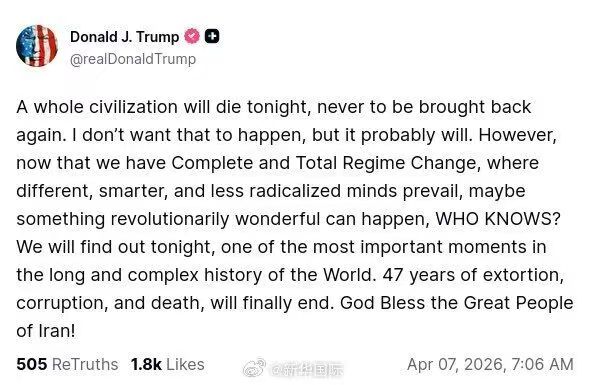
This ceasefire followed intense diplomatic efforts. The previous day, Pakistani Prime Minister Shehbaz Sharif separately called both Trump and Iran’s Supreme Leader Ayatollah Khamenei, requesting a two-week extension of the “deadline” and urging Iran to open the Strait of Hormuz for two weeks as a goodwill gesture. Trump conditioned the ceasefire on Iran’s “full, immediate, and secure” reopening of the Strait of Hormuz. Iran accepted the ceasefire proposal but explicitly stated it holds “complete distrust” toward the U.S. Under the agreement, the ceasefire entered into force at 3:30 a.m. local time in Iran (8:00 a.m. Beijing time) on April 8. Israel also agreed to suspend bombing operations during negotiations. The ceasefire lasts two weeks; negotiations will commence on April 10 in Islamabad, Pakistan, and may be extended by mutual consent. U.S. airstrikes inside Iran have paused, and Iranian armed forces have suspended defensive operations. Notably, however, this is a “mutual pause,” not a permanent peace agreement.
Iran simultaneously released a ten-point plan—submitted via Pakistan to the U.S.—with core demands including: full withdrawal of U.S. combat forces from all regional bases; lifting of all sanctions against Iran; international acceptance of Iran’s uranium enrichment activities; payment of war reparations to Iran; and final ratification of all terms via a binding UN Security Council resolution. Iran stated, “Pakistan has informed Iran that the U.S. accepts these principles as the basis for negotiations,” yet the U.S. side has never formally confirmed or responded. The vast gulf between both sides’ core demands renders the outlook highly uncertain two weeks hence. Negotiations are an extension of the battlefield—not its conclusion.
II. Market Overview: Extreme Divergence Across Four Major Asset Classes
Following the ceasefire announcement, global major asset classes exhibited rare, sharp divergence—reflecting the market’s complex pricing logic around “peace expectations.”
Crypto Markets: Broad-based rebound in risk appetite, led by Bitcoin. Bitcoin briefly breached $72,000, reaching $72,760, with a 24-hour gain exceeding 5%; Ethereum surpassed $2,200, peaking at $2,273, up over 7% in 24 hours; other major coins—including SOL—also posted varying gains. Over the past 24 hours, $595 million in liquidations occurred across the entire market, of which $429 million (72%) were short-position liquidations—with $244 million attributable to Bitcoin shorts. Bitcoin’s strong rebound was driven by two factors: first, the ceasefire triggered a concentrated unwinding of accumulated short positions; second, U.S.-listed Bitcoin spot ETFs recorded net inflows of $471.3 million on Monday, continuing last week’s inflow trend—providing fundamental support from institutional capital.
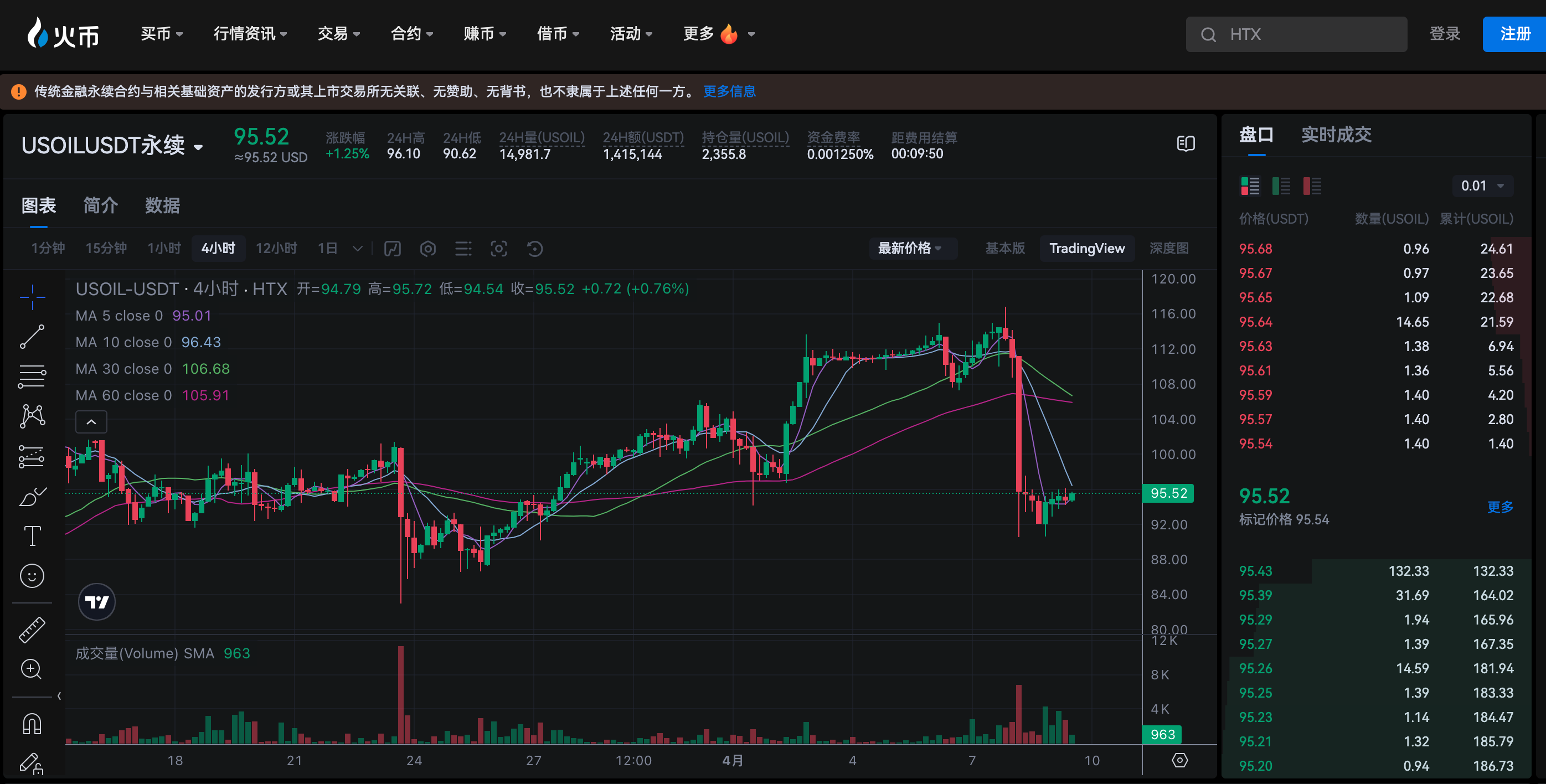
Crude Oil: Full reversal of the “war premium.” As the absolute epicenter of this conflict, oil markets experienced the most violent swings. During the conflict, fears of Strait of Hormuz closure pushed WTI crude from ~$65 to nearly $118 per barrel—a near 70% surge. Upon the ceasefire announcement, WTI crude futures plunged over 15% in a single day, briefly touching $91.30 per barrel—a decline expanding to 19%. Roughly one-fifth of global oil supply transits the Strait of Hormuz; if the ceasefire holds, oil prices face further downward pressure.
Gold: Unexpected rekindling of safe-haven demand. Gold’s performance is the most telling signal of this event. Per the conventional “buy-the-rumor, sell-the-news” pattern, easing geopolitical tensions should weaken gold’s safe-haven appeal and push prices lower. Yet spot gold surged to $4,811 per ounce—up over 3%—after the ceasefire announcement. NYMEX gold futures’ front-month contract reclaimed $4,840. This “paradoxical rally in a safe-haven asset amid de-escalation” reveals a deeper logic: long-term capital is not betting on short-term truce—but rather expressing deep, structural skepticism toward the U.S. dollar’s credibility and America’s global leadership. Gold’s rise reflects profound doubt about fiat currency stability and long-term geopolitical order. During the U.S.-Iran conflict, the U.S. Dollar Index rose over 2%; following the ceasefire news, it fell nearly 0.7% intraday to 98.9—further reinforcing this interpretation.
U.S. Equities: Rebound amid lingering concerns. Nasdaq futures rallied 2.5%, S&P 500 futures gained over 2%, and Dow futures rose 1.8%. Asian markets mirrored the move: Japan’s Nikkei 225 jumped 4.7%, and the MSCI Asia Pacific Index rose 2.1%. Yet actual trading on Tuesday showed muted results: the S&P 500 edged up just 0.08%, the Nasdaq rose 0.1%, and the Dow fell 0.18%—indicating investor caution regarding underlying economic fundamentals.
This cross-asset divergence confirms that the ceasefire triggered distinct logics across asset classes: oil reversed its war premium directly; equities repaired risk sentiment; gold priced in long-term uncertainty; and crypto markets absorbed both risk-sentiment repair *and* the digital-safe-haven narrative.
III. Crypto Assets’ New Geopolitical Logic: Dual Role as Risk & Safe Haven
Bitcoin’s behavior during this U.S.-Iran conflict provides a crucial analytical framework: it no longer maps neatly onto either “risk asset” or “safe-haven asset,” but instead displays a unique “dual attribute.”
During the escalation phase (late February to early April), Bitcoin’s performance notably diverged from traditional risk assets. Although geopolitical tension drove oil prices higher and stoked inflation expectations—undermining market bets on Fed rate cuts—and weighed heavily on tech stocks, Bitcoin did not fall proportionally. One reason: Bitcoin had already undergone a significant correction earlier in the conflict, leaving relatively limited latent forced selling pressure. Simultaneously, sustained net inflows into U.S.-listed Bitcoin spot ETFs provided liquidity support.
During the post-ceasefire rebound phase, Bitcoin’s behavior reflected two concurrent logics: first, it rebounded alongside U.S. and Asian equities—highlighting its sensitivity to global liquidity and its role as a risk asset; second, its rally’s magnitude and persistence exceeded those of traditional risk assets—signaling market pricing of its “digital gold” narrative. Market analysts note Bitcoin often outperforms traditional safe-haven assets following major global crises. Research by Mercado Bitcoin shows that across multiple 60-day windows—including the pandemic’s onset and the U.S.-China trade tariff escalation—Bitcoin’s returns significantly outpaced both gold and the S&P 500 index in most periods.
Bitcoin’s “dual attribute” is its defining distinction from other assets. It is a risk asset—highly sensitive to global liquidity and macro policy; it is also a scarce asset—commanding safe-haven premiums when sovereign creditworthiness is questioned. These attributes are not mutually exclusive, but rather alternate in dominance under different macro conditions: the safe-haven narrative prevails during escalating geopolitical conflict; the risk-asset narrative dominates during liquidity tightening.
Yet this framework rests on one precondition: continued institutional participation. On April 7, U.S. Bitcoin spot ETFs recorded $471.3 million in net inflows—evidence that institutions are strategically deploying capital amid volatility. Institutional investors now wield significantly greater pricing power over Bitcoin, shifting its reaction to geopolitical events from “retail-driven emotional impulses” toward “institution-driven macro pricing.” This transition implies Bitcoin’s correlation with macro variables—interest rates, the U.S. Dollar Index, and global liquidity—may strengthen further, while pure geopolitical news may exert diminishing direct price impact.
IV. Outlook: The Two-Week Window & Three Macro Variables
The ceasefire lasts only two weeks—meaning current market pricing rests on an extremely fragile premise: that negotiations in Islamabad on April 10 yield progress and that the ceasefire extends beyond April 24. If talks stall, geopolitical risk premia will rapidly return. Below are three core variables requiring close monitoring:
Variable 1: Trajectory of Islamabad Negotiations (Key timeline: April 10–24). Iran’s negotiation team is expected to insist on core elements of its ten-point plan—including U.S. troop withdrawal and sanctions relief—while the Trump administration’s red line remains “Iran’s complete abandonment of nuclear weapons and dismantlement of all nuclear facilities.” The chasm between core demands renders a substantive agreement within two weeks highly uncertain. Goldman Sachs maintains its 2026 Brent crude average price forecast at $85—well above its January forecast of $61—reflecting persistently elevated market pricing of long-term geopolitical risk. Multiple analysts stress that two weeks is insufficient to forge a structural agreement resolving deep-rooted Middle Eastern contradictions; the recent oil plunge reflects more profit-taking by longs and technical squeezes—not a fundamental resolution of supply-side risks.
Variable 2: Inflation Expectations & the Fed’s Policy Path. Over the past month, the U.S.-Iran conflict sent oil prices soaring over 40%, significantly heating global inflation expectations—prompting markets to price in Fed pauses—or even hikes. With oil’s collapse, inflationary pressure expectations have eased, and market forecasts for Fed rate cuts have been recalibrated. If oil stays below $100 during the ceasefire, the Fed gains greater policy flexibility—creating a macro tailwind for global risk assets, including Bitcoin. But if negotiations collapse after two weeks and oil surges anew, inflation expectations will rebound swiftly—once again clouding the Fed’s path to rate cuts.
Variable 3: Legislative Progress on the CLARITY Act. BTC Markets analyst Rachel Lucas noted: “A bull-case scenario hinges on two catalysts: first, confirmed and sustained U.S.-Iran ceasefire enabling oil to settle below $100; second, passage of the U.S. CLARITY Act—expected in late April. Institutional market participants are closely watching this bill, viewing it as regulatory ‘unlocking.’” Should the CLARITY Act pass in late April, it would deliver clearer legal guidance for stablecoins and digital assets, further lowering institutional entry barriers—and serve as a critical medium-term catalyst for crypto markets.
Additionally, on-chain derivatives markets warrant attention. In prediction markets for the U.S.-Iran ceasefire, the probability for the April 15 contract jumped from 67% to 90% within minutes of the announcement—and then climbed to 99.6% “YES”—demonstrating extremely high market confidence in short-term ceasefire continuity. Yet research from Chainalysis and others shows that when prediction-market probabilities cluster excessively around a single outcome, it often signals inadequate market pricing of tail risks—precisely when consensus is strongest, the risk of unexpected reversal peaks.
V. Risk Disclosure & Strategic Recommendations
Current market rallies rest on an exceptionally fragile foundation—the two-week ceasefire. Once this premise unravels, all currently priced assets face sharp repricing.
Geopolitical risk re-emergence is the most direct threat. Should the April 10 Islamabad negotiations fail to produce tangible progress—or if the ceasefire expires without renewal—markets will swiftly reprice geopolitical risk premia. Oil could spike anew, global inflation expectations reignite, the Fed’s rate-cut path grow uncertain once more, and risk assets—including Bitcoin—face renewed pressure.
Regulatory uncertainty also warrants attention. Passage of the CLARITY Act in late April would provide a medium-term tailwind for crypto markets; conversely, delays or setbacks in its legislative process could prompt renewed risk-pricing around regulation.
Tightening macro liquidity constitutes the third variable. A sustained oil-price decline stemming from the ceasefire eases inflation pressure, granting the Fed greater scope to cut rates—benefiting risk assets like Bitcoin. Conversely, if oil surges again due to ceasefire collapse, Fed rate-cut expectations would be suppressed—creating a macro headwind for Bitcoin.
From a strategic standpoint, the current crypto rebound presents a rare opportunity to reduce exposure or rebalance portfolios. Key upcoming data—including U.S. CPI, PPI, and retail sales reports (April 14–15)—alongside the April 10 negotiation kickoff, will offer further macro clarity. Investors are advised to maintain flexible positioning, closely monitor Islamabad negotiation developments, oil-price movements, and Fed officials’ commentary—staying rational when markets overprice “peace,” and staying clear-headed when they overreact to “war.” Amid dual-layered macro and geopolitical博弈, maintaining strategic flexibility and acute sensitivity to pivotal variables matters far more than betting on any single directional outcome.
Join TechFlow official community to stay tuned
Telegram:https://t.me/TechFlowDaily
X (Twitter):https://x.com/TechFlowPost
X (Twitter) EN:https://x.com/BlockFlow_News
 @HTXAcademy