Generating Hundreds of Millions of Dollars Annually: The Truth Behind Stake’s Crypto Casino Empire
TechFlow Selected TechFlow Selected
Generating Hundreds of Millions of Dollars Annually: The Truth Behind Stake’s Crypto Casino Empire
A scam orchestrated by influencers and odds manipulators.
 Navigating Web3 tides with focused insights
By Cecilia D’Anastasio, Olivia Solon, and Leon Yin
Translated by Luffy, Foresight News
Drake just needed a jolt. After playing online slot machines for 82 minutes, the Canadian rapper’s initial $3.5 million Bitcoin balance had dwindled to $420,000. Tens of thousands of live-stream viewers watched as he clicked the spin button again and again—tension thick in the air. But Drake knew that one twist of fate could reverse everything.
“Eddie, get on the call, bro.”
Throughout the stream, Drake kept invoking Eddie’s name: Eddie needed to top up the account; Eddie suggested roulette; Eddie needed to make things happen. It sounded like Drake was praying to an omnipotent deity.
Within seconds, a new window popped up alongside Drake’s feed and those of three other influencers streaming live that day. On screen was a man with slightly disheveled hair, wearing an all-black T-shirt and AirPods: Ed Craven, co-founder of the crypto casino Stake and the livestreaming platform Kick—and a billionaire.
From his home in Melbourne, Craven told everyone he’d been watching the entire time. Now he was publicly cheering on his top-tier team—four people each signed to multi-million-dollar contracts to promote Stake. “The vibe here isn’t great,” Craven said. He added that the casino game Drake had chosen was “terrible.”
On Craven’s earlier advice, Drake had already switched to Lightning Roulette. Soon after, his luck turned. A few spins later, he placed his chips on number 12 and spun the wheel. The ball landed on 12—he won $800,000. Craven then topped up Drake’s account with another $500,000, telling the rapper to stay steady and secure victory. Then he advised Adin Ross—the most popular American influencer on Kick—to “make your clips go viral, okay? Put the Stake logo front and center, super clear, in several clips.”
Drake decided to ride the wave and tried Puffer Stake, an ocean-themed slot game operated by Easygo Entertainment, Stake’s parent company. Leaning over his laptop, he watched colorful seashells tumble across the grid. He won another $800,000—and the screen flashed “INSANE.” Over the next hour, he hit two more jackpots on Puffer Stake and one on another Easygo game, Rooster Returns (a jackpot is defined as a win exceeding the bet amount by 1,000x). His balance rebounded to $2.2 million. Then he kept spinning—and when he finally logged off, only $730,000 remained.
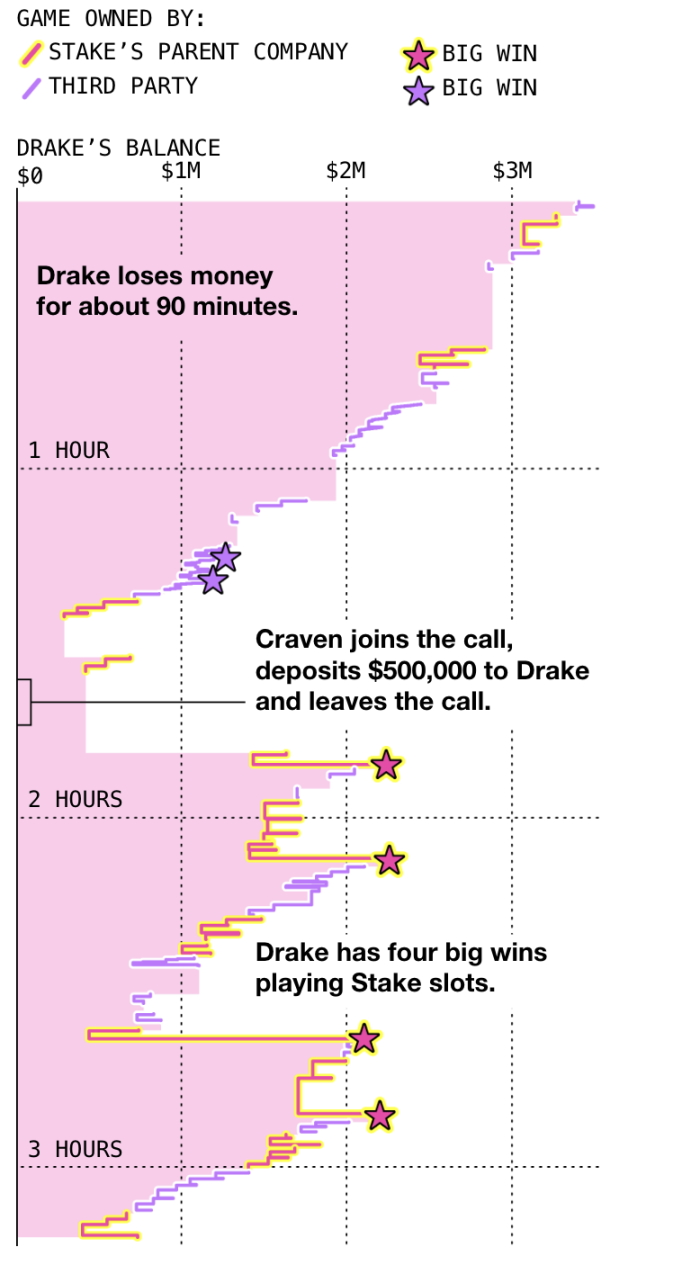
Drake’s balance changes during the August 10, 2025 livestream
Drake’s winning streak was indeed extraordinary. In just one hour of playing Easygo’s slot games, he hit four jackpots. Bloomberg Businessweek’s analysis of 500 hours of livestreamed slot play by 25 Stake gamblers shows this level of luck far exceeds normal expectations.
And it wasn’t a fluke for Drake alone. Businessweek’s investigation found his jackpot frequency on Easygo slots was four times the average: roughly one jackpot per 2,500 spins, versus one per 10,000 spins for ordinary players. Yet on third-party games, his win rate fell squarely within the norm. Drake wasn’t the only influencer on Kick enjoying freakishly good luck while streaming Easygo games.
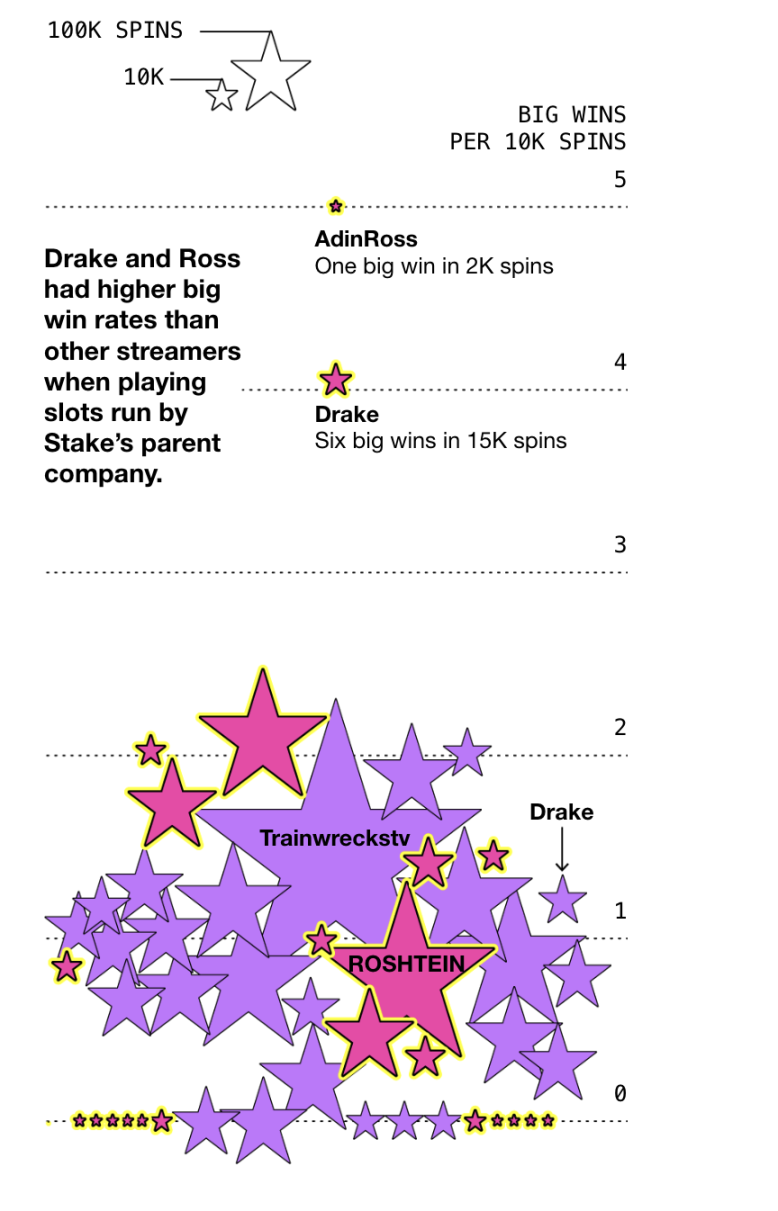
Jackpot rates from June to August 2025: Easygo-owned vs. third-party games, comparing Drake and Adin Ross—both show higher win rates on Stake slots
Stake is the world’s most popular cryptocurrency casino, offering convenient slot machines, roulette, sports betting, and live-dealer poker. It operates almost entirely unregulated, headquartered in Australia and licensed in Curaçao, a Dutch Caribbean island. According to analytics firm Similarweb, Stake’s main site and associated domains receive at least 127 million visits per month. The casino processes an estimated $10 billion in bets monthly—about 4% of Bitcoin’s annual transaction volume.
Influencers on Kick have further fueled its success. Since launching in December 2022, Kick has increased Stake’s traffic more than fivefold. In 2024, Stake reported $4.7 billion in revenue after paying out winnings—a rise of 80% from 2022. In December, Craven posted a screenshot from a third-party analytics site showing Stake’s annual deposit volume reached $18 billion.
Despite being blocked in massive potential markets—including the U.S., UK, and France—Stake continues to thrive. Even in Australia, where Craven resides and where Easygo maintains two offices, it’s banned. (Easygo also has offices in Brazil, Colombia, Peru, and Serbia.) According to former employees, users in prohibited regions can bypass geo-restrictions using VPNs—even Easygo’s own Australian staff do so. These ex-employees spoke anonymously due to confidentiality agreements.
Stake also operates a “sweepstakes”-mode website in the U.S., allowing users to play with virtual coins and so-called Stake Cash—which can be redeemed for cryptocurrency.
In an email, Stake stated it verifies every user’s identity and uses blockchain analytics to detect suspicious activity. The company claims it does not serve customers in “restricted jurisdictions” and “actively blocks access via geofencing technology,” suspending accounts found to be using VPNs. “Compliance risk is an evolving challenge faced by all major global platforms—not just Stake,” it added.
Compared to traditional online gambling sites, crypto casinos attract gamblers with lower fees, better rewards, and minimal KYC requirements. Stake also permits much larger bets than conventional online casinos—some players wager up to 100 Bitcoins per spin. For crypto-savvy users, the process is relatively seamless: create an account, fund a digital wallet with one of 21 supported cryptocurrencies, pick a game, place a bet, and withdraw winnings via blockchain.
Records reviewed by Bloomberg Businessweek show some users gamble hundreds of millions of dollars’ worth of cryptocurrency annually on Stake. Drake and other VIP users gamble under Craven’s direct encouragement and intervention. Texts and chat logs reviewed by Businessweek reveal Craven maintains ongoing communication with high-stakes clients.
These clients include Kick streamers who’ve signed Stake marketing deals, receiving wallet top-ups and other VIP perks—such as higher betting limits. These agreements can be extremely lucrative, though the money they receive is often used for gambling. Influencer Tyler Niknam (aka Trainwreckstv) told fans he’d received $360 million by October 2022—16 months prior. By 2024, according to a screenshot posted on X (where Niknam displayed his account details during a livestream), he’d placed $18 billion in crypto bets. Niknam did not respond to requests for comment.
Jackpots won by Kick influencers on slot machines are similarly astronomical. In July, Niknam wagered $6,000 on an Easygo-operated game and won a record-breaking $37.5 million in cryptocurrency. A week later, another Kick streamer, Ishmael Swartz (aka Roshtein), bet $10,000 on a different Easygo game and won $45.4 million—breaking the previous record.
Stake employs thousands of “editors” who disseminate videos of influencers celebrating wins, luring anyone drawn by the prospect of life-changing jackpots. According to insiders, editors earn $500 per million views—until December, when Stake raised the bounty to $800.
Contracted streamers typically post Stake registration links and promo codes on their Kick pages—but rarely disclose they’re paid to promote the site.
Streamers’ seemingly limitless balances, enormous jackpots, and viral social media presence have led some viewers to question the legitimacy of their wins. Craven has repeatedly denied that Stake influencers receive preferential odds, writing in a blog post: “Despite widespread claims that odds are manipulated and funds aren’t real, we cannot directly control the odds of any game.”
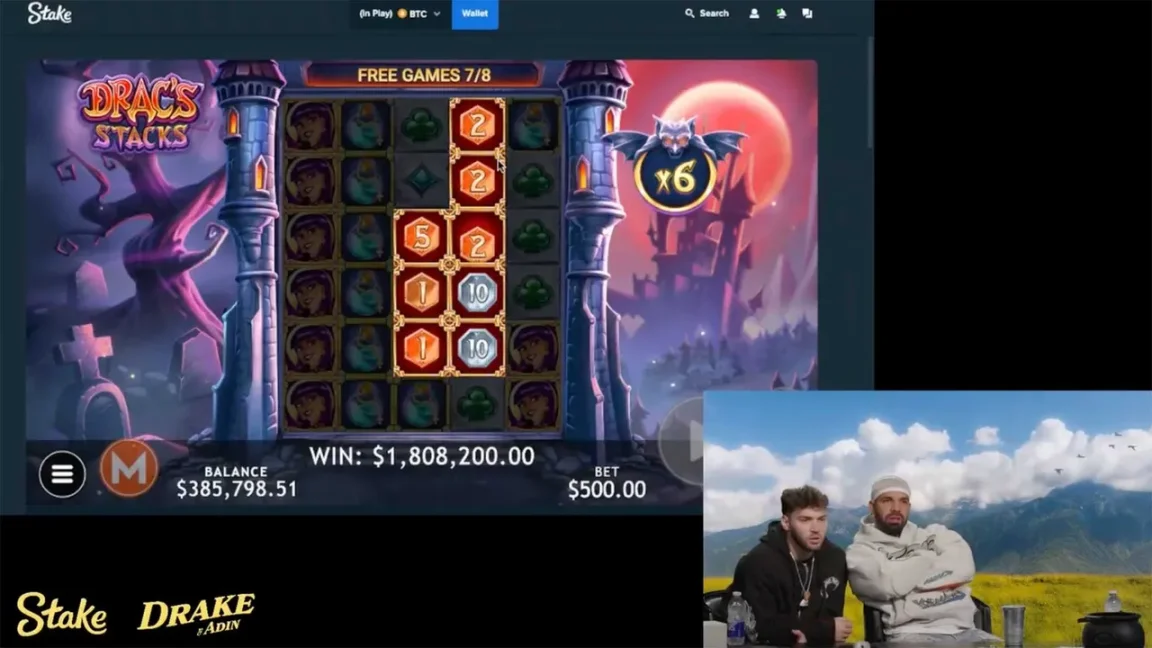
Screenshot of a Stake game, with Ross and Drake watching. Source: YouTube
So what about Drake? To verify Craven’s claim, Businessweek developed a method to count spins and determine jackpot frequency. The overall analysis covered 1,500 hours of livestream footage from 25 players on Kick—including five top influencers: Drake, Ross, Niknam, Swartz, and Félix Lengyel (aka xQc). Reporters used Anthropic’s Claude AI model to analyze frames individually, identifying on-screen balances, bet amounts, and game types. Businessweek journalists then manually verified more than 600 jackpots identified by the software and calculated frequency based on total spins per player.
Drake’s luck on Easygo games was unparalleled. His jackpot frequency was double that of the second-luckiest gambler in Businessweek’s analysis. Four players with spin counts similar to Drake’s never hit a single jackpot.
When asked to comment on Businessweek’s findings, Stake called them “completely incorrect,” stating that “jackpots” are an arbitrary metric and cross-game win-rate comparisons “ignore the mathematical foundations of individual games.” Stake refused to share player win rates or payout data and declined to answer detailed questions about influencer odds or use of platform funds.
The company also objected to Businessweek’s methodology for counting “bonus rounds”—extra spins purchased or earned by players—claiming they “have different game mechanics and win probabilities.” These rounds are sometimes sold on Stake as equivalents of standard spins—for example, a bonus round equivalent to 100 spins costs $1,000 in cryptocurrency when the base bet is $10. Businessweek therefore counted them at face value. When Businessweek separately analyzed bonus-round data for Easygo slots, Drake and Ross still held the highest win rates.
Legal complaints reviewed by Businessweek and testimonies from four users who began gambling on Stake as teenagers show that Stake’s profit-driven social media strategy attracted large numbers of adults—and minors—sometimes even in regions where the site is illegal. Some users say they ultimately spent substantial sums on Stake after watching gambling streams by their favorite game streamers.
Class-action lawsuits against Stake, Drake, and Ross allege that their livestreams normalize massive, statistically improbable wins—leading to misleading portrayals of online gambling risks and rewards. One such suit, filed in Missouri in October, claims Stake “heavily promotes these extremely rare outcomes, exploiting players’ cognitive biases” in violation of the state’s law prohibiting deceptive trade practices.
No international enforcement body ensures Stake’s odds are fair. Its business license is registered in a small office in a mall opposite a cemetery in Curaçao—an island that, until last year, had never fined or revoked a license for a casino operator. Stake’s complainants—whether alleging unfair business practices, targeting minors or addicted players, or raising other issues—have virtually no recourse on the island.
That leaves officials in other countries to act independently. Regulators in the UK, France, and Ukraine have ordered internet service providers to block access to Stake’s website. In the U.S., lawyers representing players have filed at least 10 class-action lawsuits against Stake—including the Missouri case—alleging its sweepstakes operation constitutes illegal gambling. A lawsuit filed in California in August similarly names Ross and Drake as defendants, accusing them of “orchestrating one of the largest and most profitable illegal gambling operations in California history.”
Stake has not responded to allegations in the lawsuits but denies the claims in the California case and asserts the other class actions lack merit. Drake’s representatives did not respond to requests for comment. Ross’s representatives wrote in an email to Businessweek: “We believe Mr. Ross will be dismissed from these lawsuits once courts apply the relevant law to the facts of the case.”
A decade-long advertising campaign has made Stake a highly profitable—and deeply controversial—business. At its core lies a fantasy of supernaturally lucky influencers: infinite money and unbelievable wins, seemingly consequence-free. In reality, consequences always exist.
Origin Story: From RuneScape Gambling to a Global Crypto Casino Empire
Before Stake existed, teenage Craven earned virtual gold coins in the online role-playing game RuneScape by betting on the outcomes of his battles in sand pits. This practice—called “gambling”—could be converted into real money for him and his squad, the “Australian Army,” in the early 2010s. RuneScape gold coins could be exchanged for U.S. dollars via third-party websites using PayPal—though this violated the game’s terms of service.
At some point, bettors found a more reliable business model: helping other players place bets by rolling dice with a target of 100 points. (The house won on 55 or higher.) Demand for such games was high—especially among minors, who struggled to gamble elsewhere. But soon, PayPal began flagging bettors’ accounts as “suspicious activity.” That pushed many toward Bitcoin, which imposed no such restrictions.
One such bettor who switched to cryptocurrency was Bijan Tehrani, a quiet teenager from Connecticut. He and his childhood friend Christopher Freeman decided to move beyond RuneScape and launch a competitor to the Bitcoin gambling game Satoshi Dice. Craven—Tehrani’s RuneScape gambling buddy—joined them, taking on light coding tasks and investing part of his earnings. In a later legal complaint, Freeman alleged Craven received a 40% stake—equal to Tehrani’s.

Craven and Tehrani in Melbourne, 2022
In May 2013, the new site Primedice launched. “Whoa—I’m officially hooked on gambling,” a user wrote on the Bitcoin forum BitcoinTalk after trying it. “My money doubled.”
News of incredible jackpots and Bitcoin giveaways spread fast, drawing thousands to the site. Just one week later, Tehrani posted on the forum announcing Primedice was already profitable. Freeman, thrilled, dropped out of college to focus full-time on the project.
In a later complaint, Freeman alleged that months later, Craven began gradually increasing his stake in Primedice by reallocating part of Freeman’s shares to himself and others. Documents indicate Freeman had a longer-term vision: building a mature Bitcoin casino offering both slots and poker.
U.S. regulators were slow to scrutinize cryptocurrency gambling, preoccupied by more overt harms—like using crypto to buy drugs or unregistered firearms. But Primedice clearly crossed a line: according to a complaint filed by Freeman, in 2014 Tehrani consulted a New York lawyer, who advised shutting down the site. Tehrani did not respond to requests for comment.
That terrified Freeman. Over the next few months, he blocked U.S. access to Primedice. Freeman claimed daily revenue halved within 24 hours. As income plummeted, Craven and Tehrani told Freeman they wanted to pivot and open a conventional fiat-currency online casino in Australia. Tehrani relocated there, while Freeman stayed behind—still focused on developing his crypto-casino concept.
Instead of opening a fiat casino in Australia, however, Tehrani and Craven launched Stake. In litigation, Freeman claimed he was sidelined and deceived. He sought hundreds of millions in damages, alleging fraud and idea theft. In a 2022 interview with The Guardian, a Stake spokesperson called Freeman’s claims in the lawsuit “internally inconsistent, deliberately misleading, and demonstrably false.” One suit was dismissed in 2024 over jurisdictional issues; another was terminated the same year. Freeman’s attorney declined to comment.
Stake.com launched in August 2017, offering Bitcoin blackjack, roulette, and dice. Tehrani announced it on BitcoinTalk as “the future of gambling.” The site featured a clean sky-blue layout, with a golden temple floating in the sky at the top. Above the “Sign Up Now” button read “Zero KYC Required.” Stake claimed its games were “fair and verifiable” and promised “fast withdrawals.”
Craven began posting Stake giveaways, contests, and links to his own Twitch channel—where he streamed himself gambling—on BitcoinTalk. Soon after, he started running paid ads encouraging others to do the same. Over a year after Stake opened, Tehrani posted on Reddit that the site had over 100,000 monthly players. Good times seemed ahead.
Victim Testimonies: Minors and Gamblers Losing Control
This was the world 15-year-old Chris entered. The Swedish teen requested partial anonymity to protect his privacy and created a Stake account shortly after the site launched. He recalled no ID verification or age checks during registration—consistent with Stake’s promise of “no personal information required.”
He had money to spend. Starting at age 13, he built a modest fortune trading virtual weapons and other in-game items in Counter-Strike, converting them to cryptocurrency. Initially, he only dabbled on Stake—but in early 2020, another gambler offered him generous bonuses and a 25% cashback on losses, reigniting his interest.
Chris was surprised to learn Craven had been assigned as his VIP manager. They began chatting on Telegram, Chris said, nearly every day. During the global pandemic, still only 17, he spent $10,000–$40,000 worth of Bitcoin weekly—playing surreptitiously on his phone at school and home. In one transaction reviewed by Businessweek, he deposited 14 Bitcoins—worth about $100,000 then and nearly $1 million today. Chris said no company representative contacted him for KYC when he deposited such a large sum.
He remembers gambling late into the night—and frequently re-depositing withdrawn winnings—a classic sign of addiction. He said he didn’t view his cryptocurrency as “real money,” partly because minors struggle to cash it out. It was just digital numbers moving up and down—like a video game.
Once, after losing heavily on blackjack and another game, Chris emailed customer support requesting “self-exclusion.” Some countries offer self-exclusion programs, letting individuals ban themselves from all licensed gambling sites—but Chris couldn’t join Sweden’s program until turning 18, and anyway, it wouldn’t apply to Stake, which holds no local license. His request would be honored solely at the site’s discretion. “You feel bad, and you just keep playing and playing until everything’s gone,” Chris said of his gambling. “Then you get furious and just want to lock yourself out.”
Before acting on his request, Stake gave him a 24-hour “cooling-off period” to confirm he truly wanted to quit. He didn’t. Typically, Chris would message Craven, begging for bonuses or cashback—and Craven usually complied. In October 2020, Chris mentioned losing 110 Bitcoins—about $1 million at the time—in two hours at another online casino due to “stupidly high betting limits.” Craven proposed raising his Stake limits too. “We can do $100,000 per hand,” he said. “I can set it for one or two hours.”
In most European markets, regulators require operators to cap customer deposits and conduct financial risk assessments for users whose monthly spending exceeds thresholds ranging from a few hundred to $1,000. European authorities also typically require companies to regularly send players messages about responsible gambling strategies. Chris said Stake never did any of this.
Email records show that after turning 18, he continued requesting self-exclusion—more than a dozen times between 2021 and 2024. Each time, Stake enforced the 24-hour cooling-off period. Once in 2021, he endured the 24 hours—and his six-month exclusion took effect. But five months later, he relapsed, creating another account, logging in from the same IP address, and funding it with the same crypto wallet—undetected.
That December, after another massive loss, Chris waited out the cooling-off period and permanently self-excluded from Stake. Shortly after, Craven messaged him on Telegram: “Hey bro, wanna top up Stake again?” Chris asked if Craven could unlock his account. Upon realizing Chris had applied for permanent exclusion, Craven replied: “Nope bro. I wish we could, but it’s really strict right now.”
Chris had another motive to reactivate his account: referral income (a cut of bets placed by people who signed up via his referral code) remained in that account. Messages reviewed by Businessweek show that in June 2022, Chris again asked to unlock his account. Craven changed its status from excluded to suspended—allowing Chris to withdraw funds. Two weeks later, Chris created another account and asked Craven to transfer his VIP benefits (e.g., 25% cashback for high rollers) from the old account. Craven agreed—and continued topping up and rewarding the new account per request, effectively circumventing the permanent ban.
Today, Stake states in an email: “Self-exclusion and game pauses on Stake take effect immediately, with no cooling-off period. Stake is committed to responsible gambling and provides tools supporting this commitment—including self-assessment tools and direct contact with Stake customer support. With Stake’s help—or independently—users can set deposit and betting limits. Users may also choose to self-exclude from Stake for a set period or indefinitely. We also guide users to online support organizations that can help.”
During his time on Stake, Chris spent hours watching gambling streams—first on Twitch and YouTube, occasionally broadcasting his own gameplay, later shifting to Kick. He noticed some streamers who previously focused on video games pivoted to gambling as crypto casinos like Stake began issuing huge paychecks. He said their big-win clips flooded his social feeds—triggering gambling urges. Chris suspected some used platform funds—or even favorable odds—but recalled only one streamer honestly disclosing how much of their own money they’d wagered. “They’re not honest with their audience,” Chris said.
During the pandemic, as gamblers like Chris flocked to Stake, the platform surged. Social media organized them into an emerging online subculture: “degens”—self-proclaimed degenerates who glorified failure and the art of losing money.
Degen society knows no class. Unlike Las Vegas, where high-stakes poker players gamble in separate rooms from dazed slot-machine players, on Stake, millionaire influencers with seemingly endless funds gamble alongside players in remote trailer parks betting fractions of a Bitcoin on digital slots. Everyone wagers their own money—against ostensibly identical odds.
A shift began in 2021, when influencers who’d amassed millions of underage fans on platforms like Amazon’s Twitch suddenly landed seven-figure contracts to promote Stake. By that summer, 64 of Twitch’s 1,000 most popular streamers were playing crypto slots on-air. Some openly acknowledged sponsorship deals with Stake or similar platforms; others simply played for fun. In a July 2022 blog post, Craven credited Stake’s success to “a large number of influencers who spend significant time using our product.”
Yet that summer, reports and social media posts began circulating about young people watching their favorite streamers play slots all day—and developing gambling addictions. Twitch then banned crypto-gambling streams. Two months later, Craven launched Kick, calling it a free-speech-minded rival to Twitch. Clearly embracing that ethos, Kick’s early streamers included Anthime Gionet (aka Baked Alaska), who livestreamed the January 6 Capitol riot, and Andrew Tate—accused of sex trafficking—who appeared as a guest on Ross’s stream.
Kick’s staff built Stake’s influencer army through contract after contract. Some streamers relocated to Mexico or Canada, where playing Stake’s slots is legal. Some streamed up to 15 hours daily, earning five-figure hourly incomes. When they won, they’d lean back and cheer loudly; when they lost, some just shrugged, unfazed.
Many top Twitch stars migrated to Kick—including former esports star Lengyel (xQc) and Niknam (Trainwreckstv). According to insiders, Niknam earns eight figures monthly. Ross’s contract value as Kick’s most popular U.S. influencer is unknown—but from November 2021 to March 2025, he received at least 26,000 Ethereum from Stake, worth $78 million at the time of each transaction.
According to a former Easygo employee familiar with the accounts, Drake’s wallet receives $45–50 million in cryptocurrency weekly. One week, it received $190 million.
To the public, influencers’ seemingly bottomless funding sources aren’t always clear. Some—like Swartz (Roshtein)—began Kick livestreams with Stake accounts pre-funded with hundreds of thousands of dollars, gambling for hours daily. Swartz claimed many large Stake jackpots, and his screaming celebrations of million-dollar wins went viral online.
Three former Easygo employees and three people tied to Stake contracts said some streamers used platform funds. Niknam admitted this on his own channel, criticizing influencers who “pretend they’re using real money, when I know they’re not—and Eddie knows they’re not.” He said they chose “top-up” agreements—meaning balances were provided by Stake, and even winnings couldn’t all be withdrawn. This was essentially inspirational advertising for gamblers.
Top gambling streamers don’t just appear fabulously wealthy—they’re often improbably lucky. Last July, Ross enjoyed similar luck during a three-day marathon slot livestream on Stake’s U.S. “sweepstakes” site—part of a broadcast dubbed “NO-Zempic.”
On Day Three, Ross was doing decently—but sometimes looked unhinged, pleading with Craven in chat whenever a row of slot symbols looked promising. “Eddie, please,” Ross repeated. After his balance just surpassed $100,000 in Stake Cash (the game token used by U.S. players), he called out again: “Eddie, give me a call.”
Amid a flood of emojis and profanity in chat, Craven posted “Hex Appeal”—an Easygo game. Ross switched over and cautiously placed a $5 bet using $5,000 in Stake Cash during a bonus round—then spun the wheel. This was the only time Businessweek observed Ross playing an Easygo-owned game across 15 livestreams analyzed.
“I think you’re about to win $40 million,” Craven wrote in chat—referencing Niknam’s recent jackpot on another Easygo game. Instantly, Hex Appeal icons lined up on screen. Ross touched his forehead in disbelief. “What’s happening?” he asked. Chat exploded with “WTF.” Ross began shouting. “Eddie, you’re in my chat—and you just did that!” Icons froze—and Ross leapt from his chair. “JACKPOT” appeared above the figure $52,000.
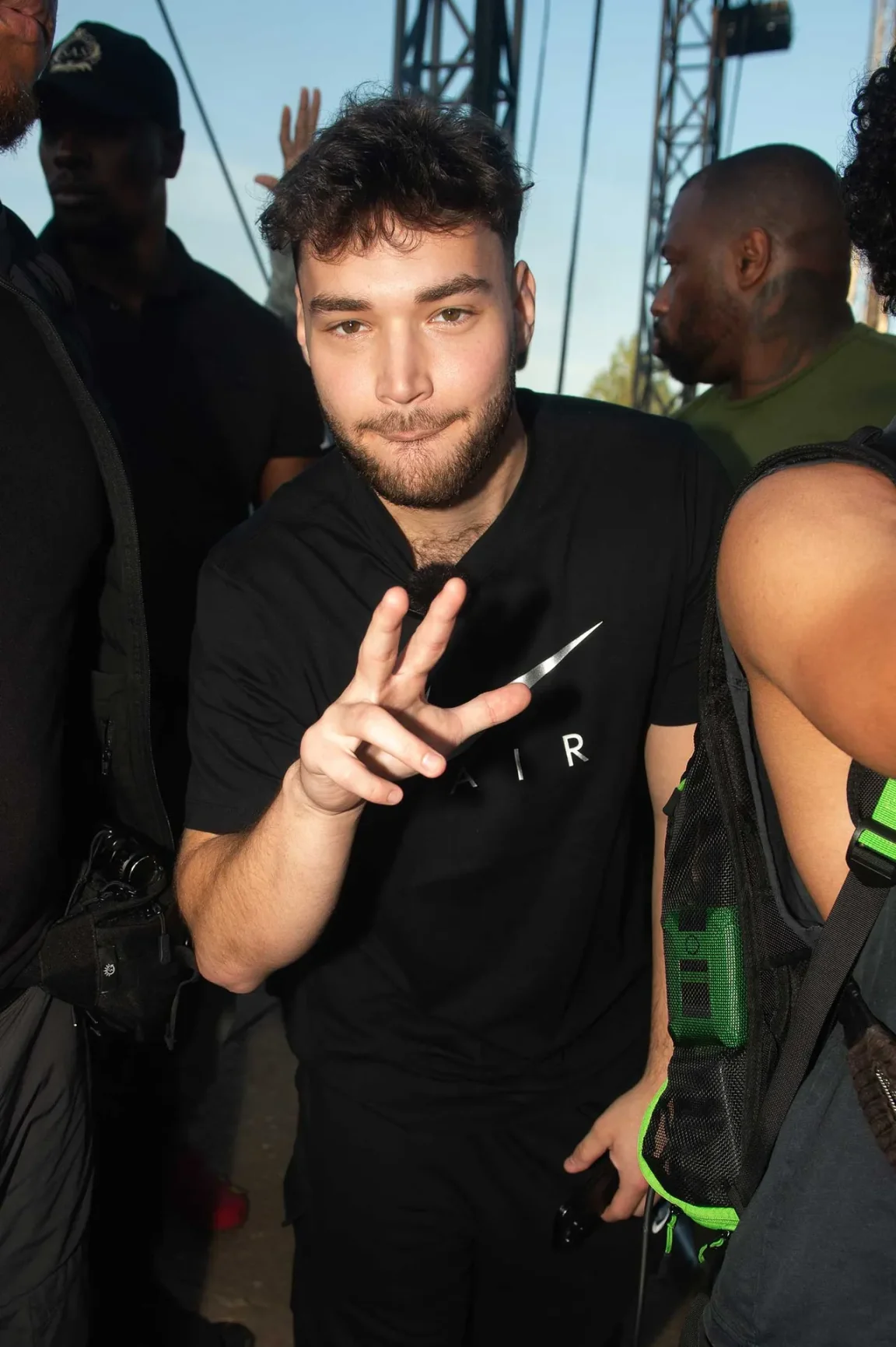
Ross at the 2025 Wireless Festival in London
Calling him lucky would be an understatement. In Businessweek’s analysis, only one in 170,000 spins yields a win over 10,000x the initial bet. But Craven wasn’t satisfied. He wrote in chat that if Ross had bet $500, “it would’ve been $5 million.”
This was the sole jackpot Ross hit while playing Easygo-owned games in Businessweek’s analysis. Though hitting one jackpot in 2,000 spins doesn’t prove anything anomalous, the average influencer in Businessweek’s analysis needed over five times as many spins to achieve the same. Whenever Ross played non-Easygo slots, his jackpot rate hovered near average. This three-day livestream—where he won the Hex Appeal jackpot—drew over 55,000 average viewers.
Kick and Stake: Same Team, Two “Separate” Businesses
Typically, gambling advertising faces strict regulation in the U.S. and other jurisdictions. Existing laws cover billboards, TV commercials, and online banner ads. Livestreams are harder to categorize and review—often evading regulatory radar. Because of this—and because Kick positions itself as a platform rather than a marketing department—it avoids the same rules and regulations as advertisers. So what Stake prohibits, Kick may allow.
Craven has repeatedly claimed the two platforms are independent—a stance that, in theory, could shield the livestream platform from accusations of illegally promoting offshore crypto casinos to young gamers. “Kick is highly independent,” he said in July. “Ownership boundaries are very clear.” After Stake shut down in the UK following chaos around a brand social-media video featuring a porn star, a Kick representative told Bloomberg News that Kick would continue operating in the UK—including letting streamers promote Stake—because “Kick and Stake are independent entities.”
Yet the two companies appear to have significant operational overlap. Both share the same parent company, Easygo—and Craven leads both. Other executives overlap too, including Tehrani (Easygo’s chief marketing officer) and the head of marketing operations, whose LinkedIn profile once listed responsibility for marketing at both Stake and Kick. Data scientists, strategists, HR staff, and others list working for both companies on LinkedIn. Profiles also show Easygo employees frequently rotating between Stake and Kick roles—and both companies operate from the same sleek office at 287 Collins Street in Melbourne.
Online branding is also intertwined. Beyond clips of Stake players winning jackpots, Kick influencers’ comedic videos often go viral on short-video apps—or get recut into gambling compilations uploaded to YouTube, with Stake’s logo prominently visible. Per contracts reviewed by Businessweek, some influencers partnering with Stake earn up to $10,000 per Instagram short video clipped from Kick, showcasing game footage and branding. One contract states the goal is to generate “viral” shorts on Instagram “pushing referral links and promo codes as much as possible.”
Stake also runs an affiliate marketing program, where meme-account operators paste the company logo onto unrelated social-media posts—from South Park clips to motivational quotes. Because platforms treat these as organic content, they’re rarely flagged as violations.
Both companies’ offline marketing strategies overlap too. Stake’s sponsorships include Premier League club Everton and UFC fighter Israel Adesanya—as well as a Formula 1 team that races under the Stake brand in countries where gambling ads are legal, and under the Kick brand where they’re not.
Global Regulation Tightens—Founders Live Lavishly
Authorities are taking notice—especially in U.S. lawsuits naming influencers and tracing links between their promotion of rare wins and gambling addiction. Some suits also accuse influencers like Drake and Ross of gambling with platform funds. Drake and Ross’s representatives did not respond to requests for comment.
In 2023, the Federal Trade Commission strengthened influencer marketing guidelines. Whitney Fore, a lawyer specializing in gambling law, said, “Any material connection—whether cash, free play, or ‘won money’—must be disclosed in a clear and conspicuous way.” Fore added that for livestreams, this goes far beyond a hashtag or passing mention. Undisclosed or misleading partnerships could incur fines up to $43,000 per violation.
Research shows fast-paced online slots—the type Stake focuses on—are among the most addictive and harmful forms of gambling. “The most addictive products, promoted in the most insidious ways to the most vulnerable people,” said Will Prochaska, director of the UK’s “Alliance for Gambling Reform.” “It’s a toxic cocktail.”
Indeed, two former Stake employees said the company’s social-media inbox was flooded with suicide threats from problem gamblers. Stake did not respond to questions about such threats.
Some players claiming they were deceived by Stake found Nardy Cramm. The Dutch activist and journalist exiled himself to a seaside town on the Mediterranean coast, waging a long campaign against Stake and similar operators licensed in Curaçao—accused of harming minors and problem gamblers. Thousands of gambling sites flocked to the tiny island (a constituent country of the Kingdom of the Netherlands, but with its own government) to exploit its fast, low-cost licensing process.
Cramm lived there for years, mastering local rules—and assembled a team of lawyers to help desperate gamblers recover funds from unscrupulous operators. “Stake has many victims. So many minors somehow ended up here—and they’re usually addicted,” Cramm said.
Challenging the status quo in Curaçao can be dangerous: In 2013, Helmin Wiels—a local politician threatening to expose corruption in the online gambling licensing system—was gunned down in broad daylight on a busy beach by masked assailants. Cramm himself left over a decade ago after receiving an implicit death threat from a notorious island powerbroker.
Since 2019, his organization—the Dutch-named “Foundation for the Representation of Victims of Online Gambling”—has handled complaints from hundreds of alleged victims of Curaçao-licensed online casinos. While Curaçao does impose some safety requirements when issuing licenses, the foundation seeks ways operators failed to comply. It then drafts demand letters and sues these companies—taking a cut of any awarded damages as commission.
Swedish teen gambler Chris was one seeking compensation. His years of transaction records and chats with Craven provided Cramm’s foundation compelling evidence that the company allowed minors to register and enabled addicts to keep gambling. A letter from a Curaçao law firm representing Stake in response to his complaint claimed Chris intentionally registered from Sweden using “false” information—violating Stake’s terms—and sought losses back under the pretext of “gambling addiction.”
Tracking down Stake is no easy task—its corporate structure is labyrinthine and spans continents. Medium Rare NV—the primary gambling licensee—is in Curaçao. The Australian headquarters houses Stake Gaming, Kick, Easygo, and a web of related entities. Payment processing occurs through Medium Rare Ltd in Cyprus. Game development is handled in the UK; a call center operates in Serbia; subsidiaries exist in Brazil, Italy, and Canada.
To date, Cramm’s foundation has secured over €15 million ($17.7 million) in settlements and court-awarded damages for more than 100 players from over ten countries—players who lost massive sums on Curaçao-licensed gambling sites. Cramm said only a small portion of that sum came from Stake. Based on her experience—even with what she considers overwhelming evidence—Stake denies misconduct allegations, files counterclaims, or otherwise drags out litigation. “Their tactics are extremely nasty,” she said.
Cramm has also spearheaded broader reform efforts—with some success. As early as 2020, she filed complaints against over a dozen casino operators—including Stake—with Curaçao’s prosecutor, highlighting alleged failures to verify player identities. In July 2025, the prosecutor’s office issued a press release declaring, “This is the first time the Curaçao online gambling industry has been held accountable.”
Yet the office announced no arrests or license revocations—only that it had reached settlements with 12 unnamed entities, each fined the equivalent of $12,500. According to two directly informed sources, Stake was one of the 12—its fine amounting to roughly a minute and a half of gambling revenue. “That’s what we call a very, very favorable investment and regulatory environment,” Cramm said wryly.
She also succeeded in pushing for a comprehensive overhaul of Curaçao’s licensing system by the end of 2024. The Dutch Supreme Court ruled that the prior system—which allowed a handful of holders of “master licenses” to sell sub-licenses to dozens of online casinos—was illegal. This forced Stake and other providers to apply for licenses directly with regulators—not through a few private firms. But in Cramm’s view, much work remains.
Beyond Curaçao, regulators have largely struggled to rein in the offshore casino industry—outmaneuvered by nimble operators exploiting gaps between national laws and enforcement capacity. Still, Stake’s prominence and odd behavior have drawn official attention. In February last year, the UK Gambling Commission stated Stake had “shut down” in the UK after the Commission began investigating whether its ads strongly appealed to youth and linked gambling to allure—violating its license conditions.
Stake’s U.S. sweepstakes model—allowing users to play with virtual coins or Stake Cash instead of dollar-denominated cryptocurrency—hasn’t stopped lawsuits from piling up. Los Angeles City Attorney Hydee Feldstein Soto declared in September that her office was suing Stake.us and related entities, calling the sweepstakes operation “a gambling scam with devastating impacts on players.”
Craven continues living lavishly in Australia. He owns a fleet of Land Rovers parked at his expensive Melbourne mansion—purchased in 2022 for A$80,000,088 ($56.8 million).
Despite lawsuits, most of his top influencers remain—except one notable exception: After being named a defendant in the California suit, Ross signed with Rainbet for a $100 million contract. Drake briefly paused livestreaming last fall after fiercely criticizing Stake for blocking his withdrawals—but returned over the holidays, announcing on Instagram he’d share 10% of his winnings with viewers during streams. His Kick channel description still reads: “Getting absolutely destroyed by Eddie since 2022.”
Swedish teen Chris recently succeeded in staying away from Stake. After circumventing the permanent ban in 2022, his cycle of deposits, losses, self-exclusion requests, and new accounts continued for two more years—until November 2024, when he resolved more firmly than ever to quit gambling. Over seven years since creating his first account, he lost roughly $1.5 million in cryptocurrency on Stake.
For a time, Chris searched online for mutual-support groups—and spent time playing with his Chihuahua, Ice, pondering where his life should go. Unlike many addicts, thanks to cryptocurrency earned during his Counter-Strike days, he hadn’t taken on debt to gamble. He’d also prudently bought Rolex watches as assets. Even so, he’s acutely aware of opportunity cost. “If I hadn’t lost that cryptocurrency gambling,” Chris said, “it would be worth $15–20 million today.”
He’s stayed away from gambling for about a year—but finds it nearly impossible to avoid influencers’ clips online. Even a popular historical meme account he follows on X posts viral posts watermarked with the Stake logo. Then, in September, his Chihuahua Ice contracted leptospirosis—and he had to euthanize him. Once again, Chris turned to cryptocurrency gambling—this time on another site. After losing a few thousand dollars in days, he stopped. “It felt awful,” he said. He installed apps on his devices to block gambling content. Still, he said, fully escaping Stake is hard. His legal case in Curaçao remains pending—and he still earns a few hundred dollars monthly in referral income, constantly reminding him of losses incurred by gamblers he once encouraged to sign up.
Join TechFlow official community to stay tuned
Telegram:https://t.me/TechFlowDaily
X (Twitter):https://x.com/TechFlowPost
X (Twitter) EN:https://x.com/BlockFlow_News
 @Bloomberg