Bitwise: The Institutional Wave Has Arrived—Why Is the Market Still Asleep?
TechFlow Selected TechFlow Selected
Bitwise: The Institutional Wave Has Arrived—Why Is the Market Still Asleep?
There is a significant gap between the cryptocurrency market people imagine and the one that actually exists.
 Navigating Web3 tides with focused insights
By Matt Hougan, Chief Investment Officer, Bitwise
Translated by Saoirse, Foresight News
The largest alpha in financial markets often stems from behavioral biases. Investors inevitably make mistakes—and if you can exploit those errors, you stand to earn substantial returns.
One of my favorite behavioral biases to exploit is anchoring: people cling stubbornly to the first piece of information they receive and resist updating their views. This is precisely why retailers price items at $9.99 instead of $10.00—you anchor on the “9,” and your brain struggles to dislodge itself.
Anchoring was one of the key reasons I decided in 2018 to go all-in on crypto full-time.
Back then, most people still dismissed cryptocurrencies as a joke. Their earliest exposure came from the 2013 Silk Road scandal and the 2014 Mt. Gox collapse—and they’d witnessed its volatile boom-and-bust cycles firsthand.
Fortunately, several people I trusted urged me to take crypto seriously.
When I looked past the surface and focused on what the technology actually *is*—rather than what people *think* it is—I was utterly stunned. The technology was far more mature, and the opportunity far larger, than most realized. Yet people remained anchored in their outdated 2014 impressions.
Right now, I feel like I’m back in that moment again.
The World Is Shouting at You
Look around: Wall Street is loudly declaring that finance is going on-chain—not just a sliver, but *all* of it.
Last July, SEC Chair Paul Atkins launched the “Crypto Project,” a commission-wide initiative aimed at modernizing securities regulation. In his words, the goal is to enable U.S. financial markets to “run on-chain.” And markets *are*, in fact, already moving on-chain:
- In October, BlackRock CEO Larry Fink stated publicly that we’re at the dawn of tokenizing *all* assets. Two weeks ago, BlackRock launched its tokenized Treasury fund, BUIDL, on Uniswap—the world’s largest decentralized exchange—with over $2 billion in assets under management. As part of the collaboration, BlackRock also invested in Uniswap’s native token, UNI.
- Apollo, a credit firm managing $700 billion in assets, partnered with Securitize to tokenize its diversified credit fund and deployed it across six public blockchains. Since January 2025, the product has attracted over $100 million in capital. The firm recently announced plans to acquire a 9% stake in Morpho, a leading decentralized lending protocol.
- JPMorgan, Bank of America, Citigroup, and Wells Fargo are reportedly negotiating a joint stablecoin initiative.
Meanwhile, JPMorgan issued deposit tokens on Coinbase’s Base network; Fidelity is hiring a Head of Decentralized Finance Vaults… and similar moves are proliferating.
The underlying markets are colossal: $30 trillion in ETFs, $110 trillion in equities, and $145 trillion in bonds.
By contrast, today’s global tokenized market stands at just $2 billion.
If Larry Fink is right—that “every stock, every bond… will eventually be tokenized”—this market still has room to grow by *thousands of times*.
A Cognitive Disconnect
Yet traditional investors remain deaf.
They’re deaf because of anchoring.
At the mention of “crypto,” their minds still conjure images of tattoos, punks, and skateboards. They haven’t realized that person has long since shaved, donned a suit, and is now building the infrastructure for the next generation of capital markets.
Ironically, crypto-native investors themselves seem equally deaf.
They’ve developed “the boy who cried wolf” syndrome. Having heard promises of institutional adoption for years, they’re now numb—even as it finally arrives.
But data doesn’t lie.
Look at the growth curve of tokenized real-world assets (RWAs)—it’s steeper than Mount Everest.
Value of tokenized real-world assets (RWAs):
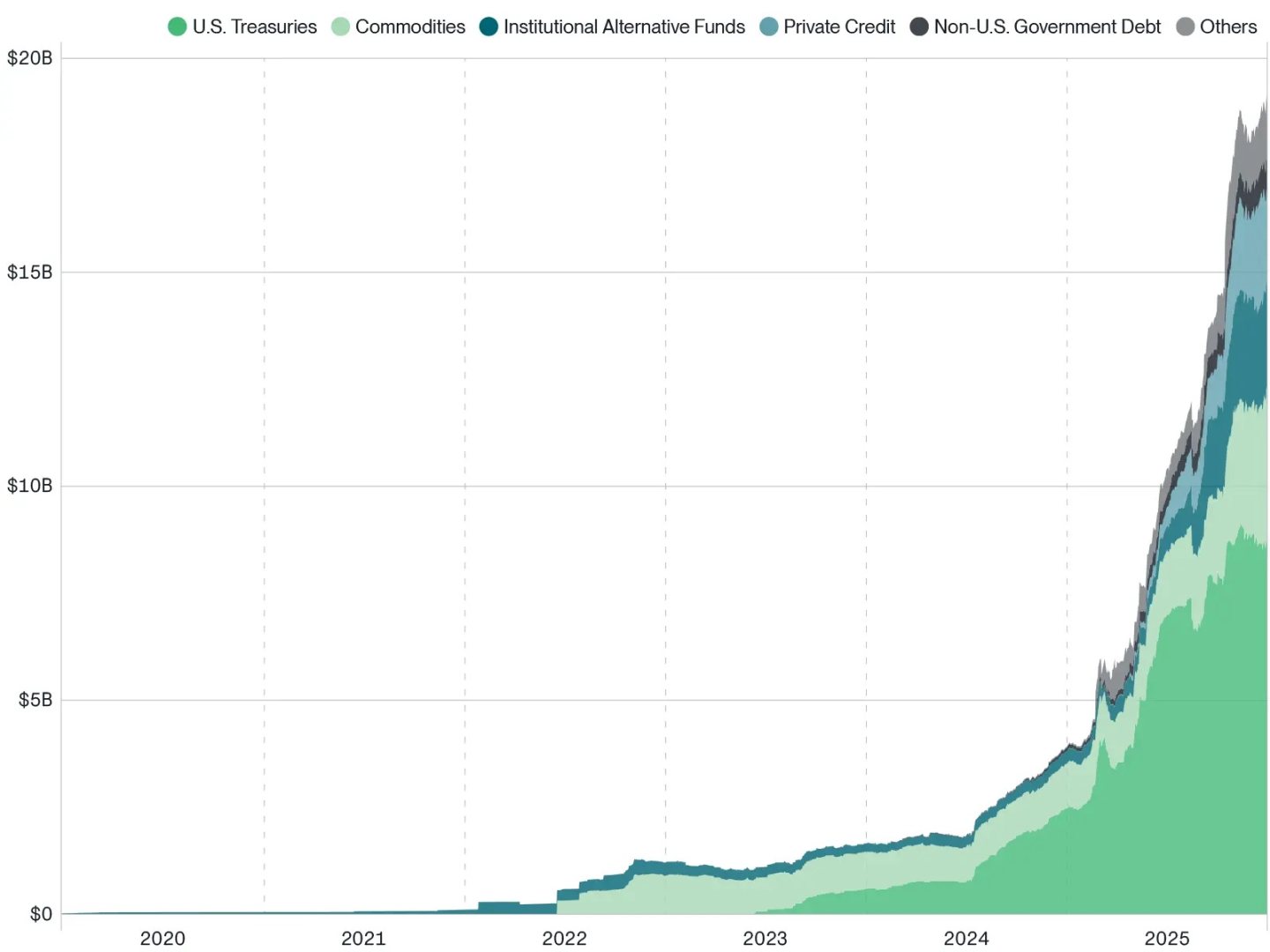
Source: Bitwise Asset Management, data from RWA.xyz. Timeframe: January 1, 2020 – December 31, 2025.
Note: Stablecoin issuers such as Circle and Tether have been intentionally excluded.
Capturing the Opportunity
The challenge lies in knowing *exactly* how to profit from it.
That’s because the crypto industry still faces several unresolved foundational questions, including:
- Will the value created by tokenization accrue to public blockchain base layers like Ethereum or Solana—or is blockspace itself becoming commoditized?
- If value does accrue to base-layer protocols, will newer quasi-private chains like Canton Network or Tempo outperform public blockchains?
- As institutions like BlackRock and Apollo embrace DeFi en masse, will DeFi tokens explode—or will their fundamental economic model challenges prove insurmountable?
- If value ultimately flows to builder companies rather than blockchains themselves, will legacy giants like BlackRock and JPMorgan benefit—or will crypto-native firms emerge as the true winners?
I have strong opinions on each of these questions—and I’ll share them in articles over the coming months. But candidly, for most of them, the honest answer today is: nobody knows.
There’s only one thing I’m certain of:
A massive chasm exists between the crypto market people *think* they see—and the crypto market that’s *actually unfolding*.
To me, that chasm *is* the opportunity—not about rushing to pick winners early, but about broadly positioning across the entire ecosystem while the market remains mispriced on this structural shift.
The greatest alpha opportunities arise when market consensus is outdated, reality has long moved forward—and investors remain anchored to old narratives.
Crypto is at that inflection point right now.
If you can see its essence clearly, opportunity is everywhere.
Join TechFlow official community to stay tuned
Telegram:https://t.me/TechFlowDaily
X (Twitter):https://x.com/TechFlowPost
X (Twitter) EN:https://x.com/BlockFlow_News
 @BitwiseInvest