The Geography of Crypto Scams: From Silicon Valley to Mumbai, Fraud Knows No Borders
TechFlow Selected TechFlow Selected
The Geography of Crypto Scams: From Silicon Valley to Mumbai, Fraud Knows No Borders
No country or region is immune to fraudsters.
 Navigating Web3 tides with focused insights
Author: Mars_DeFi
Translation: Chopper, Foresight News
In the early days of cryptocurrency, many believed scams were an inevitable cost of innovation, and "rug pulls" or "exit scams" were limited to a few bad actors in unregulated corners of the internet.
But over the years, independent investigators like ZachXBT have gradually uncovered a disturbing truth: cryptocurrency fraud has long gone global.
From 2022 to 2025 alone, ZachXBT documented 118 different financial fraud cases, ranging from million-dollar NFT rug pulls to complex cross-chain money laundering networks. His investigative reports exposed scammers across continents: meme coin teams endorsed by Silicon Valley influencers, Telegram scam groups from Mumbai, and pump-and-dump crews from Istanbul.
The consistency revealed by the data is shocking: no country or region is immune to fraudsters.
The Myth of Region-Specific Scammers
A recent geographic location feature added to social platform X, intended to increase transparency, instead sparked discussions around xenophobia.
Many users began attacking others based on their account's country of origin, especially targeting accounts linked to India, Nigeria, and Russia, labeling entire populations from these countries as "scammers."
But ZachXBT’s investigations tell a very different story. Below is a brief summary of ZachXBT's investigation data over the past three years:
Among 118 verified fraud cases:
-
Approximately 41% originated from Asia (India, China, Southeast Asia)
-
Approximately 28% from North America
-
Approximately 15% from Europe
-
Approximately 10% involved Africa
-
Approximately 6% were untraceable due to mixers or privacy coins, leaving identities anonymous
The regional distribution of perpetrators in these 118 reports is also noteworthy:
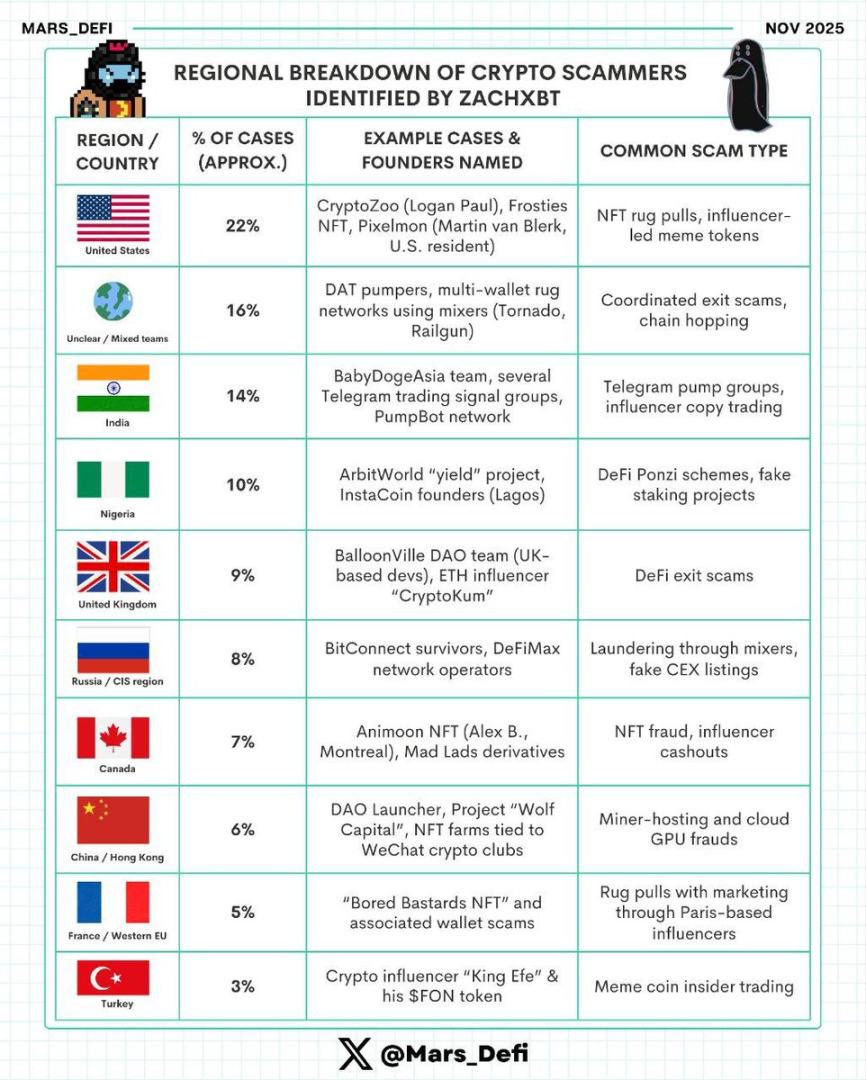
Regional distribution of cryptocurrency scammers identified by ZachXBT
The data reveals not a single problematic region, but a widespread moral failure across the globe.
The above data exposes a key fact often overlooked in online discussions: despite Africans—especially Nigerians—being frequently and unfairly labeled as cryptocurrency scammers, the reality is quite the opposite.
This shows that cryptocurrency fraud is not confined to any one region, but a global issue transcending borders, languages, and cultures.
Viewing Cryptocurrency Fraud from a Macro Perspective
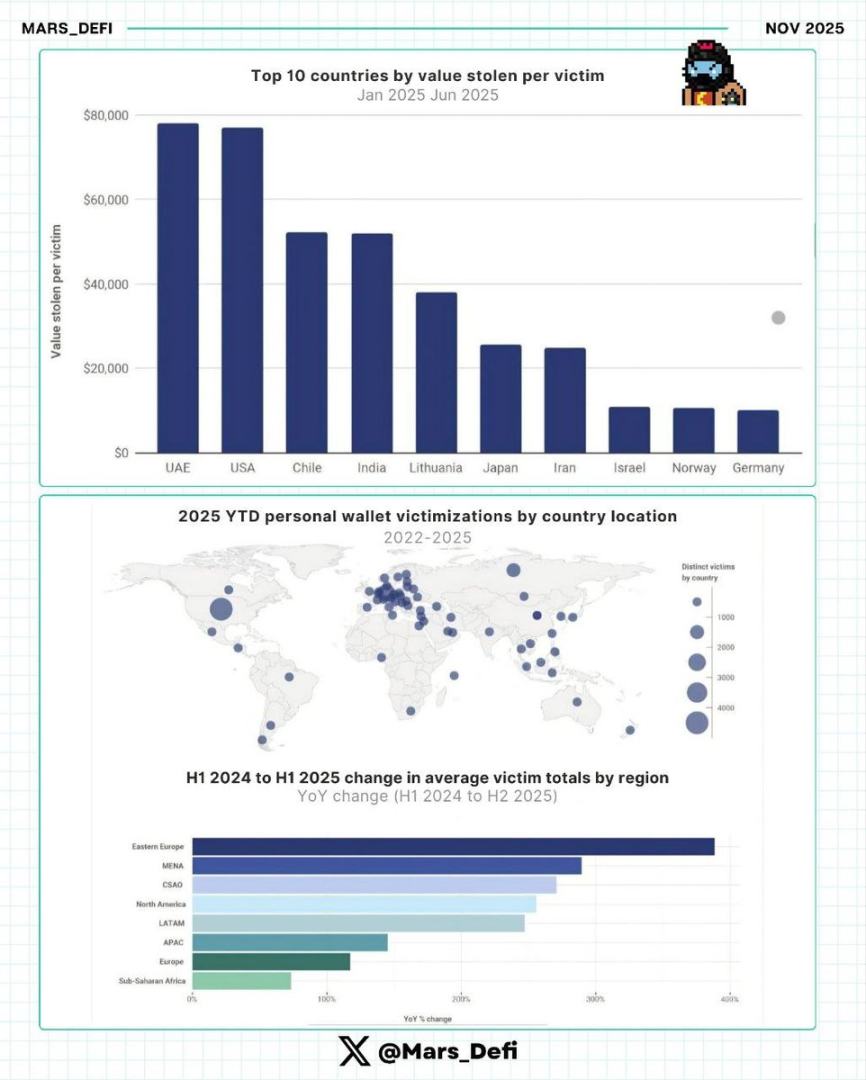
1) Countries with the highest average amount stolen per victim (January 2025 – June 2025)
For those blindly blaming Nigeria or India, the first chart is eye-opening. The top 10 countries where victims lost the most on average:
-
UAE — ~$78,000
-
United States — ~$77,000
-
Chile — ~$52,000
-
India — ~$51,000
-
Lithuania — ~$38,000
-
Japan — ~$26,000
-
Iran — ~$25,000
-
Israel — ~$12,000
-
Norway — ~$12,000
-
Germany — ~$11,000
Notice anything? Nigeria isn't even on this list, while the UAE, the US, multiple European and Asian countries clearly are.
If stereotypes were true, Nigeria or India should top this list—but they don’t.
2) Global map of wallet victims (2022–2025)
When we expand our view to total number of victims globally, the geographic picture becomes even clearer. Victims span North America, South America, Europe, the Middle East and North Africa, and Asia.
Regions with higher numbers of victims include: Western and Eastern Europe, North America, parts of Asia, and the Middle East and North Africa.
What about Africa? Compared to Europe, the Americas, and Asia, Africa has far fewer victimized wallets in total. This isn’t my subjective opinion—it’s what the map objectively shows.
3) Regions with the fastest year-on-year growth in crypto scam victims (2024–2025)
The third chart shows regions where fraud has grown most rapidly, with year-on-year growth rates as follows:
-
Eastern Europe — ~380%
-
Middle East and North Africa — ~300%
-
Central Asia / South Asia & Oceania — ~270%
-
North America — ~230%
-
Latin America — ~200%
-
Asia-Pacific — ~140%
-
Europe (overall) — ~120%
-
Sub-Saharan Africa — ~100%
Once again, Africa ranks at the bottom in growth rate. Meanwhile:
-
Europe and the Middle East and North Africa lead the world in victim growth
-
North America and Latin America follow closely behind
-
Asia-Pacific and India’s region are at moderate levels
-
Africa is the least affected region in the entire dataset
If Nigeria were the global hub of scams, Africa would never rank last.
The truth is: cryptocurrency fraud is not a Nigerian or Indian problem—it’s a global problem.
The data completely dismantles the stereotypes:
-
Countries with the highest per-victim losses are not African or Indian
-
The fastest-growing scam regions are not Africa or India
-
Africa has the lowest year-on-year growth in scam victims
So why are Nigerians and Indians unfairly labeled as "scammers"? Because people often judge emotionally, not evidentially; because one viral scam from a region becomes a collective label for 200 million people, and online bias spreads faster than truth.
According to the data:
-
Nigeria is not among the high-loss countries.
-
Africa has the lowest increase in scam victims.
-
Statistics for Europe and North America are worse.
-
Asian regions such as the UAE and India face extremely high-value thefts.
If a region had the most scammers, it would also show severe victimization (scammers tend to operate where they are familiar). But Africa and India show no such pattern.
If Nigerians and Indians generalized as others do, they could easily point fingers at Europe, the US, South America, the Middle East, and North Africa.
But they don’t—because responsible people understand: scammers exist everywhere—in every race, every region, every country. So do victims. No group should be stigmatized because of the actions of a few criminals.
Recent posts criticizing "Indian scammers," such as those by @TheQuartering (x.com/TheQuartering/status/1992098997281194375), clearly show how xenophobia exploits real pain. Portraying entire nations or communities as criminals only deepens harm.
ZachXBT’s investigations have also exposed scams by American YouTube personalities, European DeFi developers, and Asian marketing groups. Cryptocurrency fraud is not determined by nationality, but by unchecked anonymity, greed, and regulatory neglect.
How Can We Do Better?
For cryptocurrency to mature, it needs not just regulation, but a collective moral reset. This can start with:
-
Replacing nationality-based bias with transparency: require project founders to undergo public audits, complete KYC, and disclose on-chain information, rather than making assumptions based on nationality.
-
Supporting investigative journalism: investigators like ZachXBT and small detective communities have already helped prevent millions in potential losses. We should amplify their work, not nationalist noise.
-
Remaining vigilant at all times: treat every project as a potential scam until proven trustworthy.
-
Reporting instead of mocking: when encountering suspicious accounts, use verification channels or reporting tools instead of spreading hate.
Summary
Cryptocurrency was born from ideals of decentralization and freedom, but without accountability, these ideals have been twisted into tools for global exploitation. Every region has scammers, and every region has victims. Let’s stop the “on-chain xenophobia.”
Join TechFlow official community to stay tuned
Telegram:https://t.me/TechFlowDaily
X (Twitter):https://x.com/TechFlowPost
X (Twitter) EN:https://x.com/BlockFlow_News
 @@Mars_DeFi