








Web3 Compliance Hotspot | MillCity Raises $450 Million to Accumulate Tokens: Sui Foundation's Backdoor Listing, What's the Goal?
TechFlow Selected TechFlow Selected
Web3 Compliance Hotspot | MillCity Raises $450 Million to Accumulate Tokens: Sui Foundation's Backdoor Listing, What's the Goal?
Sui version of MicroStrategy?
 Navigating Web3 tides with focused insights
By: CryptoMiao

"...Based on my understanding of the Sui Foundation, acquiring a public company and playing a left-foot-to-right-foot financing game isn't its style. The official Sui team still leans toward getting real work done. More likely, as written in section four of this article, it's to facilitate further business collaborations, equity partnerships, and investor exit channels."
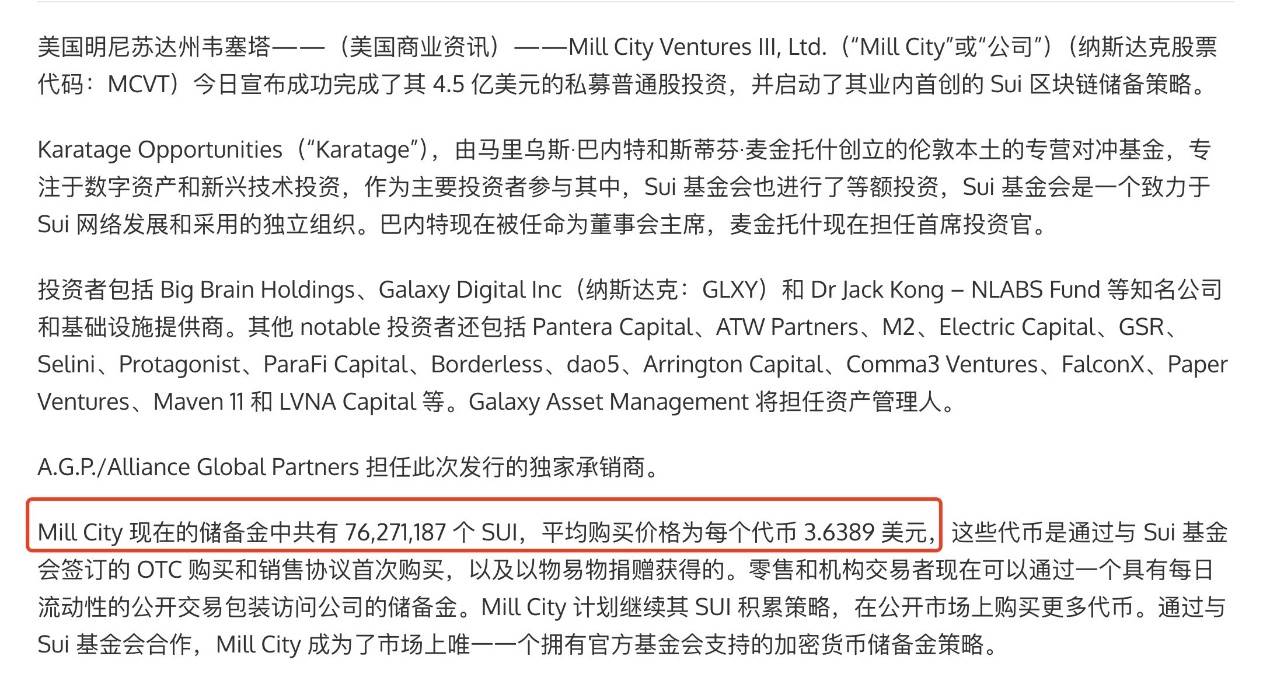
Recently, confirmed by multiple sources, publicly traded Mill City Ventures III has raised $450 million via private placement to purchase Sui tokens as asset reserves.
It has already purchased 76.27M SUI tokens from the Sui Foundation at an average price of $3.6389 through OTC transactions.
1. The Sui Strategy Is Not MicroStrategy
Many refer to this as Sui's version of MicroStrategy, but that’s inaccurate—there are fundamental differences.
MicroStrategy mostly issues convertible bonds, raises funds to buy BTC; if stock performance is poor, investors won’t convert and will instead reclaim their principal upon maturity. Essentially, it remains a form of debt.
The Sui strategy involves direct equity financing. This money doesn’t need to be repaid—it becomes shareholder equity, with no obligation to repay even if value drops to zero.
Additionally, through this fundraising, the shell of the listed company was taken over, directly changing corporate control.
2. Who Invested the $450 Million?
This $450 million private placement was funded by multiple institutions, led primarily by London-based digital asset hedge fund Karatage Opportunities, which invested equally alongside the Sui Foundation. Other notable investors include Pantera Capital, ATW Partners, M2, Electric Capital, GSR, Selini, Protagonist, ParaFi Capital, Borderless, dao5, Galaxy Digital, and Big Brain Holdings.
Hedge fund Karatage Opportunities is also an early investor in the Sui Foundation—all part of the same family.
In effect, Sui itself put up $450 million to take equity in a public company, then used that company to buy back its own asset, Sui, effectively placing Sui into the listed entity and retrieving the capital—essentially moving money from one hand to the other.
3. How Was the Shell of Mill City Acquired?
Prior to the announcement, Mill City Ventures III (MCVT) had a market cap of $11.2M on July 24, 2025. After the news broke on July 25, its market cap surged over 200% to $35.7M. As of August 2, 2025, it stands at $29.83M.
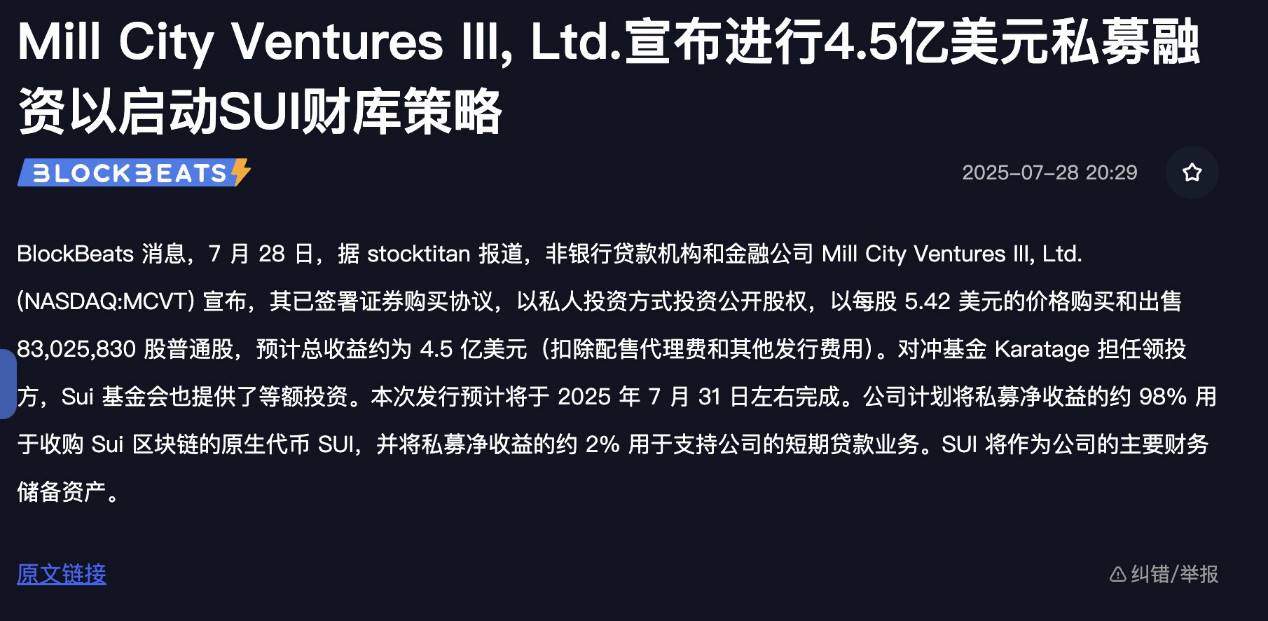
The Sui Foundation's investment price was $5.42 per share. Based on this, the pre-investment equity value of existing shareholders was $32.93M.
The foundation’s investment value was $450 million, resulting in the following equity shift:
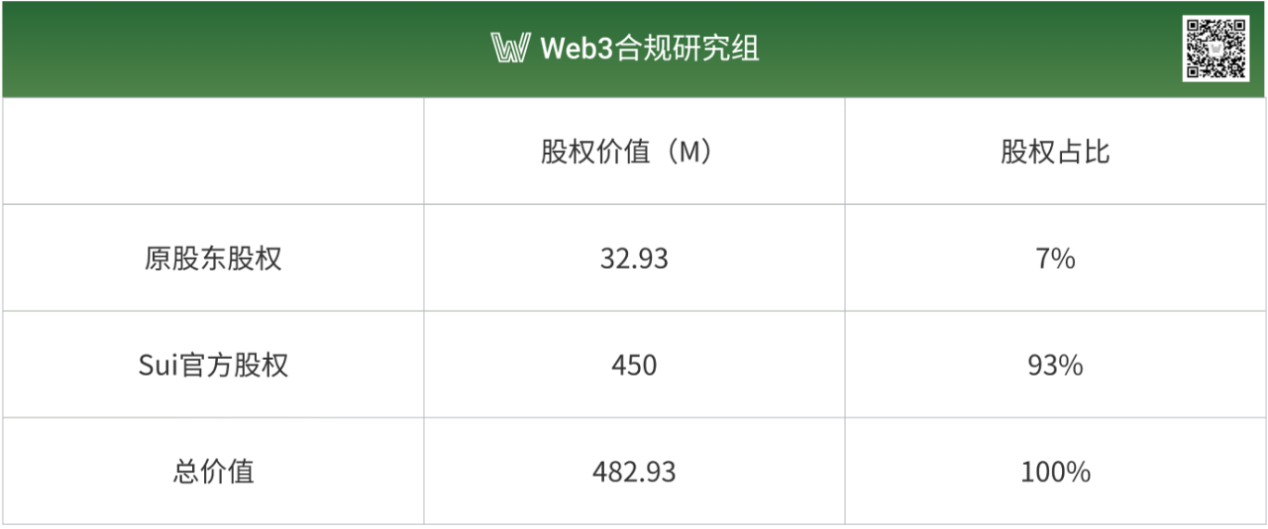
In other words, the Sui Foundation (and its allies) have become the absolute controlling shareholder of the listed company by injecting Sui as assets, now holding 93% of the shares.
PS: The Sui Foundation invested at $5.42 per share, while the pre-investment stock average was $1.80—offering existing shareholders a 3x premium to acquire control.
Effectively paid $11.2M * 2 = $22.4M to acquire a listed company.
4. Why Did Sui Take Over the Shell?
(1) Asset in Name, Listing in Reality (Seeking Partnerships)
First, it differs from MicroStrategy—not aiming to buy high-quality assets like BTC to increase shareholder value.
Instead, Sui itself becomes a shareholder. It's akin to Satoshi Nakamoto using BTC to acquire a controlling stake in a public company—the goal is to enhance Sui’s liquidity in capital markets and enable deeper commercial and equity-based collaborations with other enterprises.
After all, some companies may want to collaborate with Sui, but directly holding Sui tokens could be problematic.
For example: Does token ownership violate corporate charter rules? What if they’re stolen? How should they be held? Would a new management body be needed? How to convince the board or shareholders? How to account for them on financial statements? How to disclose information? Legal and SEC requirements vary across jurisdictions.
But holding company stock is simple—just sign a cooperation agreement through standard procedures, with no technical risks or compliance hurdles.
For instance, if Nintendo one day holds shares in Mill City, it signals a real partnership between Pokémon and Sui. Getting Nintendo to hold Sui tokens would be complicated with many procedural steps, whereas holding stock takes minutes.
(2) Creating Investor Exit Mechanisms
Many early investors gradually unlock large amounts of Sui tokens. Direct selling would significantly impact Sui’s price.
With a listed company as an intermediary, capital markets can absorb these tokens with far less impact on Sui’s price. Whether through secondary market sales or OTC deals, stock markets offer much larger liquidity than token markets.
Moreover, if new investors want to partner with Sui, they can directly negotiate to exchange early investors’ tokens for company shares.
5. Does a Drop in Token Price Affect the Company?
Some say Sui entered at $3.64 average, and now Sui is at $3.5—the musical chairs game can’t continue.
Is that really the case?
In essence, the company’s purchase of Sui is effectively the Sui team using their own money to buy their own Sui. Price fluctuations don’t matter since there’s no intention to sell.
Existing shareholders were already given a 3x premium, so their interests remain protected.
6. How Should the Company Be Valued?
The company previously hovered around $10M. Adding the $450M investment, the Fair Value (FV) is roughly $460M.
If calculated simply and ignoring other assets, FV can be based solely on the Sui holdings (similar to how MicroStrategy is valued purely on BTC).
7. Relationship Between Stock Price and Sui Token Price?
Using a simple model where Fair Value equals only the Sui holdings:
1. If the company’s market cap is $450M and the FV of its Sui holdings is $450M, buying stock is equivalent to buying an equal value of Sui.
2. If the company’s market cap is $562M > $450M FV of Sui holdings, then every $1 of stock buys $0.8 worth of Sui—indicating a 25% stock premium.
The foundation can then raise more capital from the market, use it to buy additional Sui, further increasing company value and pushing up the stock price.
3. If the company’s market cap is $360M < $450M FV of Sui holdings, then each dollar of stock buys $1.25 worth of Sui.
The foundation could then sell Sui to buy back stock—selling $1 of Sui allows buying back $1.25 of stock, thus boosting the stock price.
Ultimately, company Market Cap = Fair Value (simple calculation).
In reality, stocks usually carry a premium: Market Cap = Fair Value × (1 + premium).
8. Final Thoughts
The above analysis is based solely on current public information and does not constitute investment advice. And based on my understanding of the Sui Foundation, acquiring a public company and playing circular financing games isn't its style. The official Sui team still favors practical execution.
More likely, as stated in section 4: Why Did Sui Take Over the Shell?, it’s to facilitate further commercial collaborations, equity partnerships, and investor exit routes.
Therefore, unless other companies join in treating Sui as an asset, significant short-term buying pressure may not emerge. Long term, bridging traditional capital markets and Web3 creates better conditions for strategic development.
Sui holders, please be patient—the project team is actively executing (market making)
Join TechFlow official community to stay tuned
Telegram:https://t.me/TechFlowDaily
X (Twitter):https://x.com/TechFlowPost
X (Twitter) EN:https://x.com/BlockFlow_News






