SPAC Boom: Why Bitcoin Treasury Companies Favor Going Public via Shell Mergers?
TechFlow Selected TechFlow Selected
SPAC Boom: Why Bitcoin Treasury Companies Favor Going Public via Shell Mergers?
This is a path different from Strategy.
 Navigating Web3 tides with focused insights
By: Prathik Desai
Translation: Luffy, Foresight News
In 2020, Strategy (then known as MicroStrategy) began swapping debt and equity for bitcoin. The enterprise software company, under co-founder and chairman Michael Saylor, transformed itself by channeling corporate treasury funds into bitcoin, becoming the largest publicly listed holder of bitcoin.
Five years later, Strategy is still selling software, though its operations have steadily contributed less to the company’s overall gross profit. In 2024, operating gross margin declined to around 15% from 2023; in Q1 2025, it dropped another 10% year-over-year. By 2025, Strategy’s model had been replicated, adapted, and simplified, paving the way for over a hundred public entities to hold bitcoin.
The model is simple: issue low-cost debt backed by the corporation, buy bitcoin, wait for appreciation, then issue more debt to buy more bitcoin—a self-reinforcing loop that turns corporate treasuries into leveraged crypto funds. Maturing debt is repaid by issuing new shares, diluting existing shareholders. But rising bitcoin holdings push up the stock price, offsetting the impact of equity dilution.
Most companies following in Strategy’s footsteps already have established businesses and hope to benefit their balance sheets with an appreciating asset like bitcoin.
Strategy was once purely an enterprise analytics and business intelligence platform; Semler Scientific, the 15th-largest publicly traded bitcoin holder, was previously a pure-play health tech firm; GameStop, which recently joined the bitcoin treasury club and drew attention, was a well-known video game and electronics retailer until only recently venturing into bitcoin treasury building.
Today, a new wave of companies wants to enjoy bitcoin’s upside without bearing the burden of building a real business. They have no customers, no revenue model, and no operational roadmap. All they need is a balance sheet full of bitcoin and a fast financial shortcut to go public. Enter special purpose acquisition companies (SPACs).
Bitcoin-focused SPACs such as ReserveOne, ProCap (backed by Anthony Pompliano), and Twenty One Capital (supported by Tether, Cantor Fitzgerald, and SoftBank) are launching straightforward packages. Their pitch is clear: raise hundreds of millions of dollars, buy bitcoin at scale, and give public market investors a ticker to track it all. That’s it—that’s the entire business.
This approach flips Strategy’s playbook on its head: accumulate bitcoin first, worry about the business later. The model resembles a hedge fund more than a traditional company.
Yet many firms are still lining up for the SPAC route. Why?
A SPAC is a pre-funded shell company that raises capital from investors—typically a group of private backers—lists on a stock exchange, and then merges with a private company. It's often described as a shortcut to IPO. In crypto, it’s a way to quickly bring bitcoin-heavy entities to the public markets before sentiment or regulation shifts against them—speed is critical.
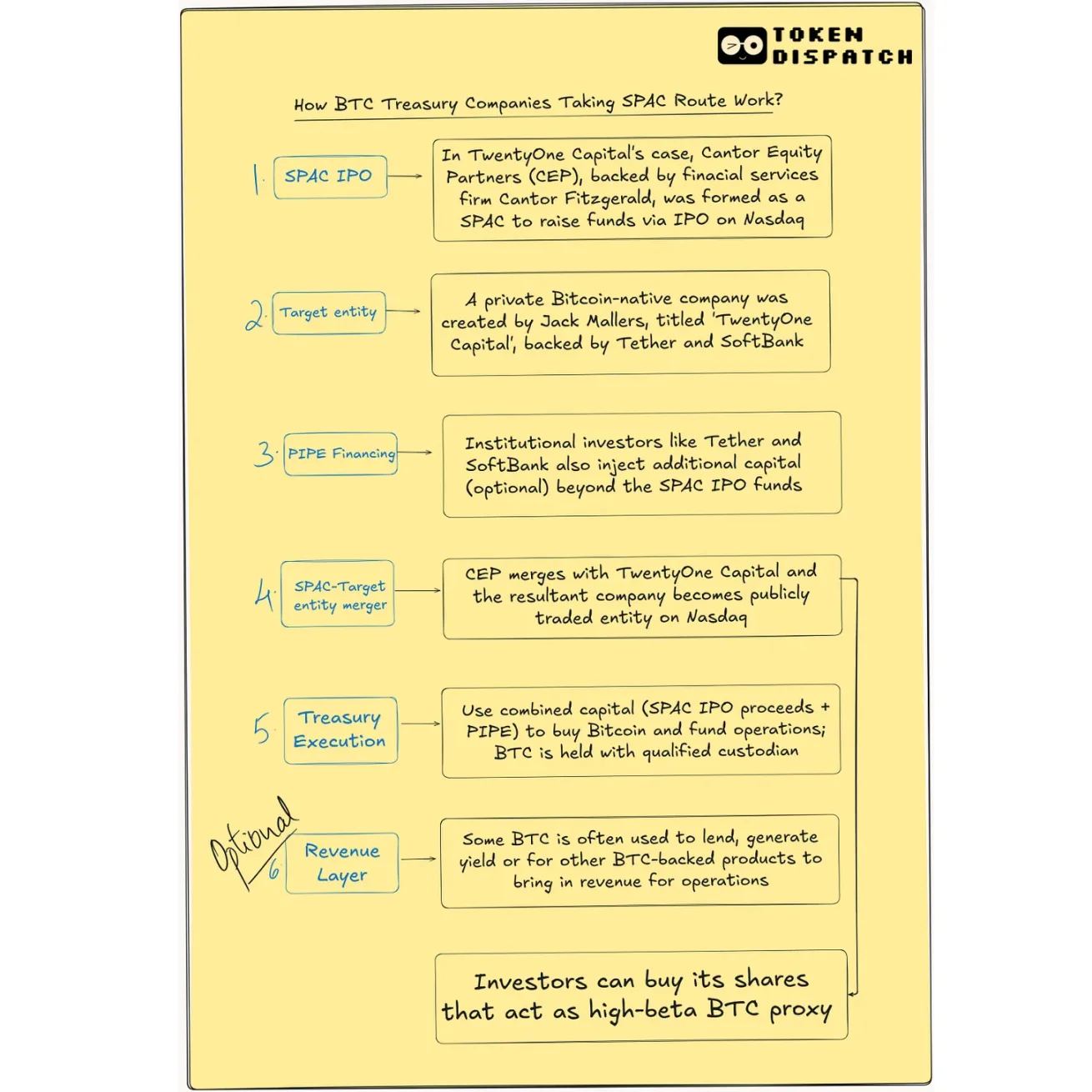
Yet this "speed advantage" is often illusory. While SPACs promise上市 in 4–6 months versus 12–18 for IPOs, regulatory scrutiny for crypto companies tends to take longer in practice. For example, Circle failed in its attempt to go public via SPAC and eventually succeeded through a traditional IPO.
But SPACs still offer advantages.
They allow these companies to present bold visions—like “$1 billion in bitcoin holdings by year-end”—without immediately undergoing the rigorous scrutiny of a traditional IPO process. They can secure post-merger private investments in public equity (PIPE) from heavyweight firms like Jane Street or Galaxy, pre-negotiate valuations, package themselves as SEC-compliant shells, and avoid being labeled as “investment funds.”
The SPAC route simply makes it easier for companies to market their strategy to stakeholders and investors when there’s nothing else to sell besides bitcoin.
Remember when Meta and Microsoft considered adding bitcoin to their treasuries? They faced overwhelming opposition.

To retail investors, SPACs appear to offer pure bitcoin exposure without direct interaction with crypto—much like buying a gold ETF.
But SPACs also face challenges in retail acceptance, as many prefer more mainstream avenues like exchange-traded funds (ETFs). The 2025 Institutional Investor Digital Assets Survey found that 60% of investors prefer accessing crypto through registered investment vehicles like ETFs.
Still, demand persists—because this model carries leverage potential.
Strategy didn’t stop after buying bitcoin. It kept issuing convertible notes—likely to be redeemed through new share issuance. This turned the former business intelligence platform into a bitcoin “turbocharger”: during bitcoin rallies, its stock outperformed bitcoin itself. That blueprint remains alive in investors’ minds: a SPAC-based bitcoin company could replicate this acceleration—buy bitcoin, issue more shares or debt to buy more bitcoin, and repeat.
When a new bitcoin company announces a $1 billion institutional PIPE investment, that act alone signals credibility, showing the market that major capital is watching. Consider how much credibility Twenty One Capital gained due to backing from heavyweights like Cantor Fitzgerald, Tether, and SoftBank.
SPACs enable founders to achieve this early in the company’s lifecycle—without first building a revenue-generating product. Early institutional validation helps attract attention, capital, and momentum while reducing investor resistance that might face an already-public company.
For many founders, the appeal of the SPAC path lies in flexibility. Unlike IPOs, where disclosure timing and pricing are tightly controlled, SPACs offer greater control over narrative, projections, and valuation negotiations. Founders can tell forward-looking stories, set capital plans, retain equity, and avoid the endless fundraising cycles of the traditional “VC → IPO” path.
The packaging itself is attractive. Publicly traded stock is a well-understood language: tickers can be traded by hedge funds, added to retail platforms, and tracked by ETFs. It’s a bridge connecting crypto-native ideas with traditional market infrastructure. For many investors, the wrapper matters more than the underlying mechanics: if it looks like a stock and trades like a stock, it fits into existing portfolios.
If a SPAC can be formed and listed without any existing business, how will it operate? Where will revenue come from?
SPACs also allow structural creativity. A company can raise $500 million, allocate $300 million to bitcoin, and use the rest to explore yield strategies, launch financial products, or acquire other revenue-generating crypto businesses. This hybrid model is hard to achieve with ETFs or other rigid structures bound by strict rules and mandates.
Twenty One Capital is exploring structured asset management. With over 30,000 bitcoins in reserve, it allocates part of its holdings to low-risk on-chain yield strategies. The company merged with a Cantor Fitzgerald-backed SPAC and raised over $585 million via PIPE and convertible bonds to buy more bitcoin. Its roadmap includes developing native bitcoin lending models, capital markets instruments, and even producing bitcoin-related media content and campaigns.
Nakamoto Holdings, founded by David Bailey of Bitcoin Magazine, takes a different path toward similar goals. It merged with publicly listed healthcare company KindlyMD to build a bitcoin treasury strategy. The deal secured $510 million in PIPE funding and $200 million in convertible notes—one of the largest crypto-related financings to date. It aims to securitize bitcoin exposure into equities, bonds, and hybrid instruments tradable on major exchanges.
Pompliano’s ProCap Financial plans to offer financial services atop a bitcoin treasury, including crypto lending, staking infrastructure, and products enabling institutions to earn yield on bitcoin.
ReserveOne takes a more diversified approach. While bitcoin remains core to its portfolio, it plans to hold a basket of assets including Ethereum and Solana, using them for institutional-grade staking, derivatives, and over-the-counter lending.
Backed by firms like Galaxy and Kraken, ReserveOne positions itself as a crypto-native BlackRock, combining passive exposure with active yield generation. In theory, its revenue comes from lending fees, staking rewards, and capturing spreads between short-term and long-term crypto asset positions.
Even if entities find sustainable revenue models, the “public company” label brings paperwork and challenges.
Post-merger operations highlight the need for sustainable income streams. Fund management, custody, compliance, and auditing become critical—especially when the sole product is a volatile asset. Unlike ETF issuers, many SPAC-backed firms are building from scratch, with custody potentially outsourced and controls weak, allowing risks to accumulate silently.
Additionally, governance issues arise. Many SPAC sponsors retain special rights—enhanced voting power, board seats, liquidity windows—but often lack cryptocurrency expertise. When bitcoin prices crash or regulations tighten, you need experts at the helm. During bull markets, no one notices; during downturns, problems surface.
How should retail investors respond?
Some are drawn by upside potential, imagining a small bet on a bitcoin SPAC could recreate Strategy’s boom. But they also face multiple risks: equity dilution, volatility, redemption clauses, and unproven management teams. Others may prefer the simplicity of spot bitcoin ETFs—or holding bitcoin directly.
Because when you buy a bitcoin stock that went public via SPAC, you’re not directly holding bitcoin. You’re buying someone else’s plan to buy bitcoin—and hoping they succeed. That hope has a price, and in a bull market, it may seem worth paying.
Still, you must understand exactly what you’re buying—and how much.
Join TechFlow official community to stay tuned
Telegram:https://t.me/TechFlowDaily
X (Twitter):https://x.com/TechFlowPost
X (Twitter) EN:https://x.com/BlockFlow_News