Wall Street's New Darling: Why Corporate Treasuries Are Betting Big on Solana After Bitcoin and Ethereum?
TechFlow Selected TechFlow Selected
Wall Street's New Darling: Why Corporate Treasuries Are Betting Big on Solana After Bitcoin and Ethereum?
Canadian publicly traded company Sol Strategies plans to list on Nasdaq under the ticker "STKE," marking a strategic evolution of corporate treasuries from Bitcoin's "digital gold" to Ethereum's "productive assets," and now to Solana's "financial operating system."
 Navigating Web3 tides with focused insights
By Luke, Mars Finance
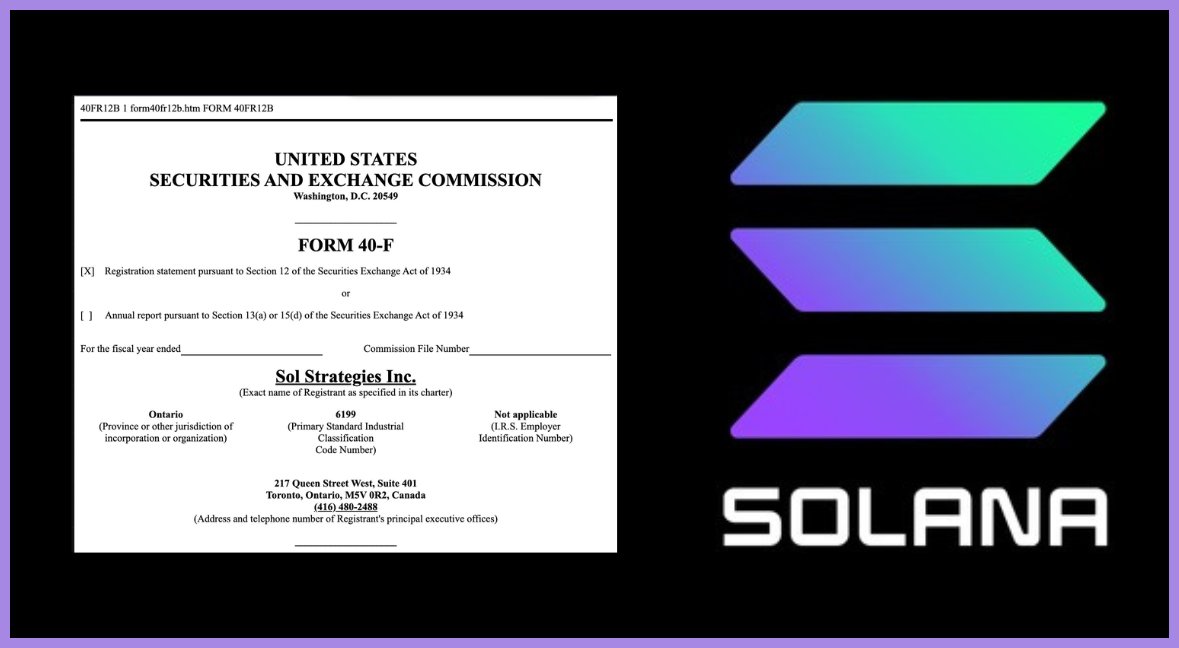
A seemingly routine announcement has dropped a meaningful stone into the converging landscape of cryptocurrency and traditional finance. On June 19, Canadian publicly traded company SOL Strategies Inc. (CSE: HODL) filed a Form 40-F registration statement with the U.S. Securities and Exchange Commission (SEC), planning to list on the Nasdaq Capital Market under the ticker "STKE." This is more than just a corporate capital move—it's a microcosm of an emerging trend.
In recent years, the strategy of public companies holding cryptocurrencies on their balance sheets has evolved clearly. From initially treating Bitcoin (BTC) as “digital gold,” to later embracing Ethereum (ETH) as a “productive asset,” each iteration reflects a deeper market understanding of digital assets. Now, we are witnessing the rise of a third wave, with Solana as its central figure.
Marked by SOL Strategies Inc.'s planned Nasdaq listing, an increasing number of corporate treasuries are turning their attention toward Solana. This raises a core question: in a context where Bitcoin and Ethereum already dominate mainstream attention, why are these companies betting so heavily on Solana? Is this merely a speculative play awaiting price appreciation, or is there a deeper strategic rationale at work? The answer is far more complex than simple price speculation—it reveals a profound bet on the future of financial infrastructure.
The Evolution of Corporate Treasuries: From “Digital Gold” to “Financial Operating System”
To understand why corporations are choosing Solana, we must first trace the three-stage evolution of corporate crypto strategies—a journey from passive value preservation, to active yield generation, and ultimately to strategic integration.
First Wave: Bitcoin as “Digital Gold”
The story began with pioneers like MicroStrategy, which pioneered the use of Bitcoin as a primary reserve asset. The core logic was to treat BTC as a store of value and a hedge against macroeconomic uncertainty—“digital gold.” This strategy was relatively passive, essentially “hold on for dear life” (HODL), betting on Bitcoin’s long-term scarcity and value consensus. Companies including Tesla and Block Inc. followed suit, adopting Bitcoin as a strategic reserve to protect against fiat currency inflation.
Second Wave: Ethereum as a “Productive Asset”
With Ethereum’s transition to Proof-of-Stake (PoS), the narrative entered its second chapter. Corporations began recognizing that ETH could be more than just a store of value—it could become a yield-generating “productive asset.” By staking ETH, companies can earn a steady income stream, enabling endogenous growth of their holdings. Recently, Nasdaq-listed sports betting platform SharpLink Gaming announced the acquisition of 176,271 ETH worth $463 million, planning to stake over 95% of its holdings, aiming to become the “MicroStrategy of Ethereum.” This shift marks a clear evolution—from “passive holding” to “active yield generation.”
Third Wave: Solana as “Strategic Infrastructure”
Now, companies such as SOL Strategies, DeFi Development Corp, and Upexi are driving the third wave. Their choice of Solana goes beyond mere price appreciation or passive staking yields. It represents a deeper strategic positioning—viewing Solana not just as an asset, but as a “high-performance financial operating system,” and seeking to actively participate in and build the future on-chain economy through SOL ownership.
Why Solana? Three Core Drivers
The decision by corporate treasuries to back Solana is not impulsive, but based on three fundamental drivers. Together, they answer the critical question—why Solana?—with an answer that extends well beyond “waiting for price gains.”
1. Not Just Yield, But “Means of Production”
Like Ethereum, Solana offers attractive staking yields. However, for companies like SOL Strategies, SOL’s significance runs much deeper. They are not simply delegating their SOL to third-party validators. Instead, they treat SOL as the foundational “means of production” for their core business.
SOL Strategies operates its own validator nodes. Its substantial SOL holdings serve as the capital base for running these nodes, generating multiple revenue streams: first, staking rewards from its own SOL; second, commission fees and block rewards earned by attracting third-party institutions (such as Australian-listed DigitalX) to delegate their SOL to its validator. This model transforms the company from a passive asset holder into an infrastructure provider and operator within the ecosystem. As CEO Leah Wald emphasizes, SOL Strategies is a “technology company,” not a fund. In this framework, SOL is no longer just a line item on a balance sheet—it becomes the essential fuel powering the company’s business engine.
2. A Firm Belief in Superior Technical Performance
All strategic decisions stem from confidence in underlying technology. Wall Street investment bank Cantor Fitzgerald made headlines with a report stating it believes “Solana’s technology is demonstrably superior to Ethereum on every metric.” This assessment is not unfounded.
The Solana network is renowned for its unmatched performance, consistently handling over 2,000 transactions per second (TPS) with average fees below $0.001. This high throughput and low cost enable applications that are prohibitively expensive on other blockchains—such as high-frequency trading, micropayments, and consumer-facing apps—to thrive on Solana. Its highly anticipated new validator client, Firedancer, aims to scale network capacity to one million TPS. As Solana co-founder Anatoly Yakovenko noted, this is largely a hardware optimization challenge, requiring no fundamental protocol changes.
For enterprises, choosing Solana means betting on a technically superior platform believed capable of supporting large-scale future applications. It is a conviction that technological excellence will translate into a more vibrant ecosystem and higher network value over time.
3. Deep Alignment with the Grand Vision of the “Next Wall Street”
This may be the most fundamental—and most exciting—reason behind the corporate bet on Solana. Holding SOL signifies deep alignment with a grand vision: Solana co-founder Anatoly Yakovenko’s original idea of a “decentralized Nasdaq.” At its core, this vision imagines all financial assets—stocks, bonds, real estate—being issued, traded, and settled as tokenized representations (RWA) on a blockchain.
Companies holding Solana are not merely investing in a token—they are investing in the foundational rails of future financial markets. By holding key network assets, they secure a seat at the table to shape and participate in this emerging ecosystem. As Autonomys Labs CEO Todd Ruoff stated, corporate SOL holdings are “not just about value storage, but about actively integrating into a growing ecosystem.” SOL Strategies has already begun collaborating with Superstate to explore tokenizing its own equity on the Solana blockchain—aiming to become a living part of this future itself.
This strategy is far more forward-looking than simply waiting for price gains. It represents a deep strategic alliance, tightly coupling the company’s future with the success or failure of the Solana ecosystem. It’s a transformation from observer, to participant, to builder.
Risks and Horizons: A Sober Assessment
Despite the promising outlook, this path is not without risks. First, the inherent price volatility of the SOL token remains a major challenge for all participants. Second, the ongoing uncertainty surrounding global cryptocurrency regulation—particularly regarding asset classification (e.g., whether tokens are deemed securities)—looms as a constant threat over all such projects.
Additionally, there is a more subtle structural financial risk. The stock prices of these “treasury companies” often trade at significant premiums above the net asset value (NAV) of their crypto holdings. Some analysts compare this phenomenon to the historical GBTC premium, arguing it effectively introduces leverage into the system. If market sentiment reverses and premiums turn into discounts, it could trigger a chain reaction, forcing these companies to liquidate assets to cover liabilities—potentially exerting downward pressure on the broader market. Finally, even Solana’s founders remain cautious. Yakovenko reminds us that converting high user engagement into sustained retention, and moving the ecosystem beyond meme coin frenzies toward maturity, are real challenges that must be addressed.
Conclusion: A Strategic Bet Beyond Price
In summary, the motivations behind corporate treasuries betting on Solana are multi-layered and profoundly strategic.
-
From a strategic standpoint, this represents an evolution—from passive holding (Bitcoin’s “digital gold”) and active yield generation (Ethereum’s “productive asset”)—to deep strategic integration (Solana as a “financial operating system”).
-
From a business perspective, SOL is not only a source of staking yield but also the productive capital driving core operations (e.g., validator nodes), enabling diversified revenue streams.
-
From a technical standpoint, it reflects a firm belief that Solana’s high-performance, low-cost architecture is poised to win the competition for the future of scalable blockchain infrastructure.
-
From a visionary standpoint, it is the ultimate bet on the grand narrative of universal tokenization and a “decentralized Nasdaq,” aiming to secure a strategic foothold in the future of on-chain finance.
Therefore, interpreting these corporate moves as merely “waiting for price gains” significantly underestimates their ambition. These companies are not buying lottery tickets—they are acquiring foundational blocks of a new continent, and actively attempting to build upon it themselves. This is the true allure of Solana as Wall Street’s rising favorite, drawing an ever-growing number of corporate treasuries into its orbit.
Join TechFlow official community to stay tuned
Telegram:https://t.me/TechFlowDaily
X (Twitter):https://x.com/TechFlowPost
X (Twitter) EN:https://x.com/BlockFlow_News