Circle releases white paper on "Stablecoin Payment Network"
TechFlow Selected TechFlow Selected
Circle releases white paper on "Stablecoin Payment Network"
At its core, Circle's blockchain-based payment network as a settlement layer is essentially a funeral invitation for traditional payment pathways like SWIFT, VISA, and Mastercard.
 Navigating Web3 tides with focused insights
Author: Will Awan
In Circle's early 2025 report, "Digital Dollars on the Internet of Value—2025 USDC Market Economic Report," the company clearly outlined three core narratives for USDC: (1) upgrading finance on the internet; (2) connecting networks via USDC; and (3) expanding USDC use cases through network effects.
For Circle, which currently holds a 26% market share in stablecoins, the first two narratives are no longer sufficient. Its newly launched Circle Payments Network (CPN) represents its strategic move—as a globally compliant stablecoin issuer—to capture value for USDC, or stablecoins in general, within a global financial network.
The U.S. dollar and the internet inherently possess powerful network effects. In both the physical world and online environments, the dollar functions as a currency with strong network effects. Blockchain technology enhances USDC with greater functionality and new application potential than traditional dollars, while leveraging existing internet infrastructure for real-world deployment.
Circle is building an open technological platform centered on USDC, capitalizing on the dollar’s current dominance and widespread adoption, along with the internet’s advantages in scale, speed, and cost-efficiency, to create similar network effects and practical utility for financial services.
The Circle Payments Network is a framework that leverages Circle’s robust compliance background to bring financial institutions (offering USDC services) into a single, compliant, seamless, and programmable environment, coordinating global payments across fiat currencies, USDC, and other payment stablecoins.
As a result, fiat money no longer needs to flow through outdated legacy systems like SWIFT. Digital dollars using blockchain as the settlement layer represent its new pathway.
In essence, Circle’s blockchain-based payment network serves as a funeral invitation to traditional payment rails such as SWIFT, VISA, and Mastercard—ushering us into a transformative era comparable to moving from mailed letters to email, horse-drawn carriages to electric vehicles, or transatlantic telegraph cables to blockchain-enabled value transmission over the internet.
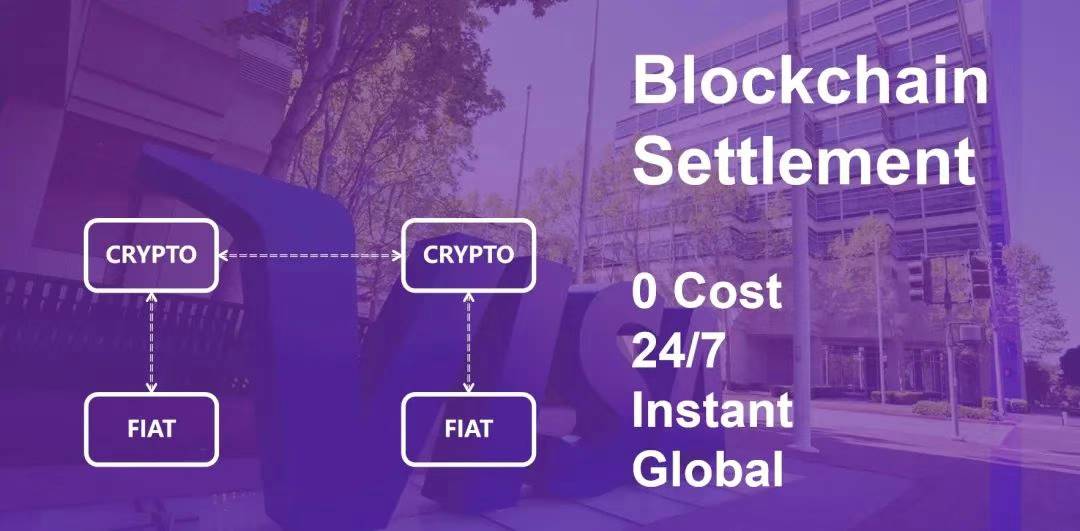
Critically, Circle positions the Circle Payments Network as a new protocol layer built upon a comprehensive, open, internet-based settlement system with stablecoins at its core. This design enables compatibility across multiple blockchain settlement layers, avoiding entanglement in the battle among blockchains to dominate financial infrastructure.
Dr. Xiao Feng from Hashkey, analyzing from the nature of finance, positioned public blockchains as next-generation financial infrastructure—not merely marginal improvements to existing systems, but disruptive advancements in transaction processing, clearing, and settlement that form an entirely new financial paradigm.
Notably, what Circle aims to build—an open blockchain-based network—is already taking shape as a prototype of the VISA network. Future evolution may be understood by studying VISA’s historical development. This stands in sharp contrast to relatively closed-loop networks like Ripple & RippleNet or Stripe & Bridge.
In October 2023, when I was presenting on Web3 payments to Ant Group, I pondered whether bridging fiat assets onto chains at both ends and settling via stablecoins might be the optimal solution. A year and a half later, Circle has provided a clear answer—and compelling use cases.
This article compiles and translates Circle’s Circle Payments Network Whitepaper to explore its design principles, real-world use cases, future opportunities, and governance model resembling that of the VISA network.
I. Executive Summary
Stablecoins have long been seen as having the potential to become the foundation for payments and fund transfers on the internet. However, until recently, stablecoins—acting as digital cash—were primarily used in global digital asset markets and decentralized finance (DeFi).
With the launch of the Circle Payments Network (CPN), Circle is advancing stablecoins further, unlocking their potential to upgrade global payment systems—just as prior internet innovations transformed media, commerce, software, communications, and other industries. These transformations significantly improved customer experiences, reduced costs, accelerated processes, and fueled economic growth for individuals and businesses worldwide.
To realize this potential, CPN acts as foundational infrastructure designed to overcome many barriers that have so far limited mainstream adoption of stablecoins in payments. These include high entry barriers, unclear compliance requirements, technical complexity, and concerns about secure storage of digital cash.
The Circle Payments Network (CPN) brings financial institutions together within a compliant, seamless, and programmable framework to coordinate global payments involving fiat currencies, USDC, and other payment stablecoins.
Corporate and individual clients of these financial institutions can enjoy faster and lower-cost payment services compared to traditional systems, which are often constrained by fragmented networks or closed ecosystems. Crucially, CPN provides the underlying infrastructure that eliminates much of the technical complexity and operational hurdles that have hindered mainstream stablecoin adoption—including the need for enterprises to self-custody stablecoins. CPN also opens the door to breakthroughs in programmable money, unlocking entirely new uses for currency in global value exchange.
This whitepaper outlines the design principles of the Circle Payments Network (CPN), presents initial and near-term use cases, and explores future potential applications and growth opportunities. It aims to help financial institutions, payment companies, application developers, innovators, and other stakeholders understand their roles in building and utilizing CPN—and how the network enables them to innovate and deliver the benefits of stablecoins to customers.
II. Introduction
2.1 Deficiencies in the Global Financial Payment System
Today’s global economy is more interconnected than ever before. Yet unlike other sectors, the infrastructure supporting money movement still largely relies on pre-internet frameworks.
In the past, it was impossible to have a native digital “Money Protocol” capable of transferring value fully natively over the internet.
The U.S. Automated Clearing House (ACH) and similar protocols emerged globally in the early 1970s and now form key components of today’s fragmented global payment landscape. While recent developments—such as the Eurozone’s Single Euro Payments Area (SEPA), Brazil’s PIX, and India’s Unified Payments Interface (UPI)—have improved domestic transaction speeds, they lack global interoperability standards, global scalability, and fail to leverage the openness and extensibility offered by programmable money built on open blockchain networks.
Businesses and individuals around the world pay a high price for relying on this legacy payment infrastructure. According to McKinsey’s report (Global Payments in 2024), the global payments industry generates over $2.4 trillion in annual revenue. Much of this “revenue” comes in the form of fees charged to senders and receivers, reflecting the operational complexity and intermediation inherent in traditional infrastructure—a de facto tax on global commerce and households.
Currently, international wire transfers can cost up to $50 per transaction, with intermediary banks often adding additional charges. According to World Bank data, in Q2 2024, the average cost of sending $200 globally was 6.65%. Foreign exchange conversion further compounds these challenges, introducing expensive FX fees and price volatility.
Fragmented settlement processes within the correspondent banking system continue to impose significant economic costs on businesses and society. For importers and buyers, waiting days for payments to clear can strain cash flow and complicate liquidity planning. For exporters and sellers, unpredictable multi-day settlement windows mean increased reliance on costly short-term working capital loans to maintain operations. Recipients of cross-border remittances—dependent on funds for food, housing, and other basic needs—may see their income eroded due to fees imposed by traditional intermediaries, face delays in receiving funds, and in some cases, risk handling cash in unsafe environments.
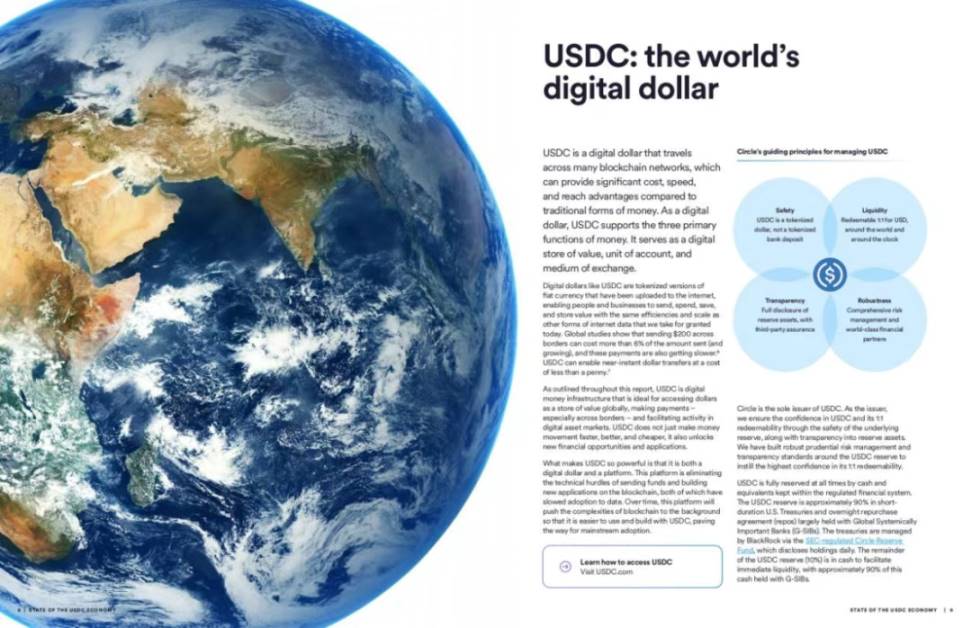
(Digital Dollars on the Internet of Value—2025 USDC Market Economic Report)
2.2 Change Has Arrived
Change is long overdue. Despite the internet transforming nearly every aspect of global business over the past decades, the way money moves still depends on opaque, inefficient, and innovation-resistant fragmented legacy networks. Although some countries have successfully implemented national real-time payment systems, these solutions cannot scale globally and offer limited developer accessibility.
Half a century after the emergence of early payment messaging and settlement systems like ACH, global communication technology has advanced to instantly connect people worldwide. Today, billions can watch movies on their phones during commutes, access humanity’s collective knowledge at near-zero cost, and buy almost any product from anywhere in the world.
It is time to adopt a new way of moving money—one that operates 24/7, connects seamlessly, eliminates inefficiencies of traditional payment systems, while integrating and building upon the solid foundations of the traditional financial system.
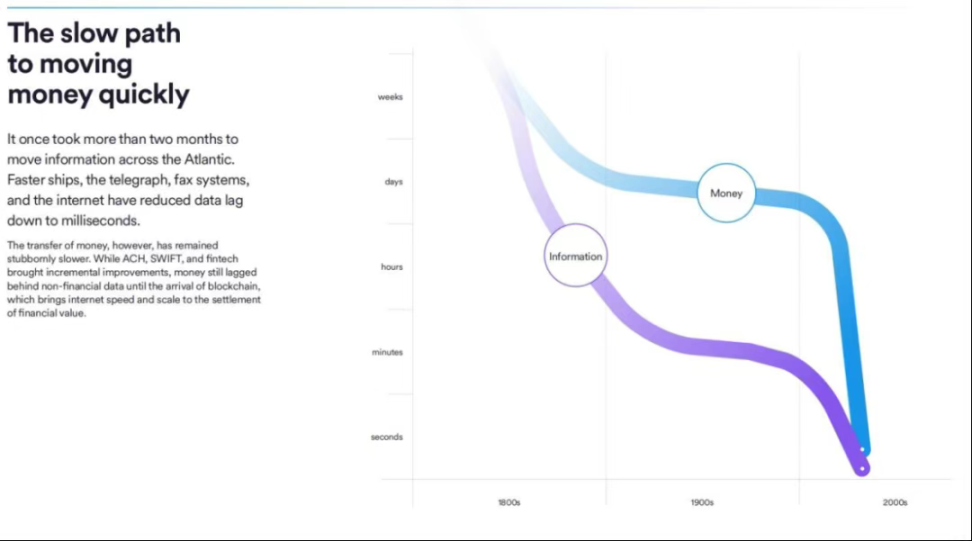
(Digital Dollars on the Internet of Value—2025 USDC Market Economic Report)
2.3 An Internet-Based Monetary Settlement Layer—Circle Payments Network
With the launch of the Circle Payments Network (CPN), this vision is becoming reality. CPN is a new protocol layer built atop a comprehensive, open, internet-based settlement system, with regulated payment stablecoins like USDC, EURC, and future others at its core. By connecting an open platform with global scale and reducing intermediaries, CPN enables capital flows in ways closed networks cannot.
Importantly, CPN does not directly transfer funds. Instead, it functions as a marketplace for financial institutions and acts as a coordination protocol to orchestrate seamless global fund movements and information exchange.
CPN marks the first integration of regulated settlement assets (in the form of stablecoins) with a coordination and governance layer specifically designed for financial institutions. This integration links traditional payment systems with assets like USDC and EURC, while establishing a trusted counterparty framework for more efficient, less-intermediated global settlements.
By introducing a new “Clearing Layer” based on compliant, always-on digital dollars, CPN lays the groundwork for internet-scale cross-border settlement.
(https://x.com/circle/status/1914411337683480654)
2.4 Benefits of the Circle Payments Network
A. Internet-Scale Financial Payment Services
CPN will benefit billions of individuals and millions of businesses by enabling access to money and financial services just as easily as other transformative global internet services. Payers can initiate payments using either fiat or stablecoins, while recipients—whether businesses or individuals—can choose to receive stablecoins or convert them into local currency. CPN will make near-instantaneous, borderless payments a universal reality.
CPN makes it easier to envision a future where international suppliers can receive cross-border payments almost instantly and at low cost via a modern, compliance-first platform supporting global supply chains; small merchants can achieve near-real-time settlements without high fees eating into profits; global sellers can directly enter new markets; content creators can receive micropayments from consumers efficiently via stablecoins; and remittance recipients can retain a larger share of transferred funds, boosting purchasing power where it matters most.
B. Reduced Technical Complexity
Beyond being an upgrade to many current inter-institutional payment networks—which are often burdened by legacy infrastructure, closed ecosystems, and slow or expensive settlements—CPN is designed as a modern payment orchestration layer based on stablecoins and blockchain, built for scalable expansion.
Although blockchain-based payments have gained traction, they are not frictionless or inherently trustworthy in institutional settings, where settlement finality, reversibility, compliance, standardized protocols, and strong security are fundamental requirements. CPN further reduces technical complexity and minimizes the operational and financial challenges that have so far prevented stablecoins from entering mainstream payments and commerce, paving the way for a more efficient, inclusive, innovative, and transparent financial ecosystem.
C. Cost Reduction and Efficiency Gains
From cost and efficiency perspectives, CPN is a powerful alternative to traditional cross-border payments. While there are costs associated with buying stablecoins and converting them back to fiat, in many markets outside the U.S., these “on/off-ramp” costs are declining and may fall below the cost of accessing U.S. dollars through banks.
Traditional dollar transfers can be expensive and slow for both sender and receiver, increasing dependency on short-term working capital financing (as noted above). By enabling near-instant settlement and reducing reliance on intermediaries, CPN unlocks significant cost efficiencies.
Moreover, as an open platform, CPN has the potential to foster competitive markets for on/off-ramping, foreign exchange, and other services, further lowering costs and improving access conditions.
D. Transparent, Secure, and Scalable
CPN is a transparent, secure, and scalable infrastructure designed to help financial institutions better serve their corporate and individual clients. Crucially, CPN delivers these efficiencies without compromising compliance. Circle has established a rigorous governance framework requiring participating financial institutions to meet global anti-money laundering and counter-terrorism financing (AML/CFT) standards and economic sanctions requirements.
E. Open Infrastructure Driving Innovation
Importantly, CPN does not directly transfer funds. Rather, it operates as a marketplace for financial institutions and serves as a coordination protocol to orchestrate seamless global fund flows and information exchange. As the network operator, Circle defines the CPN protocol and provides APIs, developer SDKs, and public smart contracts to coordinate global payments.
The growth and success of CPN extend beyond Circle’s ecosystem and depend on participants outside Circle to jointly unlock economic value. The network creates fertile ground for banks, payment companies, on/off-ramp providers, app developers, and other regulated stablecoin issuers to co-innovate and deliver greater value and improved experiences to their own customers.
It is precisely this open public blockchain infrastructure that empowers builders with a powerful foundation—through CPN and regulated payment stablecoins—to launch on-chain applications that seamlessly transfer funds across networks.
CPN provides innovators and builders with modular components to develop new user experiences and support diverse payment use cases. Over time, builders will create a vibrant ecosystem of modules and application services on top of CPN—a third-party feature marketplace benefiting CPN participants and end users alike—and unlock a powerful new distribution platform for fintech developers.
III. Circle’s Vision
Through the Circle Payments Network (CPN), Circle is building a new platform and ecosystem that creates value for every stakeholder in the global economy, accelerating the societal benefits of this internet-native financial system:
Enterprises:
Importers, exporters, merchants, and large corporations can leverage CPN-enabled financial institutions to eliminate substantial costs and friction, strengthen global supply chains, optimize treasury operations, and reduce dependence on costly short-term working capital financing.
Individuals:
Remitters and recipients, content creators, and others frequently sending or receiving micropayments will gain greater value, as CPN-enabled financial institutions can deliver improved services faster, cheaper, and more simply.
Builders:
Banks, payment companies, and other providers can leverage CPN’s platform services to develop innovative payment use cases, harnessing the programmability of stablecoins, SDKs, and smart contracts to cultivate a thriving ecosystem. Over time, this will fully unlock the potential of stablecoin payments for businesses and individuals. Additionally, third-party developers and enterprises can introduce value-added services to further expand the network’s capabilities.
All participants and end users of the CPN network will benefit from an open, continuously upgradable fund transfer infrastructure that not only lowers the cost and increases the speed of cross-border payments but also ensures technical readiness for the internet-based financial system.
IV. Use Cases
The Circle Payments Network (CPN) supports a wide range of payment and value transfer use cases by enabling seamless, efficient, and secure transactions using regulated stablecoins on supported blockchain networks.
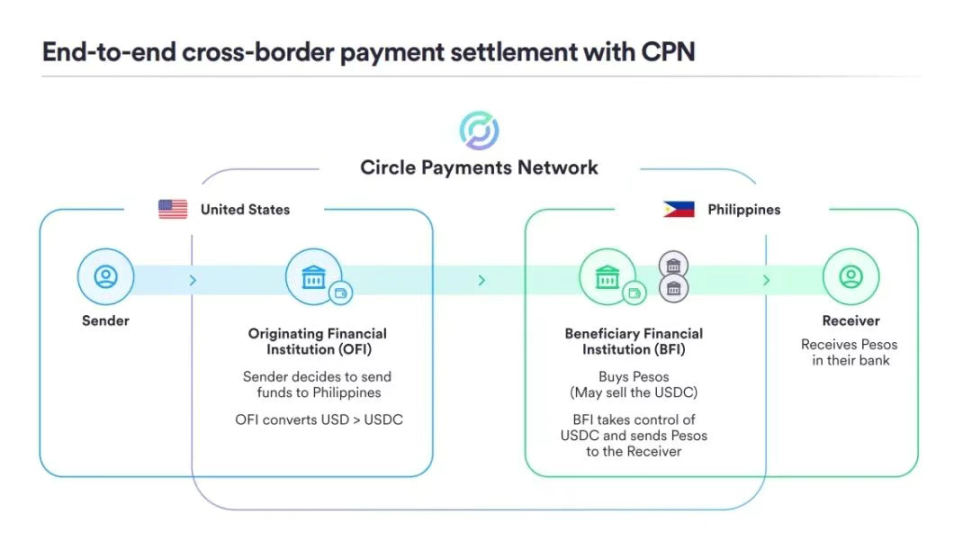
Its compliance-driven architecture allows Originating Financial Institutions (OFIs) to discover and connect with Beneficiary Financial Institutions (BFIs) via CPN, empowering builders to develop innovative solutions for individuals, enterprises, and institutions.
(www.circle.com/cpn)
4.1 Business Payments
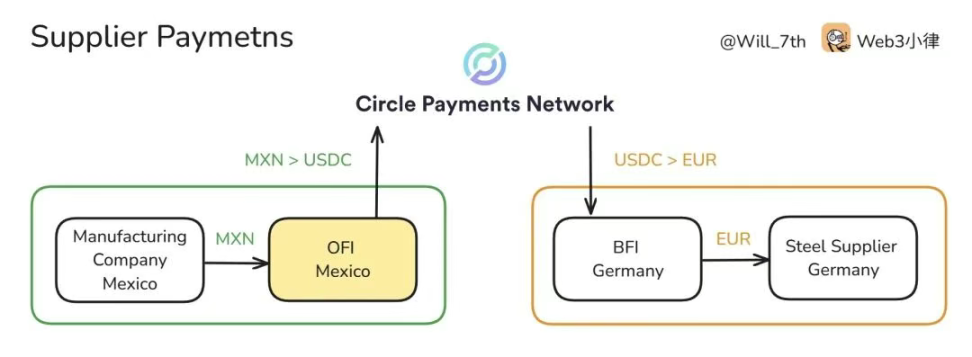
A. Supplier Payments
Accelerates and simplifies cross-border payments between companies by shortening settlement times and eliminating intermediaries.
A manufacturing company in Mexico needs to pay a steel supplier in Germany but wants to avoid high foreign exchange fees and multi-day bank transfers. The company’s OFI converts Mexican pesos (MXN) into USDC, contacts the German BFI via CPN, and sends the USDC. The BFI then seamlessly converts the USDC into euros and instantly settles the amount into the supplier’s account.
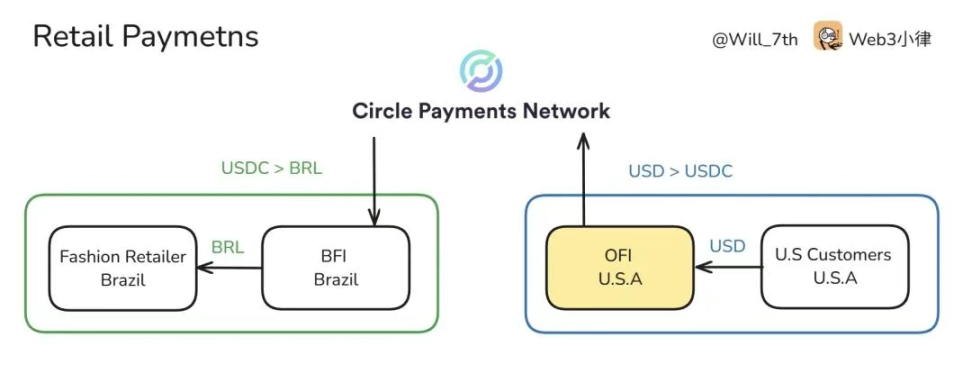
B. Retail Payments
Enhances global e-commerce with secure, efficient, and flexible payment options.
A fashion retailer in Brazil sells goods to customers in the U.S. The retailer’s BFI uses CPN to connect with an OFI to collect USD payments. The OFI converts USD into USDC and sends it to the BFI, which then seamlessly converts the USDC into Brazilian reais (BRL), or keeps it as USDC in a digital asset custodian on behalf of the retailer. The retailer receives funds instantly, achieving faster settlement than traditional processors and optionally retaining working capital as digital dollars.
C. Trade Finance
Simplifies and secures international trade payments.
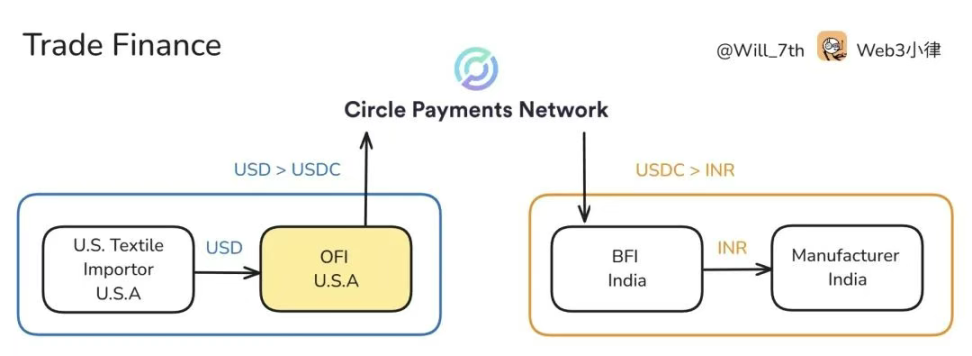
A U.S. textile importer places an order with an Indian manufacturer and seeks to reduce the time and cost of traditional trade finance. The importer’s OFI converts USD into USDC and connects via CPN to an Indian BFI to transfer funds. The BFI manages the USDC in escrow via smart contract and settles Indian rupees (INR) to the manufacturer upon verification of shipping documents. This approach enables faster settlement, reduces counterparty risk, and leverages smart contract innovation for escrow services.
D. Payroll and Salary Disbursements
Enables enterprises to process global payroll with minimal fees and instant settlement.
A multinational corporation pays remote employees across multiple countries. Instead of relying on traditional banking channels, the company uses its OFI to convert local currencies into USDC and immediately disburses salaries via multiple BFIs discovered through CPN. These BFIs receive USDC from the OFI and complete final disbursements in each employee’s local currency.
E. AI Payments
In the future, CPN will support autonomous AI agents acting on behalf of users or systems to send and receive payments, enabling real-time value exchange.
A logistics company uses an AI agent to book freight services cross-border. When the agent selects a service provider in Singapore, it uses an OFI integrated with CPN to convert USD into USDC and automatically sends the payment to the Singaporean BFI, which then converts it into Singapore dollars (SGD). The entire payment process executes programmatically via smart contracts, minimizing manual steps and enabling intelligent machine-to-machine cross-border payments.
4.2 Consumer Payments
A. Remittances
Empowers individuals with fast and cost-effective remittance services, avoiding high fees and delays.
A person living in the U.S. wishes to send money to family in the Philippines. A remittance company serving as the U.S.-based OFI converts USD into USDC and dynamically discovers, via CPN, a local Philippine BFI that converts the USDC into Philippine pesos (PHP), delivering funds to the recipient almost in real time at a fraction of traditional remittance costs.
B. Subscriptions
Supports recurring payments for digital services via programmable stablecoin billing.
A digital media platform offers premium subscription services to a global audience. Each month, users’ digital wallets initiate a USDC payment via their OFI, routed through the platform’s BFI discovered via CPN. The BFI receives the funds, holds them as USDC in a digital asset custodian on behalf of the media platform, or converts them into local fiat and credits the platform’s account as needed.
C. Micropayments and Content Monetization
Provides content creators and digital service providers with instant, low-cost micropayment support.
A Brazilian content creator receives micro-donations from global fans via CPN, using a local OFI and a CPN-supported BFI. Fans no longer face long delays and high platform fees, instead sending stablecoins instantly—enabling quick and low-cost monetization.
D. E-commerce
Expands consumer access to global online markets through faster payment experiences.
A UK customer purchases electronics from a Korean seller via an international e-commerce platform. At checkout, the customer pays in British pounds (GBP) via their local OFI, which converts the funds into USDC and transfers them to the Korean BFI. The BFI converts the USDC into Korean won (KRW) and deposits it into the seller’s account.
4.3 Institutional Payments
A. Capital Markets Settlement
Improves trading efficiency by enabling faster, more transparent settlements between financial institutions, reducing counterparty risk and operational costs.
An asset management firm in the U.S. executes an over-the-counter (OTC) bond trade with a European investment bank but wants to avoid T+2 settlement delays, inefficient capital usage, and counterparty risk. The asset manager’s OFI converts USD into USDC and connects via CPN to the European BFI to transfer the USDC. The BFI then instantly settles the transaction in euros (EUR) for the investment bank.
B. Foreign Exchange (FX)
Simplifies currency conversion by improving efficiency in multi-currency operations, addressing high FX rates from traditional providers and the complexity and delays of managing multiple currencies.
A European investment firm wants to fund a real estate acquisition in Japan but aims to avoid high FX costs and delays. The firm’s OFI converts EUR into EURC, which the Japanese BFI receives and seamlessly converts into yen (JPY) at competitive on-chain FX venues before immediate settlement.
C. Treasury Services
Simplifies repatriation of overseas revenues by efficiently converting foreign earnings back into the home-market currency.
A U.S.-headquartered enterprise software provider offers cloud-based solutions to numerous businesses across Southeast Asia. To repatriate regional revenues to the U.S., the company’s U.S.-based BFI discovers a local Philippine OFI via CPN. The OFI collects PHP payments from enterprise customers, converts them into USDC, and transmits them to the U.S. BFI. The BFI then converts the USDC into USD and deposits it into the company’s treasury account, enabling faster and compliant global revenue consolidation.
D. Government and Humanitarian Payments
Provides a secure, reliable, and efficient channel for large-scale payments—from disaster relief funding to institutional transfers.
An international NGO uses stablecoins to distribute disaster relief funds. The NGO initiates payments through its OFI, which converts local fiat into USDC and transfers it to a BFI operating in the affected region. The BFI then either directly delivers funds to beneficiaries’ digital wallets or converts USDC into local fiat and deposits it into their bank accounts—ensuring transparency, accelerating delivery, and enhancing accountability in aid distribution.
E. DeFi Integrations
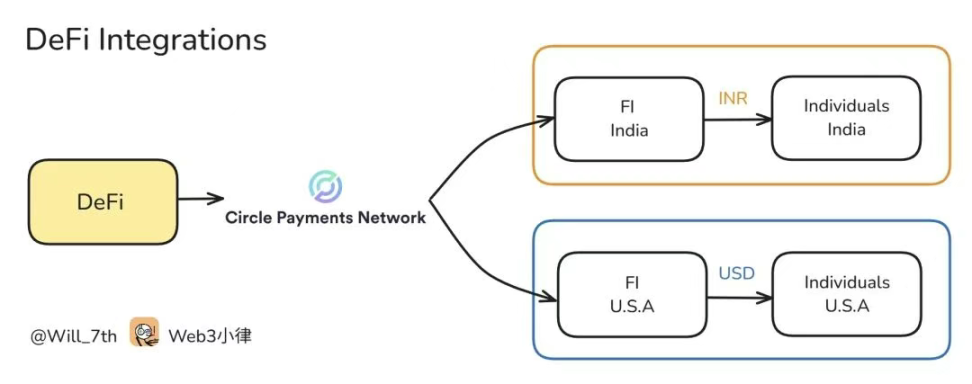
Supports DeFi innovators by providing the foundation for lending, borrowing, savings, and unlocking the potential of mainstream-scale on-chain finance.
A properly licensed and regulated DeFi lending platform integrates USDC and EURC to offer loan and savings products. Leveraging CPN’s infrastructure, the platform facilitates seamless cross-border transactions, reduces volatility, supports compliant institutional client flows, and builds trust across a diverse user base.
V. CPN Ecosystem Stakeholders and Roles
The CPN ecosystem consists of stakeholders and participants who play vital roles in facilitating global payments, driving technological innovation, and advancing network governance, economic value creation, and network adoption.
5.1 CPN Governing Body
Circle serves as the primary governing body, standard-setter, and network operator for CPN.
Circle’s key responsibilities include:
-
Establishing and maintaining the “Circle Payments Network Rules” (“CPN Rules”) governing participant eligibility, operations, and compliance.
-
Developing and maintaining core infrastructure—smart contracts, APIs, and SDKs—for seamless cross-blockchain payment settlement (sending/receiving transactions).
-
Operating the coordination protocol for member discovery, price discovery, payment routing, and settlement between counterparties.
-
Facilitating standardized and automated information sharing among members to ensure Travel Rule compliance.
-
Verifying financial institution eligibility, approving participation, and issuing credentials confirming adherence to CPN standards related to licensing, AML/CFT, sanctions compliance, and financial strength.
-
Overseeing member compliance with regulatory requirements (including AML/CFT and sanctions) through ongoing risk-based reviews.
-
Planning and managing cybersecurity, incident response, and infrastructure to ensure operational integrity and resilience.
-
Introducing pre-vetted third-party service providers and modular applications meeting CPN’s compliance, security, and performance standards.
5.2 CPN Members
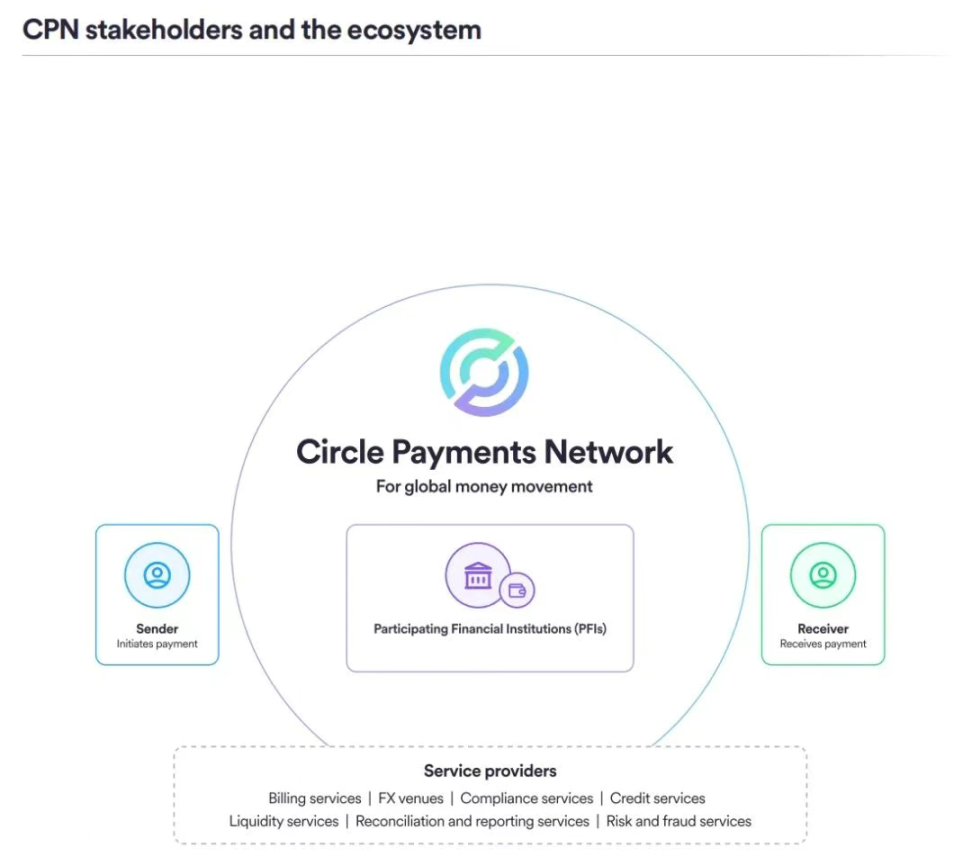
Members, also known as Participating Financial Institutions (PFIs), are the backbone of CPN. They act as counterparties initiating, facilitating, or receiving payments within the network and executing transactions in accordance with CPN rules and governance standards.
PFIs include Virtual Asset Service Providers (VASPs), traditional and crypto-native Payment Service Providers (PSPs), and traditional or digital banks. Depending on their role in a transaction, PFIs may act as Originating Financial Institutions (OFIs), initiating payments on behalf of senders, or as Beneficiary Financial Institutions (BFIs), receiving stablecoin payments and facilitating last-mile fiat disbursement via local payment systems or offering stablecoin custody services on behalf of recipients.
Core responsibilities of CPN members include:
-
Maintaining appropriate licenses and ensuring continuous compliance with all applicable regulations in relevant jurisdictions, including AML/CFT and sanctions requirements, while adhering to CPN Rules.
-
Participating in Circle’s qualification process and keeping legal entity information, compliance status, jurisdictional scope, and risk profiles updated and verified.
-
Conducting risk-based assessments of counterparties and transactions using information collected and oversight conducted via CPN, in line with their compliance obligations.
-
Executing payments via a suite of technical services and protocols detailed in the CPN Rules, based on their role as OFI or BFI.
-
Complying with CPN’s technical and infrastructure requirements, including secure integration, SLA performance, transaction monitoring, and data protection protocols.
-
Sharing necessary sender and recipient information in accordance with CPN’s Travel Rule compliance framework, Request for Information (RFI), and other supervisory requests.
-
Monitoring transactions to detect and report suspicious activity under applicable laws.
-
Participating in CPN governance through structured feedback, operational reviews, and member reputation scoring to enhance transparency and support continuous improvement.
-
Providing timely support and resolution for inquiries from other members or end users regarding the network.
-
Leveraging CPN’s developer SDK, regulated stablecoins, and smart contract infrastructure to develop and offer innovative payment use cases.
5.3 CPN End Users (Enterprises and Individuals)
End users are the ultimate initiators and beneficiaries of payment transactions—though they do not interact directly with CPN, they benefit from lower costs, faster settlement, higher transparency, and ongoing innovation. Senders initiate payments through OFIs, while recipients receive payments through BFIs.
5.4 CPN Service Providers
These entities include both financial institutions (FIs) and non-financial institutions (non-FIs) that provide value-added technical solutions and financial services to CPN members and end users.
They include:
-
Liquidity providers and FX venues: Entities that offer efficient market-making, price discovery, and currency conversion services for stablecoin trading within CPN. They provide liquidity for cross-border stablecoin settlement and ensure competitive FX rates.
-
Stablecoin issuers: Institutions that issue regulated payment stablecoins, the primary mediums of exchange within CPN. Stablecoin issuers ensure transparent reserves, regulatory compliance, and underlying fiat liquidity to support seamless cross-border transactions.
-
Technology and financial service providers: Entities offering a range of services to CPN members, including fraud and risk management, wallet infrastructure, custody solutions, billing and invoicing, and compliance and transaction monitoring tools to support their business and operational needs.
(www.circle.com/cpn)
VI. CPN Governance, Qualification, and Network Operations
CPN operates under a collaborative and transparent governance framework designed to prioritize compliance, security, and trust within the network. This framework covers three key aspects:
-
Qualification and oversight: Circle, as the primary governing body, establishes strict qualification standards documented in the “Circle Payments Network Rules,” and drives the integration of regulated payment stablecoins into the network.
-
Network functionality and operations: Core functions support seamless, compliant transactions while ensuring operational rigor and continuous improvement.
-
Transparency and stakeholder engagement: Through active interaction with diverse stakeholders—including financial institutions, regulators, enterprises, and builders—CPN aligns with global standards to build trust, accelerate adoption, and promote sustainable ecosystem growth.
Network operations:
-
Restricted to legally authorized financial institutions;
-
Mandatory AML/CFT and sanctions compliance;
-
Secure transaction data sharing, including Travel Rule;
-
Ongoing audits and supervision.
6.1 Qualification and Oversight
The CPN governance framework defines qualification criteria, certification protocols, and integration of regulated stablecoins to ensure credible participation by financial institutions, regulated stablecoin issuers, and service providers.
A. Strict Qualification Standards
Members must meet comprehensive eligibility requirements before gaining network access. These include holding all necessary licenses, implementing sanctions and AML programs aligned with local regulations and global norms, maintaining reasonable security controls, and demonstrating sufficient financial strength. As network operator, Circle evaluates all potential members before granting access and conducts periodic re-evaluations based on risk. Members licensed under robust regulatory regimes established by international standards bodies (e.g., FATF) undergo standard review, while others require deeper assessment. Qualification standards are publicly available, and Circle’s evaluations can inform members’ own counterparty due diligence processes.
B. Member Certification and Access
After successful qualification and approval, CPN issues unique network certifications to eligible members. These certifications enable counterparties to securely identify each other and retrieve counterparty information, promoting transparency, enabling informed risk assessments, and improving efficiency in counterparty due diligence. The certification includes a set of well-defined attributes—including membership status, jurisdictional scope, and qualification details—that are continuously monitored and updated to reflect changes in risk posture.
C. Integration of Regulated Payment Stablecoins
The CPN governance framework outlines a structured evaluation and approval process for integrating new regulated payment stablecoins into CPN. Potential stablecoins must undergo rigorous assessment against CPN’s strict qualification criteria, including regulatory compliance, transparent reserves and audit proofs, availability of bank payment channels, underlying fiat liquidity, risk management standards, information and cybersecurity capabilities, and reporting practices. Only stablecoins fully satisfying these criteria and approved by the governing body may operate within the network, ensuring they contribute to a stable, secure, and efficient ecosystem.
6.2 Network Functionality and Operations
CPN enables members to conduct secure, real-time transactions through a robust operational framework that ensures consistency, scalability, and resilience. This includes transaction coordination, operational support, incident response, and infrastructure management.
A. Transaction Coordination and Risk Management
Transactions within CPN are coordinated through a series of technical services and protocols, ensuring seamless execution among participating members. Additionally, network members use automated alerts and regular risk assessments provided by CPN to continuously monitor transaction flows, focusing on anomalies and partner performance—such as failed transaction rates and SLA violations. Together, these measures proactively mitigate operational risks and help maintain network reliability and efficiency.
B. Member Operational Support
CPN provides clear operational guidelines, including Service Level Agreements (SLAs) defined in the CPN Rules covering uptime, transaction speed, dispute resolution, and timely information sharing. The network also standardizes the exchange of transaction and counterparty data, simplifying operations by reducing the need for customized coordination.
C. Incident and Crisis Management
CPN has detailed protocols for managing security incidents, regulatory compliance issues, and system outages. These include predefined communication channels with members and transparent, fair resolution processes to ensure swift action and effective dispute management, regardless of whether issues involve compliance or transactions.
D. Infrastructure Scalability and Planning
CPN’s infrastructure is continuously monitored using observability tools that track throughput, latency, and error rates. Automated performance monitoring and regular load testing allow the network to scale with demand. Circle partners with vetted infrastructure and cloud providers to ensure resilient computing and storage resources. Scalability reviews and corridor-level stress tests validate the network’s readiness for growing transaction volumes and network expansion.
6.3 Transparency and Stakeholder Engagement
CPN’s governance is built on transparency, fostering trust and confidence among all participants. As the governing body, Circle adopts strategic recommendations from advisory committees to strengthen the governance framework. CPN regularly conducts surveys, focus groups, and structured reviews to gather member feedback and assess service quality. These inputs drive continuous improvement and help ensure network development meets participant needs. Independent audits and periodic public reports on transaction volume, system uptime, and member compliance further reinforce operational integrity and accountability.
Representatives of CPN members, end users, and interactions with regulators play critical roles in network development. CPN members are encouraged to actively participate in shaping network rules and technical standards, contributing insights that guide network strategy and growth. Furthermore, Circle’s financial services division maintains ongoing engagement with global regulators, leveraging its strong track record to ensure CPN aligns with international standards—particularly AML/CFT and FATF Travel Rule standards—and operates within a safe, trusted, and compliant environment.
VII. CPN Core Services
CPN functions as a coordination protocol purpose-built for stablecoins, enabling seamless, compliant, and programmable global transactions.
CPN uses public blockchain networks for final settlement while optimizing payment coordination, compliance-related data exchange, and intelligent routing between payment stablecoins and network members. Stablecoins are the foundational digital asset class within CPN, providing the stability, interoperability, and programmability required for high-trust financial applications.
At launch, the network supports USDC and EURC, with plans to expand to other regulated payment stablecoins meeting CPN’s stringent governance and qualification standards. Over time, CPN will become a foundation for builders to develop interoperable modules and application services, expanding network utility and unlocking new use cases in global payments and financial innovation.
7.1 Payments Through Intelligent Orchestration
CPN’s payment protocol is built on a hybrid architecture combining off-chain and on-chain systems, helping aggregate liquidity and facilitate price discovery among network members. As more payment stablecoins join, CPN will evolve into an on-chain FX routing infrastructure, enabling efficient and instant conversions between stablecoins while continuing to coordinate transaction settlement between OFIs and BFIs.
In its initial version, coordination occurs via an off-chain API system that generates payment requests. OFIs sign these requests to initiate USDC or EURC transfers to designated BFI wallets. At this stage, Circle—as network operator and governing body—broadcasts the transaction to the appropriate blockchain. This process verifies payment details, ensures correct amounts and tokens are delivered to the BFI, and confirms all associated fees are covered within the agreed settlement window.
Subsequently, CPN will transition to a smart contract protocol architecture, enhancing network composability and introducing more efficient, value-added features. The CPN smart contract payment protocol is designed for seamless on-chain payments between members using stablecoins like USDC and EURC. By leveraging smart contracts, the protocol will minimize transaction errors, enable automatic reconciliation, and streamline fee collection—all while maintaining a non-custodial design.
Under this protocol, OFIs initiate payments via smart contracts deployed on CPN-supported public blockchains. The contract validates key transaction parameters—such as token type, amount, recipient address, and deadline—before executing the payment. Unlike error-prone traditional transfers requiring separate transaction fee invoices, the smart contract enforces precise payments and efficiently routes transactions to different BFIs in multi-quote scenarios.
To enhance transparency and security, each transaction is uniquely identified and timestamped, ensuring clear auditability for compliance and reconciliation purposes. Additionally, future versions of the protocol will include an optional “revoke” feature, allowing senders to cancel erroneous transactions within a brief window before final confirmation.
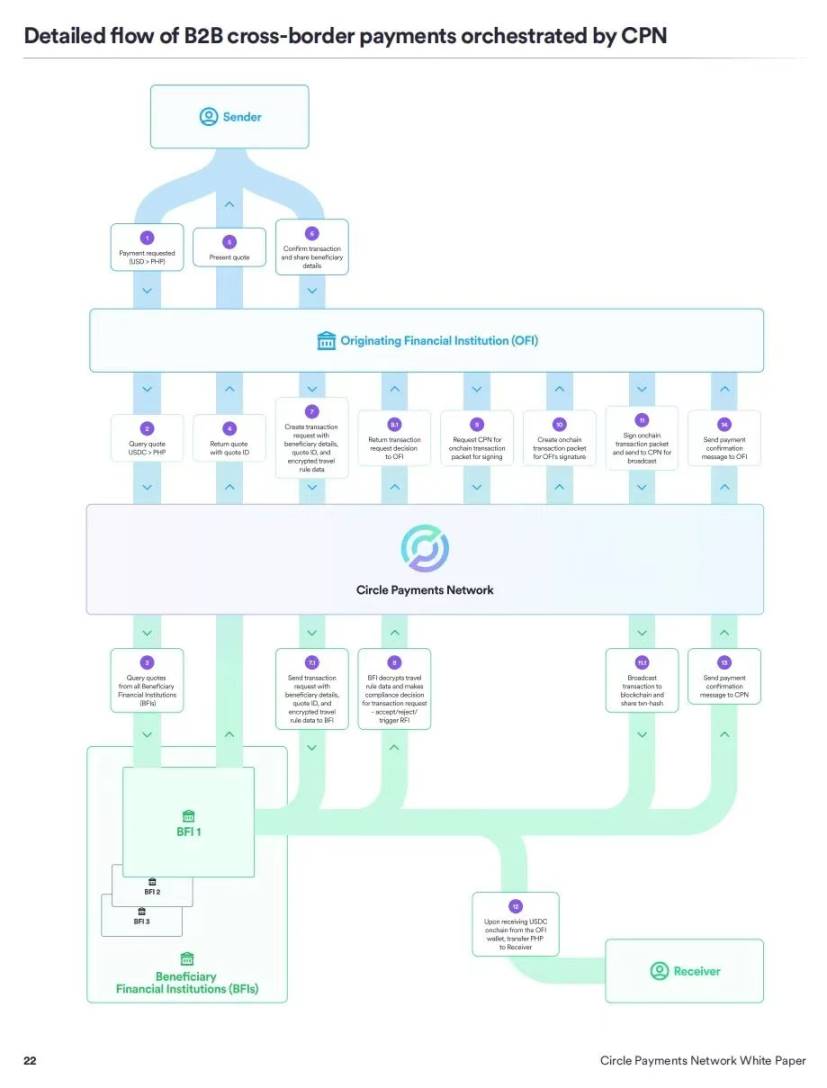
(www.circle.com/cpn)
7.2 Optimized FX Through Smart Discovery and Routing
CPN enables participating OFIs to discover BFIs and send stablecoins for payment settlement. During discovery, CPN allows OFIs to query the network for specific stablecoin or fiat currency pairs. The system enables OFIs to discover network participants and request corresponding exchange rates and liquidity. Initially, the platform integrates USDC and EURC with local fiat liquidity order books and private liquidity sources. Over time, the system will transition to a fully on-chain FX routing, aggregation, and settlement architecture—providing direct access to on-chain FX pools, order books, and private liquidity. The network’s discovery capability will include order routing, and a Request-for-Quote (RFQ) system will further optimize FX execution to meet performance standards of traditional payment systems.
While initially focused on discovering liquidity among BFIs, the network will gradually expand to include whitelisted on-chain venues—such as automated market makers (AMMs), on-chain order books, and other liquidity providers—to broaden access to stablecoin liquidity. Once discovered, CPN will intelligently match orders from these sources, enabling direct stablecoin FX swaps with built-in security and transparent execution, coordinated by Circle as network operator.
7.3 Seamless Cross-Chain Settlement
CPN supports native settlement of stablecoins across multiple blockchains, offering a seamless mechanism for cross-chain payment transfers. Participating Financial Institutions (PFIs) bring their preferred blockchains into the network, and CPN coordinates transactions between selected source and destination blockchains for efficient payment settlement. Leveraging Circle’s Cross-Chain Transfer Protocol (CCTP v2), CPN enables fast and secure cross-chain transfers for permitted stablecoins, preserving speed and integrity across blockchain networks. Initially, the platform will support a limited number of blockchains at launch, expanding to more based on member preferences over time.
7.4 Protecting Confidentiality Through Selective Transparency
CPN introduces advanced confidentiality-enhancing features on public blockchains to protect transaction data, helping members fulfill privacy and operational obligations. These mechanisms allow users to designate certain transactions as confidential, ensuring sensitive payment information is not permanently visible on public blockchains. This capability supports a wide range of use cases, enabling enterprises to maintain confidentiality for critical activities such as corporate payments, trade finance, and payroll via CPN.
Additionally, CPN will adopt a confidentiality protocol (to be separately defined and not included in this whitepaper) enabling selective disclosure. Under this protocol, transaction details will only be visible to authorized parties—including counterparties, law enforcement, regulators, and auditors—when required for compliance or legal purposes.
7.5 Expanding Capabilities Through Composability and Trusted Interoperability
To expand the ecosystem’s value, CPN allows pre-vetted third-party protocols to integrate and interoperate with its core infrastructure, enhancing the utility and versatility of its payment capabilities. Circle envisions diverse integrations—including lending and credit, liquidity aggregation, institutional yield, custody, and subscription services. Participation is restricted to protocols whitelisted, audited, and rigorously reviewed by Circle, meeting strict standards for regulatory compliance, security, and liquidity management. Through this composable architecture, CPN aims to unlock a secure, programmable foundation and third-party ecosystem for global payments, financial services, and technology-driven solutions.
VIII. CPN Economic Model
CPN’s economic model and incentive structure aim to drive rapid early adoption while establishing a sustainable long-term revenue strategy for all network members. It aligns incentives across network members, end users, builders, and service providers to promote network growth and sustainability.
Transactions processed through CPN generate three primary types of fees:
-
Payout Fees: Compensate Beneficiary Financial Institutions (BFIs) for local fiat disbursement and processing.
-
FX Spreads: Reflect liquidity risk and currency conversion costs.
-
CPN Network Fee: A tiered, variable basis point fee based on country groupings, supporting core network functions including compliance, security, infrastructure, and development.
As CPN grows and Circle and third-party developers introduce new value-added services via curated marketplaces, additional usage-based fees will be implemented to support and sustain these services. These may include fraud detection tools, risk management, wallet infrastructure, custody, billing, and advanced compliance capabilities. First-party (1P) and third-party (3P) service fees will create revenue opportunities for providers and enable financial institutions to customize payment experiences through modular, plug-and-play solutions.
A portion of network and marketplace fees will be strategically reinvested into core priorities such as infrastructure upgrades, R&D, network operations, user acquisition incentives, and developer ecosystem growth—including funding for CPN integrations and new applications. This reinvestment strategy aims to enhance platform resilience, drive innovation, and accelerate long-term network expansion.
Join TechFlow official community to stay tuned
Telegram:https://t.me/TechFlowDaily
X (Twitter):https://x.com/TechFlowPost
X (Twitter) EN:https://x.com/BlockFlow_News
 0xWillmfer