All trading platforms are requested to immediately cease promoting contract trial funds to college students.
TechFlow Selected TechFlow Selected
All trading platforms are requested to immediately cease promoting contract trial funds to college students.
If the industry truly seeks long-term development, it should first abandon growth models that come at the cost of destroying a generation's future.
 Navigating Web3 tides with focused insights
Recently, Brucexu.eth, co-founder of ETHPanda and LXDAO, exposed on social media the practice of certain cryptocurrency exchanges distributing so-called "futures trial funds" to college students. These trial funds cannot be withdrawn directly. If trades generate profits, students keep the gains; if losses occur, they bear no repayment responsibility. Additionally, sharing high-earning screenshots on social media feeds earns extra incentives.
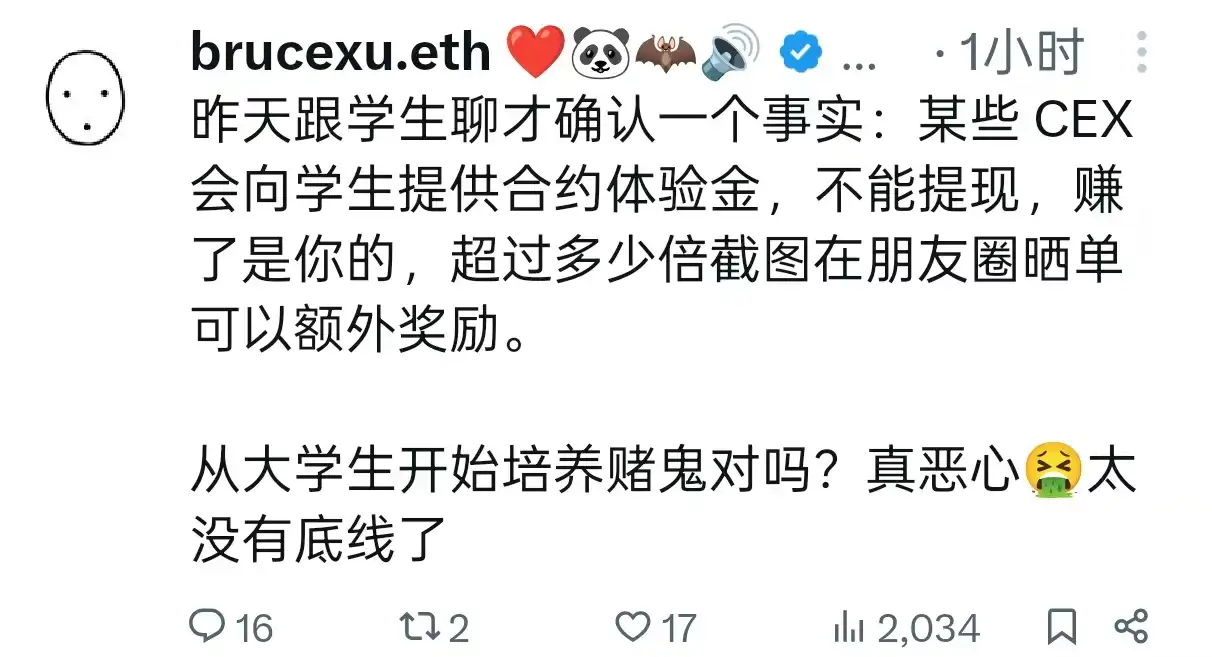
From initial capital giveaways to leverage incentives and social virality, this entire process precisely targets and exploits college students. This is not financial education or contract literacy promotion—it’s gambling inducement disguised as “financial enlightenment,” systematically preying on young people with weak risk awareness and poor money management skills.
Even though centralized crypto exchanges (CEXs) currently face user growth bottlenecks, that doesn’t justify turning college students into a growth lever. Such practices carry compliance risks and inflict long-term damage on the industry's reputation.
High-Risk Financial Instruments Should Not Target College Students
When technology meets finance, the "precise targeting" of youth has become a global challenge. Whether it's the structural design in the U.S. student loan system encouraging over-borrowing, or the proliferation of predatory lending through fintech products aimed at young people in Indonesia and the Philippines, countless young individuals worldwide have fallen into debt traps.
In 2015, as China’s mobile payment ecosystem began to take off, consumerism started spreading among youth. At the same time, internet finance platforms like Qufenqi, Fenqile, and Aiyomi aggressively entered university campuses under slogans such as “buy now, build credit.”
Qufenqi was the most prominent player. Through offline sales teams, it partnered with merchants selling smartphones, laptops, and cosmetics to host “campus exclusive sales events,” luring students into installment purchases. With just an ID card and student ID, one could “freeroll” an iPhone for less than 300 RMB per month.

But the dark side of this so-called “financial innovation” quickly emerged. Opaque interest rates, high service fees, and unreasonable repayment schedules rapidly pushed many students into debt spirals. To repay loans, numerous students resorted to borrowing from multiple platforms, rolling their debts like snowballs.
Worse still, as collections became difficult, some platforms and underground debt collectors resorted to extreme tactics like “naked-photo loans”—requiring female students to submit compromising photos as collateral, threatening exposure upon default. When the media exposed these practices, public outrage erupted across China.

Morally, this wave shattered societal底线. Even after rebranding and attempting to pivot into a “installment e-commerce platform” or “B2B fintech service provider,” Qufenqi remained stigmatized as the pioneer of predatory campus lending and faced widespread backlash.
Later renamed Qudian, the company launched an auto-financing project in 2018 offering young people car leases-to-own—again triggering resistance. In 2022, Qudian founder Luo Min made headlines by announcing his entry into the prepared-meal market, promoting heavily via Douyin livestreams. However, due to public distrust rooted in its campus lending past, celebrity endorsers including Jia Nailiang and Fu Shou'er quickly distanced themselves.
This episode remains a painful chapter—a collective memory of what happens when there is no regulation and no one intervenes until thousands of families are left paying the price.
Now, in today’s crypto landscape, futures trial funds are being openly marketed to college students—an apparent prelude to another disaster. This time, instead of usury, it’s about cultivating gambling addiction in subtler, harder-to-detect ways.
Futures Aren't Inherently Evil, But Greed Shouldn't Invade Campuses
In this cycle, university students have briefly become central figures in Web3 discourse. Many projects and VCs actively recruit diligent, motivated undergraduates as interns. Even crypto exchanges launched campus ambassador programs, allowing students to earn commissions and job opportunities by referring new users. However, amid community backlash, these initiatives were soon suspended, and official pages for them have since disappeared.
Now, some exchanges are escalating further—luring students into derivatives trading using futures coupons. Compared to the earlier campus loan crisis, this new push into crypto futures hasn’t even touched basic regulatory red lines.
Many centralized exchanges operate servers across jurisdictions, hide behind exhaustive disclaimers in user agreements, and employ globally dispersed staff. They often avoid full compliance with any single country’s regulations while expanding aggressively—especially in regions where financial literacy remains low.
In this regulatory vacuum, we can’t expect swift policy intervention. That means public moral pressure and collective user action are the most realistic and powerful forms of “regulation” available. No user or industry participant should remain silent about efforts to lure students into futures trading.
Futures trading, as a financial instrument, is legitimate—but context matters. The following three use cases can be considered ethically acceptable:
First, hedging risk—the original purpose of futures contracts. Institutions or experienced investors use futures to hedge spot price volatility. For example, miners lock in mining revenues, traders manage portfolio risk. This is a professional tool grounded in real assets and clear risk strategies.
Second, small-scale speculative entertainment by financially independent adults. Some individuals may allocate tiny portions of capital to short-term trading purely for thrill-seeking. This is acceptable only if they possess adequate risk awareness, have solid financial safety nets, and fully understand the consequences.
Third, mutual agreement between willing gamblers and casinos—what many call “degenerate gamblers.” These users neither hedge nor analyze—they trade based on gut feelings alone. While discouraged, if adults knowingly engage in gambling behavior, the principle of “winner takes all, loser pays up” applies between them and the platform.
But—college students are not degenerate gamblers.
They haven’t entered society yet. They lack stable income, risk awareness, and financial literacy. They should be building critical thinking in school—not being conditioned by platforms to think in terms of leverage. Any exchange directing its marketing toward college students is committing a deeply harmful act.
Take Action: Pressure CEXs Now
In the face of such predatory tactics targeting students with high-risk futures trading, the industry must break its silence. This behavior betrays the original promise of inclusive fintech and severely damages the credibility of the entire crypto sector. We need consistent, visible public pushback against practices involving free trial funds, encouragement of profit flexing, and nudges toward leveraged trading.
We must raise our voices and draw ethical boundaries:
We can—boycott CEXs running these programs on social media, refuse to register or deposit funds, and vote with our wallets: reminding platforms that users are not ATMs;
We can—maintain sustained public pressure on companies still pursuing such marketing strategies;
We can—encourage KOLs and journalists across the industry to publicly expose and condemn these exploitative tactics.
Only through such actions can we force platforms to realize that regulatory gray zones do not equate to moral free passes. College students should never be acquisition targets. If the industry truly values long-term sustainability, it must abandon growth models built on sacrificing the future of a generation. Such practices won’t drive industry progress or send crypto prices soaring—they will only deepen public stigma, hinder global regulatory acceptance, and betray the true vision of decentralization.
This isn’t the first time the industry has tested ethical boundaries in gray areas. Today it’s trial funds for students; tomorrow it might be “futures loans,” or AI-driven “micro-high-frequency leverage recommendation systems” tailored for newcomers. There will always be those designing traps specifically for young people who haven’t yet developed risk awareness.
If we don’t want to see disasters like “naked-photo loans” replayed in the crypto world, if we refuse to let another generation be turned into gamblers, we must act now. Resist this trend. And if platforms continue ignoring us, we will unite more KOLs and media outlets to keep exposing them—until this ends once and for all.
Join TechFlow official community to stay tuned
Telegram:https://t.me/TechFlowDaily
X (Twitter):https://x.com/TechFlowPost
X (Twitter) EN:https://x.com/BlockFlow_News
 BlockBeats