








Sign Protocol: Harnessing Blockchain Power to Enable Verification Anywhere
TechFlow Selected TechFlow Selected
Sign Protocol: Harnessing Blockchain Power to Enable Verification Anywhere
Leverage the core value of blockchain databases to deconstruct and solve verification challenges on-chain.
 Navigating Web3 tides with focused insights
Written by: TechFlow
As a fan of China's Super League, I recently noticed that a local club released season ticket packages for the upcoming league season—grab one, and you can attend all home games of the 2025 season in person.
But I didn't get one. Fans who held 2024 season tickets were given priority purchasing rights. While this policy was intended to reward long-term supporters, the reality turned out differently:
Many of last year’s season tickets were actually snatched up by scalpers. These scalpers never attend matches; instead, they resell the match attendance rights at inflated prices. Genuine fans are then forced to either buy tickets from scalpers at several times the original price or miss the games entirely.
As a blockchain practitioner, this prompted me to reflect on "how blockchain can truly impact real life":
How can a club ensure season tickets go directly to genuine fans?
The crux lies in accurately and efficiently verifying the identity of buyers.
What if data such as past match attendance rates and purchases of team merchandise were recorded on a blockchain? Could we leverage blockchain’s powerful distributed data verification capabilities to easily authenticate fan identities during ticket sales?
This is just one example. In fact, verification scenarios are everywhere in daily life, yet most suffer from inefficiency, high costs, and lack of rigor. If large-scale real-world data could be brought onto the blockchain—enabling fast, simple, and low-cost verification anytime, anywhere—could this be an effective path to unlock blockchain’s true value and drive widespread adoption?
Motivated by these thoughts, I began exploring the emerging field of "on-chain verification." To my surprise, there has already been a project focusing on this since 2020, steadily building a complete product suite, rich ecosystem, and vibrant community over years of dedicated development.
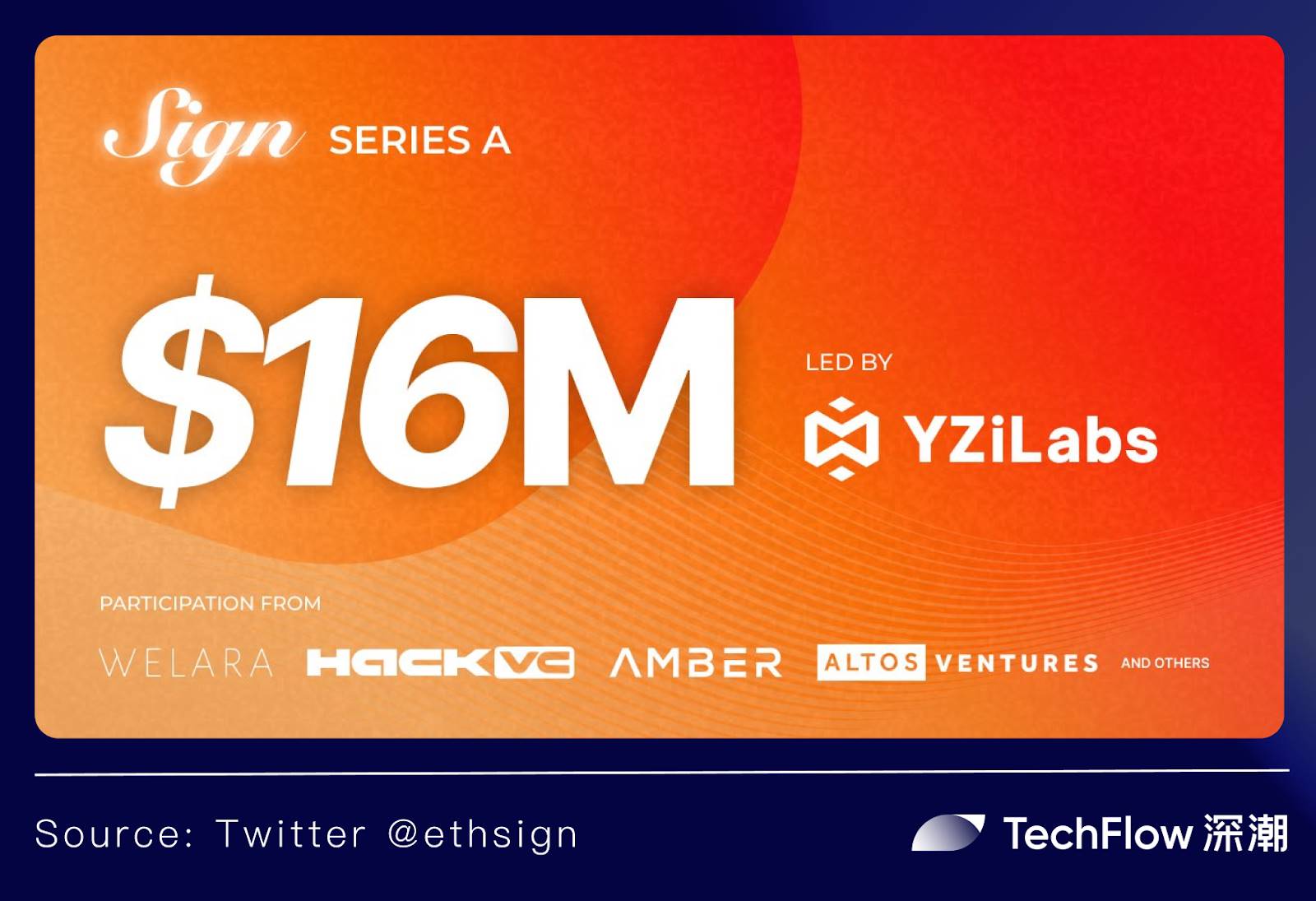
That project is Sign Protocol, the universal attestation protocol.
Unlocking Blockchain’s Core Value as a Database: Solving Verification Challenges On-Chain
Verification is everywhere in everyday life.
When checking into a hotel, you present identification to verify your reservation;
When starting a new job, you submit academic credentials and professional certificates to verify your qualifications;
When applying for a mortgage, you provide household registration, social security payment records, bank statements, and proof of stable income to demonstrate eligibility…
Yet upon closer inspection, traditional verification systems have serious flaws:
Daily verifications often lack rigor—just like those league tickets never meant for real fans;
Critical verifications are typically controlled by centralized authorities, making them inefficient and costly.
Take applying for a U.S. visa as an example. You usually need to prepare numerous documents:
-
Identification: Household registration, ID card, etc.
-
Financial status: Bank statements, income proofs, property deeds, etc.
-
Employment status: Employment confirmation letter issued by your company
-
Travel itinerary: Round-trip flight bookings, hotel reservations, etc.
-
……
You end up shuttling between banks, social security offices, and consulates to collect these documents—a time-consuming, expensive process often involving long waits.
Worse still, when applying for visas to other countries, you must repeat this cumbersome process over and over again, since different nations’ visa systems don’t interoperate.
Anyone who’s gone through it knows: it’s incredibly inconvenient.
We urgently need a verification solution that is rigorous, efficient, convenient, and low-cost.
Blockchain technology, with its decentralized, tamper-proof, and transparent nature, shows exceptional promise in addressing these verification challenges.
We know that due to fragmented sovereignty and isolated institutions in the real world, information silos lead to inefficient and expensive verification processes.
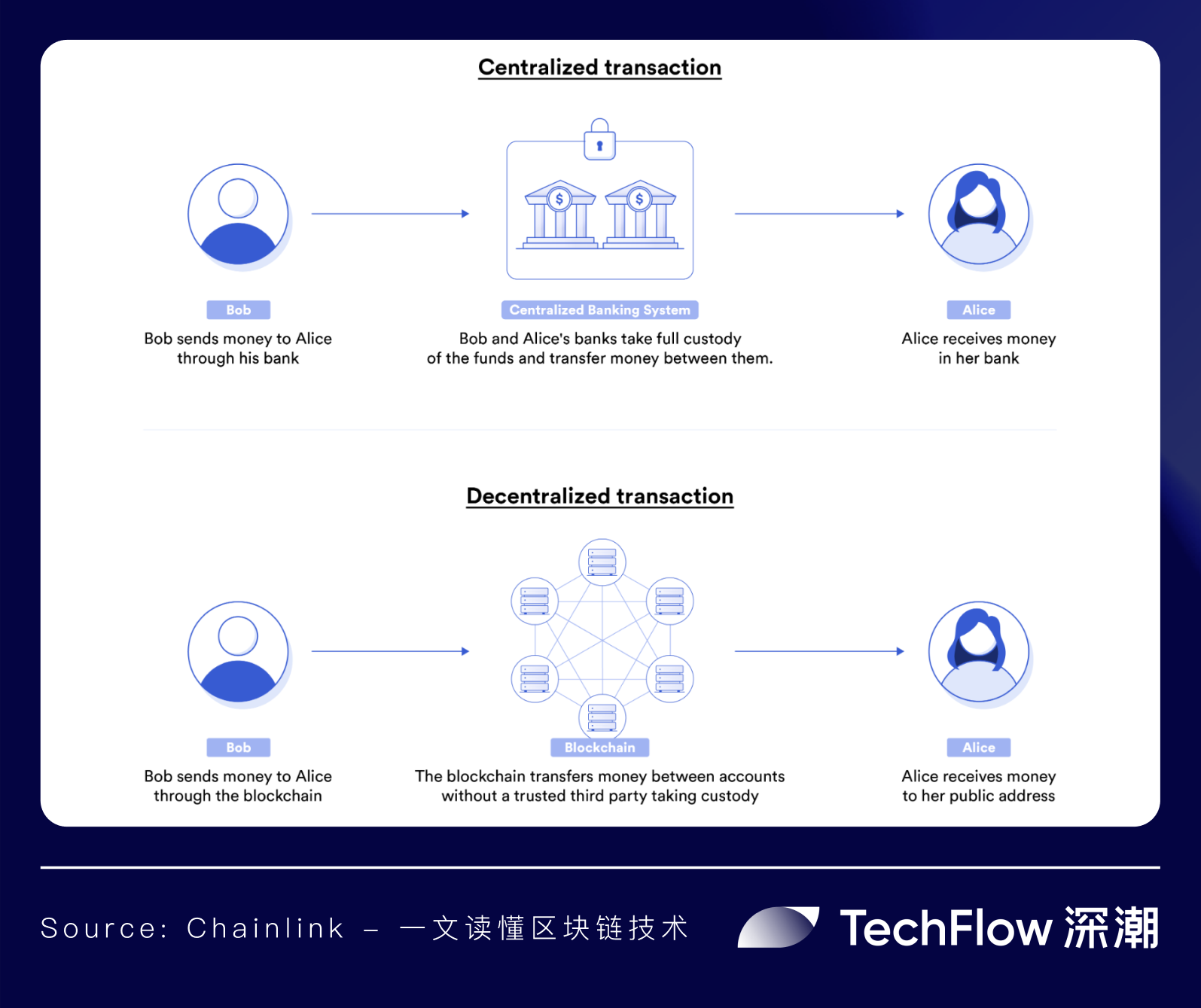
Blockchain transcends these boundaries. At its core, it is a distributed ledger where every node maintains a full copy of transaction history. This gives blockchain a crucial technical feature:
Every transaction can be verified anytime, anywhere.
Building on this capability:
Could we write data onto the blockchain using standardized formats so that it becomes universally verifiable anytime and anywhere?
Furthermore, could this data include vast amounts of real-world information, enabling virtually anything to be recorded on-chain and verified simply, efficiently, and affordably?
And thanks to blockchain’s transparency, could privacy-preserving technologies like zero-knowledge (ZK) proofs allow selective disclosure without exposing sensitive details?
This is exactly what Sign Protocol achieves.
From Standardized Data Writing to Efficient Retrieval: How Sign Makes Everything Verifiable On-Chain
At its heart, Sign Protocol aims to do one thing clearly:
Leverage blockchain’s role as a distributed database, empowering users to freely prove and retrieve structured, verifiable data on-chain—providing solutions for any user or scenario requiring authentication.
This vision is realized through several key steps:
-
Writing data
-
Creating attestations
-
Storing attestations
-
Efficiently retrieving attestations
Sign Protocol’s architecture revolves around these foundational processes.
Two concepts are central to Sign Protocol’s design:
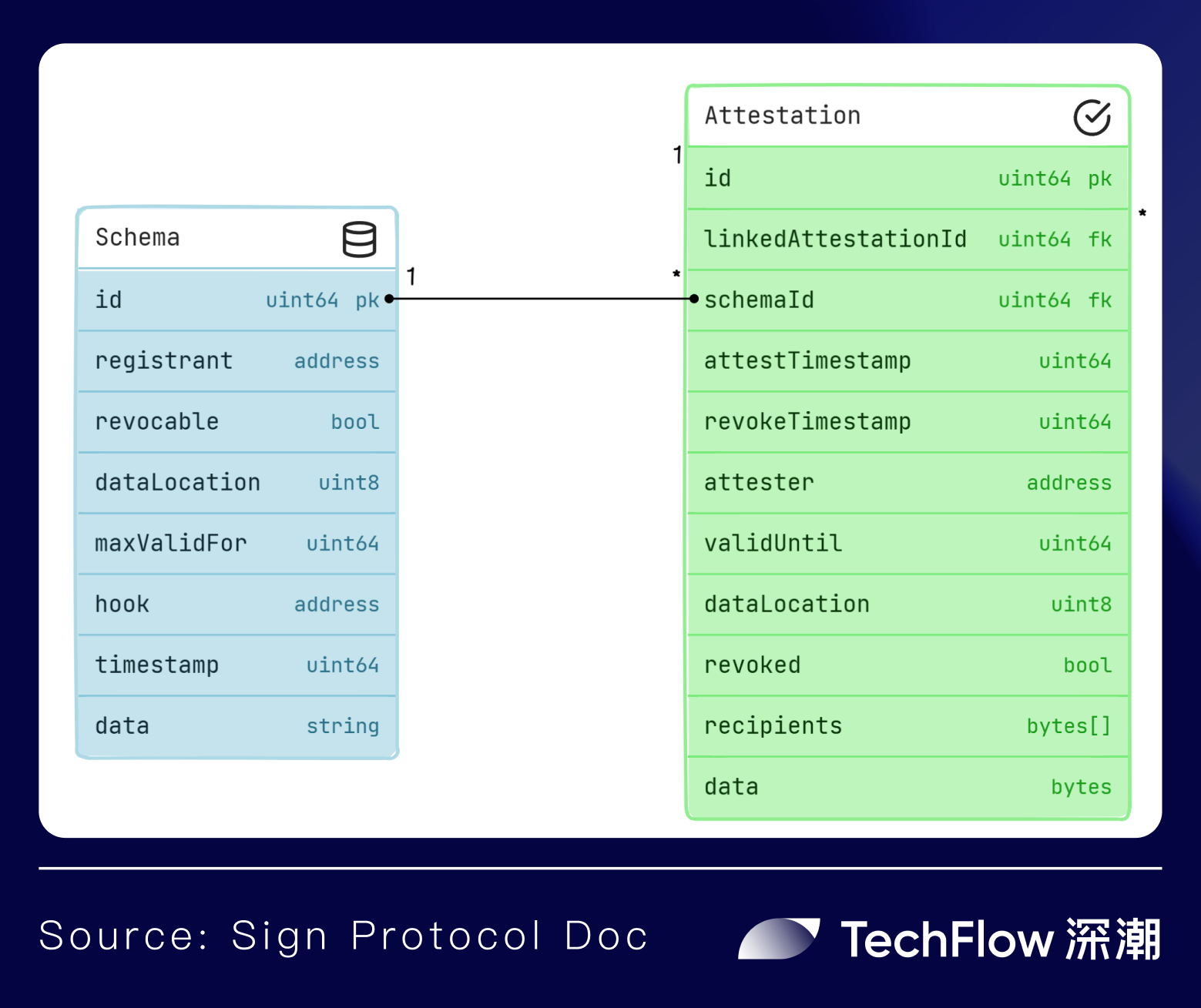
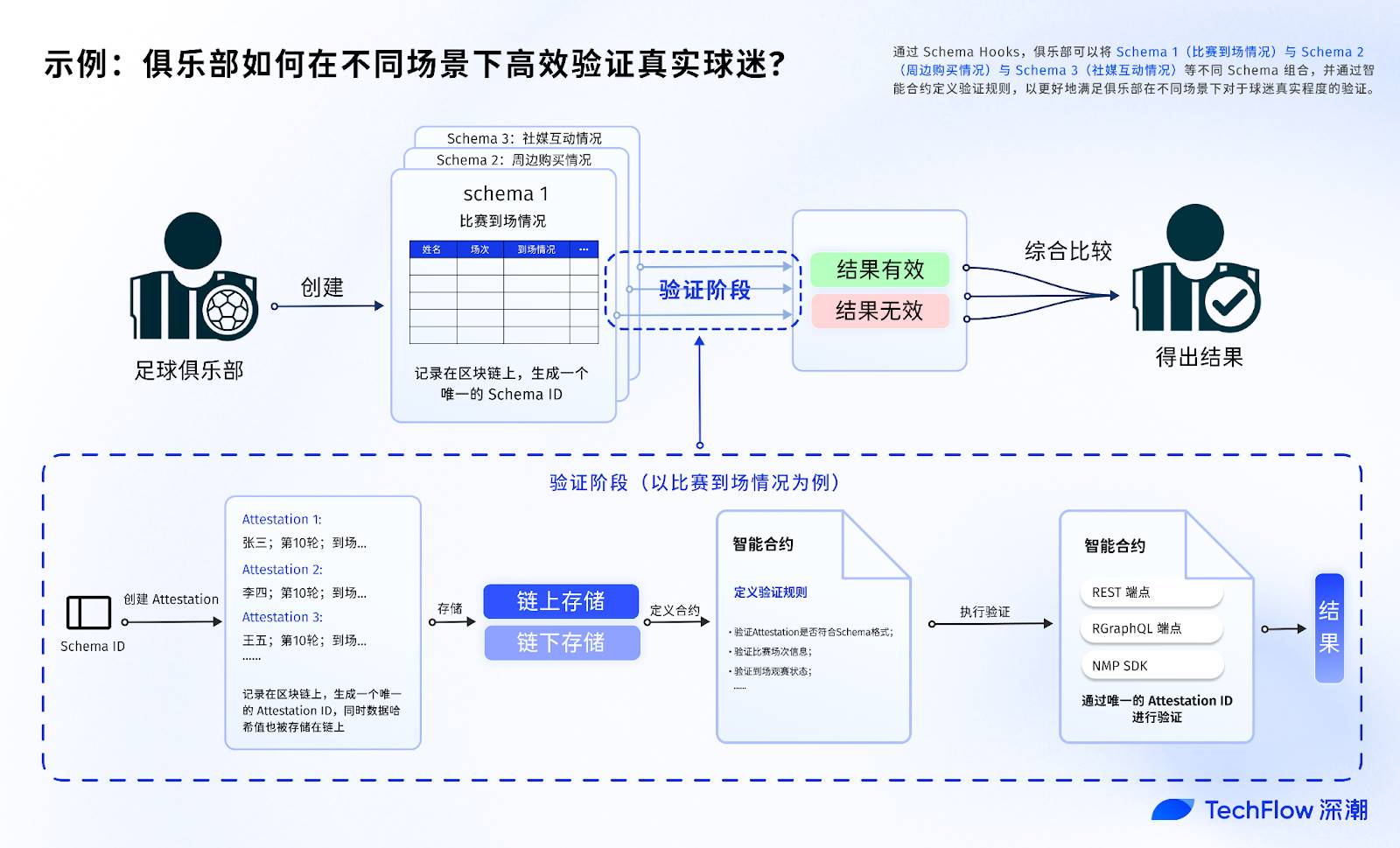
First is Schema, which acts as a data standard defining the types and structure of information used when creating attestations.
Second is Attestation, a digital signature representing structured data compliant with a Schema. Given blockchain’s public nature, many use cases require privacy protection. To address this, Sign Protocol integrates ZK technology as an optional layer, allowing data to be verified without revealing its contents—greatly expanding the applicability of on-chain verification.
Schema and Attestation are interdependent:
To create a Schema, you first define the intended Attestation: What kind of information will it store? How much data is involved?
To create an Attestation, you must find or define a compatible Schema. The Attestation must strictly follow the Schema format to ensure it is accurate, parseable, and composable for any verifier.
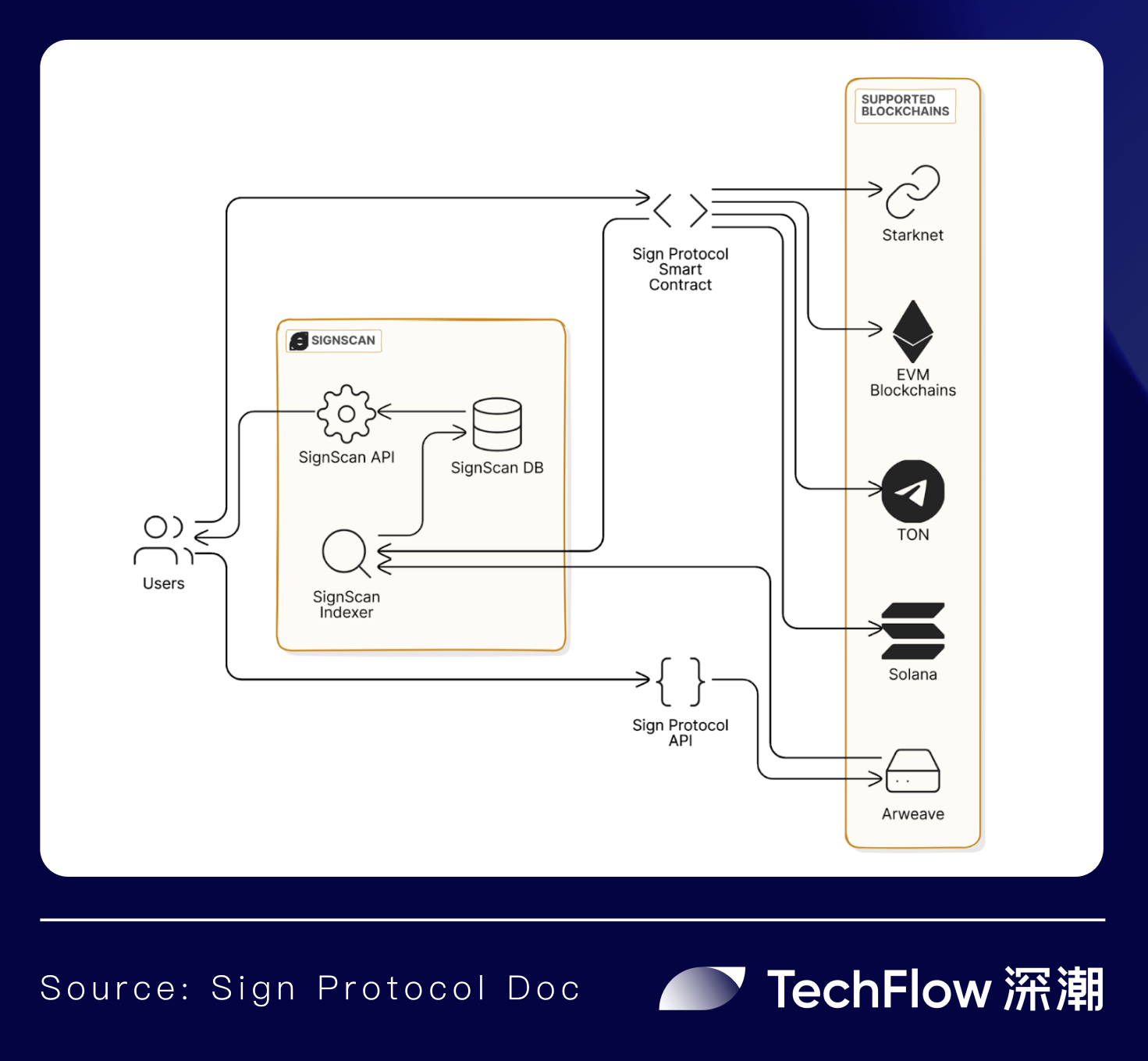
Once created, Attestations are stored via smart contracts. Sign Protocol supports both on-chain and off-chain storage to better accommodate large datasets. Typically, larger data is stored off-chain at lower cost, with support for Arweave and IPFS.
When querying proofs, Sign Protocol offers efficient indexing services. Users can access attestations via REST or GraphQL endpoints, or directly through an NPM SDK. On-chain data is validated through blockchain consensus; off-chain data is verified by comparing hash values stored on-chain.
Moreover, to handle diverse and complex verification needs, Sign Protocol offers strong composability:
Developers can use Schema Hooks to deploy custom smart contracts, enabling arbitrary logic to execute upon Attestation creation or revocation—enhancing flexibility and functionality. This allows combining multiple Schemas for complex scenarios. For instance, integrating schemas for bank statements, social security records, and household registration enables streamlined home purchase eligibility verification.
In addition, as a cross-chain protocol, Sign Protocol operates independently of any single blockchain, seamlessly deploying across various environments to serve the entire blockchain ecosystem. It currently supports Ethereum and EVM-compatible chains, with plans to expand to more blockchains—aiming to become the universal verification solution for all chains and use cases.
Bridging On-Chain and Off-Chain Verification: A Leap Toward a Blockchain-Based Sovereign-Agnostic Society
In this current cycle dominated by PvP (player versus player) dynamics, we’re immersed in the adrenaline rush of quick trades and rapid exits. Yet many are left wondering:
What can blockchain actually do? Is it just creating a massive casino on-chain?
Returning to our earlier point: blockchain is fundamentally a distributed database.
Previously, this database had limited interaction with the real world, functioning mostly as a ledger for on-chain transactions.
But once it begins incorporating extensive real-life data, blockchain evolves into a parallel, sovereign-agnostic digital society coexisting with the physical world.
Sign Protocol, built on a deep understanding of blockchain’s technical strengths, uses practical verification mechanisms to bring massive real-world data on-chain. It creates genuine demand for blockchain technology and sets a powerful precedent for how blockchain can drive meaningful change—while providing critical real-world grounding for the development of this “sovereign-agnostic” digital society.
Let’s revisit international travel. Imagine:
No matter which country’s visa you apply for, you can prepare all required documents in under two minutes. Your employment verification, income proof, bank statements, and family relationship records are already on-chain and instantly retrievable. You simply query relevant attestations, combine them as needed, and leverage ZK proofs to protect your privacy—all without exposing raw data.
No matter where you travel, you carry one compliant, globally recognized digital ID. You can securely, efficiently, and conveniently prove “you are you” anytime, anywhere—in airports, border control, hotels. Officials scan a QR code on your card and instantly verify its authenticity on-chain, while biometric checks (e.g., photo matching) confirm your identity in seconds.
You can also use this ID online—for example, during exchange KYC. No more repeated facial recognition, document uploads, or waiting for manual review. Everything is digitally verified on-chain within minutes.
This kind of verification is not only rigorous and fast—it dramatically reduces costs, marking a revolutionary upgrade to traditional verification experiences.
Verification is ubiquitous in life. With Sign Protocol’s on-chain solution, transformative changes await every verification-dependent scenario:
In an increasingly interconnected global economy, you can sign agreements anytime, anywhere via Sign Protocol—and anyone, anywhere, can instantly verify your signature;
When buying health insurance, your medical history can be efficiently verified on-chain, streamlining assessments across insurers;
When attending a capital-verification-required art auction but lacking liquid cash, your on-chain assets can serve as proof of funds;
During voting processes, you can verify ballots originate from legitimate voters, ensuring outcomes reflect stakeholders’ true interests;
Even further, under the principle of “everything can be verified on-chain,” countless new applications emerge:
Verifying social behaviors—like being an AI enthusiast—can form interest-based communities;
Validating contributors in a community enables fair, merit-based governance;
Tracking consumer purchase histories allows brands to build efficient membership programs.
The possibilities are endless. Wherever there is verification, Sign Protocol can play a role.
In fact, Sign Protocol has already achieved notable success across multiple domains:
EthSign, a decentralized e-signature platform built on Sign Protocol, has served over 300,000 users;
TokenTable, an on-chain token distribution protocol based on Sign Protocol, has partnered with 200+ projects, facilitated over $4 billion in token airdrops and unlocks, reaching 40 million users and investors, and generated over $15 million in revenue in 2024;
SignPass, a digital identity system powered by Sign Protocol, has partnered with the government of Sierra Leone to issue national IDs. SignPass provides users with blockchain-verifiable digital identities, with all credentials cryptographically registered on-chain via Sign Protocol. Holders also receive a physical ID card compliant with ICAO machine-readable passport standards, featuring a unique QR code linked to the blockchain record. Scanning this code enables seamless global mobility.
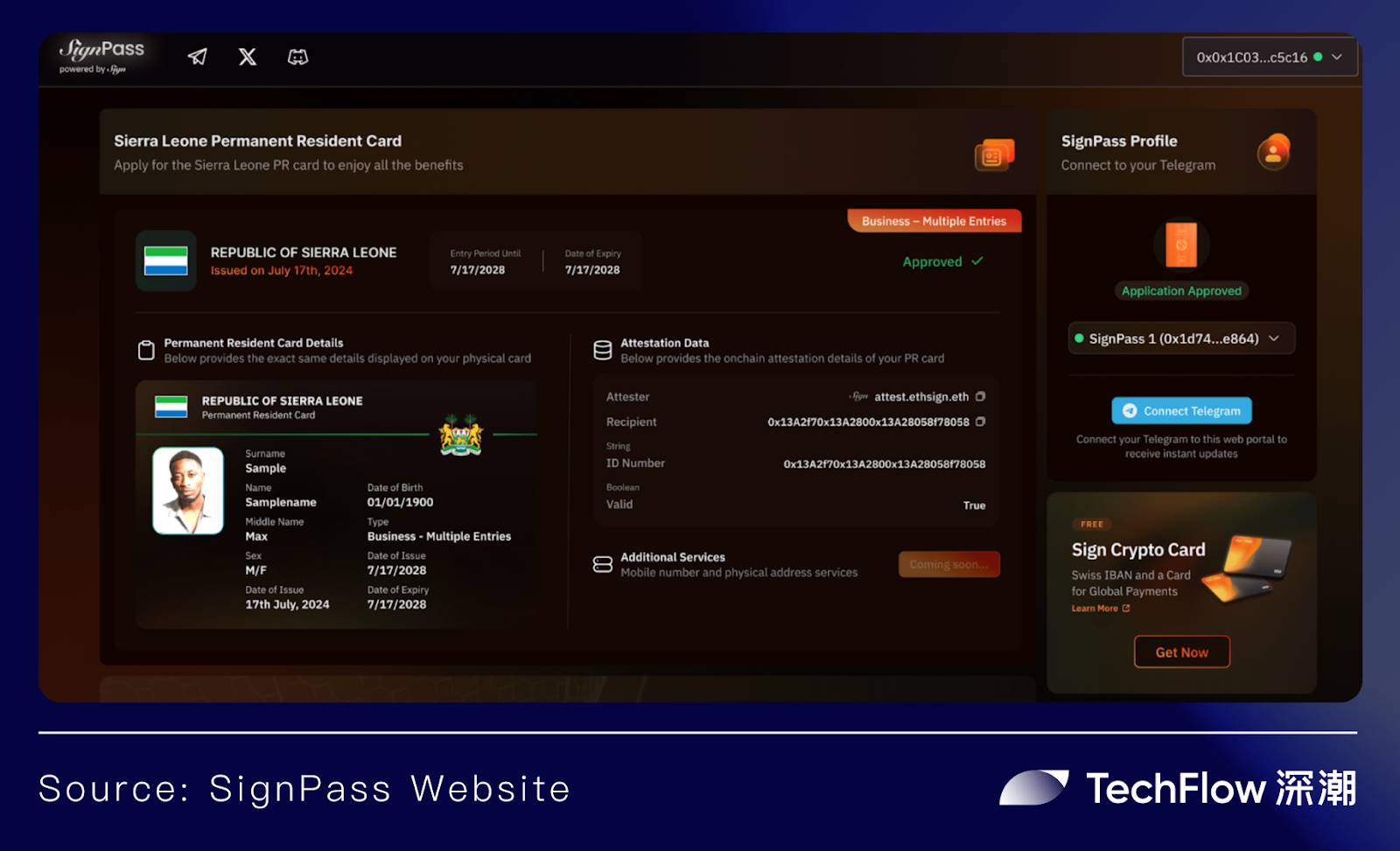
Following Sierra Leone, Sign Protocol has announced collaboration with the UAE government on its Web3 Entrepreneur Program. According to its official roadmap, in 2025, Sign Protocol will focus on deepening partnerships between SignPass and national governments, regulatory bodies, and industry alliances.
2025 will be a pivotal year for deeper integration between blockchain and the real world. With the U.S. government adopting crypto-friendly policies, active engagement from political leaders, and traditional institutions entering the space, regulatory clarity and broader exploration of blockchain applications appear increasingly likely.
As Sign Protocol expands into more real-world use cases and more citizens gain blockchain-based identities through SignPass, as national-scale user bases migrate on-chain—what innovations will emerge within this blockchain-powered, sovereign-agnostic society?
As long-term value regains focus, stay tuned. Stay ready.
Join TechFlow official community to stay tuned
Telegram:https://t.me/TechFlowDaily
X (Twitter):https://x.com/TechFlowPost
X (Twitter) EN:https://x.com/BlockFlow_News
 深潮TechFlow


