








Weeklong surge of 500%, understanding Sonic's "DeFi engine" Shadow Exchange
TechFlow Selected TechFlow Selected
Weeklong surge of 500%, understanding Sonic's "DeFi engine" Shadow Exchange
Will Shadow Exchange lead the DeFi season 2.0?
 Navigating Web3 tides with focused insights
Author: Penny
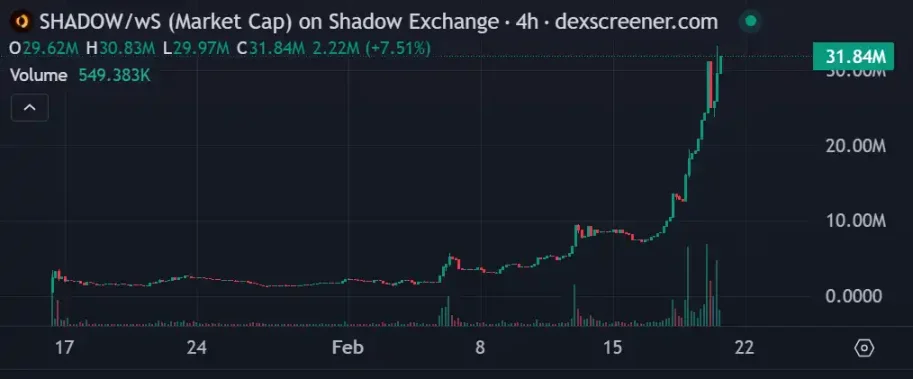
Currently in the Sonic ecosystem, one of the hottest sectors is Shadow Exchange. Its native token $SHADOW has surged from a market cap of around $5M to $31.84M within a week—an increase of over 500%. Shadow Exchange currently hosts 457 liquidity pools, with a 7-day trading volume of $557 million and a single-day peak volume reaching $171 million.
While other chains remain distracted by meme markets amid constant unexpected events, Sonic Labs has focused on DeFi development. Sonic has announced multiple new initiatives to incentivize DeFi projects within its ecosystem, driving a 500% surge in TVL over the past month. In just two months, Sonic has grown from zero to over $500 million in TVL, attracting a net inflow of $110 million from external capital—primarily from Solana, followed by Base and ETH. DEX trading volume on Sonic has also surpassed $1 billion.
Shadow Exchange is a native concentrated liquidity layer and exchange on Sonic. Within Sonic’s high-speed, low-cost EVM-compatible Layer 1 environment, Shadow Exchange serves as one of the core trading protocols, enhancing the traditional ve(3,3) model into an x(3,3) incentive model that has captured significant investor attention.
Familiar (3,3), But With an x
The history of decentralized finance has long been marked by repeated attempts to solve the "DEX trilemma"—how to align incentives among traders, liquidity providers, and token holders. While Andre Cronje's ve(3,3) model theoretically addressed this by balancing incentives across all participants, the requirement for long-term locking created a high-friction system, forcing users to lock tokens to fairly participate in the incentive structure.
Uniswap focuses on a simple two-party system: traders and liquidity providers (LPs). ve(3,3) improves upon this by incorporating token holder incentives, but access to these incentives remains unfair and heavily favors the protocol itself.
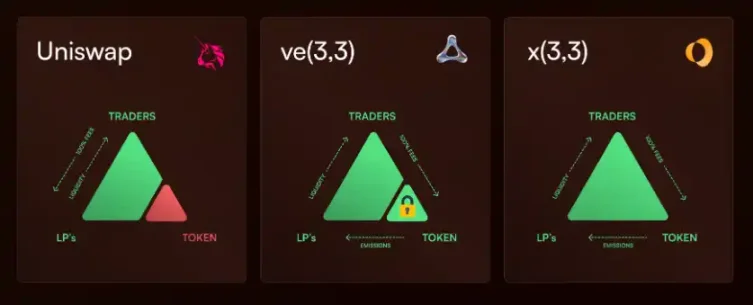
The x(3,3) model resolves these issues by allowing users to exit at any time and removing lock-up restrictions through incentives. Users can stake platform tokens to participate in governance and vote on emission weights for liquidity pools. Voters receive fee shares and additional "bribe rewards," encouraging long-term holders to deeply engage in ecosystem development. The diagram below clearly illustrates the entire DeFi model flow:
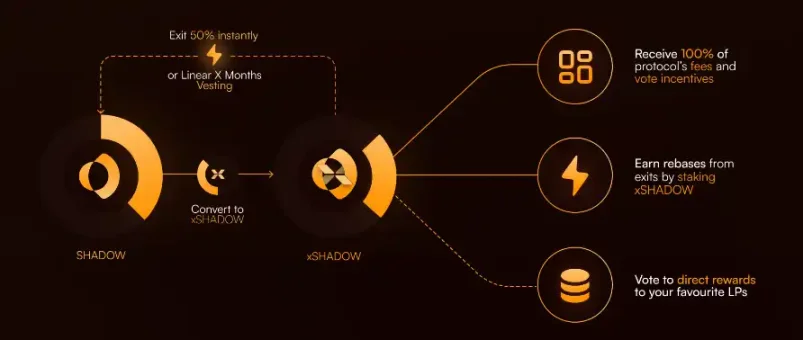
$SHADOW is the base token, freely exchangeable with other currencies. $SHADOW can be converted 1:1 into xSHADOW, the central token in the model. xSHADOW stakers can vote to direct rewards directly to LP pairs and earn 100% of protocol fees, voting rewards, and exit penalties through staking.
For user exits, Shadow implements a unique player-versus-player (PvP) rebasing mechanism where exit penalties are distributed to existing xSHADOW stakers. When a user prematurely exits their xSHADOW position, 100% of the forfeited tokens are redistributed proportionally to current xSHADOW stakers. In terms of token selection, users may claim liquid SHADOW and enjoy the default APY, or opt for non-liquid xSHADOW to receive double the APY.
Users can convert xSHADOW back to SHADOW at any time: immediate conversion (with a 50% penalty) or conversion over a chosen vesting period (e.g., 3 months = 1:0.73 ratio). Longer vesting periods yield more favorable conversion rates, with full 1:1 conversion achievable after a complete 6-month vesting period, incurring no penalties.
Voting Incentives
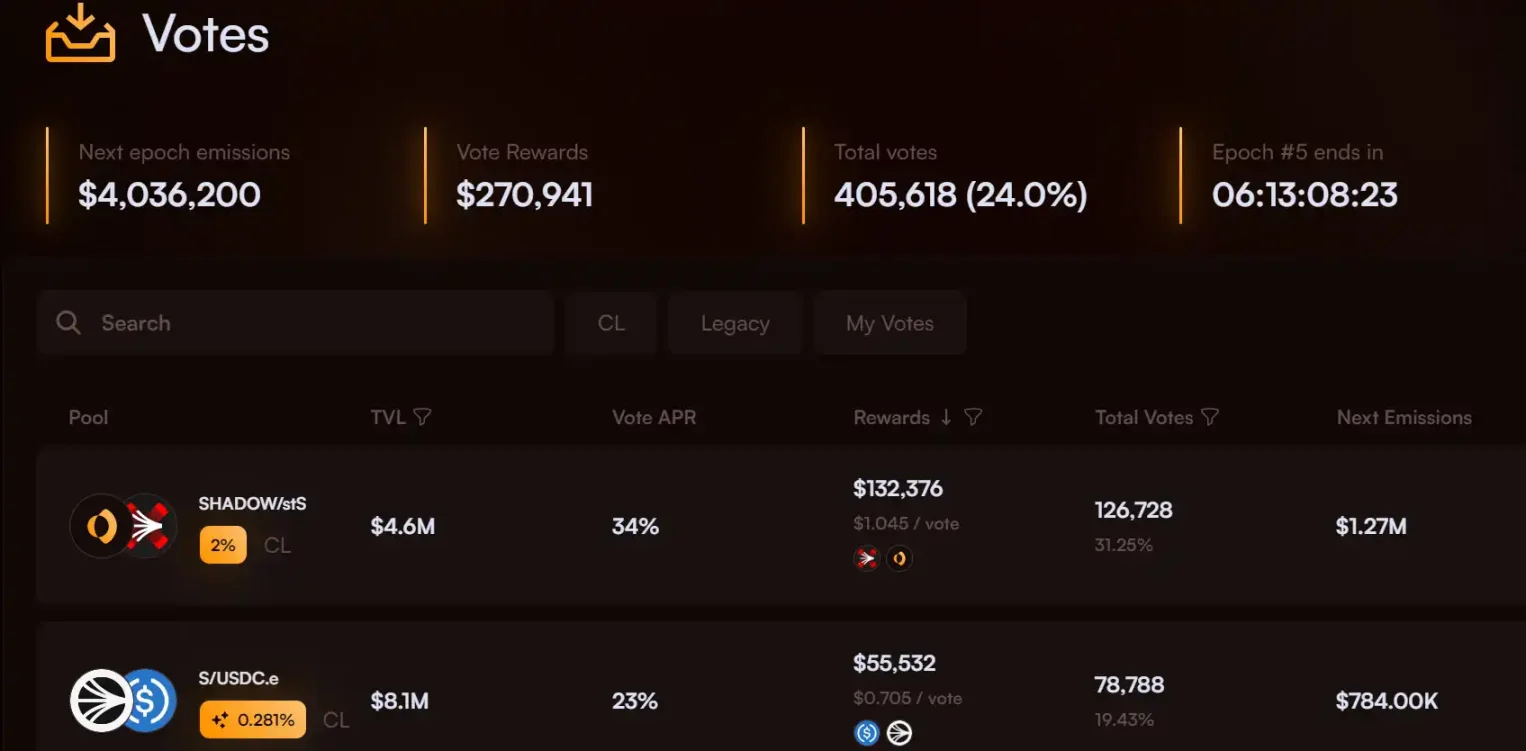
xSHADOW holders earn rewards through active participation and voting. When holders vote via gauge to support liquidity, they proportionally share all fees generated by that liquidity, along with additional voting incentives offered by the protocol to boost engagement. The primary purpose of the xSHADOW token is to guide token emissions toward boosting liquidity—the portion of emitted tokens allocated based on the percentage of votes received during a cycle. For example, if 100,000 xSHADOW are distributed in a single epoch and 10% of all votes are assigned to the SHADOW/USDC pair, that pair receives 10,000 xSHADOW tokens, which are then linearly distributed to the corresponding LP pair’s liquidity providers throughout the period.
Liquid Staking
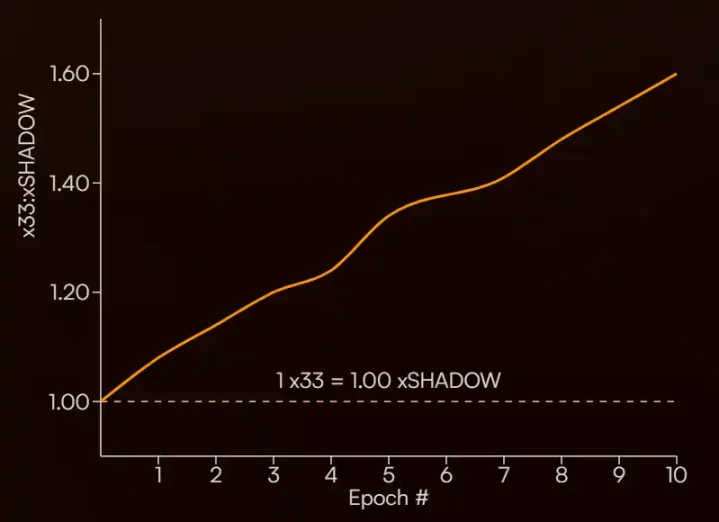
Shadow aims to eliminate friction present in the ve(3,3) model, with management of voting positions being one of the biggest sources of friction. By enabling liquid staking of xSHADOW, users can mint $x33, simplifying the process through automated voting and reward collection without interfering with xSHADOW’s core mechanics. The $x33:xSHADOW ratio starts at 1.00:1.00 and gradually increases in favor of $x33 as rewards accumulate from fees, voting incentives, and resets. At the end of each cycle, rewards from fees and voting incentives are automatically sold to improve the $x33:xSHADOW ratio. While $x33 offers instant liquidity, it still inherits the exit penalties associated with xSHADOW. As a liquid staked version of xSHADOW, the market price of $x33 naturally reflects the immediate exit cost structure and cannot trade below the redemption value of xSHADOW.
Shadow adopts a unique player-versus-player (PvP) approach to enhance the traditional ve(3,3) anti-dilution model, aiming to both protect xSHADOW holders from dilution and incentivize them to maintain holdings and contribute to SHADOW’s ongoing success. Longer-staying xSHADOW stakers earn greater fees, voting incentives, and rewards from user and emission exits. Users retain the ability to exit at any time, ensuring rewards flow to those who value and actively sustain the system. This mechanism not only discourages premature exits but also ensures remaining participants are rewarded for loyalty and active engagement.
With Sonic’s rapidly growing TVL (up 13x since early 2025 to $357 million) and endorsements from core developers like Andre Cronje, Shadow Exchange is well-positioned to leverage ecosystem momentum and become a benchmark for next-generation DeFi trading protocols. Shadow Exchange is not merely a technical testing ground for the Sonic chain, but also a frontier for innovation in DeFi governance and liquidity, offering a new paradigm for traders, liquidity providers, and project teams alike.
Join TechFlow official community to stay tuned
Telegram:https://t.me/TechFlowDaily
X (Twitter):https://x.com/TechFlowPost
X (Twitter) EN:https://x.com/BlockFlow_News
 BlockBeats






