Google CEO: We are now in a golden age of AI innovation
TechFlow Selected TechFlow Selected
Google CEO: We are now in a golden age of AI innovation
As one of the global leaders in AI, Google is willing to continue participating in and leading this golden age of AI innovation.
 Navigating Web3 tides with focused insights
Author: AIGC Open Community

Image source: Generated by Wujie AI
At 3 a.m. today, Sundar Pichai, CEO of Google and Alphabet, delivered a keynote speech at the Global AI Summit currently taking place in Paris, France — declaring that we are now in the golden age of AI innovation.
Pichai believes AI technology is advancing rapidly, with particularly notable reductions in cost. Over the past 18 months, the cost of processing tokens has dropped from $4 per million to just 13 cents — a 97% decrease.
AI has also achieved significant breakthroughs in science. For example, Google's protein model AlphaFold has helped over 2.5 million researchers worldwide develop new malaria vaccines and cancer treatments. Google has also made major progress in quantum computing, where its latest Willow quantum chip solved an extremely difficult problem in under five minutes — a task that would take a classical computer billions of billions of years.
From AlphaGo Zero, which defeated top human Go players, to the protein model AlphaFold, and the Transformer architecture that changed the course of AI, Google — as one of the global leaders in AI — is committed to continuing participation and leadership in this golden age of AI innovation.
Below is the full text of Pichai’s speech:
Distinguished leaders and guests, I am truly honored to be here with you today.
President Macron, thank you for your invitation, and for bringing together such an exceptional group of people.
AI is a once-in-a-generation technology. Discussions like today’s, focused on collaboration and concrete actions, will drive this work forward.
Today, I’d like to share some examples explaining why I’m so optimistic about AI and its applications, and how we have the opportunity to ensure everyone around the world benefits from it.
To me, improving lives through technology is deeply personal.

I grew up in Chennai, India. Every new technology took a long time to reach us — including rotary dial phones. We were on a five-year waiting list. When the phone was finally installed at home, it transformed our lives.
Before, I had to spend four hours round-trip to collect my mother’s blood test results. Sometimes, after arriving at the hospital, I was told, “It’s not ready yet. Come back tomorrow.” Now, we can simply make a call.
I’ve seen firsthand how technology can have a positive impact and improve lives. That experience set me on a path — first to the United States, and eventually to a then-small startup called Google.
Back then, I couldn’t have imagined that one day I’d raise a toast celebrating three Nobel Prizes won by Google colleagues within weeks, or take my parents for a ride in a self-driving car. All made possible by another technology: AI.
We’re still in the early stages of AI, but I firmly believe it will bring the most profound changes of our lifetimes.
Its impact will surpass even the rise of personal computers and mobile internet. And compared to the internet, it will do far more to democratize access to information.
In the past 18 months alone, developers’ cost to process a token has dropped by 97%. Processing one million tokens used to cost $4; now it’s just 13 cents — and I expect this trend to continue.
The result? Intelligence is more accessible and widespread than ever before.
So right now feels like a platform shift. But what makes it so transformative? A few key reasons:
As interactions with AI become more intuitive and human-like, it puts us at the center of the experience. Technology begins to feel like a natural extension of ourselves, enhancing human capabilities, bridging gaps in expertise and experience, and breaking down language and accessibility barriers.
As a true general-purpose technology, AI applies across countless human activities and every sector of the economy. Every company, every industry — including the public sector — will adopt it in their own way.
As AI evolves, it will fuel innovation, opportunity, and growth across the global economy, sparking explosive advances in knowledge, learning, creativity, and productivity — shaping the future in exciting ways.
The opportunities AI brings are immense. And all of you here bear the responsibility to ensure as many people as possible benefit.
Why Google Invests in AI
The chance to improve lives and transform the world is precisely why Google has invested in AI for over a decade. Because we see it as the most important path to advance our mission: organizing the world’s information and making it universally accessible and useful.
Looking back at the past decade of major breakthroughs in AI, our researchers have played a pivotal role — from foundational language understanding technologies, to AI that beat the world’s best Go players, to the Transformer architecture, which underpins today’s generative AI revolution and powers the most advanced models.
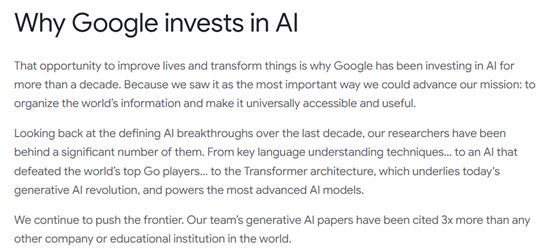
We continue pushing the frontier. Our team’s research papers on generative AI have been cited three times more than those of any other company or academic institution worldwide.
Advancing this field means building infrastructure. This includes our network of over 2 million miles of terrestrial and undersea fiber-optic cables. It also includes our custom AI chips — Tensor Processing Units (TPUs) — now in their sixth generation. In just the last two generations, we’ve improved their carbon efficiency by 3x.
This infrastructure enables cutting-edge models like Gemini, which breaks new ground in multimodal understanding — handling text, images, video, audio, and code — while also offering long-context reasoning and agent capabilities.
Our infrastructure also allows us to deliver these frontier technologies to developers, entrepreneurs, and businesses.
Finally, we’re building applications that bring AI’s help to people around the world. Today, seven of our products each serve over 2 billion users — including Google Maps, Google Search, and Android — all enhanced by our AI innovations and the latest Gemini models.
Together, these form our unique full-stack innovation model, creating entirely new experiences.
How AI Enables New Experiences
I’m especially excited about experiences powered by deep research and reasoning — helping people dive deep into specific topics, like having a personal research assistant that searches the web, analyzes documents, and summarizes key findings.
I know many of you are already thinking about summer plans.
You could ask a deep research agent: “Where in Europe should I go for a two-week vacation in August?” Five minutes later, you’ll receive a comprehensive analysis considering costs, weather, visa requirements, and more — with all sources cited. And the speed of information retrieval keeps accelerating.
Or perhaps you don’t want to search the web, but instead want the model to extract insights only from documents you provide — that’s the magic of NotebookLM. Imagine turning a stack of dense documents into an engaging podcast. In just three months, people have generated over 350 years’ worth of audio summaries. Enterprises are using it to build centralized knowledge bases — like an internal expert that answers questions about policies, processes, and customers.
As models grow more multimodal, their understanding of the physical world improves. Just point your phone’s camera at an object and ask Project Astra.
What’s truly exciting is that Project Astra brings us closer to the vision of a universal AI assistant — seamlessly integrated across devices and contexts. We’ll soon bring similar capabilities into our products.
How AI Accelerates Scientific Discovery
These are some current examples of how people and businesses use AI.
But in science and exploration, some of AI’s most thrilling achievements lie ahead.
A powerful example is AlphaFold, which made a breakthrough in predicting complex protein structures. The Nobel Prize celebration I mentioned earlier was for the work of Demis and John from DeepMind, a subsidiary of Google. Demis — or should I say, Sir Demis — is here today. Let’s give him a round of applause.
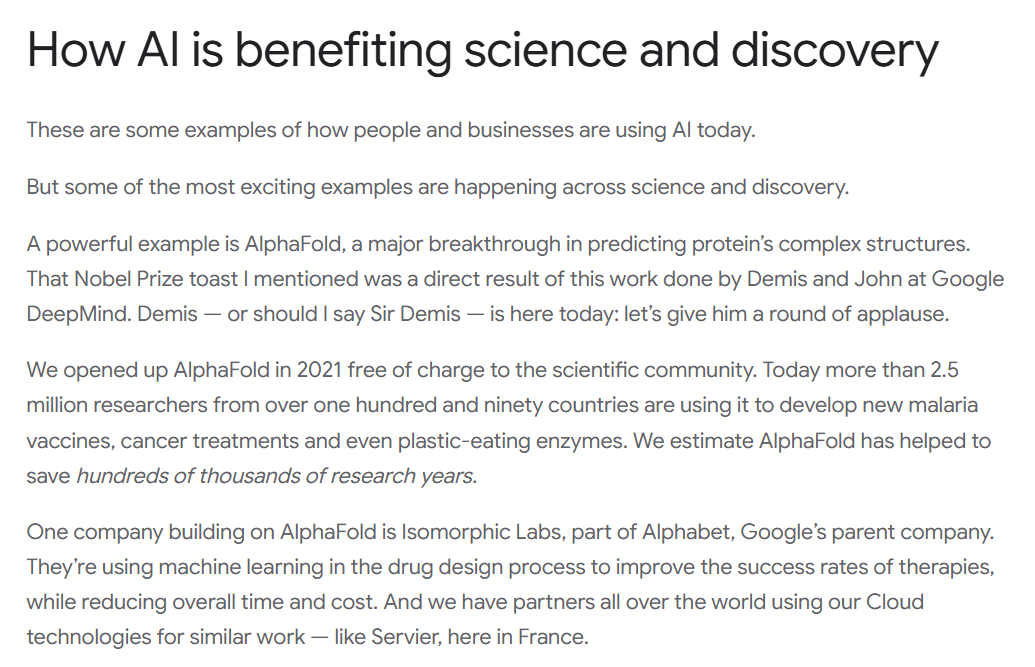
In 2021, we opened AlphaFold to the scientific community for free. Today, over 2.5 million researchers from more than 190 countries use it to develop new malaria vaccines, cancer therapies, and even enzymes that break down plastic. We estimate AlphaFold has saved hundreds of thousands of research hours.
Isomorphic Labs, a company under Alphabet, builds on AlphaFold’s foundation, applying machine learning to drug design to increase treatment success rates while reducing development time and cost. We also have numerous global partners using our cloud technology for similar efforts — including Servier in France.
Quantum computing will also help scientists discover new drugs, design better batteries for electric vehicles, and accelerate research in nuclear fusion and clean energy.
This is the next major paradigm shift in computing after AI. And we’re making solid progress.
Last December, we achieved a new breakthrough. Our most advanced Willow quantum chip completed a computation in under five minutes — a task that would take a classical computer 10^25 years (that’s 1 followed by 25 zeros — longer than the age of the universe by many multiples).
And as we scale up the number of quantum chips, error rates actually decrease. By the way, AI plays a role here too. We’ll continue progressing toward fully error-corrected quantum computers.
Now let me share an example that’s already real: fully autonomous vehicles.
After years of R&D and deployment, recent progress in self-driving cars has been remarkable.
In 2024, Waymo operated in four cities and provided over 4 million passenger rides.
Recently, one of those rides took me and my parents to a park near the Golden Gate Bridge in San Francisco.
I’d ridden in Waymo vehicles before, but seeing my father, in his 80s, experience this technology gave me a whole new appreciation for how far it’s come.
How AI Benefits Society
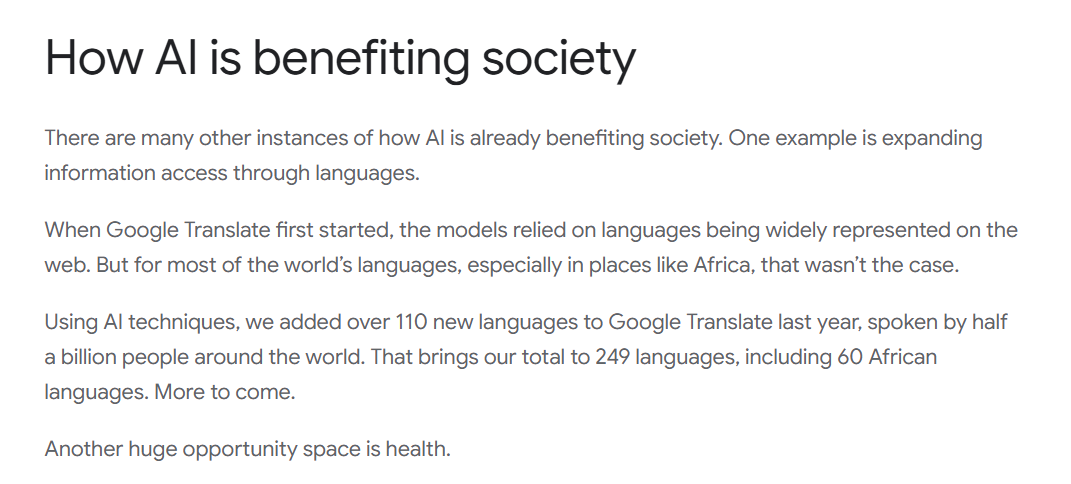
There are many more examples of AI benefiting society. One is expanding access to information through language.
When Google Translate launched, its models relied on widely available language data online. But for most languages in the world — especially in regions like Africa — this wasn’t the case.
Last year, we used AI to add over 110 new languages to Google Translate, spoken by 500 million people globally. This brings our total supported languages to 249, including 60 African languages — with more to come.
Another area of immense potential is healthcare.
In Paris, we’re proud to partner with Institut Curie, combining their world-class research with our cutting-edge AI. Our goal is to improve outcomes for women with rare and deadly cancers — including identifying predictive biomarkers for certain uterine cancers and more accurately predicting breast cancer patients’ responses to specific treatments. We’re honored to collaborate with Institut Curie.
In India and Thailand, we’ve partnered with local organizations to conduct 6 million AI-powered screenings for diabetic retinopathy — a preventable cause of blindness — all offered free of charge.
Beyond healthcare, AI is improving how communities respond to natural disasters.
Our AI-powered FloodHub system now covers over 700 million people across 100+ countries, providing early warnings up to seven days in advance — even in data-scarce regions.
We also use AI to map the boundaries of large wildfires across 27 countries, delivering accurate information. Last year, this service reached 30 million people, helping residents evacuate safely during the Los Angeles wildfires last month.
Our new satellite technology, FireSat, will give us even greater capabilities. Using advanced sensors and high-resolution imaging, it can detect fires as small as 5×5 meters — transforming firefighting operations.
From all these examples, I hope you can see AI’s vast potential to benefit humanity, boost economic development, advance science, and tackle humanity’s greatest challenges.
But these positive outcomes aren’t guaranteed or automatic.
They require concerted effort from all of us across multiple fronts.
How to Unlock AI’s Potential
Let me outline what we need to do.
First, we must build an ecosystem of innovators and adopters.
I mentioned France’s growing innovation ecosystem — how can we create such hubs in more places?
As Mario Draghi noted in his recent report, Europe’s productivity depends on adopting these emerging technologies, and Europe’s competitiveness depends on productivity. So driving adoption is key to boosting productivity at scale across the economy.
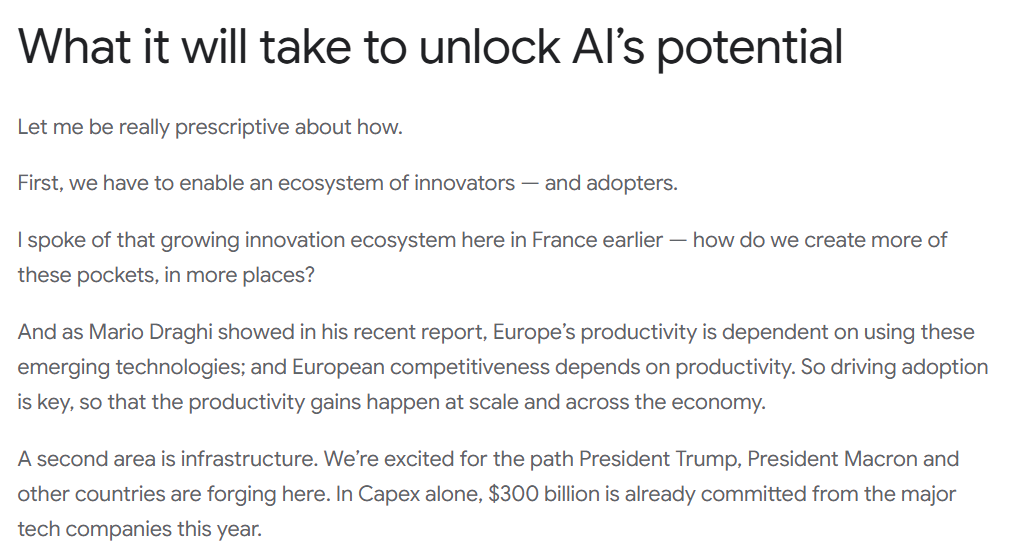
Second is infrastructure. We’re encouraged by the paths being forged by President Trump, President Macron, and others. This year alone, major tech companies have committed $300 billion in capital expenditures.
Last week, we announced that we expect our capital expenditure in 2025 to be approximately $75 billion.
Third, we must invest in talent, helping people prepare for the jobs of the future.
A recent World Economic Forum report estimates that most European jobs will soon be augmented by generative AI, with 7% facing automation. An ILO report suggests AI’s augmentation effect will be six times greater than its displacement effect.
We want to help the workforce adapt to this reality.
Over the past decade, Google Career Certificates have helped 100 million people worldwide upgrade their digital skills. Now, we’re launching a $120 million Global AI Opportunity Fund to deliver AI education and training in communities around the world — reaching 20,000 people across 24 European countries.
Fourth, we must act boldly to advance AI’s most transformative applications, while ensuring they’re developed responsibly so everyone benefits.
This means addressing limitations like accuracy and factual correctness, mitigating risks of misuse such as deepfakes, and navigating new complexities — including impacts on employment, energy demand, and the digital divide.
I often reflect on how fortunate I was to gain access to technology, even if slowly.
But not everyone has that opportunity.
With AI, we have a chance to democratize access from the start — ensuring the digital divide doesn’t become an AI divide, and that AI helps everyone.
The Role of Public Policy in AI
Public policy will play a vital role in all four areas above.
Effective policies should:
Promote innovation, progress, and positive impact without stifling them in the name of risk mitigation.
Build on existing laws and fill gaps, rather than creating entirely new legal frameworks from scratch.
Align across countries. Fragmented regulations with different rules in every region will hinder AI’s growth.
Finally, governments need a thoughtful strategic approach to AI — investing in infrastructure, talent development, and technology adoption, and actively participating themselves.
This is a pivotal moment in history.
I believe future generations will look back and see this as the beginning of a golden age of innovation.
But these outcomes are not guaranteed.
The greatest risk may be missing the opportunity altogether.
Every generation fears new technologies will make life worse for the next — but history shows the opposite is usually true.
When I was young, I used logarithm tables for math. I found it hard to accept kids learning math on smartphones. But they’re thriving.
We must not let present-day assumptions block future progress. We have a once-in-a-generation chance to use AI to improve lives.
Let’s seize it — together.
Join TechFlow official community to stay tuned
Telegram:https://t.me/TechFlowDaily
X (Twitter):https://x.com/TechFlowPost
X (Twitter) EN:https://x.com/BlockFlow_News