Sui Year in Review: 2025 is the year to go mainstream, making Sui the most user-friendly platform
TechFlow Selected TechFlow Selected
Sui Year in Review: 2025 is the year to go mainstream, making Sui the most user-friendly platform
We've wrapped up 2024 with a full stop, but 2025 is when the real show begins.
 Navigating Web3 tides with focused insights
Author: Adeniyi.sui
Translation: TechFlow
Mysten Labs is working closely with researchers from @CarnegieMellon to develop and optimize programmable peer-to-peer (P2P) tunnels—a technology that will unlock new possibilities for blockchain applications.
Looking ahead to 2025, our goal goes beyond just "faster transaction finality." We're building a future where Sui becomes the foundational layer for finance, gaming, AI-driven agents, and everyday applications.
If you'd like to stay updated on our latest developments, feel free to subscribe to my Substack.
We closed 2024 strong—and 2025 is when the real magic begins
Folks, 2024 was the year we showed the world what “long-term building” truly means.
This year, Sui made a powerful entrance into DeFi, capturing developers’ attention and demonstrating how truly seamless user experiences can be achieved.
By December, Sui was no longer seen as just another Layer 1—it had become something entirely unique: a genuinely user-centric platform capable of handling real-world complexity with ease.
Now, as we step into 2025, believe me—if you thought 2024 was exciting, what’s coming next will exceed all expectations.
In 2025, our ambitions go far beyond "faster finality."
We’re building a future where Sui’s core engine powers financial systems, games, AI agents, and daily-use applications.
2025 will prove that Sui is the first blockchain capable of meeting these complex demands end-to-end.
Let’s dive in!
Last year we achieved sub-second finality—this year we go further
With Mysticeti V1, we demonstrated how a Directed Acyclic Graph (DAG)-based consensus mechanism could achieve sub-second transaction finality even under high load. This means Sui confirms transactions in under one second regardless of system pressure—delivering an exceptional user experience.
But from day one of designing Sui’s architecture, we knew our initial consensus design was only the beginning.
Our vision has always been to build a flexible chain architecture that evolves alongside developers’ real-world needs, adapting to increasingly diverse use cases.

2024 was a turning point. Developers—especially in the DeFi community—pushed Sui’s shared object model to its limits.
While sub-second finality is already impressive, DeFi demands near-instant confirmation for shared assets.
This requires reducing latency, increasing throughput, and giving developers simpler, more efficient tools to build ultra-fast applications.
That’s exactly what Mysticeti V2 is built for.
Currently, Sui uses a “dual-protocol” architecture,
with a reliable broadcast layer and a separate consensus layer operating in tandem. However, this setup means regular transactions require multiple signatures and message exchanges for validation.
The certificate aggregation process consumes significant cryptographic verification resources, limiting CPU capacity available for actual transaction execution.
Mysticeti V2 (also known as FastPath) revolutionizes this by integrating broadcast logic directly into the DAG.
Instead of requesting multiple signatures from validators and merging them, it drastically reduces the number of certificates, crypto operations, and network round trips.
From a user perspective, this feels more like traditional transaction processing systems: submit a transaction once to a validator, get confirmation, and you’re done.
No need to manage complex signature schemes or fallback mechanisms—all handled automatically under the hood.
The benefits are clear.
Validators spend fewer resources verifying complex proofs, freeing up CPU power for executing actual transactions.
This directly enables higher throughput, lower latency, and a simplified transaction flow.
Even better, this upgrade fits perfectly within Sui’s existing architecture.
We can seamlessly upgrade from Mysticeti V1 to V2 without requiring validator restarts or disrupting developer workflows.
We plan to roll out this upgrade cautiously in 2025, maintaining the perfect balance between speed and stability.
Once single-validator performance is maximized, our next step is scaling across multiple machines to multiply this capability.
Beyond speed limits: Remora unlocks infinite scalability for Sui
When we first showed Sui confirming transactions in under a second, people asked: “When will you hit a bottleneck?”
Indeed, as any blockchain grows, even with optimal hardware, individual validator nodes eventually hit their CPU or memory limits when processing hundreds of thousands of transactions per second.
We’ve long anticipated this. No matter how powerful the hardware, a single validator has inherent limitations.
But Sui’s promise is simple: no matter how high network demand climbs, transaction processing remains stable.
We don’t claim “infinite bandwidth,” but instead dynamically scale resources so the network handles traffic spikes smoothly—without skyrocketing fees.
So in 2025, our focus isn’t just making one machine faster—it’s distributing transaction processing across many machines for true horizontal scalability.
Previously, Sui relied on a single-threaded transaction pipeline. Now, we’re transforming it into a massively parallel system that scales simply by adding more hardware.
To solve the challenge of horizontal scaling, we began exploring through the Pilotfish research project.
Pilotfish revealed an ideal model of linear scalability: adding more machines to a validator cluster increases TPS (transactions per second) linearly while preserving sub-second finality.
This research evolved into Remora—a suite of technologies designed to systematically distribute validator workloads across multiple machines.

Whether facing massive DeFi usage or peak loads in on-chain gaming, Sui will adapt and perform efficiently.
Early experiments have been incredibly promising—not only boosting our confidence but also attracting collaboration from university research teams.
The results so far are stunning.
In testing environments, we’ve already achieved throughput in the hundreds of thousands of TPS—with room to grow.
Crucially, this doesn’t require expensive supercomputers.
Validators can run clusters of standard machines—cost-effective and efficient.
Naturally, we’re being cautious.
We’re closely monitoring how DeFi, NFTs, gaming, and data-intensive apps gradually approach the performance ceiling of single-machine validators.
By the time real-world demand reaches five or ten times current levels, Remora will be fully ready—scaling seamlessly without overhauling existing infrastructure.
All of this ensures Sui remains future-proof. No matter how much demand grows, we maintain our key competitive edge: unmatched speed.
Simply put, if last year’s performance gains impressed you, Remora will show you a deeper level of technical breakthrough.
Once we have a blockchain with near-infinite throughput, we can begin exploring advanced off-chain interactions that ultimately settle on Sui.
And that’s precisely where Programmable P2P Tunnels come in.
On-chain speed is blazing fast—now let’s accelerate off-chain too
When people hear “off-chain tunnels,” they often think of Bitcoin’s Lightning Network—a simple, closed channel for P2P payments.
On Sui, we’re redefining the concept with Programmable P2P Tunnels—taking it to a whole new level.
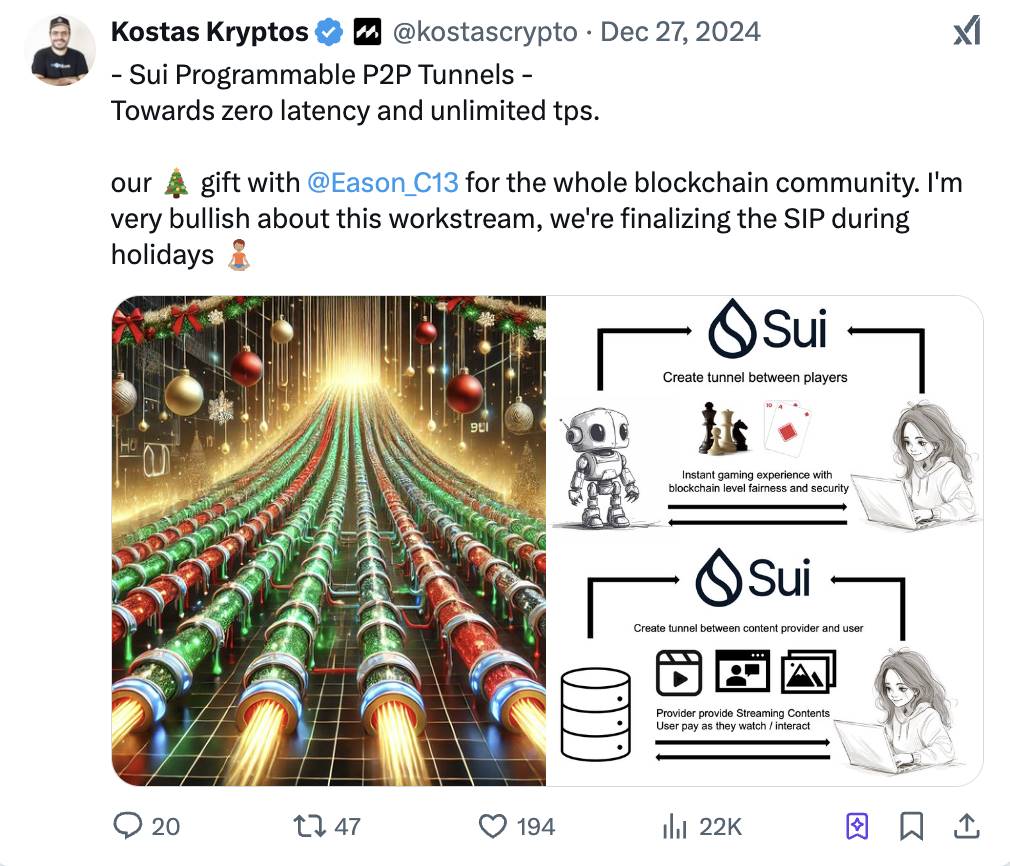
These P2P tunnels aren’t limited to simple transfers—they support everything from low-latency daily payments to real-time game logic.
For example, they enable multi-player off-chain interactions, syncing final states back onto the chain afterward.
This means you can lock SUI tokens (or any Sui-based asset) into a channel, interact or trade off-chain, then batch-confirm all actions on-chain when closing the channel.
Even more exciting: Sui’s programmable P2P tunnels offer near-infinite throughput with zero latency.
How is this possible?
The secret lies in combining several unique technical elements.
First, since each asset or data block is treated as an independent object, we can create unlimited channels without global resource contention.
For added privacy—such as in gambling games or complex P2P trades—you can integrate Zero-Knowledge Proofs (ZKPs), ensuring full confidentiality until transactions are finalized.
For more complex scenarios—like storing partial game state—the @WalrusProtocol provides a powerful off-chain file storage layer tightly cryptographically linked to Sui.
Plus, we hide all underlying complexity—specialized cryptography or transaction batching—behind developer-friendly interfaces, dramatically reducing dev overhead.
Moreover, Mysten Labs is actively collaborating with Carnegie Mellon University’s research team to co-develop and optimize these programmable P2P tunnels.
As off-chain tunnel capabilities grow, a critical question arises: How do we fairly order and prioritize transactions under heavy load?
We’re laying the groundwork for a new paradigm in transaction ordering and value extraction.
This paves the way for a novel MEV (Maximal Extractable Value) model—one designed to benefit users rather than exploit them, creating a fairer blockchain ecosystem.
We’re not patching MEV—we’re rewriting the rules
Speed alone isn’t enough—if your transactions are constantly front-run, even instant confirmation feels slow.
For most blockchains, “MEV” acts as an invisible tax, costing users dearly.
Bots profit from frontrunning, while ordinary users lose out.
To change this, SIP-45 was introduced.
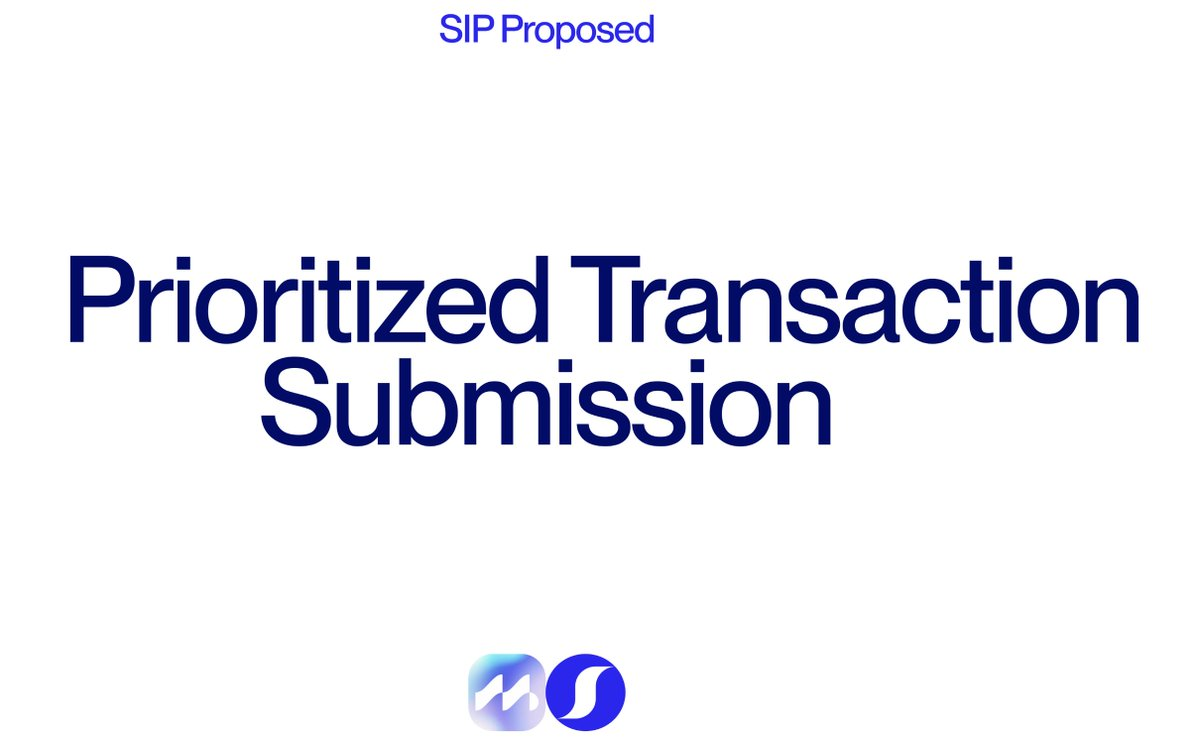
This proposal not only raises gas caps (allowing users to pay more during congestion) but fundamentally rethinks transaction broadcasting and ordering rules.
Its goal? Make fee payments predictable and transparent when users want guaranteed inclusion.
Of course, during events like sudden liquidity pool changes, gas bidding wars may intensify.
You might wonder: Does this turn into a “pay-to-win” race where the highest bidder always wins?
In reality, SIP-45 aims to create a fairer environment by giving developers, validators, and users clearer visibility into fees and priorities.
More importantly, it opens the door to innovative MEV solutions.
Imagine redistributing profits from transaction ordering to regular users or stakers—instead of letting a few malicious searchers capture all the value.
We know MEV won’t disappear overnight.
But if we can structure it so ordinary users benefit, the entire ecosystem transforms.
These improvements help the protocol resist frontrunning and sandwich attacks.
Our vision is to turn MEV from a zero-sum game into a public resource that fuels ecosystem growth. SIP-45 redefines transaction ordering logic to ensure a level playing field for all participants.
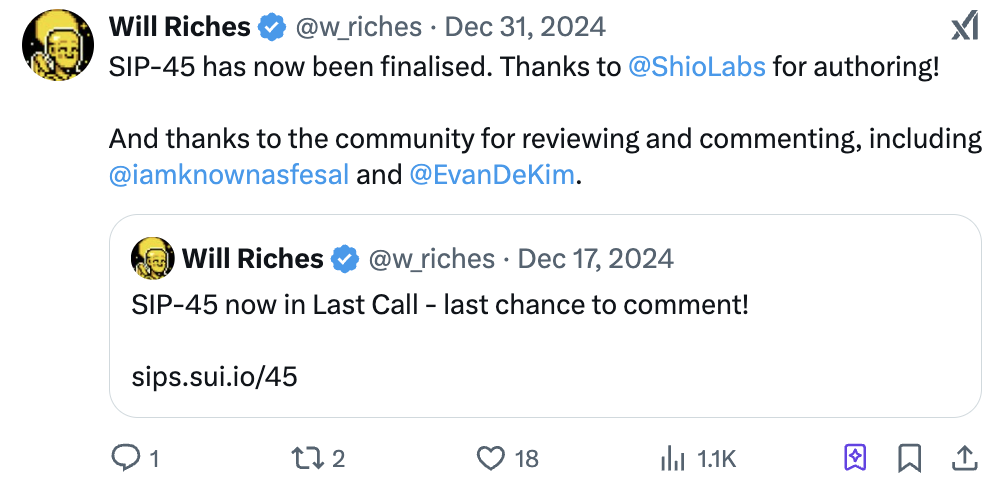
SIP-45 is just the starting point in solving MEV.
Deeper initiatives like DAG Observability will give the entire network real-time insight into upcoming transactions, eliminating information asymmetry.
We’re building a platform that not only handles high-volume, high-competition scenarios—but does so with fairness at its core.
But our ambitions extend even further.
Decentralized storage used to be clunky and inefficient—Walrus is changing that
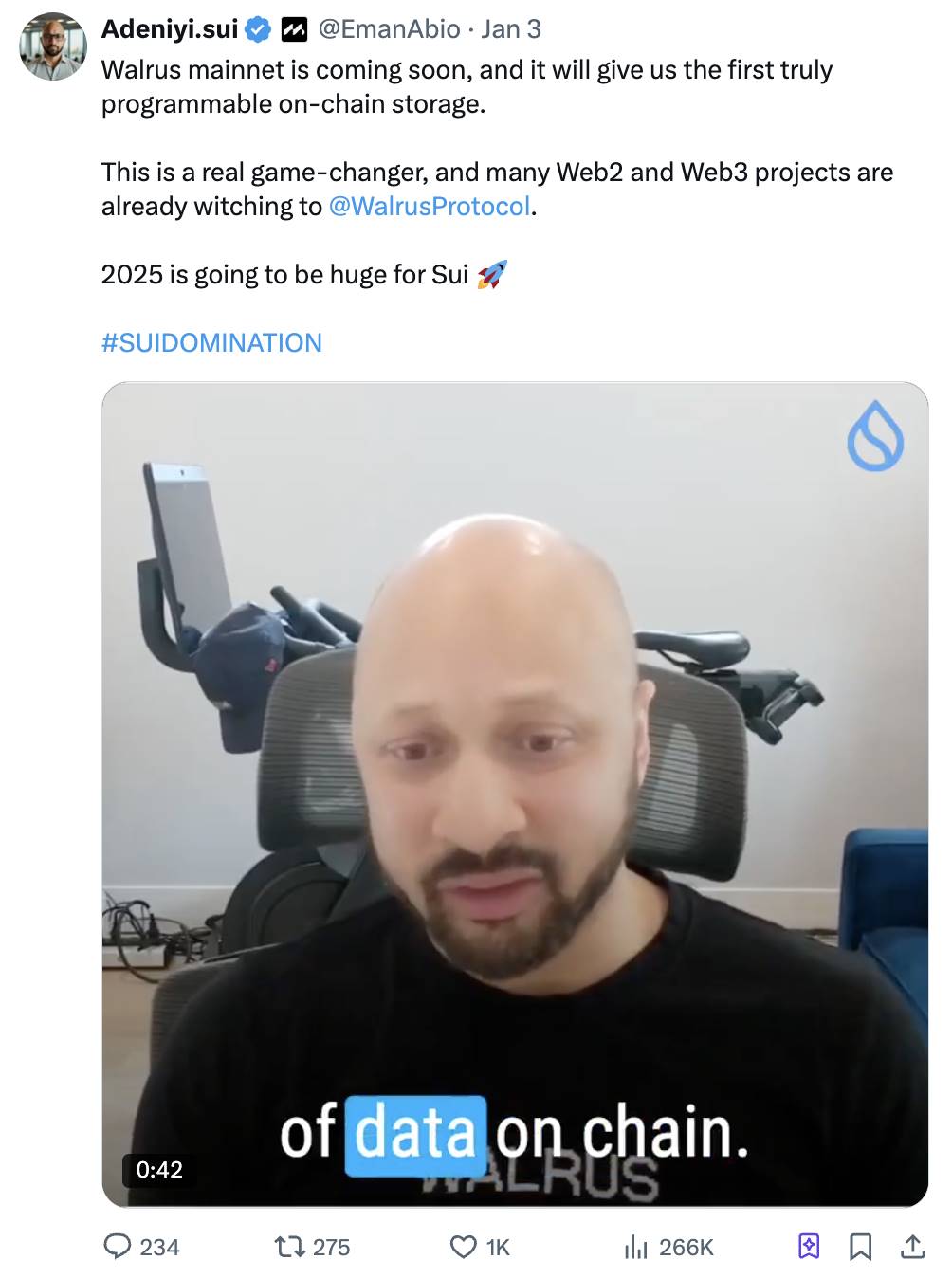
In Q1 2025, Walrus launches on mainnet.
Walrus represents a bold new approach to large-scale data storage, natively built atop Sui’s coordination layer.
It’s not just another IPFS-like file store—it’s a distributed storage layer embodying Sui’s core principles: no single point of failure, massive scalability, and a sustainable economic model.
Traditional blockchain storage often stops at basic file saving or referencing.
Walrus goes further—enabling developers to set rules, integrate with smart contracts, and unlock entirely new application patterns.
With Walrus, you can build truly end-to-end decentralized apps (dApps).
Frontends, user-generated content, and other data can all live in Walrus, fully aligned with Sui’s trust-minimized philosophy.
Soon, anyone will be able to host entire website frontends, user files, or even artifacts from large AI models on Walrus.
Leveraging Sui’s object model, every piece of data becomes a strongly-typed object on-chain.
Developers can tie storage events directly to Sui smart contracts, enabling dynamic applications.
Massive datasets once locked in AWS can now be globally accessible, programmatically managed, and transparently stored.
Yet decentralized storage is just the foundation.
If all data is stored in plain text by default, building apps like DocuSign or private Dropbox becomes impossible.
That’s where the “SEAL” framework comes in.
We solved storage—now SEAL makes data privacy and access control effortless
SEAL is an encryption and access control framework designed for data privacy, supporting complex, programmable policies.
Think of SEAL as a rulebook stating: “Only these addresses can decrypt this data under specific conditions.”
Whether streaming HD video or building DocuSign-style workflows, SEAL ensures only authorized parties can unlock data.
SEAL goes beyond simple “public vs private” modes.
You can define flexible encryption policies like “grant User X read access for one week, then auto-revoke” or “share data only after a certain on-chain event, like contract signing.”
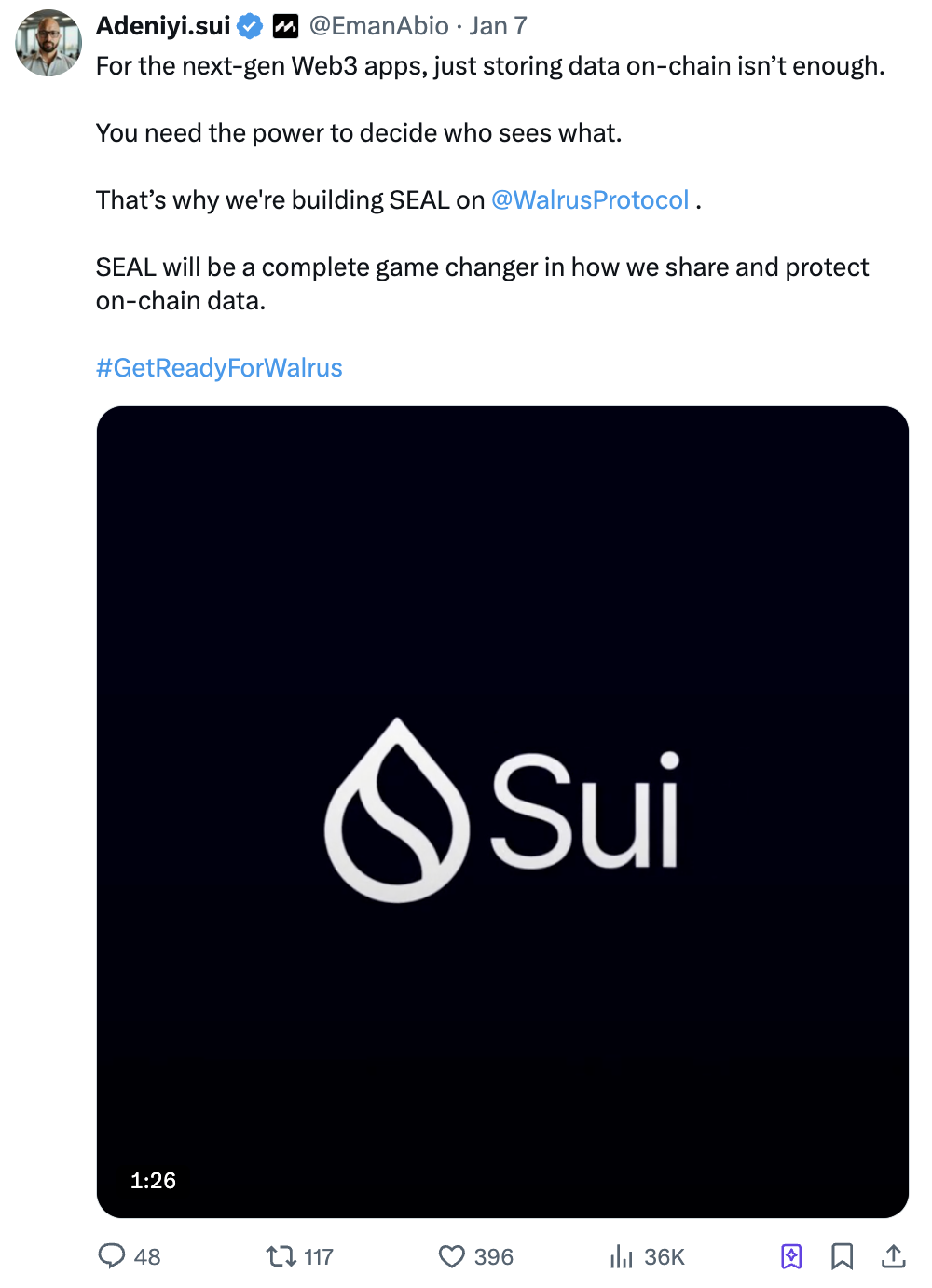
Together, Walrus and SEAL offer dApps the ideal solution: scalable storage with built-in robust encryption and policy enforcement.
Building a “Dropbox” or “Netflix” on Sui is no longer a distant dream—you now have the tools to make it happen.
With Walrus launching on mainnet, 2025 will mark the breakout year for enterprise-grade Web3 applications.
Storing data on-chain is one thing; unlocking it seamlessly, conditionally, and securely—that’s the revolutionary leap.
All these efforts pave the way for Sui’s next phase: ensuring data and transactions move with path awareness, stability, and high elasticity.
Sui’s core is strengthened—now it’s time to supercharge the network layer with SCION
When discussing how to build a blockchain truly suited for the internet, we must confront a fundamental truth: the internet itself is flawed.
Even with the most secure consensus and cutting-edge cryptography, if packets are hijacked mid-transit, blockchain security collapses.
That’s why we’re integrating SCION into Sui’s global validator network.
SCION empowers Sui to bypass common internet vulnerabilities like single points of failure.
We aim for a stable, reliable connection resilient against DNS attacks, BGP hijacking, and large-scale DDoS—while preserving blockchain openness.
Our goal is to fully embed SCION into Sui’s mainnet infrastructure by 2025.
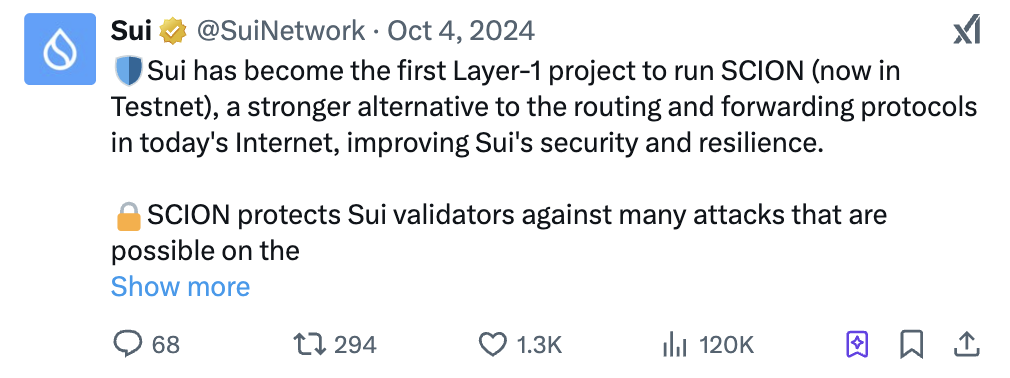
This means redundant design: multiple SCION paths, diverse service providers, and fallback to standard IP when needed.
This changes the game completely.
However, none of this matters if building on Sui remains too difficult or developers can’t easily leverage these powerful tools.
So in 2025, we’ll double down on developer experience—refining every tool to make building on Sui smoother than ever.
Technical barriers are broken—now let developers build effortlessly on Sui
Sui is already among the best chains for developer experience (DevEx).
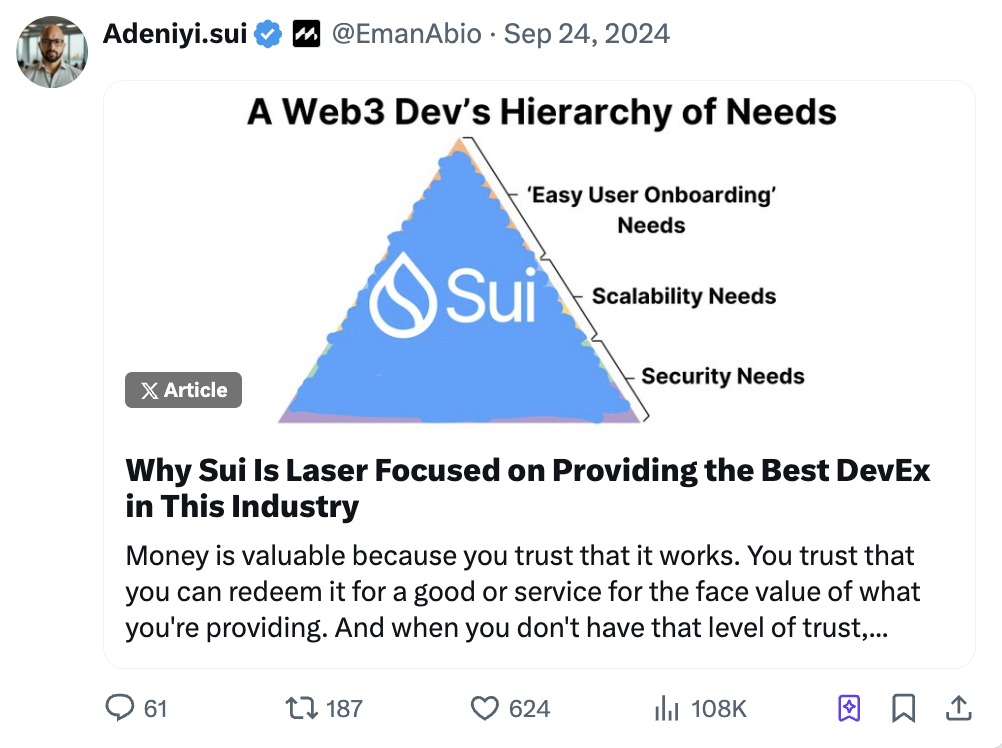
But in 2025, we’re leveling up—from on-chain data queries to Move code verification—optimizing every stage of development.
Our guiding principle: reduce boilerplate, boost productivity.
Whether launching a DeFi protocol or building an AI-powered dApp, Sui lets you focus on functionality—not infrastructure headaches.
First, RPC 2.0: a smarter way to query Sui
We’re retiring JSON-RPC in favor of GraphQL—an excellent fit for Sui’s object model.
This eliminates endpoint complexity and enables natural querying—especially powerful for complex relationships like nested sub-objects or dynamic NFTs.
Additionally, RPC services will operate independently from full nodes.
This removes bottlenecks between reads and writes. Indexers handle heavy lifting by batch-processing transaction data, feeding it into a stateless RPC layer that stays responsive even under load.
Meanwhile, the launch of Move Registry will streamline Move-based development and encourage deeper community engagement.
Next: Sui Move Prover
Security is paramount, which is why we’re introducing Sui Move Prover—a developer-friendly formal verification tool.
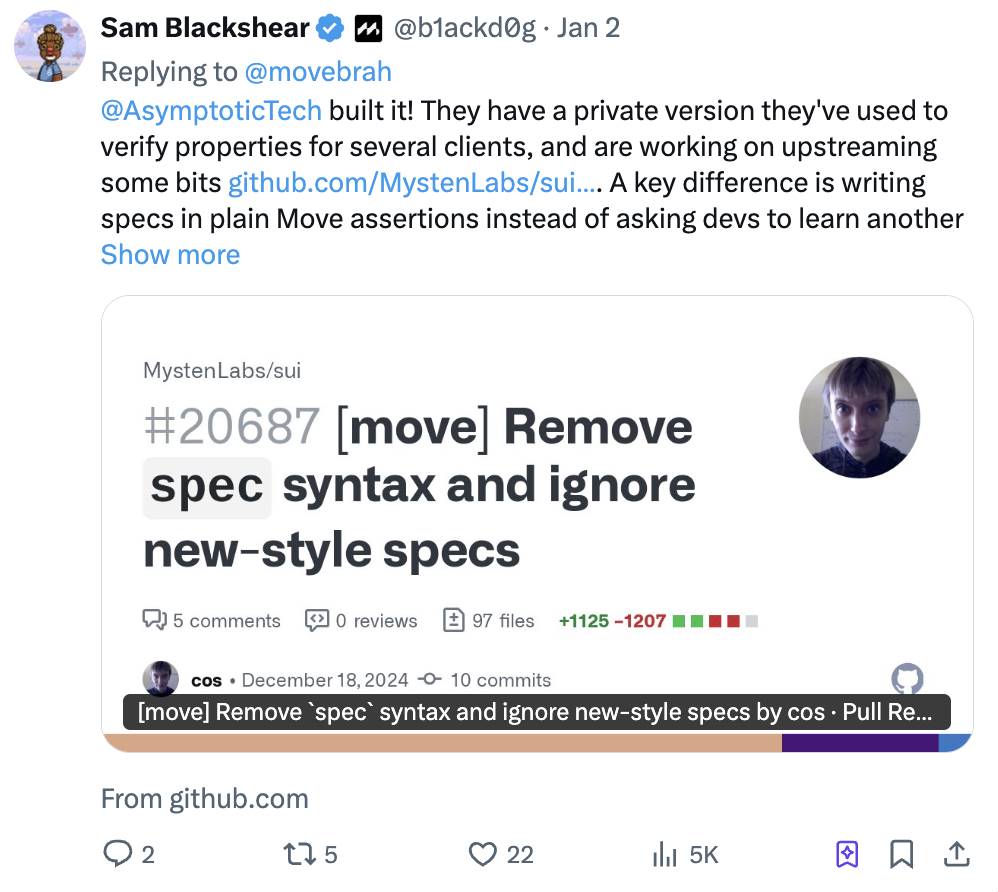
It allows developers to write code specifications using Move assertions—no need to learn a separate specification language.
The advantage? You can systematically verify code properties without switching mental contexts.
For advanced developers building high-security DeFi protocols or next-gen dApps, this is a major breakthrough.
And our security efforts go beyond static analysis.
Bugdar: AI-powered smart contract auditing
Bugdar is an AI-driven vulnerability scanner that detects and alerts potential bugs before they reach mainnet.
Built on cutting-edge LLMs like o1, Gemini, and Claude, it runs in real time—so developers can catch issues from day one.
Think of it as an embedded security research assistant inside your IDE, continuously scanning for reentrancy risks or suspicious code patterns.
Trained on real attack scenarios, Bugdar identifies subtle threats that traditional audits might miss.
Move Registry: a naming service to simplify code management
Move Registry is a universal package and module naming service.
Just as NPM and crates.io transformed JavaScript and Rust ecosystems, Move Registry lets developers reference code without memorizing complex addresses.
Simply type a human-readable package name—the system resolves it automatically.
Whether building PTBs, importing libraries, or managing cross-project dependencies, Move Registry slashes effort and accelerates delivery.
It reduces naming conflicts and duplication, boosting code reuse efficiency.
Our goal: make sharing and borrowing code on Sui as easy as on Web2 platforms.
To further lower barriers, we’re launching new SDKs—letting developers harness Sui’s power without wrestling with complex zero-knowledge circuits.
Write less code, ship faster—let SDKs handle the complexity
Many developers ask: “How can I build Web3 apps without a dedicated cryptography team?”

The answer? These SDKs—they let developers tap into Sui’s full power without deep crypto expertise.
We’ve worked closely with developers to craft comprehensive toolkits—from basic transaction calls to advanced ZK features.
Thanks to Sui’s object-centric architecture, structured SDKs make it easy to compose and reuse functional modules.
These SDKs wrap core functions into intuitive APIs—whether JavaScript, Python, or Move-based DSLs—drastically reducing friction.
No more struggling with incomplete docs or repetitive logic—just import, configure, and start building.
Together, these improvements deliver a faster, safer development workflow on Sui.
But our mission isn’t just about developers—we also want everyday users to enjoy seamless blockchain experiences.
Developers are happy—now remove the last hurdles for users
One of our core goals in 2025 is making Sui feel invisible to average users.
We’re bundling all our technical breakthroughs into one unified theme: frictionless user experience.
Next-Gen Passkeys
Passkeys are transforming daily usage—combining biometrics with ephemeral session keys to eliminate constant signing.
Imagine unlocking a DeFi trade with Face ID, then jumping into a Sui-based game without reauthorizing every action.
We’re experimenting with temporary keys that expire after use—leaving no “digital footprint.”
This blends Web2’s smooth UX with Web3’s trust-minimized security—creating a new kind of interaction flow.
Still, people lose devices or forget passwords. That’s why KELP exists.
KELP: a flexible safety net for user accounts
KELP is Sui’s intelligent account recovery solution—letting users set flexible fallbacks like 2FA logic or zkLogin as backup login methods.
KELP layers smart recovery logic—combining 2FA, backups, and zkLogin—for enhanced account protection.
For example, set Google Login as a fallback when you forget your seed phrase—or link recovery to Facebook or an extra Passkey device.
With KELP, losing your mnemonic no longer means losing access.
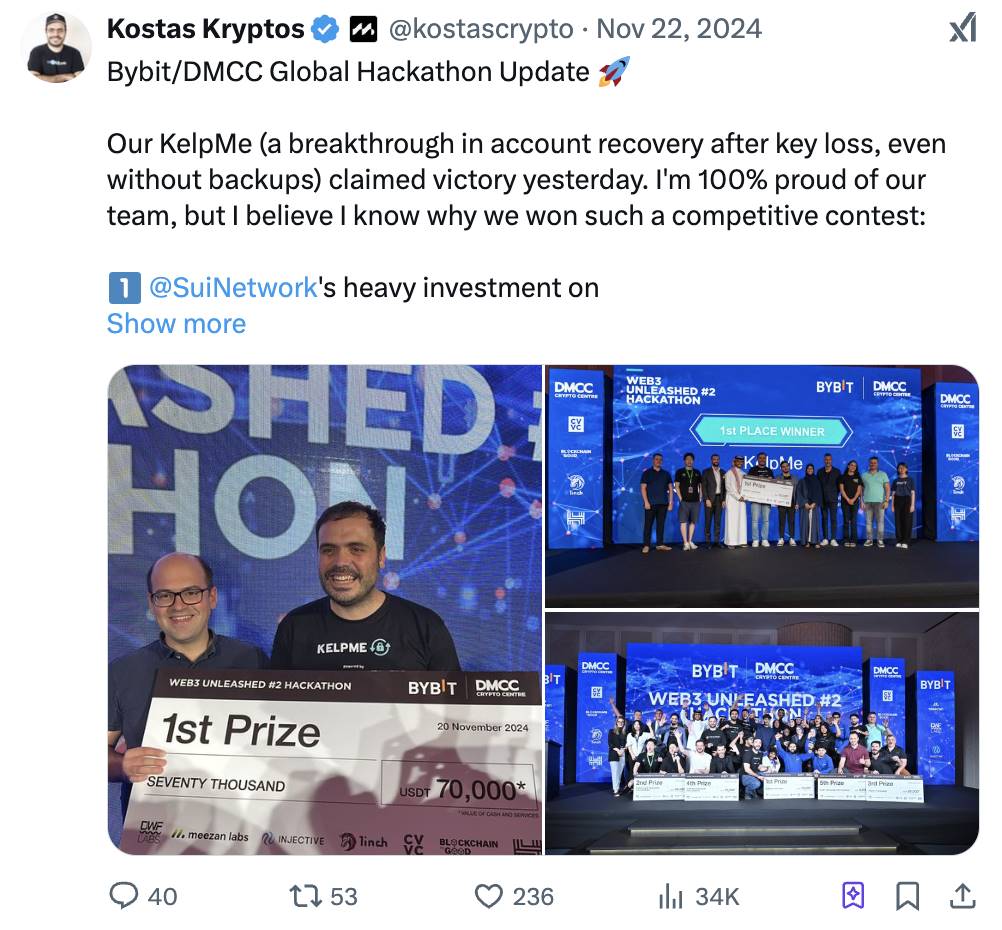
For advanced users and institutions, KELP supports multi-factor wallets—integrating hardware enclaves, multi-sig logic, and advanced key-loss protection into a flexible, robust security framework.
Whether you seek full self-sovereignty or want trusted third parties to assist in emergencies, KELP delivers.
By combining hardware isolation, multi-sig logic, and KELP’s advanced key-loss safeguards, Sui offers adaptable security—supporting both fully self-owned and “shared guardian” models, where trusted parties can intervene when needed.
In short, it’s a secure yet flexible solution—ensuring your assets remain safe even if keys are lost.
Today, thanks to Sui’s robust infrastructure and user-friendly features, using Sui is nothing like traditional crypto—complex, intimidating, risky.
It’s fast, secure, and simple.
And this sets the stage for the next big wave: gaming going mainstream.
We’ve fixed UX—now gaming will bring Sui to the masses in 2025
People used to say Web3 is too complex, too slow, too niche. But in 2025, @SuiPlay devices and the @PLAYTR0N OS change everything.
Gaming is Sui’s gateway to mass adoption.
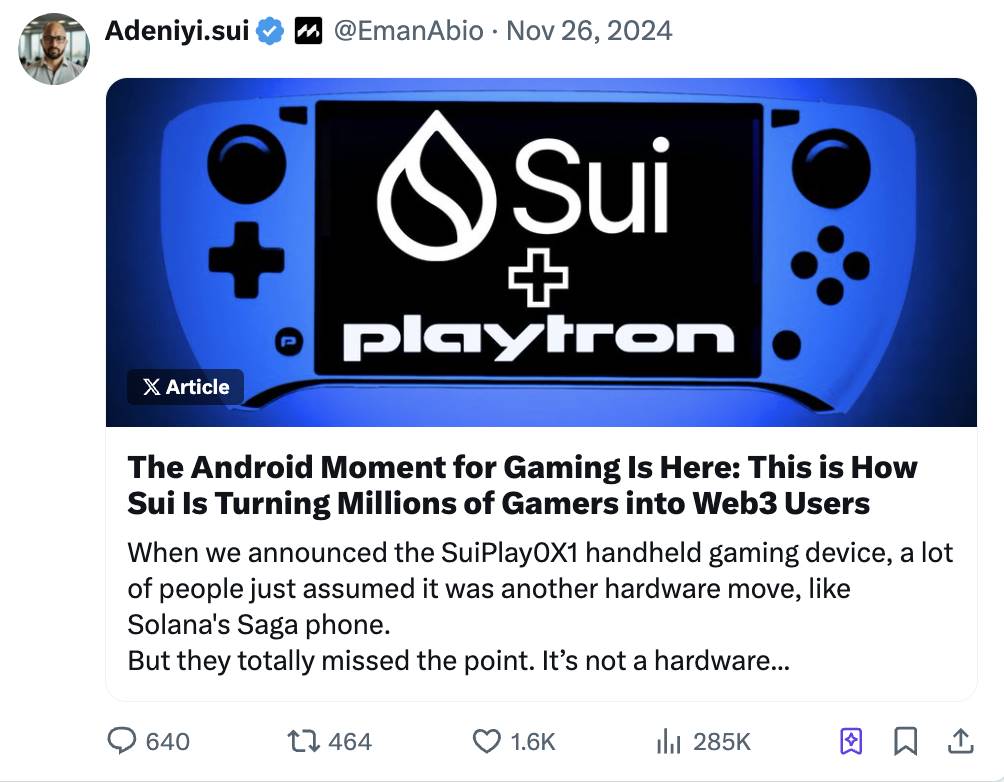
We’re not asking players to wrestle with complex wallets or cumbersome logins. Instead, blockchain is seamlessly integrated at the OS-level gaming experience.
No friction, no fees, no setup—just pure gameplay, with real-time asset trading powered silently by Sui in the background.
In 2025, players will receive their pre-ordered @SuiPlay devices.
We’ve already partnered with top studios and popular projects like @panzerdogs, @playDARKTIMES, @xocietyofficial, and @samuraishodown.
This isn’t just indie experimentation.
Over 65 studios are building games on Sui, planning to release around 70 titles in 2025.
This will drive explosive user growth—thousands of players enjoying seamless gaming, free from wallet complexities.
Whether selling a legendary weapon mid-battle, instantly upgrading armor, or trading NFTs with global players—all happens instantly.
This is how we bridge the gap between “on-chain assets” and real-time in-game actions.
Over time, players will naturally explore Sui’s broader ecosystem—converting in-game coins to stablecoins, or staking them in DeFi protocols.
In doing so, millions of new users enter DeFi—many of whom never saw themselves as “blockchain users.”
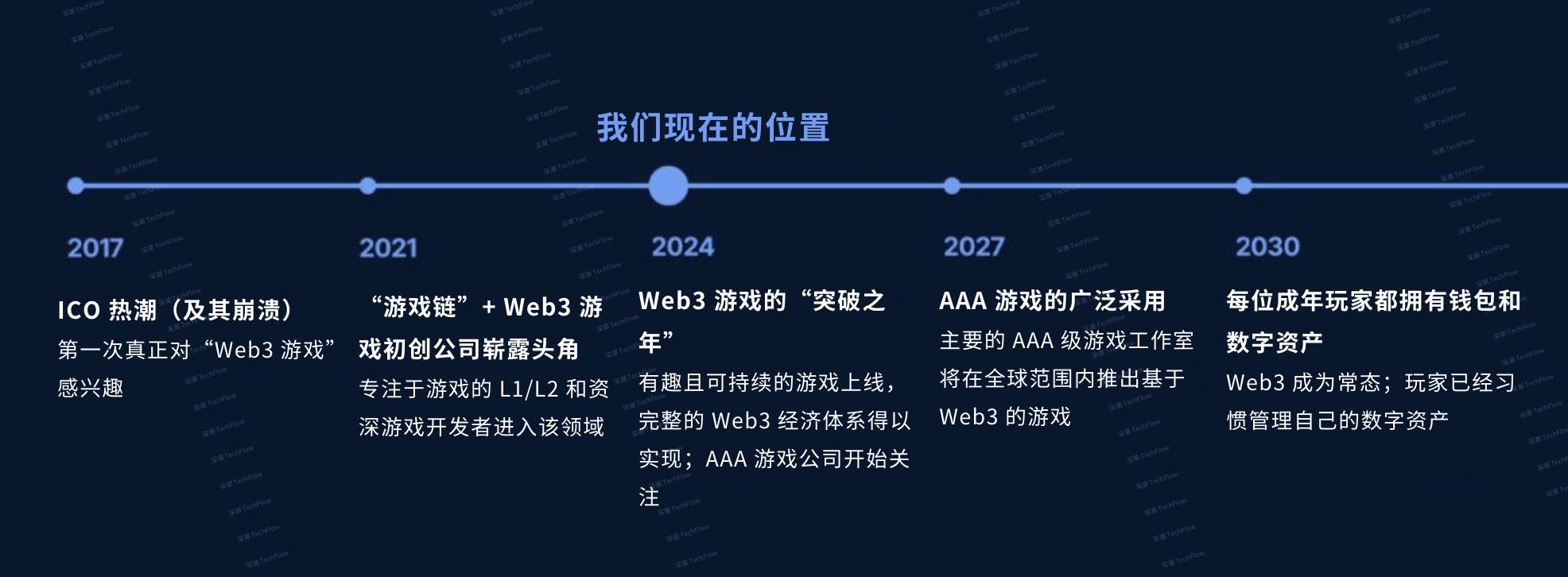
Original image by Adeniyi.sui, translated by TechFlow.
One top-tier game can bring millions of daily active users—whose microtransactions flow into liquidity pools, token markets, and stablecoin trading.
In all these transactions, one protocol stands at the center: @DeepBookonSui.
When players trade, they’re actually using DeepBook—the omnichain order book offering CEX-like smoothness.
The surprise? Players don’t even realize they’re using DeFi—they just feel the benefits: lower fees, true ownership, unstoppable liquidity.
This is the key to mainstream adoption: when the underlying tech stops being a barrier and becomes a bridge to a richer digital economy.
This nearly “invisible” blockchain experience doesn’t just attract gamers—it sends a powerful signal to traditional institutions.
Through Sui, they see a globally scalable platform for real-value transactions with simple, user-friendly experiences.
The RealFi revolution is coming—we’re just getting started
In 2024, Sui’s ecosystem captured attention with over $1.75B in DeFi TVL.
This wasn’t just a signal to crypto traders.
But the shift coming in 2025 goes far beyond speculation and yield farming.

The partnership with Ant Digital will bring billions in fixed-income assets directly onto Sui.
This means an investor in Hong Kong can easily own part of a European-issued bond—without layers of intermediaries.
We’re already seeing stablecoin liquidity (e.g., USDC, FDUSD) entering this space, along with Lombard Finance’s cross-chain BTC integration.
On the consumer side, Sui wallets act as “digital bank accounts” for the unbanked.
They bypass cross-border transfer hurdles and currency instability—logging in via zkLogin, depositing instantly (or receiving remittances), holding digital assets without relying on local banks.
For users in countries where opening a checking account is extremely difficult, this changes everything.
In the end, this forms a powerful, interconnected network—more like a 2.0 version of global finance, designed to be cheaper, faster, and more transparent.
When real-world assets move on-chain, they need a transaction infrastructure that scales with demand—without performance drops.
This is where DeepBook becomes the key driver.
As a global central limit order book, DeepBook handles any tokenizable asset with sub-second speed and full transparency.
No middlemen, no delays—DeepBook is a seamless, unstoppable engine, deeply integrated with DeFi’s vast liquidity ecosystem.
Institutions now realize “on-chain trading” doesn’t mean “slow or risky”—it’s a complete upgrade over isolated, outdated financial systems.
Since Sui resolved UX friction over the past year, 2025 will see a flood of institutional capital—previously waiting for a reliable, low-latency L1.
What’s next?
Scaling these powerful infrastructures into a global coordination layer for the digital economy.
2025: The real beginning of Sui as the global coordination layer
Sui was never meant to be just a “faster, cheaper blockchain.”
From day one, Sui was designed to solve a fundamental challenge: enabling human coordination across time and space—without centralized intermediaries.
By 2025, this vision becomes reality—at scale.
Sui isn’t just a collection of isolated dApps. It’s evolving into a global digital coordination layer—connecting everything from cross-chain liquidity to 3D printing supply chains.
Coordinating cross-chain assets with IKA
For Sui, “global coordination layer” isn’t a slogan—it’s the ultimate destination.
When you realize Sui can manage complex digital assets, off-chain infrastructure, and cross-chain liquidity—all on one platform—you see how it becomes the natural base layer.
Wherever humans or machines need a single source of truth, Sui delivers.
This is already being validated by leading projects.
Imagine controlling Ethereum or Solana assets directly through Sui-based smart contracts—without dealing with traditional cross-chain bridges.
That’s the core value of IKA.
IKA is a system using distributed MPC signers and two-party computation (2PC) to let Sui smart contracts sign transactions on other chains.
There’s no single “bridge” holding all keys.
Instead, every user is a key participant—even if half the network turns malicious, your tokens won’t vanish.
This transforms cross-chain interactions from fragile patchworks into user-centric, secure interoperability models.
Sui becomes the universal ledger coordinating different networks—turning multi-chain complexity into a few lines of Move code.
3DOS: reinventing manufacturing logistics
Then there’s 3DOS—a platform using 3D printing networks to coordinate global manufacturing.
It replaces traditional supply chains with real-time, on-demand production—powered by Sui’s immutability and low-cost transactions.

Press a button, and your request goes to the nearest idle 3D printer—the item gets printed instantly—no warehouses, no shipping hassles.
Meanwhile, Walrus ties it all together—providing decentralized, flexible large-scale data storage on-chain.
It enables decentralized storage and retrieval—building full off-chain solutions like 3D printing pipelines or supply chain aggregators.
You can rely on Sui’s consensus to coordinate data storage—what, when, and how much it costs.
Even more exciting: these protocols will soon be driven by AI agents, autonomously conducting transactions, verifications, and data reasoning.
That’s the most exciting part of 2025.
We’ve removed all barriers—AI agents are the final missing piece
To me, 2025 is the year AI moves from backend servers to the forefront.
AI won’t be hidden—it’ll be visible, deeply integrated into human interactions, social dynamics, and on-chain transactions.
These agents are revolutionary because they operate with minimal human input, engaging directly with real money flows and services worldwide.
This means a project management agent could spawn a web design agent, autonomously pay it upon delivery, and compile the result—all without manual oversight.
The challenge? Ensuring agents trust each other, run verified code, and interact with real data while preserving privacy.
This is where Sui shines.
By easily assigning encrypted wallets (via zkLogin) to each agent, Sui removes the need for credit cards or bank accounts—letting them transact directly in digital currency.
With Sui’s low cost and high speed, microtransactions and frequent data updates don’t burden the system or break budgets.
For example, attestation ensures the code-review agent you hire runs a verified LLM—not a hacked or backdoored version.
You can securely store large datasets or full AI models in Walrus—letting agents share and use information without fear of leaks.
Plus, Sui’s emerging DRM-like features ensure your data or content is delivered as intended—encrypted at rest, protected by a chain of trust.
In the end, this creates the ideal sandbox for next-gen AI agent collaboration.
This is how we’ll witness the full emergence of an AI agent ecosystem in 2025.
@Mysten_Labs aims to make @SuiNetwork the global coordination layer—empowering billions of autonomous agents to trade, build, and innovate freely.
That’s why we’ll see a complete agent ecosystem take shape in 2025.
We’re already seeing early AI development platforms like @Atoma_Network building on Sui.
I believe soon we’ll see AI agents reading, writing, executing, and paying for services at sub-second speeds.
This isn’t fantasy—it’s the logical next step.
A new era is here—and we’ve only scratched the surface of what autonomous agents can do.
We’ve built the foundation—now it’s time for Sui to go mainstream
Sui first gained fame for breaking speed and throughput records. But by 2025, you’ll realize that was just the beginning.
Looking back, it’s clear Sui has moved far beyond the old label of “just another L1.”
Sui’s tech stack is mature—so advanced that even the biggest skeptics must acknowledge its strength.
Now, our goal is to make building on Sui not just easy—but compelling.
Our message is clear: if you have a bold Web3 idea, Sui should be your first choice—not because of hype, but because it’s the best path to success.
We want Sui to be the foundation of the digital world in 2025—which means becoming the most developer-friendly platform out there.
Join TechFlow official community to stay tuned
Telegram:https://t.me/TechFlowDaily
X (Twitter):https://x.com/TechFlowPost
X (Twitter) EN:https://x.com/BlockFlow_News
 Sui Network