








WOO X Research: Can AI Save DeFi Summer? Understanding DeFAI
TechFlow Selected TechFlow Selected
WOO X Research: Can AI Save DeFi Summer? Understanding DeFAI
DeFi's poor usability is an old issue, with only 1.4% penetration rate.
 Navigating Web3 tides with focused insights
Author: WOO X Research
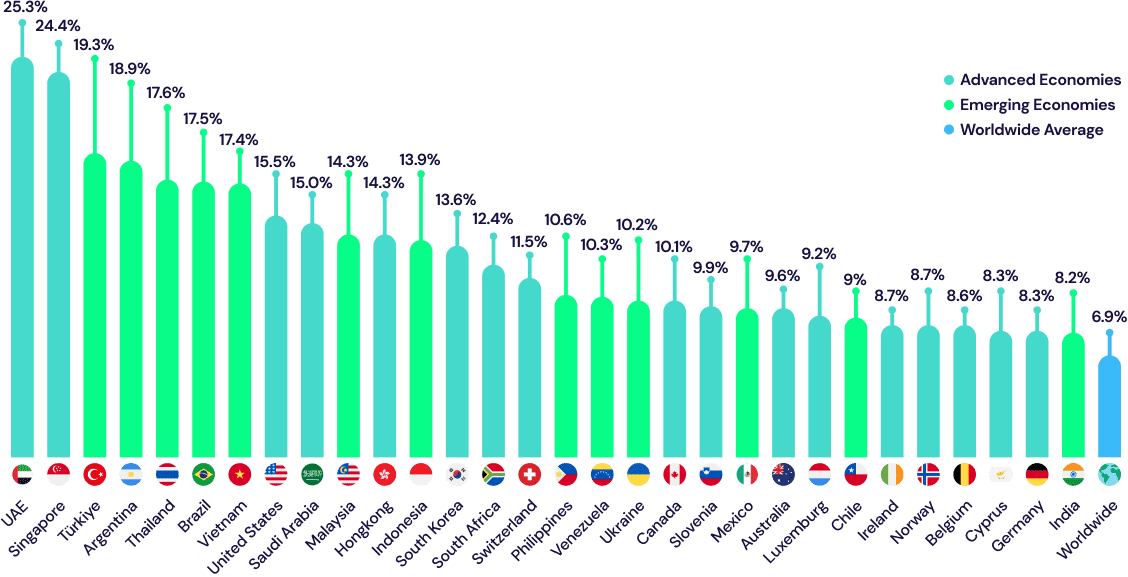
According to Triple A's 2024 survey on global cryptocurrency ownership, approximately 6.9% of the world's population currently owns cryptocurrency, amounting to around 562 million people.
DeFi has long been seen as the hope for mass adoption, yet its actual penetration rate remains dismal.
How can we estimate the number of DeFi users? We can calculate based on daily active addresses from major blockchains and Layer 2 networks. Adding up ETH, Base, and Solana’s daily active addresses gives a total of roughly 8 million. However, this figure does not account for sybil addresses or multi-chain users, so 8 million is an overestimate.
8 million / 562 million = 1.4%
This means that DeFi's current penetration rate among all crypto holders stands at only 1.4%. Yet in terms of trading volume, DEXs have seen explosive growth—now accounting for a record high 16.7% of CEX trading volumes.
This highlights a key reality: the DeFi market continues to be dominated by existing users with larger capital sizes, offering limited appeal to new users.
The primary reasons DeFi struggles to attract new users boil down to high knowledge barriers and poor user experience. Take the simplest action—Swap—as an example. Users must understand how to transfer tokens onto a blockchain, reserve gas tokens, grasp concepts like slippage and approval, and navigate a series of complex operations far less convenient than the one-click buy/sell function offered by centralized exchanges.
Is DeFi destined to remain a zero-sum game—a playground exclusively for veteran users?
AI integration may finally break through these longstanding limitations, giving rise to an entirely new narrative—DeFAI.
Reference: https://www.triple-a.io/cryptocurrency-ownership-data
What is DeFAI?
If DeFi represents innovation in decentralized finance, then DeFAI (DeFi + AI) signifies the next evolutionary stage aimed at making decentralized finance truly accessible to the masses. The core value of DeFAI lies in "using AI to reduce the complexity of DeFi," while simultaneously expanding application scenarios, enabling more people to easily and securely access various blockchain financial services.
DeFAI offers three core benefits:
-
Lowering operational barriers: Users no longer need to manually switch between complex interfaces. By simply entering natural language instructions such as “Swap 1 ETH to USDC, then provide liquidity in a given pool,” AI can execute multi-step processes automatically.
-
Automated strategies: Arbitrage and investment strategies previously requiring professional traders can now be managed by AI agents, which can even auto-adjust risk parameters, allowing ordinary investors to access quant-grade tools.
-
Integrated data analysis: AI can monitor social sentiment, KOL commentary, on-chain transaction data, and price trends in real time, triggering automatic trades when predefined conditions are met—delivering actions closely aligned with actual market dynamics.
Categories & Representative Projects of DeFAI
-
AI Abstraction Layer: This category simplifies complex DeFi operations—such as swaps, bridging, and staking—through natural language abstraction. Users need only input intuitive commands like “Convert 2 ETH to USDC and provide liquidity,” after which AI handles protocol integration, optimal routing, and gas efficiency behind the scenes. This is currently the largest category within DeFAI.
Representative Projects:
Griffain
-
Operates within the Solana ecosystem, supporting natural language trading, NFT minting, and sniping new token launches.
-
The Solana Foundation has retweeted Griffain multiple times.
-
Features multi-agent collaboration and customizable automation functions.
Heyanon.ai (anonymous)
-
Developed by the Danielesesta team, emphasizing a “one-stop” solution integrating cross-chain trading, lending, and yield strategies.
-
Back-end integrates cross-chain bridge LayerZero and real-time price oracle Pyth, helping users quickly complete complex operations.
Grift
-
Focused on cross-chain functionality, integrating over 100 public chains and more than 200 DeFi protocols, enabling convenient cross-chain asset management.
-
Emphasizes automated strategies and liquidity management, capable of handling multi-step transaction workflows.
Buzz
-
Won first place at the Solana AI Hackathon.
-
Enables users to express trading intent via natural language and provides detailed insights into liquidity pools, token locks, and smart money wallet portfolios.
-
Automated Trading Agents: After receiving user authorization, these AI agents can automatically execute complex, multi-step trading strategies—such as “regularly buy ETH and deposit into a liquidity pool” or “arbitrage immediately after cross-chain bridging.” Users only need to define high-level goals without managing execution details.
Representative Projects:
Almanak
-
Focuses on institutional-grade quantitative trading and security, utilizing TEE (Trusted Execution Environment) to prevent strategy theft or MEV attacks.
-
Allows strategy simulation on an EVM fork environment before deployment on mainnet, reducing real-world risks.
Cod3x
-
Offers a no-code environment where users can build AI trading agents by dragging and connecting components.
-
Integrates external APIs and machine learning prediction models to make trading strategies smarter.
-
Market Analysis Agents: These AI systems aggregate and analyze vast amounts of on-chain data, KOL tweets, and forum activity to deliver timely, multidimensional market insights. When combined with trading agents, they can trigger automatic buy/sell orders.
Representative Projects:
AIXBT
-
Tracks over 400 KOLs and their social interactions, monitoring topic热度 and community sentiment in real time.
-
Answers user queries and delivers instant analysis or token price forecasts.
Kwant
-
Provides investment recommendations based on technical analysis of candlestick charts.
Conclusion
DeFi has historically excluded mainstream users due to high barriers and operational complexity, forming a niche circle dominated by a small group of experienced, well-capitalized participants. However, breakthroughs in AI—particularly in conversational interfaces, strategy automation, and data integration—are paving a new path forward for DeFi through DeFAI. In the future, simple natural language transactions, advanced automated arbitrage, and even ecosystems powered by collaborative AI agents will mature thanks to DeFAI.
Perhaps the next true "DeFi Summer" will be driven by DeFAI, enabling more users to access the potential returns of decentralized finance with minimal friction. At the same time, professional investors can leverage these tools for more flexible and secure trading strategies. As blockchain and AI continue to deeply integrate, the wave of DeFAI is steadily expanding—making it a space worth watching closely.
Join TechFlow official community to stay tuned
Telegram:https://t.me/TechFlowDaily
X (Twitter):https://x.com/TechFlowPost
X (Twitter) EN:https://x.com/BlockFlow_News
 @WOOXResearch






