Steve, founder of CGV: Learning from Japan's "Lost Thirty Years," Web3 development must avoid being "all form and no substance"
TechFlow Selected TechFlow Selected
Steve, founder of CGV: Learning from Japan's "Lost Thirty Years," Web3 development must avoid being "all form and no substance"
Although Japan has quickly embraced Web3 technology and introduced supportive policies, its deeply entrenched conservative culture and cumbersome bureaucracy have made the pace of innovation unusually slow.
 Navigating Web3 tides with focused insights
Author: Shigeru
"In my view, Japan's current state in the Web3 space is like the Japanese proverb 'hotoke tsukutte tamashii irazu'—creating a Buddha but failing to breathe life into it. While the Japanese government has done extensive work in formulating Web3 policies and drafting standards, there are clear shortcomings in actual implementation and critical execution steps."
— Steve, Founding Partner of CGV, a Japanese crypto fund
As Steve from CGV points out, although Japan has rapidly embraced Web3 technology and introduced supportive policies, its deeply entrenched conservative culture and cumbersome bureaucracy have significantly slowed the pace of innovation.
This culture stems from Japan’s traditional societal emphasis on stability and risk avoidance. Both corporations and government institutions tend to favor safe, established paths over bold experimentation with emerging technologies. As a result, even though Japan quickly adopts new technologies during global tech waves, it often struggles to transform them into commercial applications, moving forward slowly and hesitantly.
Japan’s Historical Lessons: The Reality of "Tech Hype" vs. "Slow Commercialization"
Meiji Restoration Era: Technology Adoption and the Challenge of Modernization
The Meiji Restoration (1868) marked a pivotal moment in Japan’s modernization. By importing Western military, industrial, and educational systems, Japan achieved rapid progress toward becoming a modern nation. However, this process also presented major challenges in absorbing and adapting foreign technologies. Although Japan learned advanced Western techniques, internalizing them into independent innovation capabilities took decades. For example, during industrialization, Japan imported railway technology extensively from Britain and Germany. Due to lack of local expertise, early railways suffered frequent breakdowns and high maintenance costs. It wasn’t until the early 20th century that Japan gradually mastered railway technology, eventually achieving localized innovation and improvements.
Post-WWII Technology Transfer: From Imitation to Independent Innovation
After World War II, Japan achieved rapid growth through its so-called "economic miracle," largely driven by swift adoption and application of foreign technologies. In the 1950s, Japan imported automotive and electronics technologies from the United States and within decades became a global leader in these fields. Yet this journey was far from smooth. In the early postwar years, most Japanese cars and electronic products were direct copies of American and European designs, lacking independent R&D capacity. For instance, Toyota initially replicated Ford and General Motors’ production lines almost entirely. However, Japanese companies continuously refined these technologies, ultimately pioneering the "lean manufacturing" model—an innovative leap that secured their global leadership. In the electronics sector, Sony stands as a prime example. In the early 1950s, Sony launched its first transistor radio. Though the core technology originated from Bell Labs in the U.S., Sony improved upon design and sound quality, successfully entering international markets and becoming a symbol of Japanese innovation. Through persistent imitation, refinement, and innovation, Japanese firms evolved from followers into leaders—a transformation that spanned decades and consumed vast resources.
The Lost Three Decades: Stagnant Innovation and Eroding Competitiveness
The collapse of Japan’s bubble economy in the 1990s ushered in what is now known as the "lost three decades." During this period, Japan’s economy stagnated, and its innovation capacity and global competitiveness steadily declined. Data shows that from 1990 to 2020, Japan’s GDP growth remained persistently low, while emerging economies like South Korea and China surged ahead, surpassing Japan in many high-tech sectors. For example, in 1995, Japan held over 50% of the global semiconductor market share; by 2020, this had plummeted to less than 10%.
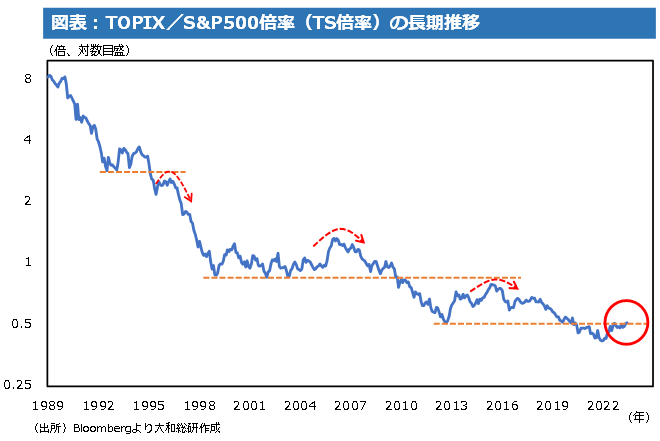
Historical ratio of Tokyo Stock Price Index to S&P 500 Index (a key indicator of Japan's stock market standing globally). Source: Daiwa Institute of Research
A key reason for this decline lies in Japanese companies’ overly cautious approach to technology commercialization and slow response to emerging markets and technologies. For example, electronics giants like Panasonic and Toshiba failed to adapt swiftly to the rise of smartphones and next-generation semiconductors, eventually being overtaken by global rivals such as Apple and Samsung. Meanwhile, Japan’s bureaucratic system exacerbated this innovation stagnation. Companies often spend years navigating government support applications, approvals, and compliance procedures, causing many innovative projects to lag behind dynamic market shifts.
In the automotive industry, Japan maintained strong competitiveness at the end of the 20th century. However, with the arrival of the electric vehicle revolution, startups like Tesla quickly captured market share, while Japanese automakers like Toyota and Nissan moved slowly, only launching competitive EV models in recent years. Data indicates that in 2020, Japan’s share of the global EV market was just 1.1%, far below China’s 44% and Europe’s 28%. This delayed transition reflects the conservative mindset of Japanese firms when facing technological disruption, further contributing to the erosion of competitiveness during the "lost three decades."
In summary, Japan has historically leveraged foreign technology imports for rapid initial development. However, transforming these technologies into autonomous innovation has consistently faced cultural, institutional, and market-related hurdles. These historical lessons offer profound insights for Japan’s current Web3 ambitions—if it fails to swiftly overcome conservative mindsets and bureaucratic inertia, it risks missing yet another transformative technological wave.
Japan’s Web3 Landscape: Fast Policy Response, Slow Implementation?
Rapid Policy Response and Strategic Motivations
In 2023, the Japanese government released the *Japan Web3 White Paper*, outlining detailed plans for blockchain and digital asset development. The goal is to create a policy environment conducive to Web3 innovation. In 2024, Japan passed legislation allowing venture capital and investment funds to hold cryptocurrency assets. These moves reflect Japan’s strategic intent to leverage Web3 for broader economic digitalization.
Additionally, these policies aim to keep pace with other nations—such as Singapore and South Korea—that have made significant strides in blockchain and digital assets. Japan hopes to attract global Web3 businesses and technical talent through proactive regulation, avoiding marginalization in the new global tech race.
Mainstream Corporate Engagement: From Sony to SBI’s Web3 Initiatives
Many major Japanese corporations are actively participating in Web3. For example, Sony announced the creation of a dedicated division focused on blockchain and NFTs, aiming to leverage its strong presence in entertainment to integrate digital assets into music, film, and other content areas, exploring new business models. In August 2024, Sony Block Solution Labs Pte. Ltd., a subsidiary headquartered in Singapore, officially launched Soneium, an Ethereum Layer-2 scaling platform.

Soneium’s initial Web3 ecosystem partners (Source: Soneium official website)
SBI Holdings (formerly the financial investment arm of SoftBank Group) is one of Japan’s earliest financial institutions to enter the cryptocurrency space. Its Web3 investments span blockchain payments, digital asset management, and more. SBI has partnered with Ripple to enhance financial service efficiency via blockchain-based cross-border payment systems. Additionally, SBI established a dedicated blockchain investment fund targeting early-stage startups and projects to drive innovation in Japan’s blockchain sector.
NTT Group is focusing on infrastructure, planning to develop high-performance communication networks capable of supporting Web3 applications, ensuring sufficient bandwidth and stability for future blockchain services. In 2024, NTT also announced collaborations with multiple Web3 projects to explore integrating blockchain into smart city and Internet of Things (IoT) solutions.
Regulatory Delays: Complex Legal Frameworks and Compliance Challenges
Despite proactive government policies, complex regulations and oversight frameworks pose significant hurdles for companies implementing Web3 technologies. For instance, Japan’s *Financial Instruments and Exchange Act* and *Payment Services Act* impose strict rules on digital assets, requiring compliance with anti-money laundering (AML) and know-your-customer (KYC) obligations. The complexity of these regulations means companies spend substantial time and resources obtaining licenses and approvals.
Data from 2024 shows that over 70% of Web3 companies cite compliance costs as a major barrier to market entry, with average compliance expenses accounting for more than 20% of total operational costs. This heavy burden is especially challenging for resource-constrained startups.
Moreover, listing new projects on Japanese exchanges faces stringent regulatory scrutiny. The Financial Services Agency (FSA) conducts rigorous reviews, requiring exchanges to perform exhaustive due diligence on each project. According to industry surveys, the average time for a new project to be listed on a domestic crypto exchange in Japan ranges from 9 to 12 months—compared to just 3 to 4 months in some other jurisdictions.
Limited Innovation Capacity: Talent Shortages and Global Competition
Japan faces a clear shortage of talent in emerging fields like Web3, falling significantly behind other countries. According to LinkedIn’s 2023 Global Blockchain Talent Report, Japan has only one-tenth the number of blockchain professionals compared to the United States and fewer than a quarter of those in South Korea. The lack of skilled developers and technical experts remains a key bottleneck for Japan’s Web3 industry.
This talent gap stems from insufficient emphasis on emerging technologies within Japan’s education system. While Japanese universities excel in traditional engineering disciplines, they have limited investment in blockchain and smart contract education, with outdated or sparse course offerings. Furthermore, the conservative nature of Japanese corporate culture hinders the cultivation of innovative talent internally, as young professionals often lack the freedom or encouragement to experiment and learn from failure.
Breaking Free from 'Hotoke Tsukutte Tamashii Irazu'
Improving Policy Execution: Streamlining Procedures and Inter-Agency Coordination
To address delays in policy implementation, the Japanese government must take concrete actions. First, streamline approval processes by eliminating redundant bureaucratic steps, particularly by introducing flexible regulatory adjustments for emerging technologies. For example, establishing a dedicated Web3 fast-track approval channel could accelerate licensing for blockchain and digital asset projects, reducing the timeline from concept to launch. Additionally, enhancing inter-agency coordination is essential. A cross-departmental task force should be created to oversee Web3 policy deployment, ensuring smoother collaboration across ministries and minimizing friction and delays. Japan could also learn from successful models in Singapore and Hong Kong by implementing regulatory sandboxes—allowing Web3 projects to pilot in controlled environments, lowering compliance barriers while gradually refining oversight mechanisms.
Incentivizing Corporate Innovation: Tax Breaks and Government Funding
To encourage bolder innovation in Web3, the Japanese government should introduce targeted incentives. One effective measure would be tax breaks for R&D spending—offering tax reductions to companies investing in blockchain research lowers the cost of innovation. Additionally, establishing a dedicated innovation fund could provide crucial financial support to small and mid-sized Web3 startups, addressing funding gaps in their early stages. Similar government-backed programs in the U.S. and South Korea have successfully nurtured multiple unicorn companies through public-private partnerships.
Strengthening International Collaboration: Choosing the Right Partners and Models
International cooperation is vital for Japan to break through in Web3. To compensate for domestic technological shortcomings, Japan must actively seek partnerships with leading global players. First, Japanese companies should form strategic alliances with firms in technologically advanced regions like the U.S. and China, leveraging joint projects and knowledge exchange to access cutting-edge expertise. For example, collaborating with Hong Kong regulators on sandbox initiatives or partnering with American blockchain firms to innovate in user protection and crypto transaction monitoring could yield valuable results.
Furthermore, strengthening ties with overseas universities and research institutions is crucial. Japanese universities could collaborate with world-leading institutions (such as Stanford University, UC Berkeley, and the Hong Kong University of Science and Technology) on joint blockchain research and talent development programs, helping to close the domestic talent gap in Web3.
Conclusion
Web3 offers Japan a chance for "digital revival." But whether it can escape the historical trap of "building the Buddha without breathing soul into it" depends on the efficiency of policy execution, the strength of corporate innovation, and its ability to attract global talent. If Japan remains trapped in conservatism and bureaucratic inertia, its Web3 industry may become yet another lost opportunity in the "lost three decades."
Amid the global Web3 wave, Japan faces both immense challenges and opportunities. Only by truly breaking free from cultural rigidity and institutional constraints—and seizing the moment of technological transformation—can Japan avoid falling behind and achieve long-term, sustainable digital growth.
Join TechFlow official community to stay tuned
Telegram:https://t.me/TechFlowDaily
X (Twitter):https://x.com/TechFlowPost
X (Twitter) EN:https://x.com/BlockFlow_News
 @CGVFOF