








Uncovering Polymarket: Positioning, Expansion, and Shadows of the Crypto Prediction Market
TechFlow Selected TechFlow Selected
Uncovering Polymarket: Positioning, Expansion, and Shadows of the Crypto Prediction Market
After the November 5 election concludes, Polymarket is expected to face significant liquidity withdrawals.
 Navigating Web3 tides with focused insights
Author: Lydia Wu
TL; DR
-
Narrowly defined, prediction markets typically exclude traditional gambling and sports betting, emphasizing information discovery and public decision-making reference functions;
-
Prediction markets cannot remain "correct"—failures occur precisely when people treat the probabilities generated by prediction markets as established facts;
-
Cryptocurrencies bring more flexible trade sizes and lower-friction payment experiences to prediction markets;
-
Polymarket’s user profile differs significantly from that of NFT traders and meme enthusiasts—its users tend to be older, less obsessed with maximizing profit/loss ratios, and strongly motivated by information acquisition and analysis;
-
The competitive edge in prediction market products lies in curating higher-quality events and attracting rational bettors (creators). Polymarket's advantage stems from the attention (liquidity base) it has gained through mainstream visibility;
-
Polymarket is cautious about volume-based incentives and complex trading features. New projects approaching prediction markets from a derivatives-trading perspective may face misfit and poor adaptation;
-
After the U.S. election concludes on November 5, Polymarket is expected to face significant liquidity withdrawal. Public evaluation of its election forecast performance and Polymarket’s next strategic moves could profoundly impact the future of prediction markets.
Rise: "That Prediction Market"
Polymarket is currently the largest "2024 U.S. Presidential Election prediction market." Users have placed nearly $1.5 billion in bets on whether Harris or Trump will win—far surpassing Web2 rivals PredictIt and Smarkets, which recorded transaction volumes of $37 million and $9 million respectively on the same question.
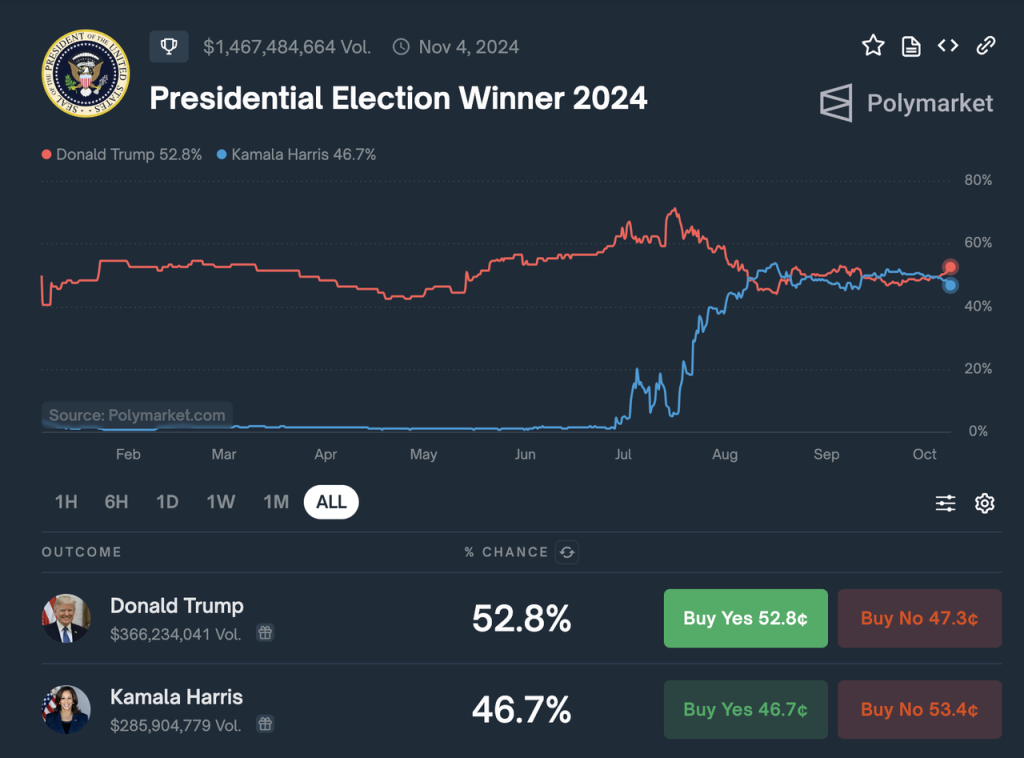
Polymarket’s 2024 U.S. Election interface
Conceptual Clarification of Prediction Markets
Broadly speaking, prediction markets evolved from gambling and betting markets, referring to situations where individuals allocate funds toward anticipated outcomes of events in hopes of returns.
Narrowly defined, prediction markets usually exclude traditional gambling and sports betting. Instead, they focus on broader political, economic, and cultural events, emphasizing information aggregation and potentially informing policy or public decisions. This form of prediction market dates back at least to papal elections in early 16th-century Rome. The Iowa Electronic Markets, launched during the 1988 U.S. presidential election, was one of the earliest modern electronic prediction markets.
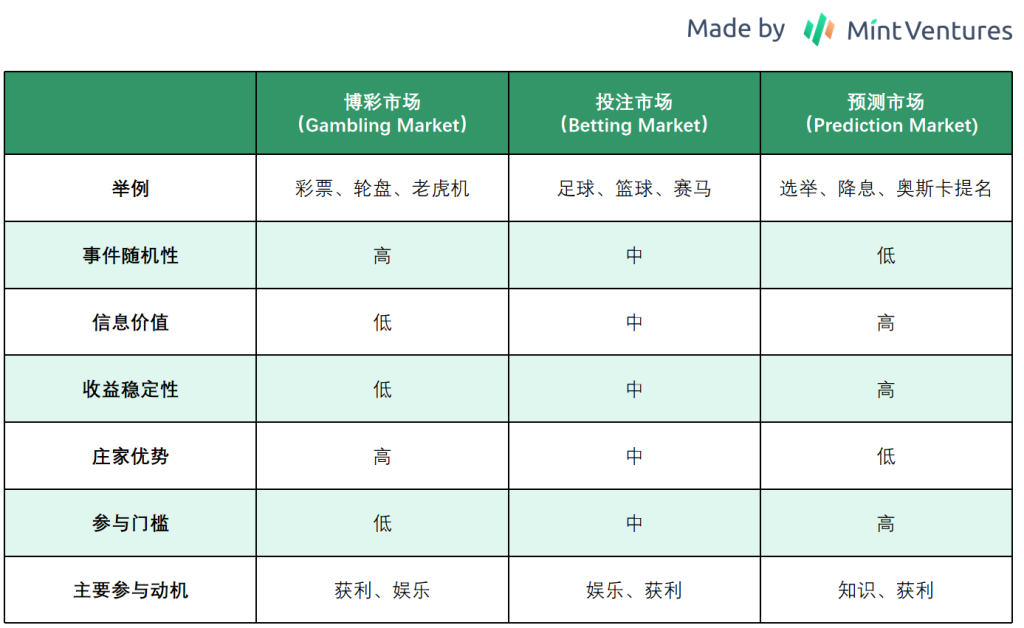
Can Crypto-Prediction Markets Be Truth Machines?
Vitalik Buterin is likely the most influential advocate for prediction markets in the Web3 world. As early as 2014, he discussed prediction markets as a practical implementation of Futarchy—a governance model proposed by Robin Hanson where decisions are made via betting. In 2020, he revisited the topic in an article exploring “credible neutrality,” citing prediction markets as a case study, later proposing a design linking bets on extremely unlikely events. In 2021, he published a systematic analysis of the value proposition and decentralization advantages of prediction markets. Since then, he has repeatedly expressed public support for prediction markets and participated in Polymarket’s Series B funding round in May this year.
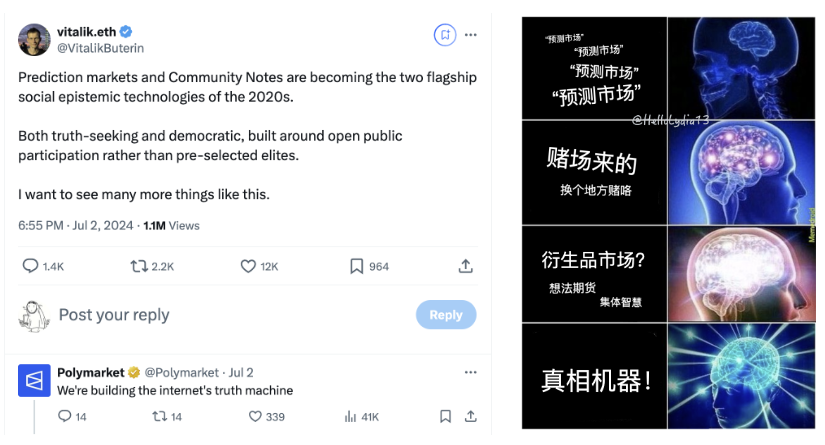
Different perspectives on prediction markets
To understand the philosophy behind prediction markets and the high expectations crypto enthusiasts hold for them, consider three simple questions:
-
What do prediction outcomes represent?
-
Are prediction markets actually accurate?
-
What does cryptocurrency bring to prediction markets?
Due to space constraints, I will briefly answer these three questions.
What do prediction market outcomes represent? Are they truth?
The term "truth machine" is controversial. Prediction markets measure participants’ interpretations of symbolic events (Event) and use these as proxies to infer objective future facts (Fact). This process does not produce truth but rather reflects probabilistic estimates of event outcomes by participants. Even when predictions align with reality, it remains a post-hoc validation.
How accurate are prediction markets?
The theoretical foundation of prediction markets often traces back to Hayek, Bayesian theorem, Futarchy, and the efficient market hypothesis. Synthesizing these ideas: although knowledge is dispersed across society, if there are enough market participants continuously updating their views based on new evidence, an asset price can emerge that reflects all publicly available information—an efficient market capable of aiding decision-making.
Proponents frequently cite cases like the 2008 U.S. election and Polymarket’s performance during the 2020 pandemic. However, prediction markets performed poorly during the 2016 Brexit referendum and U.S. election, undermining this argument. Post-mortems suggest that traders treated prediction market probabilities as settled facts, stopped updating beliefs based on new external information, and caused prices to become overly stable. This reveals reflexivity in prediction markets—the very trust placed in them can erode their credibility.
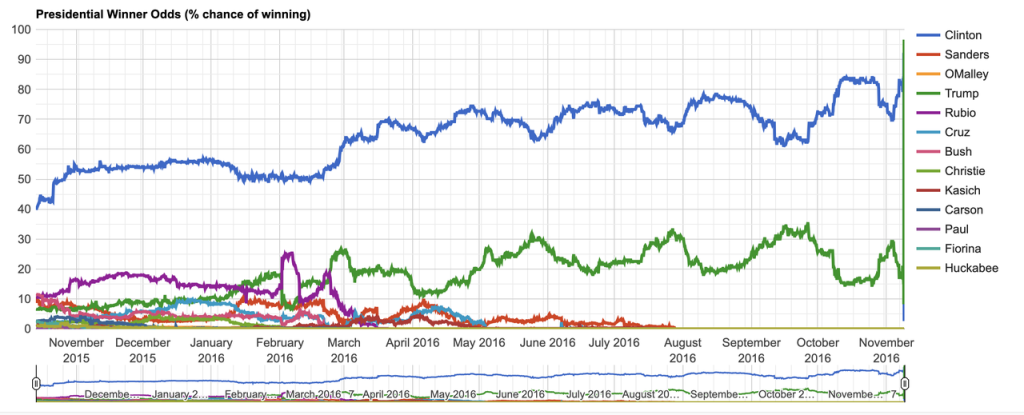
Betting odds during the 2016 election, with Hillary maintaining a decisive lead throughout
What role has cryptocurrency played in the long history of prediction markets?
In terms of concept and practice, decentralized prediction markets typically impose no betting limits (compared to PredictIt’s $850 cap), allowing users to weight their opinions financially according to confidence levels, potentially capturing market trends more accurately.
From an operational standpoint, using cryptocurrency enables instant settlements and drastically reduces chargeback fraud (where users dispute payments via credit card companies after losing bets). Notably, major online betting platforms like Stake accept only crypto payments.
The Rise of Polymarket
A common question arises: given that prediction markets are neither new nor newly combined with cryptocurrency, why has Polymarket uniquely surged ahead—operating on-chain yet capturing the largest market share, becoming nearly synonymous with "prediction market" itself?
First, 2024 is a rare global super-election year. Incomplete statistics indicate that 76 countries/regions held national elections this year, covering 4.17 billion people. Among these, the U.S. election received the most attention, further amplified by Biden’s withdrawal and the attempted assassination of Trump.
Additionally, global events such as the Paris Summer Olympics, Federal Reserve rate cuts, geopolitical tensions, and advances in artificial intelligence have drawn widespread media coverage. In Web3, Bitcoin halving and ETF approvals for Bitcoin and Ethereum also generated substantial buzz—making this a veritable "golden age" for prediction markets.
Polymarket’s success is often attributed to its smoother UX/UI compared to earlier generations, seamless deposit/withdrawal experience, and more transparent, non-custodial mechanism versus its Web2 competitors. Riding favorable macro conditions, it quickly rose to prominence.
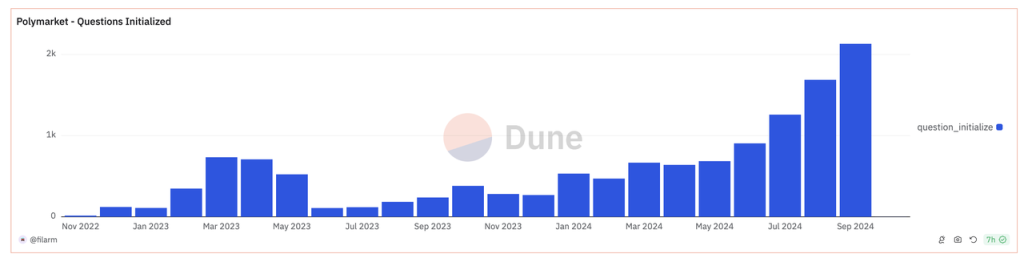
Number of events created on Polymarket shows clear growth in 2024

New user influx rapidly increased Polymarket’s user base
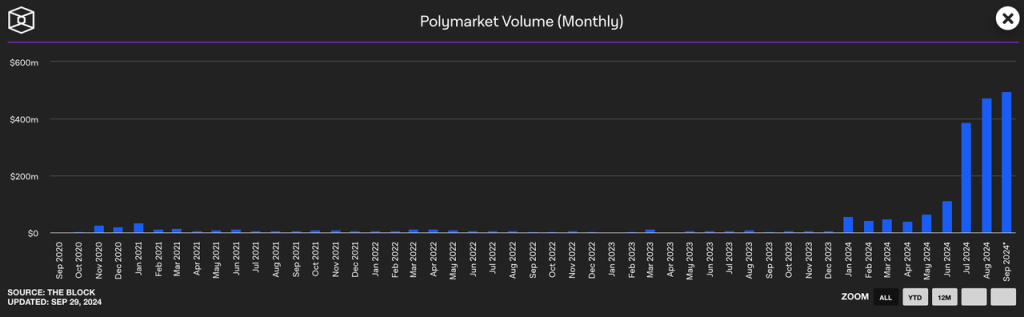
Polymarket’s trading volume clearly expanded in 2024
While shifting global dynamics, industry maturation, and product improvements are important, this article focuses on a rarely discussed angle—Polymarket’s market strategy and potential misconceptions about it.
Misconception: "Event Trading Platform"
To clarify: compared to utopian visions of "prediction markets" or reductive labels like "event trading platform," a clearer, de-hyped description of today’s Polymarket might be "crypto-native media / creator ecosystem / information platform."
The Hidden Audience: Readers Behind the Scenes
Polymarket hit a record 90,000 monthly active users (MAUs) in September, with daily active users (DAUs) consistently above 10,000. Yet website traffic reached 15 million that month—yielding a pageview-to-MAU ratio exceeding 166.
In contrast, OpenSea had 110,000 MAUs and ~9,000 DAUs in September—similar to Polymarket—with 4.5 million site visits and a pageview-to-MAU ratio of ~41.
Adding pump.fun into the comparison, we see Polymarket’s overall traffic and mobile share significantly exceed both—suggesting a distinct audience, different from NFT traders and meme speculators: a "news-reading crowd."
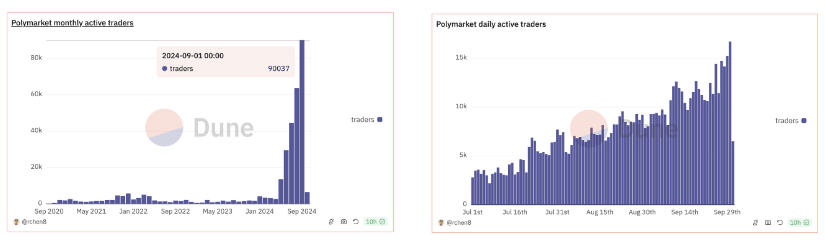
Polymarket’s MAU and DAU data
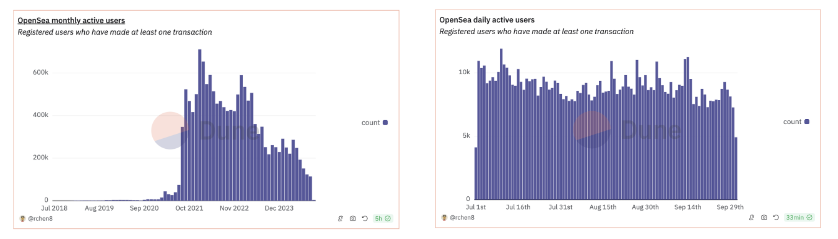
OpenSea’s MAU and DAU data
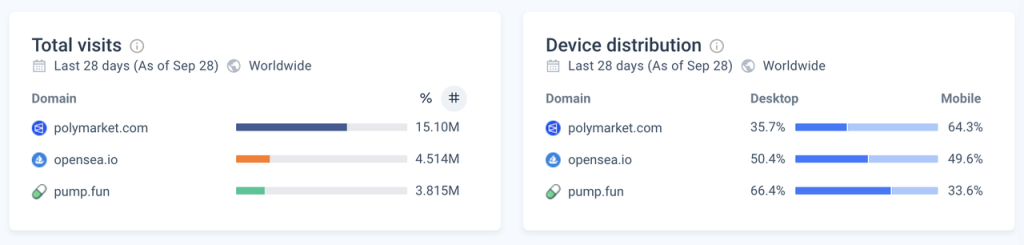
Website metrics comparison: Polymarket, OpenSea, pump.fun
Source: SimilarWeb
In fact, Polymarket founder Coplan has repeatedly described his product on X using terms like "alternative news source" and "the future of media," often referencing its ranking in the App Store’s news category. Although Polymarket receives only 3% of The New York Times’ web traffic, it performs well on engagement metrics such as time-on-site and bounce rate.
Moreover, through integrations with Substack, Bloomberg, and other media platforms, Polymarket acts as a "reverse oracle," conveying diverse opinions and sentiments from the Web3 world.
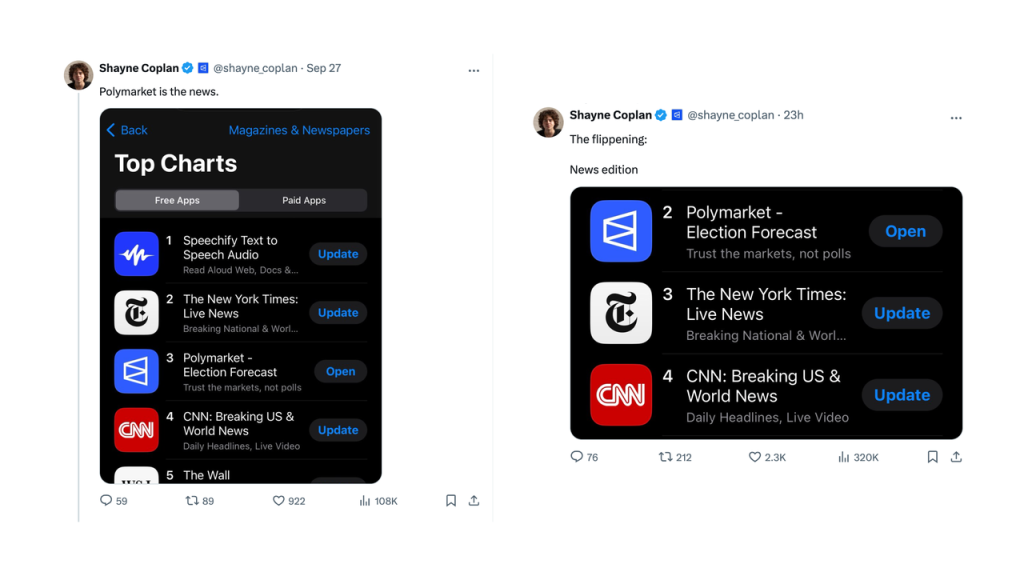
Coplan believes Polymarket is the news
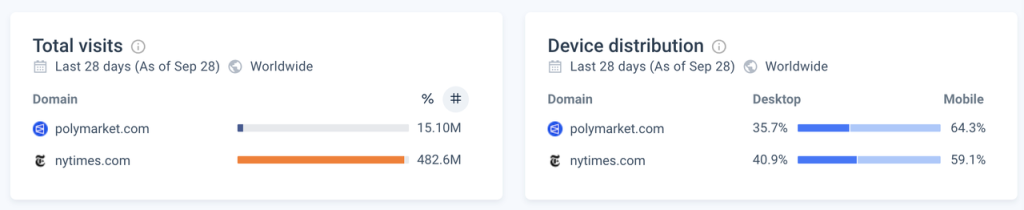
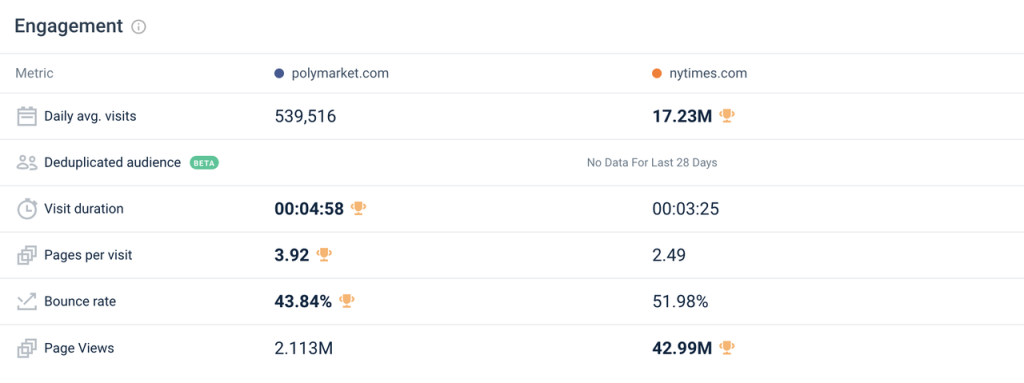
Polymarket vs. The New York Times: website metrics
Source: SimilarWeb
Unique Traders
Polymarket doesn’t need a large editorial team—core content is produced by real-money bettors, who constitute its intellectual capital. The history and past failures of prediction markets underscore the importance of participants: their rational analysis and continuous reassessment of new information are foundational to market accuracy.
A 2022 study of over 40,000 Finnish residents' online horse racing betting behavior found that individuals with higher numerical IQ (better at arithmetic reasoning, math problem-solving, and quantitative analysis) showed significantly greater willingness to participate in skill-based gambling (as opposed to luck-based). The study also revealed that only about 9% of total bettors achieved net profits. On Polymarket, this figure is 11.5%.
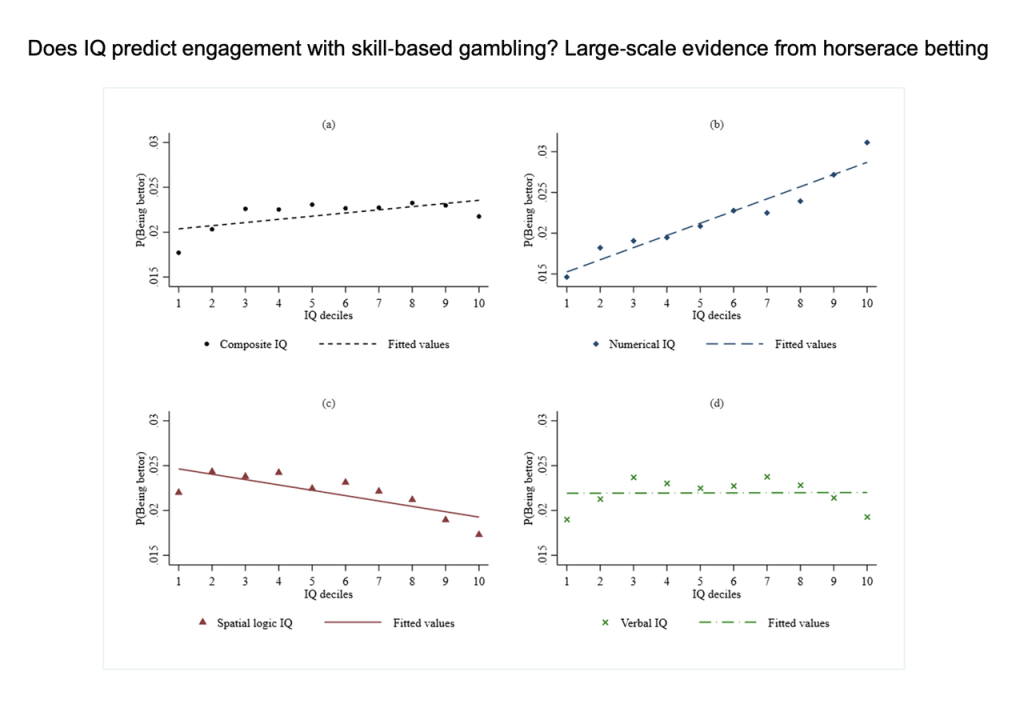
(a): General IQ positively correlates with willingness to bet on horse racing (b): Numerical IQ shows strong positive correlation (c): Spatial-logical IQ shows strong negative correlation (d): Verbal IQ shows no correlation
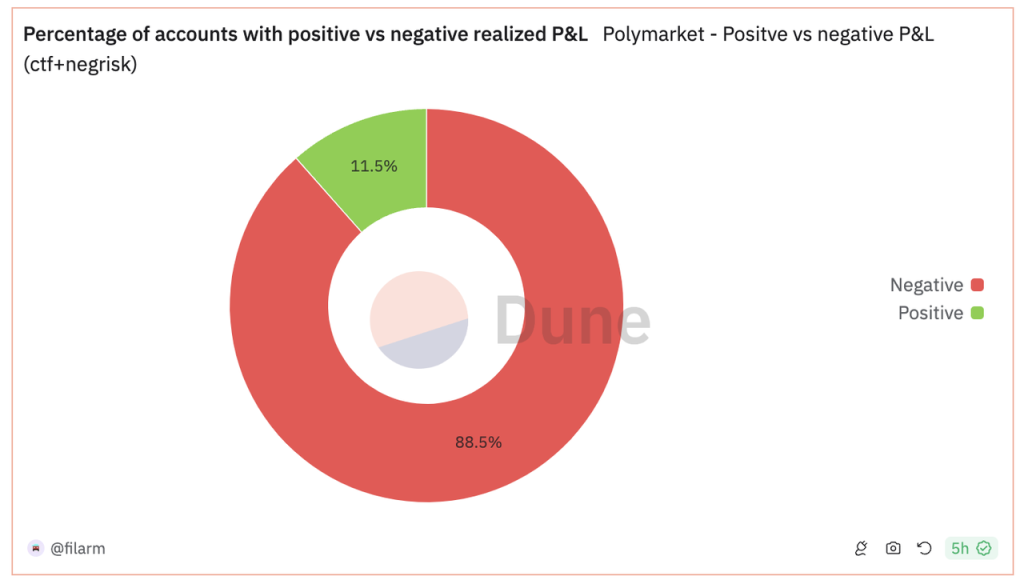
Profit and loss distribution among Polymarket users
Polymarket’s advertising referral sources also reveal insights into its user acquisition strategy.
-
#1: electionbettingodds.com, a well-known aggregator of election prediction markets, compiling data from five platforms including Polymarket
-
citizenfreepress.com, a conservative-leaning U.S. political news aggregator, half of whose users are American males over 55
-
natesilver.net, Substack of statistician, author, and poker player Nate Silver. His election forecasting system correctly predicted 49 out of 50 states in the 2008 U.S. presidential election. He joined Polymarket as an advisor in June this year
-
Only Coindesk and DappRadar among the top 10 referrers primarily target crypto-native users
-
Compared to OpenSea and pump.fun, Polymarket’s user age distribution is more balanced, with a significantly higher proportion of users aged 35+
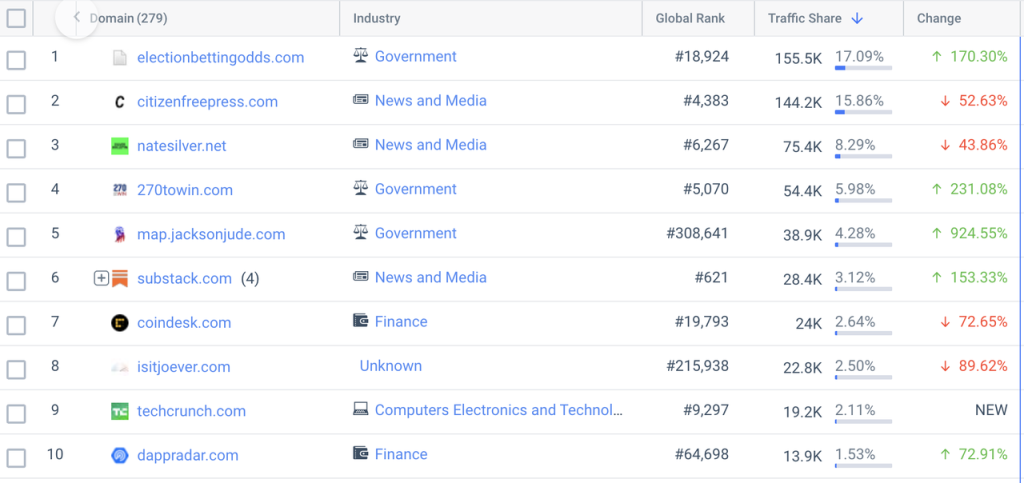
Top 10 referral websites to Polymarket
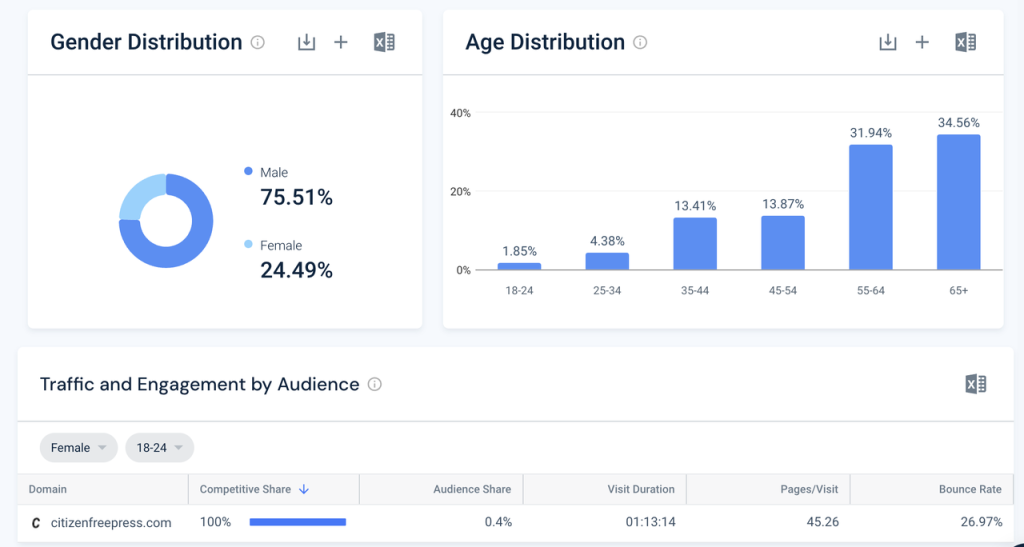
User demographics of citizenfreepress.com
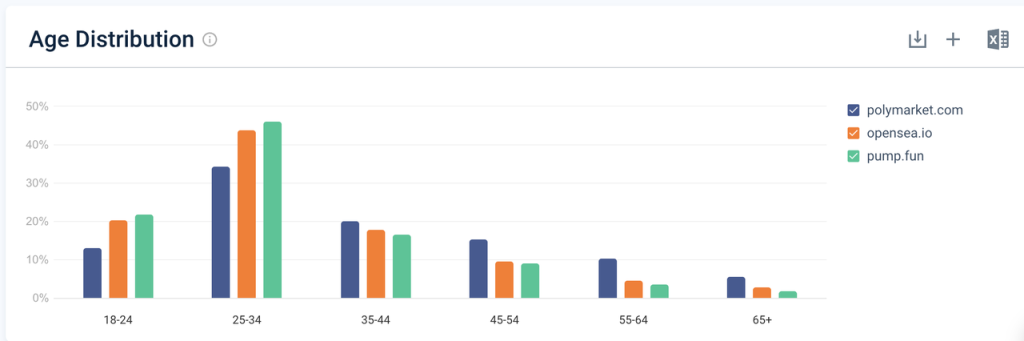
Age composition of users: Polymarket, OpenSea, pump.fun
Source: SimilarWeb
We rarely hear stories of legendary traders on Polymarket. This is inherent to prediction markets—they aim to keep odds within reasonable bounds, avoiding extreme deviations from actual event probabilities.
Polymarket’s leaderboard supports this. Only three users have earned over $1 million in total profit, while pump.fun has 197 addresses with over $1 million in gains. Considering Polymarket’s September MAU was just 14% of pump.fun’s and that Polymarket launched in 2020, the chance of getting rich on Polymarket appears much slimmer.
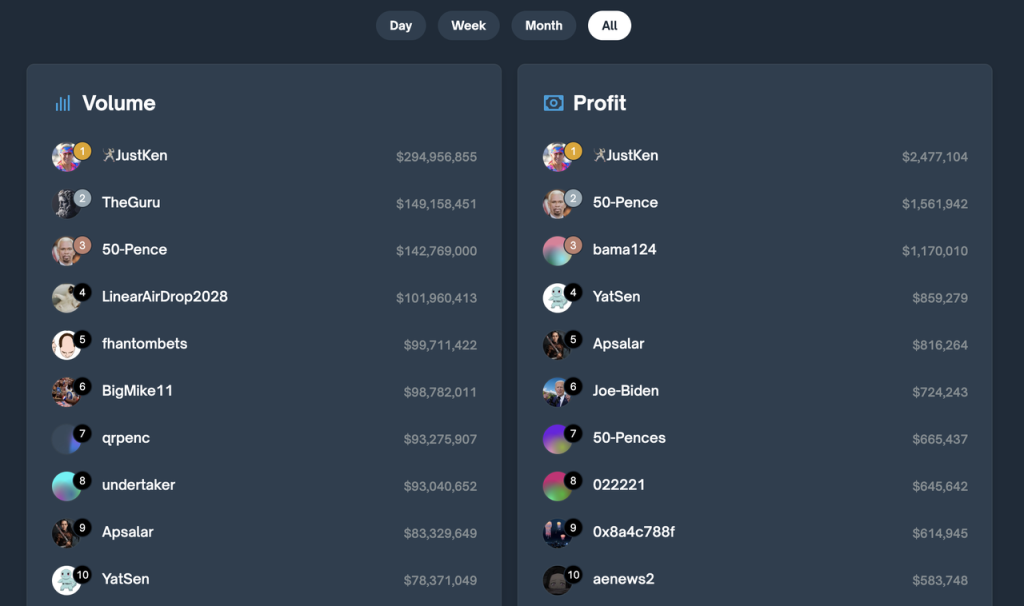
Polymarket leaderboard
Correspondingly, Polymarket keeps trading features minimal. Beyond deposits and withdrawals, only basic market and limit orders are offered. Though it open-sourced Polylend—a lending protocol allowing users to borrow USDC against collateral—in June, Polymarket clarified it won’t deploy this in production, merely enabling community development. Additionally, Polymarket avoids large-scale liquidity incentives. It seems to believe complex trading tools blur users’ intent to speculate, while market-making and incentives distort market efficiency.
While the conversion rate from "reading" to "trading" is hard to quantify, we can sketch an idealized portrait of Polymarket’s user base: a relatively rational and mature group, possibly unfamiliar with crypto beforehand, economically stable, unconcerned with maximizing P&L, and deriving satisfaction from proving their analytical judgments correct. This profile starkly contrasts with typical crypto gamblers and represents a demographic largely unreachable by current Web3 products.
Stall: The Crucial November
In aviation, "stall" refers to a condition where an aircraft’s wing exceeds its critical angle of attack, failing to generate sufficient lift and causing rapid altitude loss. To recover from a stall, pilots must lower the nose and increase thrust to regain airflow and lift.
Polymarket’s rapid rise and reliance on the election "killer app" have raised concerns about what comes next—after the U.S. election concludes on November 5, where does Polymarket go? After all, it faces no shortage of watchful competitors, ambitious new entrants, and persistent critics.
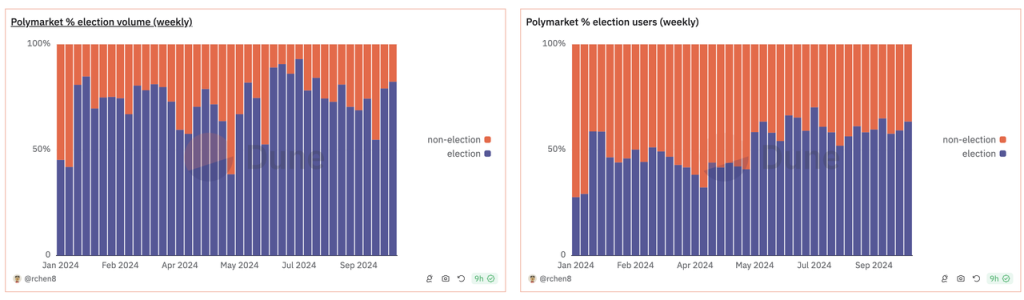
Election-related trading volume accounts for 70%, user activity 60%
Polymarket’s Strategic Options
For Polymarket, the election outcome is crucial—not just for its own reputation, but for the credibility of prediction markets broadly, and whether it can distance itself from its investors’ political leanings to genuinely reflect public sentiment.
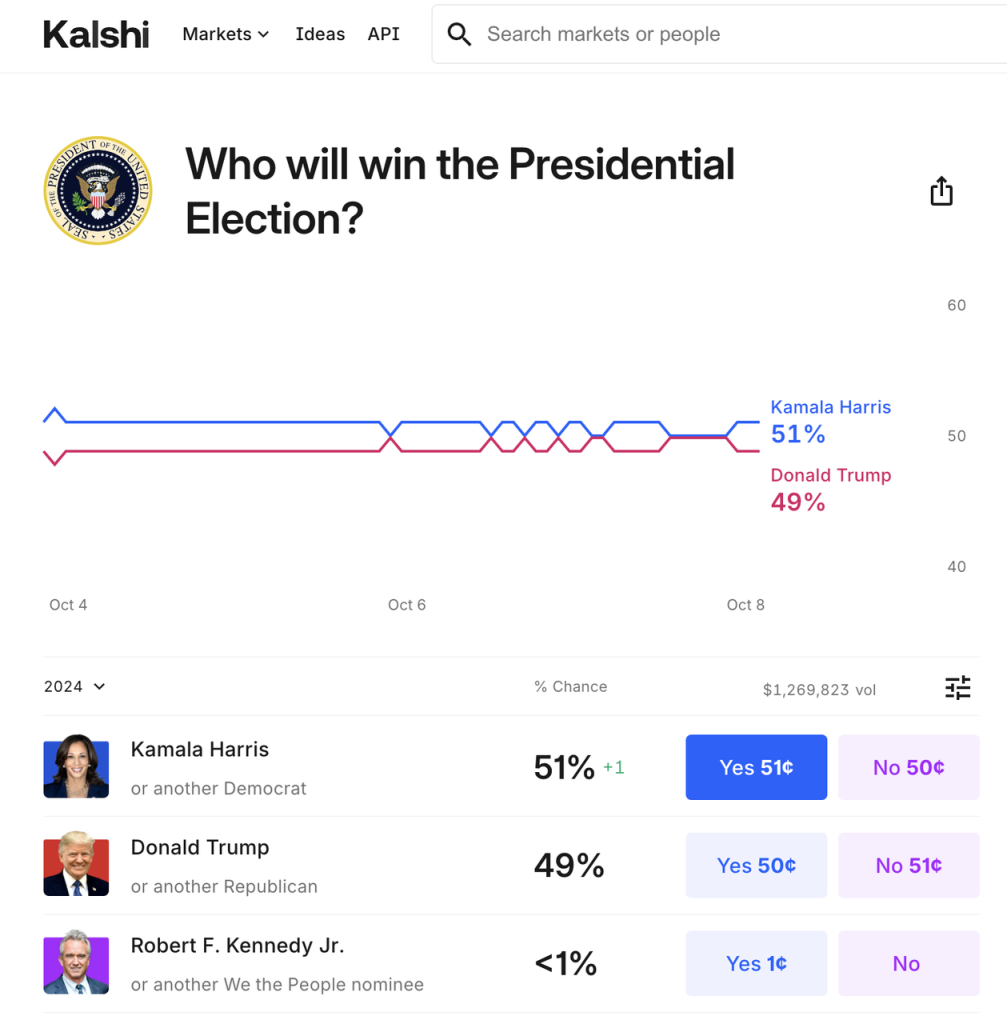
Unlike Polymarket, where Trump recently overtook Harris, Kalshi has consistently shown Harris leading

Peter Thiel, founder of Funders Fund (lead investor in Polymarket), "very strongly supports Trump"
After the election, facing declining volume and user attrition, potential strategies for Polymarket (and areas new entrants hope to exploit) fall roughly into three categories:
1. Expand into sports betting
Sports are currently Polymarket’s second-largest event category after elections, but trading volume lags by orders of magnitude—likely benefiting mainly from election-related traffic overflow. Whether this traffic can sustain post-election is questionable.
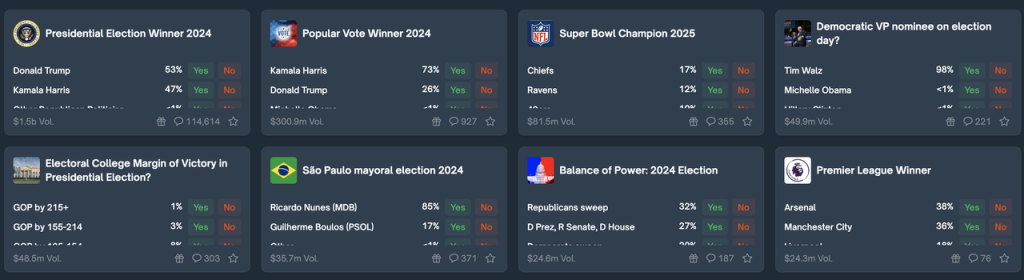
Super Bowl and Premier League rank among Polymarket’s top 8 by trading volume
Beyond the fact that sports betting is already highly fragmented and saturated, it isn't core to prediction markets. Fan betting is often emotionally driven, seeking immediate excitement and enhanced viewing experience rather than long-term profitability—clashing with the rational filtering logic of prediction markets.
2. Add derivatives trading
Another saturated market—entering it would mean competing on others’ turf with weaker advantages.
3. Become the "event version of pump.fun"
This is a popular idea: an open market where anyone can create events and place bets, seemingly addressing Polymarket’s limitation where users cannot self-create markets and rely on centralized curation ("listing"). But examining the characteristics of the most popular election events reveals:
-
Extremely broad impact → ample liquidity
-
Long duration with multiple sub-events → thorough information flow
-
Fixed timeline and binary outcome → clear settlement
Similarly, Polymarket’s official criteria for listing events include:
-
Is there sufficient trading demand to generate accurate probabilities?
-
Does the event outcome have social or news value?
-
Can the result be definitively resolved within a fixed timeframe?
For most people, crafting a well-defined binary question, expressing it clearly and unambiguously (without excessive jargon), setting a precise settlement point and criteria, while ensuring societal relevance—is far harder than uploading an image to launch a meme.
Even Polymarket has faced controversy over ambiguous resolution criteria—for example, questions like "Will the ETF be approved?" or "Did Trump’s son participate?" If fully open, malicious actors could create absurd markets (e.g., "Will Trump say a certain word in his next speech?"), and disputes over resolution (e.g., defining participation) would impose massive operational burdens.
Thus, all three seemingly viable transformation paths prove difficult. At their core, they risk pushing Polymarket to emphasize trading and speculation—something it struggles to sustain and arguably should avoid. Even if launching a token, Polymarket must carefully design incentives—favoring quality question creation and correct predictions over raw trading volume.
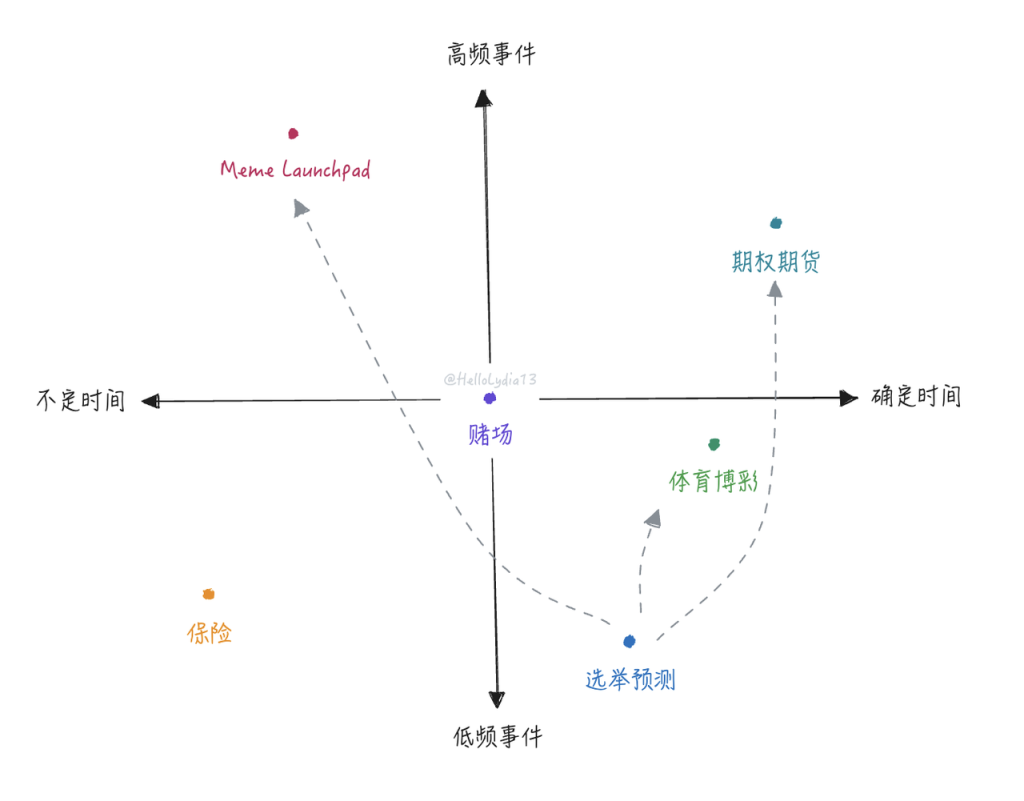
Proposed "transformation paths" differ from current business in event nature and time horizon
The Elephant in the Room: Regulation
Until regulatory clarity improves, Polymarket’s token is unlikely to arrive soon.
Markets bordering on gambling face strict oversight. In 2022, Polymarket was fined $1.4 million by the CFTC and barred from operating in the U.S. In May this year, the CFTC proposed a rule banning all U.S. election-related derivatives trading. That same month, Polymarket announced a $70 million funding round, stating its mission is to serve as a public good providing more accurate, real-time event forecasts.
Positive news emerged in the final weeks before the election. Following a District Court in Colombia supporting election prediction markets, a federal appeals court also rejected the CFTC’s attempt to block election betting. The CFTC had previously warned that "the use of such contracts may adversely affect the fairness of elections or public perception thereof."
All eyes now turn to Polymarket’s upcoming election performance report card.
Join TechFlow official community to stay tuned
Telegram:https://t.me/TechFlowDaily
X (Twitter):https://x.com/TechFlowPost
X (Twitter) EN:https://x.com/BlockFlow_News
 Mint Ventures






