Fractal Bitcoin: An Innovative Scaling Solution for Bitcoin
TechFlow Selected TechFlow Selected
Fractal Bitcoin: An Innovative Scaling Solution for Bitcoin
The Fractal Bitcoin mainnet will officially launch in September.
 Navigating Web3 tides with focused insights
Author: dt
This week's crypto market rally was triggered by Federal Reserve Chair Jerome Powell's clear indication of rate cuts during his speech at Jackson Hole, sparking a strong rebound led by Bitcoin and bringing about a rare broad-based uptrend across altcoins in August.
Bitcoin-related narratives have consistently been the biggest catalyst this cycle, starting with BTC ETFs and subsequently igniting various tokens and projects within Bitcoin’s on-chain ecosystem. This week, CryptoSnap's Dr. DODO dives into another Bitcoin-centric project—Fractal Bitcoin, currently gaining momentum through its public testnet phase. Let’s explore what Fractal Bitcoin really is.
What Is Fractal Bitcoin?
Fractal Bitcoin emerged from the long-standing scalability challenges facing the Bitcoin network. As Bitcoin adoption grows, surging transaction volumes have led to longer confirmation times and higher fees. Over the years, the Bitcoin community has explored solutions such as the Lightning Network—Layer 2 protocols. However, these often require additional infrastructure or complex user operations.
In this context, the UniSat team introduced Fractal Bitcoin, aiming to create a seamless scaling solution integrated within the Bitcoin ecosystem—one that avoids major changes to Bitcoin’s core protocol while significantly enhancing network performance.
Inspired by fractal geometry, Fractal Bitcoin recursively builds infinite expansion layers atop the Bitcoin mainchain to boost transaction throughput and speed, while maintaining full compatibility with the existing Bitcoin ecosystem. Its core concept leverages Bitcoin’s own foundational code to create a tree-like scaling structure, where each layer can further branch out, dramatically increasing the network’s parallel processing capacity.
Source: https://www.fractalbitcoin.io/
Technical Features of Fractal Bitcoin
-
Core Technology: Uses Bitcoin’s core code, directly inheriting the security and reliability of the Bitcoin blockchain.
-
Scaling Mechanism: Builds a tree-like structure via recursive expansion layers, increasing the network’s parallel processing capability.
-
Performance Boost: Block confirmation time of approximately 30 seconds; transaction capacity up to 20x that of the Bitcoin mainchain.
-
Compatibility: Fully compatible with existing Bitcoin wallets, tools, and mining hardware.
-
Mining Methods: Supports both permissionless mining and merge mining.
-
Security: All transactions are ultimately traceable to the Bitcoin mainchain, ensuring security and verifiability.
-
Dynamic Adjustment: Automatically adjusts the number of expansion layers based on network congestion.

Source: https://www.fractalbitcoin.io/about
Fractal Bitcoin Ecosystem
The Fractal Bitcoin ecosystem is rapidly evolving, with several promising projects already emerging:
-
UniWorlds: A metaverse project built on Fractal Bitcoin, offering customizable virtual spaces.
-
InfinityAI: An AI initiative providing test tasks and point-based rewards.
-
Satspumpfun: A clone of pump.fun, serving as a token launch platform on Fractal Bitcoin.
-
Motoswap: A decentralized exchange (DEX) project on the Fractal Bitcoin chain.
Although the Fractal Bitcoin mainnet has not yet launched, many of these projects are already deployed on the testnet, allowing users to participate in testing. InfinityAI, for instance, currently offers multiple test tasks to help users become familiar with on-chain operations.
Current Status of Fractal Bitcoin
Fractal Bitcoin is currently in the testnet phase. Users can obtain test tokens via the official faucet or through testnet mining. The network employs the same Proof-of-Work (PoW) consensus mechanism as Bitcoin, enabling BTC miners to seamlessly transition their existing ASICs, GPUs, and other hardware to mine Fractal blocks. It introduces an innovative merged mining mechanism called Cadence Mining, which combines permissionless mining and merge mining in a cyclical pattern: every three blocks, two are mined via "permissionless mining" and one via "merge mining."
-
Permissionless Mining: Allows anyone with suitable tools and hardware to mine Fractal blocks, similar to BTC mining.
-
Merge Mining: Designed specifically for BTC miners, enabling them to simultaneously mine BTC and Fractal blocks without requiring additional computational power.
According to the official website, the mainnet is scheduled to launch in September.
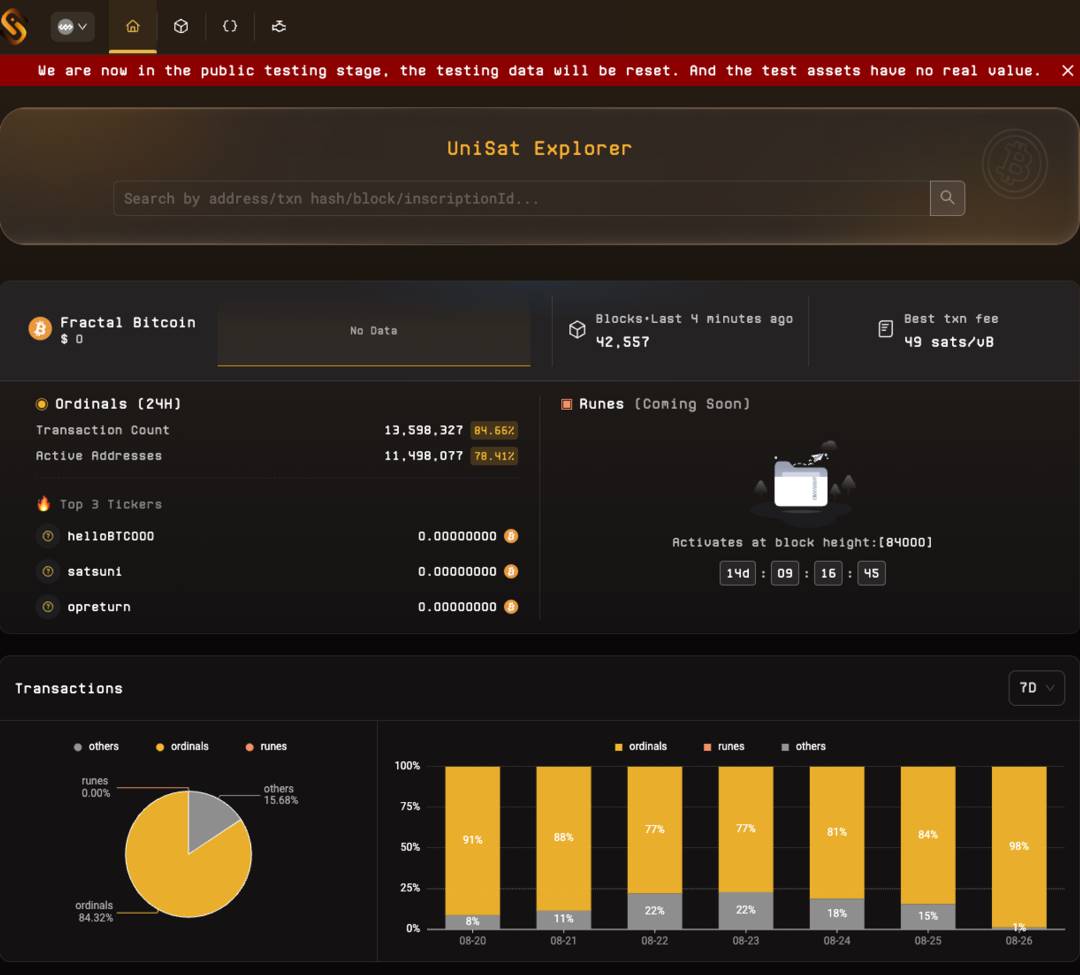
Source: https://explorer-testnet.fractalbitcoin.io/
Potential and Impact of Fractal Bitcoin
Fractal Bitcoin has the potential to significantly enhance Bitcoin’s transaction efficiency. Through its innovative recursive layering architecture, it could drastically improve transaction speed and throughput—not only improving user experience but also opening new use cases for Bitcoin in everyday payments and microtransactions.
Moreover, Fractal Bitcoin offers developers broader room for innovation. Thanks to its compatibility with Bitcoin’s core code, developers can explore new possibilities within a familiar technical framework, potentially accelerating innovation across the broader Bitcoin ecosystem.
Author’s Perspective
The most notable aspect of Fractal Bitcoin is undoubtedly its origin—the UniSat team, backed by major exchanges Binance and OKX. UniSat has set a high bar in the BRC20 trading space, outperforming nearly all competitors. Additionally, its previously issued token $PIZZA demonstrated solid price performance, earning widespread approval from retail investors.
However, setting aside the team’s reputation, I find little apparent advantage of Fractal Bitcoin over other Bitcoin-based public chains when reviewing project documentation or official website content. In fact, both the docs and site appear overly simplistic, lacking detailed explanations of how Fractal Bitcoin operates under the hood. Most content focuses on usage instructions rather than explaining the system’s internal mechanics.
Furthermore, it remains questionable whether Bitcoin truly needs a functional public chain at this stage. Before Fractal Bitcoin, several Bitcoin L2 chains like Merlin and B² Network launched but failed to attract genuine user engagement. Most assets remain confined to air-dropped mining activities, as the majority of Bitcoin-native users aren’t seeking complex functionalities—they’re primarily drawn to the hype around Bitcoin-pegged assets.
That said, since Fractal Bitcoin adopts a PoW model more akin to a sidechain rather than a traditional L2, miner participation might help sustain interest post-launch, avoiding the “launch-and-die” fate seen with others.
I hope Fractal Bitcoin introduces novel gameplay distinct from Ethereum’s DeFi ecosystems or new token issuance trends on native Bitcoin like BRC20 and Rune—something truly innovative that redefines engagement within the Bitcoin space.
Join TechFlow official community to stay tuned
Telegram:https://t.me/TechFlowDaily
X (Twitter):https://x.com/TechFlowPost
X (Twitter) EN:https://x.com/BlockFlow_News
 白话区块链
白话区块链