








Solana's Boom or Bust: 70% of Trades by Bots, Meme Data Dives Sharply
TechFlow Selected TechFlow Selected
Solana's Boom or Bust: 70% of Trades by Bots, Meme Data Dives Sharply
The state of the Solana ecosystem is not as dire as some opinions suggest.
 Navigating Web3 tides with focused insights
By Frank, PANews
As Solana's on-chain data begins to surpass Ethereum across multiple metrics, speculation about whether Solana could overtake Ethereum has intensified. At the same time, debates around the authenticity of Solana’s apparent boom have drawn significant attention on social media. Recently, several KOLs have argued that Solana's data-driven prosperity is not genuine. The main points of contention regarding Solana on social media can be summarized as follows: 1) widespread bot activity; 2) inflated transaction volume; 3) MEV (Maximal Extractable Value) issues; 4) financial losses; and 5) concerns over SOL token inflation.
Based on long-term observation of the Solana ecosystem, PANews has conducted its own data investigation into the legitimacy of Solana’s growth narrative.
Bot Overload: Nearly 70% of Transactions Are From Bots
The issue of rampant bots on Solana has been widely discussed by KOLs on social media recently. Researcher Dan Smith revealed on July 29 that Solana’s weekly transaction fees and MEV revenue surpassed Ethereum for the first time.
This phenomenon is especially severe on pump.fun if you frequently trade MEME coins. Randomly opening a token trading page on pump.fun reveals that bot transactions (marked with an exclamation mark in the list) dominate most trades, as shown in the image below.
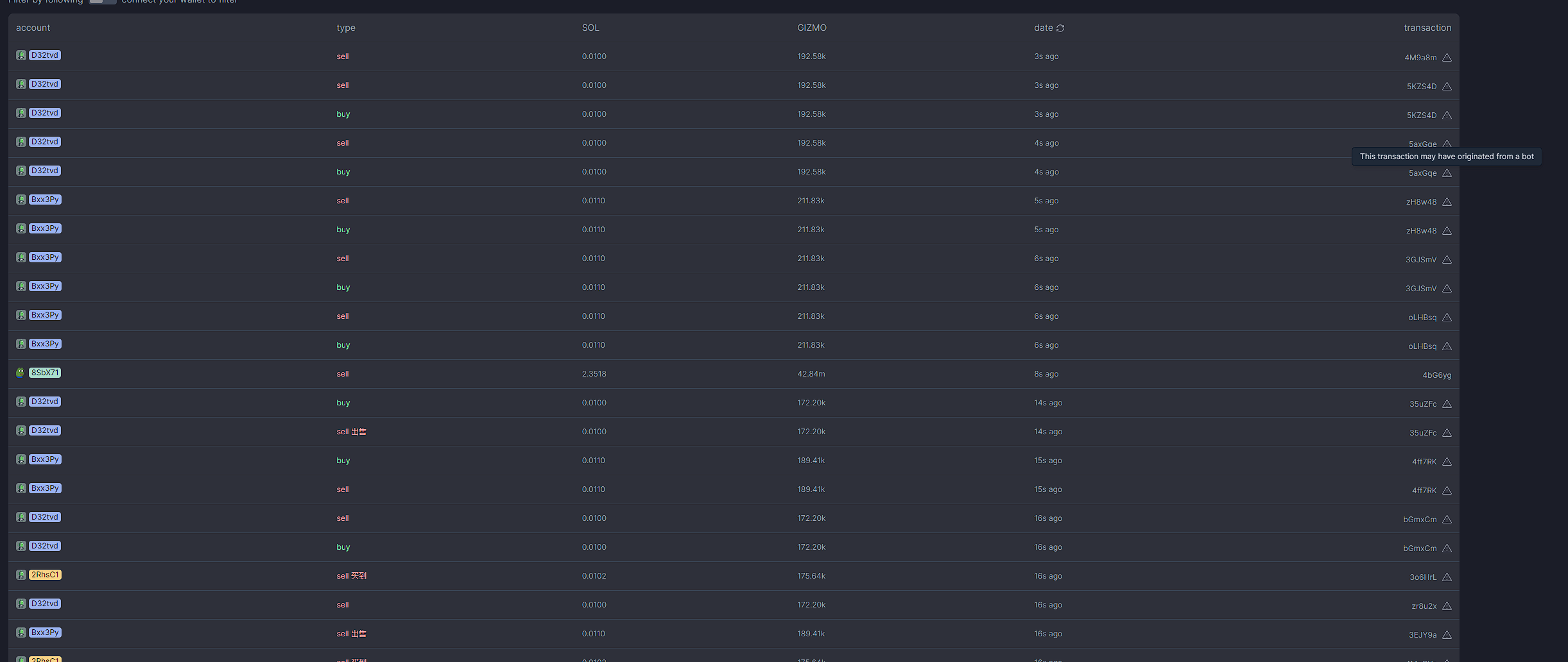
However, identifying bot transactions and filtering such data remains difficult, and official sources lack transparency in this area.
Flip Research estimates the bot ratio at as high as 93%, stating: "Given the abnormally high transaction-to-user ratio and the volume of wash trades on-chain, it appears the vast majority of transactions are non-organic. On major Ethereum L2s, the highest daily transaction-to-user ratio is 15.0x on Blast (a platform with similarly low fees where users actively engage with Blast S2). As a rough comparison, assuming real SOL transaction and user ratios are similar to Blast, this would imply over 93% of Solana’s transactions—and by extension, fees—are non-organic."
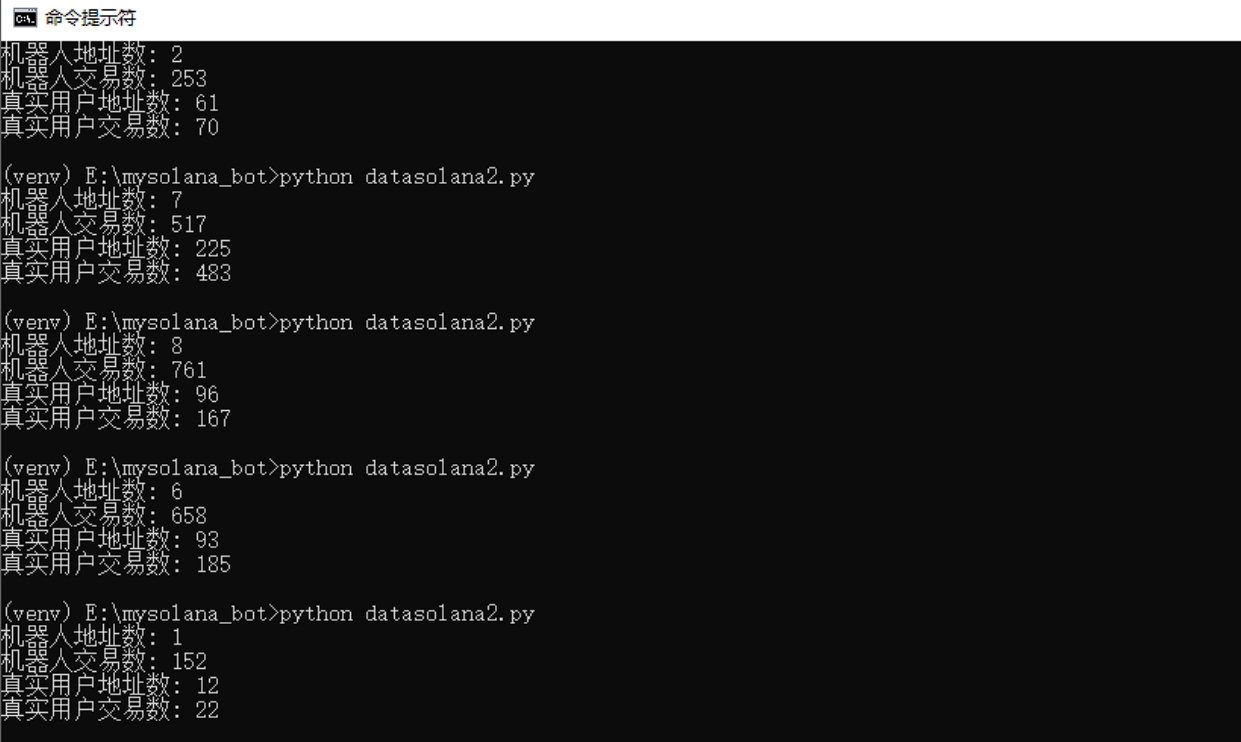
However, this figure may not be entirely accurate. PANews randomly selected 10 relatively active tokens from pump.fun and analyzed their most recent 1,000 transactions each. Using two criteria to detect bots—buy/sell actions within a short timeframe (less than 10 seconds) or repeated transactions involving identical addresses and amounts—the analysis found that out of a total of 8,268 transactions across these 10 tokens, 80.85% were executed by bots, with genuine user transactions accounting for less than 20%. For individual tokens, bot dominance reached up to 99.5%, with bots averaging 159 transactions per interval compared to just 1.99 for real users.
That said, not all trading pairs on Solana exhibit such extreme bot dominance. PANews then analyzed the most recent 10,000 transactions for 10 higher-market-cap tokens such as $WIF, JUP, POPCAT, BOME, and MEW. Among these more established tokens, the proportion of bot activity dropped significantly to 50.73%. Higher bot concentrations were observed among MEME coins: $WIF (81.6%), POPCAT (87.5%), and MEW (88%). In contrast, JUP (Jupiter’s governance token) had a bot share of 51%, while KAMA showed only 27.3% bot involvement.
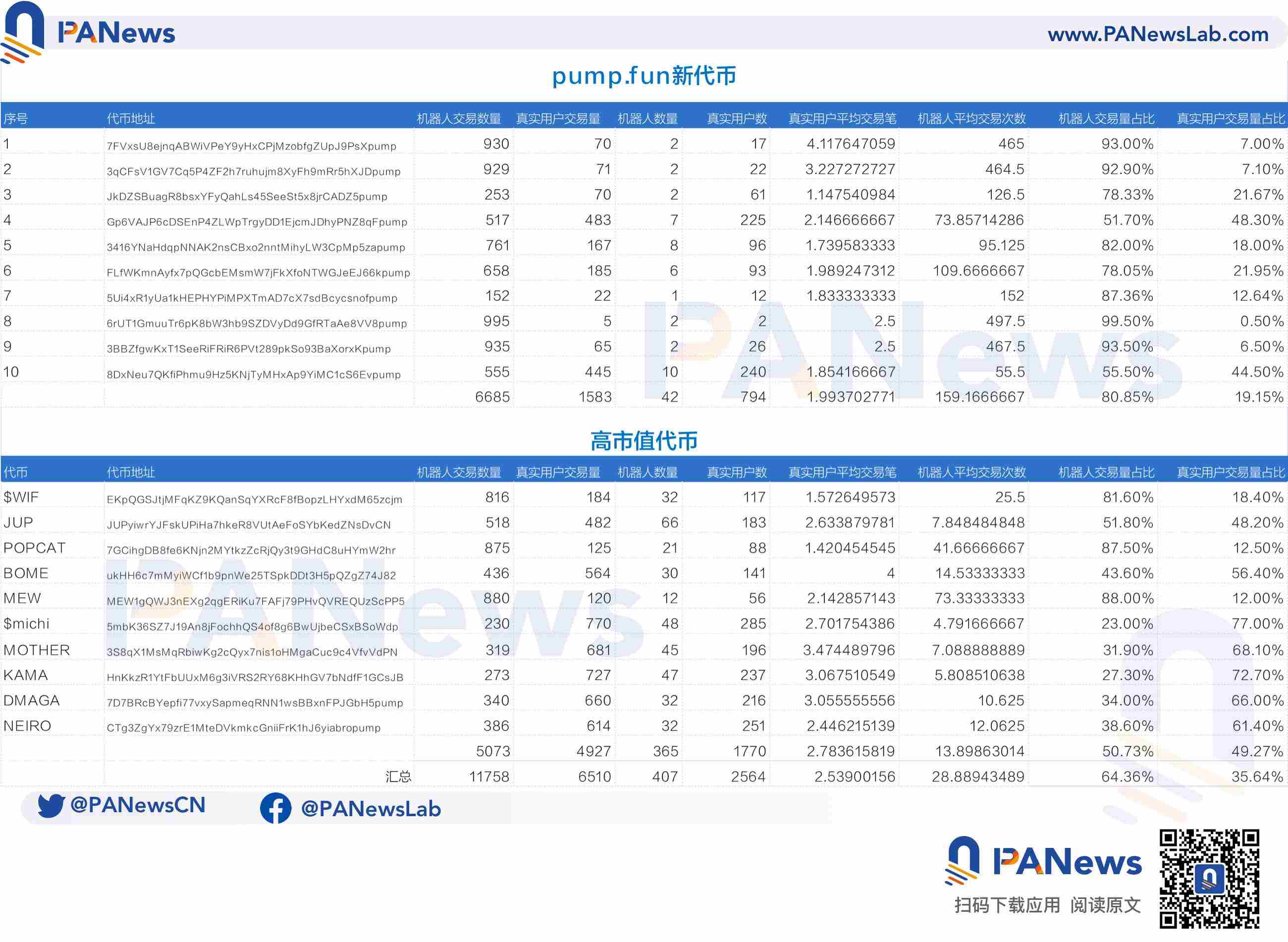
Tokens without completed liquidity curves remain traded on pump.fun, while those completing them are listed on Raydium. Thus, the above comparison can also reflect differences between newly launched tokens on pump.fun versus mature tokens listed on DEXs like Raydium. According to current trading volume distribution, pump.fun accounts for approximately 53% of Solana’s DEX transaction count (as of August 8). Based on this, roughly 66% of Solana’s daily transactions are estimated to come from bots. This suggests that real users currently favor high-market-cap, price-stable tokens rather than speculative new launches.
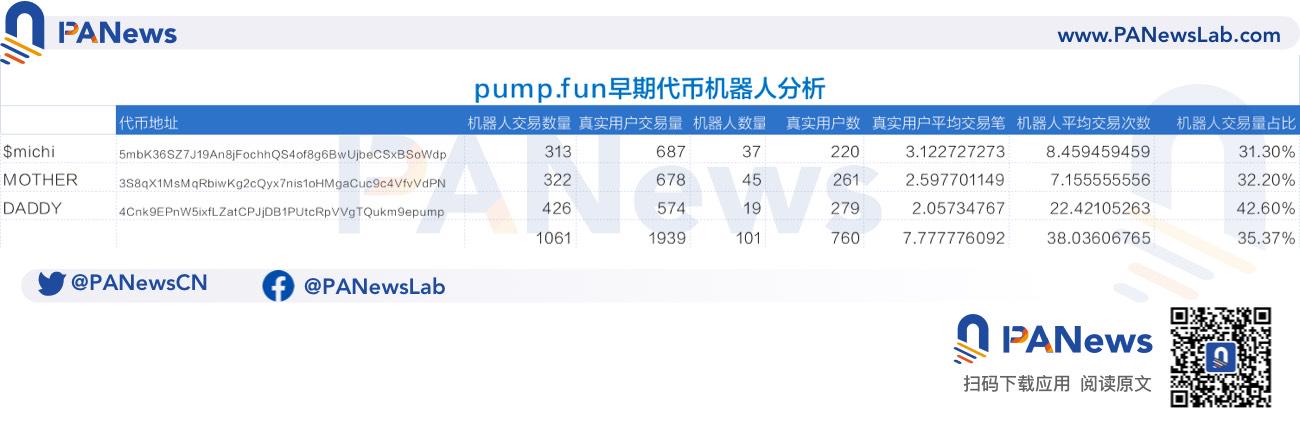
PANews further analyzed transaction data for the top three market cap tokens on pump.fun during their initial creation phase and found that about two months ago, the bot ratio was only around 35%, and both the number of real users and transaction counts were significantly higher than they are today.
Average Daily Transactions Per Real User Is ~16, Comparable to Ethereum L2s
What is the actual average daily transaction volume per user on Solana? Flip Research claimed that each Solana user conducts as many as 217 transactions per day—far exceeding other blockchains.
In reality, Solana transactions are categorized into vote transactions and non-vote transactions. The data Flip Research sourced from TokenTerminal includes both types, but regular user activity primarily occurs within non-vote transactions, which typically differ in scale by about an order of magnitude.
On August 6, there were 34.8 million non-vote transactions and 987,000 active users, averaging 35 transactions per user.
Additionally, PANews estimates that about 13% of current active addresses are bots, leaving 86% as genuine users.
Using August 8 data—34.26 million total transactions, 822,000 DAUs—the estimated number of real user transactions is about 11.3 million, with approximately 706,900 real users, resulting in an average of around 16 transactions per real user. This is significantly higher than Ethereum (~3.37) and Base (~6.18), close to Arbitrum (~12.39), but lower than Blast (~30.8, data from August 6). From this perspective, excluding bot activity, Solana’s real user engagement does not significantly diverge from other Ethereum L2s.
Sharp Decline in MEME Coin Activity
Another metric indirectly reflects Solana’s superficial boom. While the daily issuance of new SPL tokens has not declined significantly—remaining around 20,000 per day—the quality of these launches is deteriorating. In early July, pump.fun issued 71,000 tokens, with 5,187 subsequently listed on Raydium (automatically upon meeting liquidity requirements). By the week of August 5, despite issuing 55,000 tokens, only 1,850 made it to Raydium. This indicates that although token creation remains steady, the success rate for upgrading to Raydium is declining sharply—from about 7.3% in early July to under 3%. On August 12, according to Dune analytics, pump.fun launched 11,796 Meme tokens in 24 hours, with only 157 successfully listed on Raydium—just 1.33%.
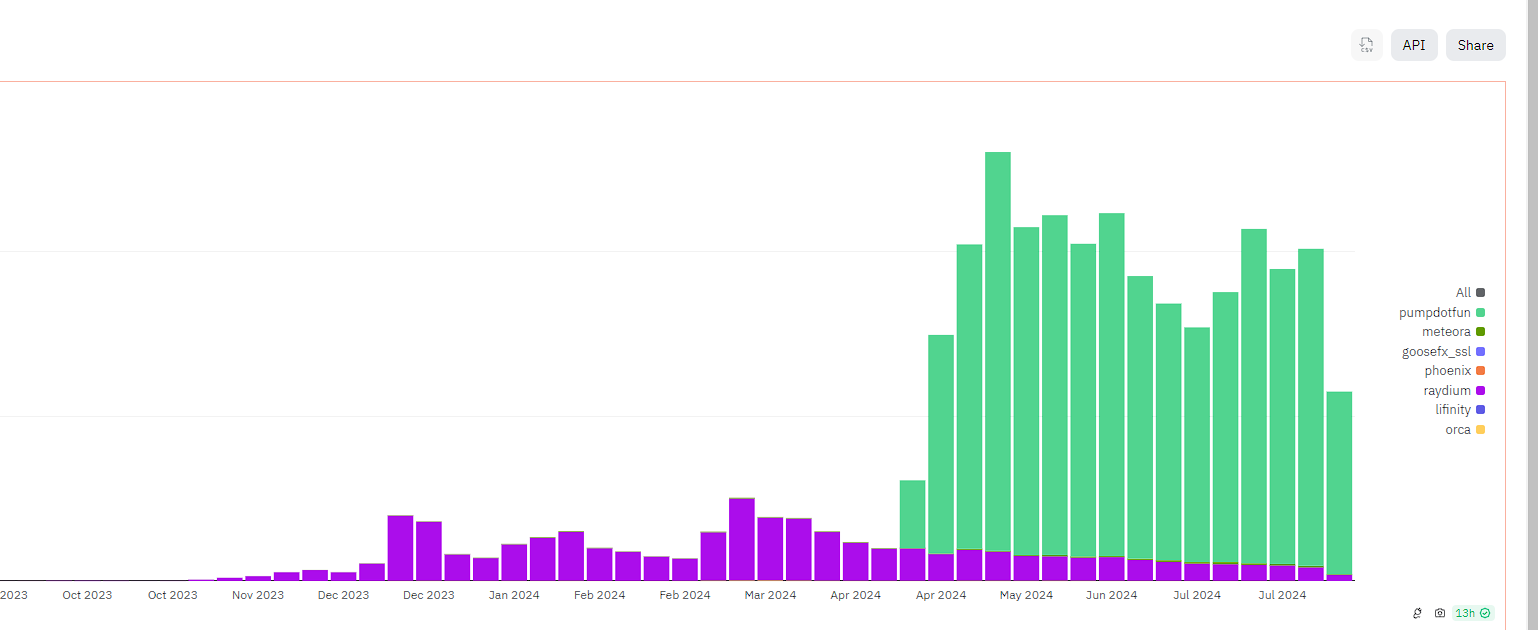
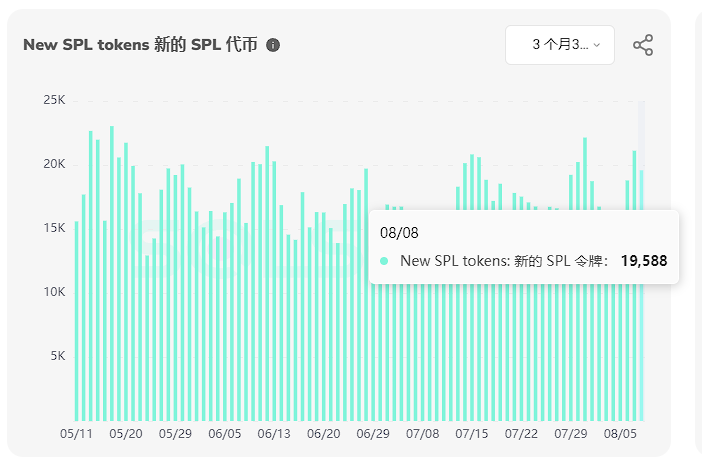
Moreover, New Token Accounts (newly created token holder addresses) on Solana have seen a sharp drop recently—falling from 12.24 million on July 20 to 6.67 million on August 8, nearly halving. This represents the total number of new token holder addresses created each day. Despite stable new token creation, the number of unique holders per token has plummeted. As bots dominate the transaction pool, real users are increasingly abandoning new MEME coins.
Validators Benefit from Fake Transactions
Meanwhile, Solana validators are reaping massive profits from bot-generated transactions. Dan Smith disclosed that on July 29, total fees reached $5.5 million—the highest in the past three months—with 58% coming from MEV tips and 37% from priority fees. He noted: "MEV only happens when profitable—meaning as long as retail investors keep chasing MEMEs, MEV will continue. Once MEME enthusiasm cools, MEV revenue will collapse accordingly."
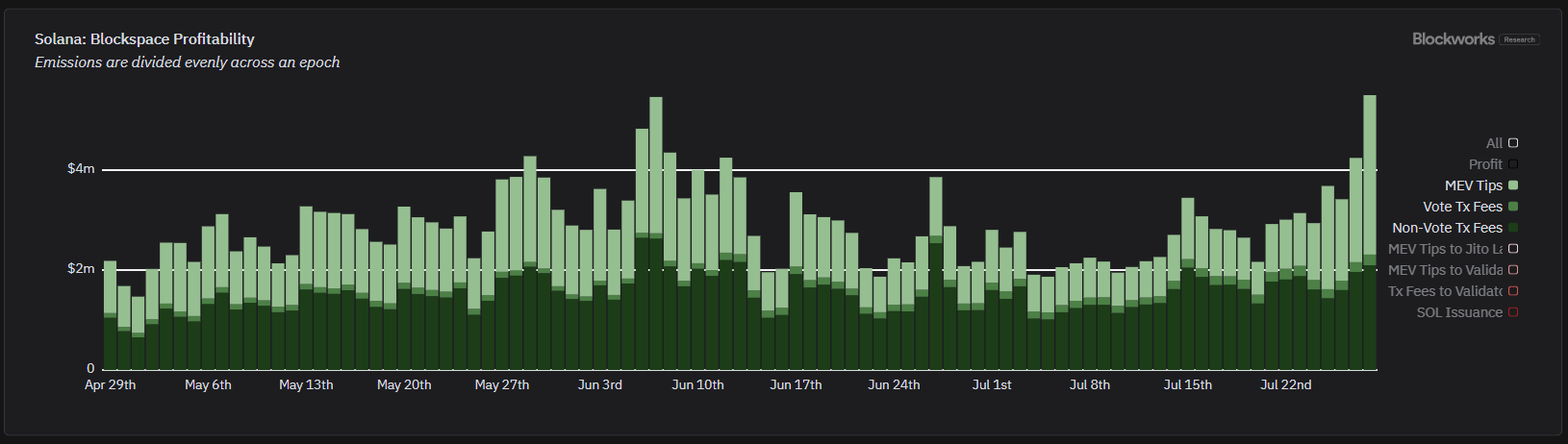
On a dedicated sandwich attack tracking website, PANews conducted a rough estimate showing 16–20 identified sandwich attacks per minute—translating to at least 23,000 daily attacks. Previous reports indicated that one notorious address extracted over $30 million in two months, and sandwich attackers now appear even more numerous. (Related reading: “Solana’s Largest Sandwich Attacker Earns $570K Daily Amid Outrage”). To mitigate this, 82% of current transactions include priority fees (to avoid being sandwiched), increasing costs for ordinary users.
No Evidence of Financial Losses
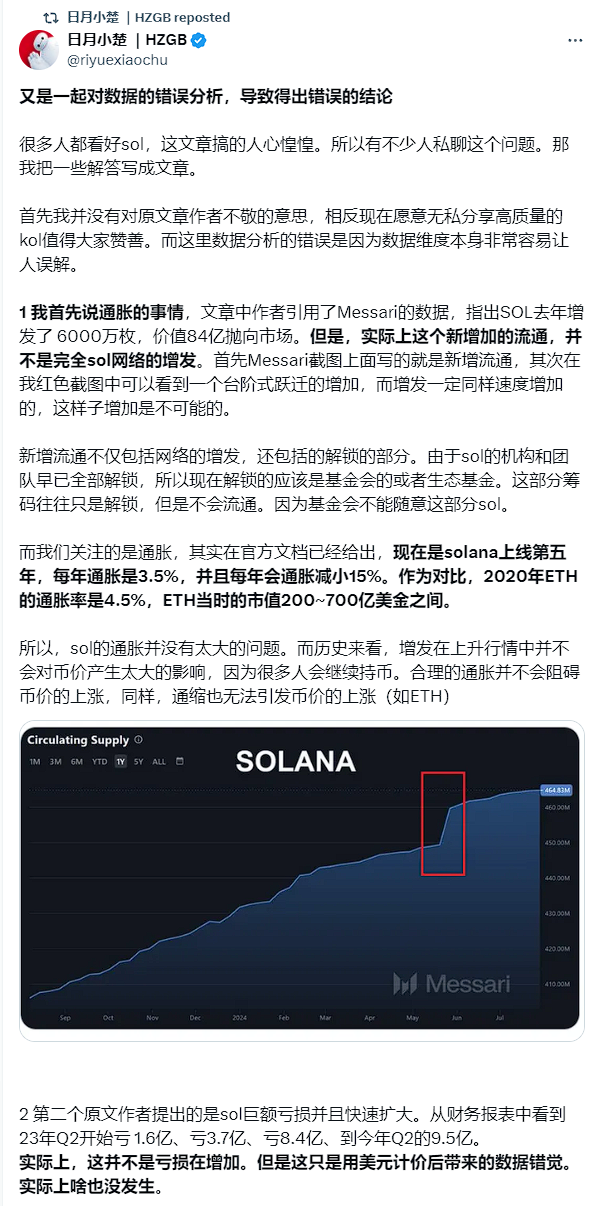
Separately, KOL Xiao Xiong Biscuit.eth raised concerns about Solana’s financial losses and inflation rates, claiming that Solana has been operating at a loss, with quarterly expenses rising from $143 million in Q2 2023 to $956 million in Q2 2024. However, another KOL, Ri Yue Xiao Chu, offered a different interpretation: "This isn’t actually increasing losses—it’s merely a dollar-denominated illusion." The average SOL price was around $25 in Q2 2023, rose to about $50 in Q4 due to market rallies, and averaged around $160 in Q2 2024. With a rough quarterly issuance of 6 million SOL, multiplying gives approximately $150 million in Q2 2023, $300 million in Q4, and $960 million in Q2 2024.
Furthermore, PANews found that the Solana Foundation has never publicly disclosed its current holdings or financial statements. The only online source for such figures is Coin98 Analytics, which itself does not reveal its data origins.
Regarding SOL token emissions, Ri Yue Xiao Chu explained that the Messari data cited by Xiao Xiong Biscuit.eth refers to newly unlocked supply, potentially from foundation unlocks, which often do not immediately enter the open market.
As for SOL inflation, solanacompass shows the current rate at 5.1%, contradicting claims of a 15% inflation rate.

Debates surrounding Solana will likely persist. Overall, the state of the Solana ecosystem is not as dire as some suggest. According to The Funding, some crypto fund managers are aggressively increasing their Solana positions. Ryan Watkins, co-founder of Syncracy Capital, stated: “Right now, Solana matches Ethereum across most meaningful metrics, yet its valuation is only one-fifth that of Ethereum.”
Yet upon closer inspection, Solana still faces challenges. Its once-thriving MEME coin ecosystem—the very force that propelled it to prominence—is now experiencing a serious downturn. Meanwhile, the broader industry continues searching for the next breakout trend. Within Solana, a dark forest-style hunt targeting retail investors is unfolding. But when the beneficiaries begin draining the ecosystem dry, is the peak already behind us?
Join TechFlow official community to stay tuned
Telegram:https://t.me/TechFlowDaily
X (Twitter):https://x.com/TechFlowPost
X (Twitter) EN:https://x.com/BlockFlow_News
 PANews









