








Arthur Hayes' latest article: Why a weakening yen could push Bitcoin to $1 million?
TechFlow Selected TechFlow Selected
Arthur Hayes' latest article: Why a weakening yen could push Bitcoin to $1 million?
Timing is key.
 Navigating Web3 tides with focused insights
Author: Arthur Hayes
Translation: TechFlow

Introduction: Arthur provides a deep analysis of how global elites use policy tools to maintain the status quo, even though these tools bring pain now or in the future. His central argument is that the USD/JPY exchange rate is one of the most critical variables in the global economy, and he explores the complex monetary interactions between Japan, the United States, and China—and their profound implications for the world economy.
Global elites have various policy tools at their disposal to preserve the current system—tools that inevitably inflict pain either now or later. I am skeptical that elected and unelected bureaucrats are driven by anything other than the desire to retain power. As such, the easy button is always pressed first. Difficult decisions and strong measures are best left for the next administration.
It would take an extremely long series of articles to fully explain why the dollar-yen exchange rate is among the most important global economic variables. This is my third attempt to describe the chain of events that brought us into the cryptocurrency paradise. Rather than presenting a complete and comprehensive picture upfront, I will follow their lead and give readers the easy button first. If policymakers abandon this tool, then I know longer, harder, and more painful corrective actions will follow. At that point, I can offer you a fuller explanation of the sequence of monetary events and the relevant historical context.
The real “oh, they’re truly screwed” moment came when I read two recent issues of Russell Napier’s “Solid Ground” newsletter. These pieces vividly depict the dilemma faced by the monetary aristocrats who have presided over Pax Americana and Pax Japonica. The most recent issue, published on May 12, describes the easy buttons available to the Bank of Japan (BOJ), the Federal Reserve (Fed), and the U.S. Treasury.
Simply put, the Fed, acting under Treasury guidance, can legally engage in unlimited dollar-yen swaps with the BOJ at any time and in any amount. The BOJ and Japan’s Ministry of Finance (MOF) can then use these dollars to buy yen in the foreign exchange market, thereby strengthening the yen. This avoids the following:
-
The BOJ raising interest rates, which would force regulated financial pools like banks, insurers, and pension funds to buy Japanese Government Bonds (JGBs) at high prices and low yields.
-
These pools having to sell their U.S. Treasury bonds (USTs) to raise dollars, which they then convert into yen and repatriate.
-
Japan’s Ministry of Finance selling U.S. Treasuries to raise dollars to buy yen.
This helps the U.S. Treasury continue funding an extravagantly spending federal government at negative real interest rates—as long as Japanese corporations—the largest holders of U.S. Treasuries—do not become forced sellers. Otherwise, the Treasury would be forced to initiate Yield Curve Control (YCC). That is the final destination, but it must be delayed as long as possible due to its obvious inflationary and potentially hyperinflationary consequences.
Seppuku
Who is the largest holder of Japanese Government Bonds? The Bank of Japan.
Who controls Japan’s monetary policy? The Bank of Japan.
What happens to bond prices when interest rates rise? They fall.
Who suffers the biggest losses if interest rates rise? The Bank of Japan.
If the BOJ raises interest rates, it commits seppuku. Given its strong self-preservation instinct, the institution will not raise rates unless there is a solution to distribute the losses to other financial participants.
If the BOJ does not raise rates and the Fed does not cut them, the dollar-yen interest rate differential remains. Because dollar yields exceed yen yields, investors will keep selling yen.
China Is Not Happy
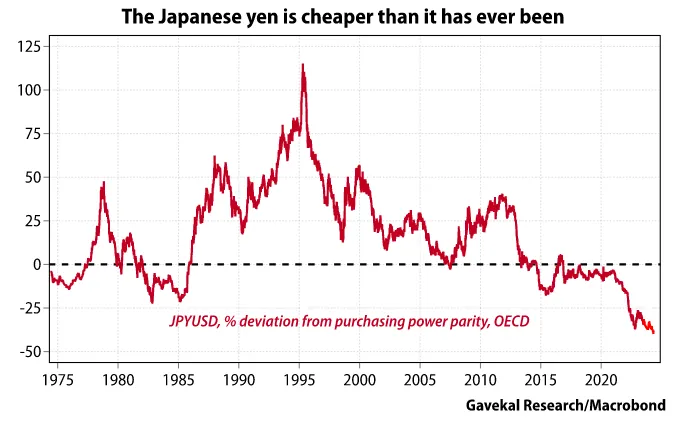
China and Japan are direct export competitors. In many industries, Chinese goods match Japanese quality. Therefore, price becomes the only differentiator. If the yuan weakens against the yen (a weaker yen vs. a stronger yuan), China's export competitiveness suffers.
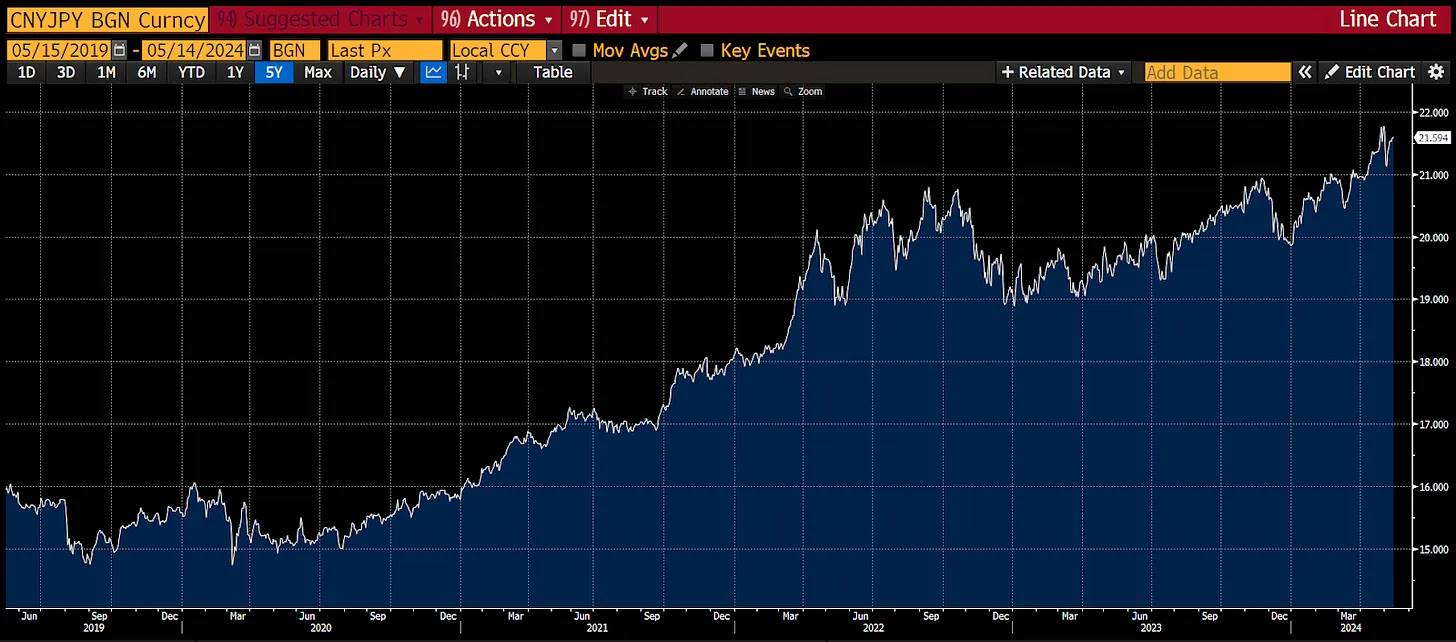
China won’t like this CNY/JPY chart.
China wants to escape deflation by manufacturing and exporting more goods.
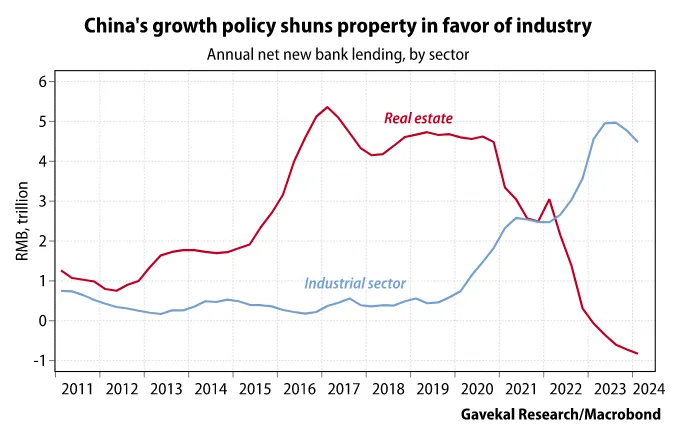
Real estate = bad
Manufacturing = good
That’s where cheap bank credit will flow.
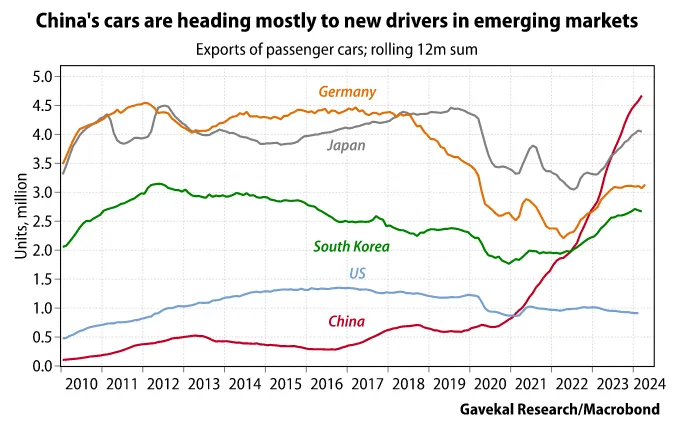
As you can see, China and Japan are neck-and-neck in the emerging passenger vehicle export market. I use this as an example of global export competition. Given the volume of cars purchased annually, this is arguably the most important export market. Moreover, the Global South is young and growing, and per capita car ownership will rise significantly in the coming years.
If the yen continues to depreciate, China will respond by devaluing the yuan.
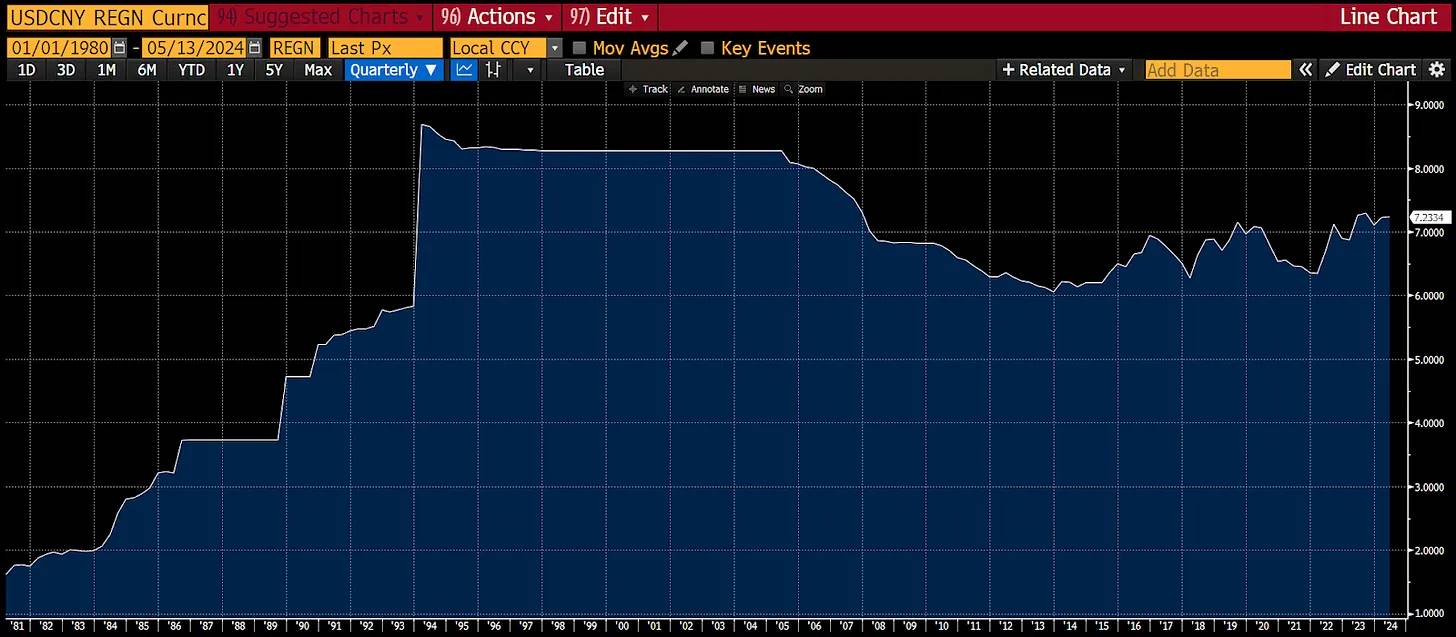
Since 1994, the People’s Bank of China (PBOC) has essentially pegged the yuan to the dollar, with a slight appreciation bias. This is what the USDCNY chart shows. That is about to change.
China must implicitly devalue the yuan by creating more onshore yuan credit and explicitly devalue it through a higher USDCNY rate to win on price against Japan. China must do this to counteract the deflationary collapse triggered by the bursting of its property bubble.
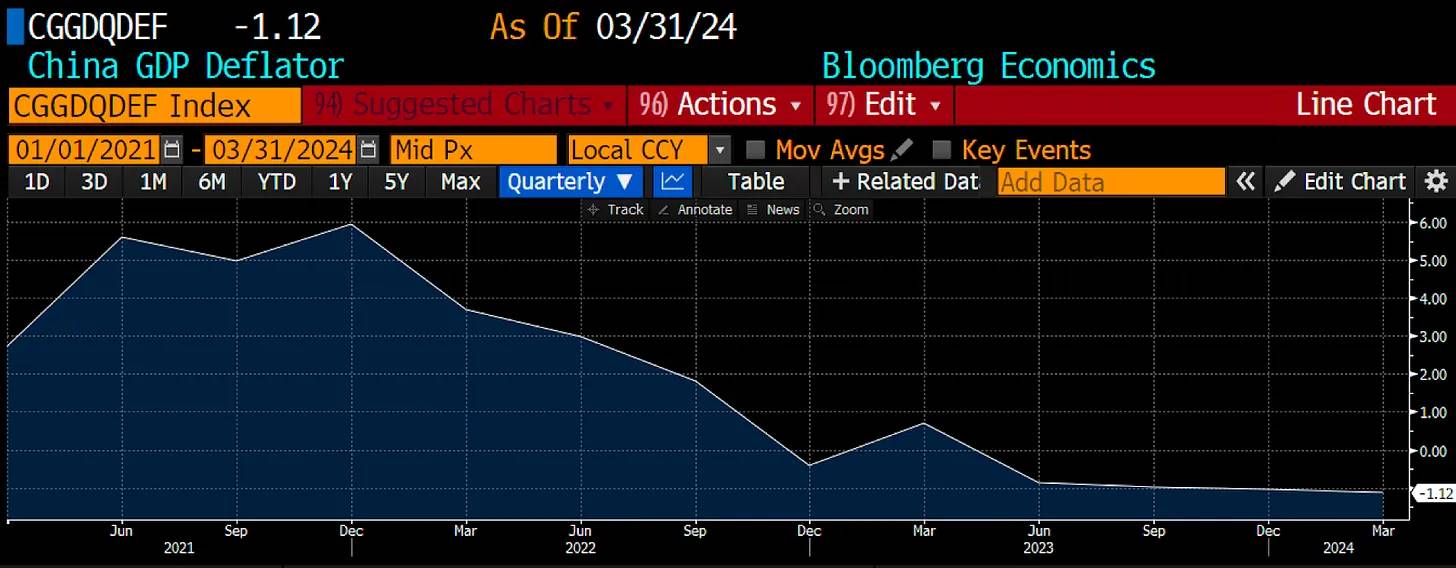
The GDP deflator converts nominal GDP into real GDP. A negative number means prices are falling, which is bad news for debt-based economies. Since banks lend against asset collateral, falling asset prices make debt repayment problematic, and prices fall further. This is deadly, which is why China—and all global economies—need inflation to function.
Creating the needed inflation is easy—just print more money. However, China’s money printer isn’t running at full capacity. Credit, as always, is created by the commercial banking system.
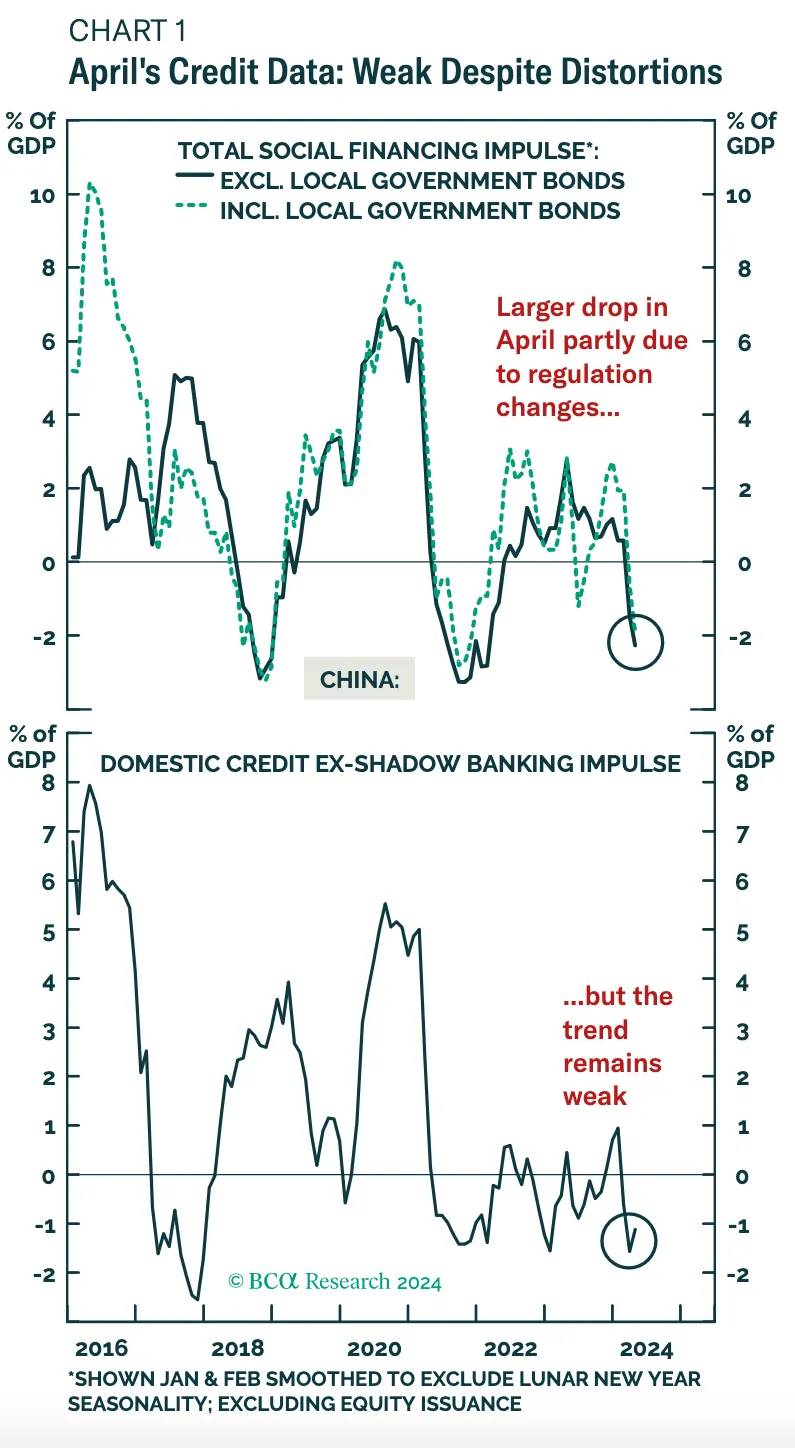
These BCA Research charts clearly show a negative credit impulse, indicating insufficient credit and money creation.
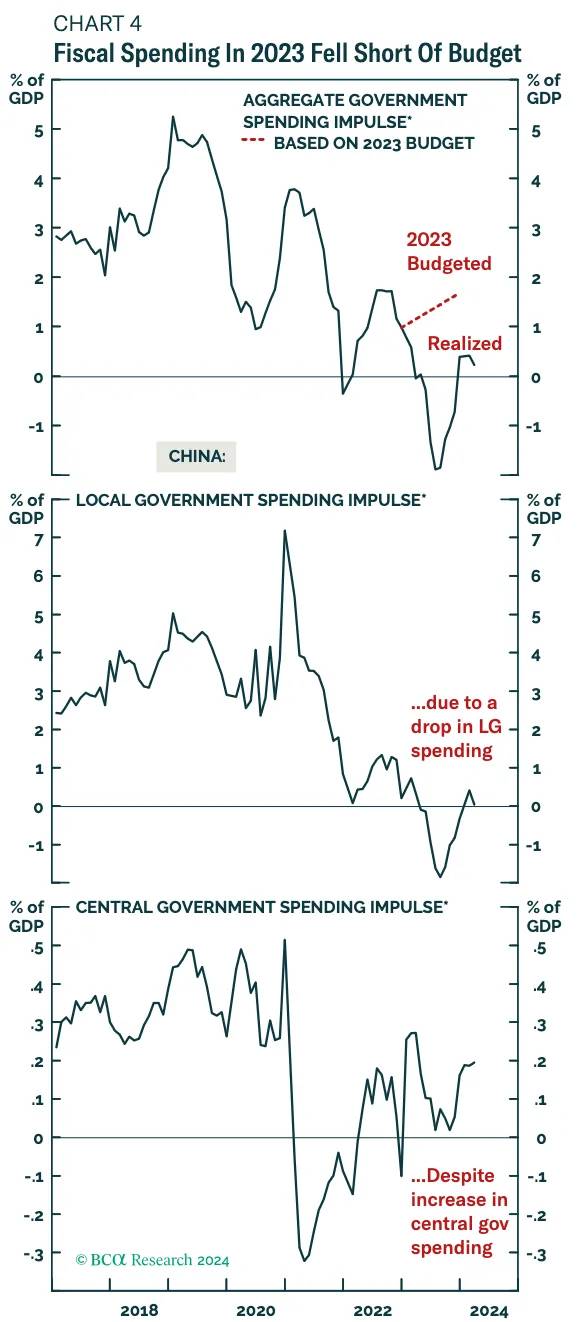
Spending by local and central governments is also insufficient to end deflation.
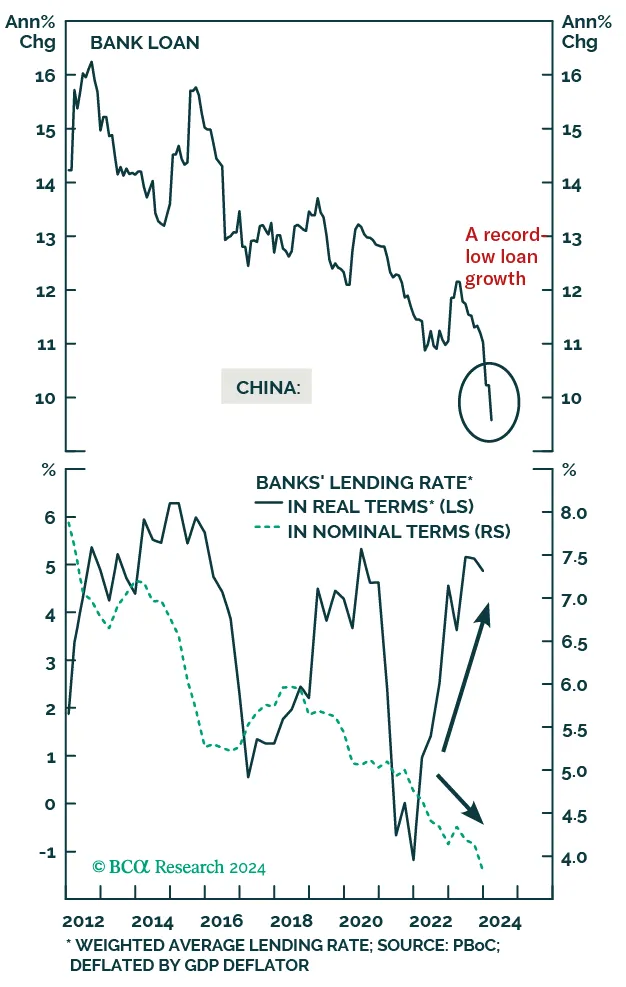
Real interest rates are positive. Growth in money supply is slowing while its price is rising. Very bad.
China must create more credit via government spending or corporate lending. So far, China has refrained from launching another massive stimulus like those in 2009 and 2015. I believe this is because there are legitimate concerns that such domestic monetary policies would negatively impact the exchange rate, and for now, they wish to maintain stability against the dollar.
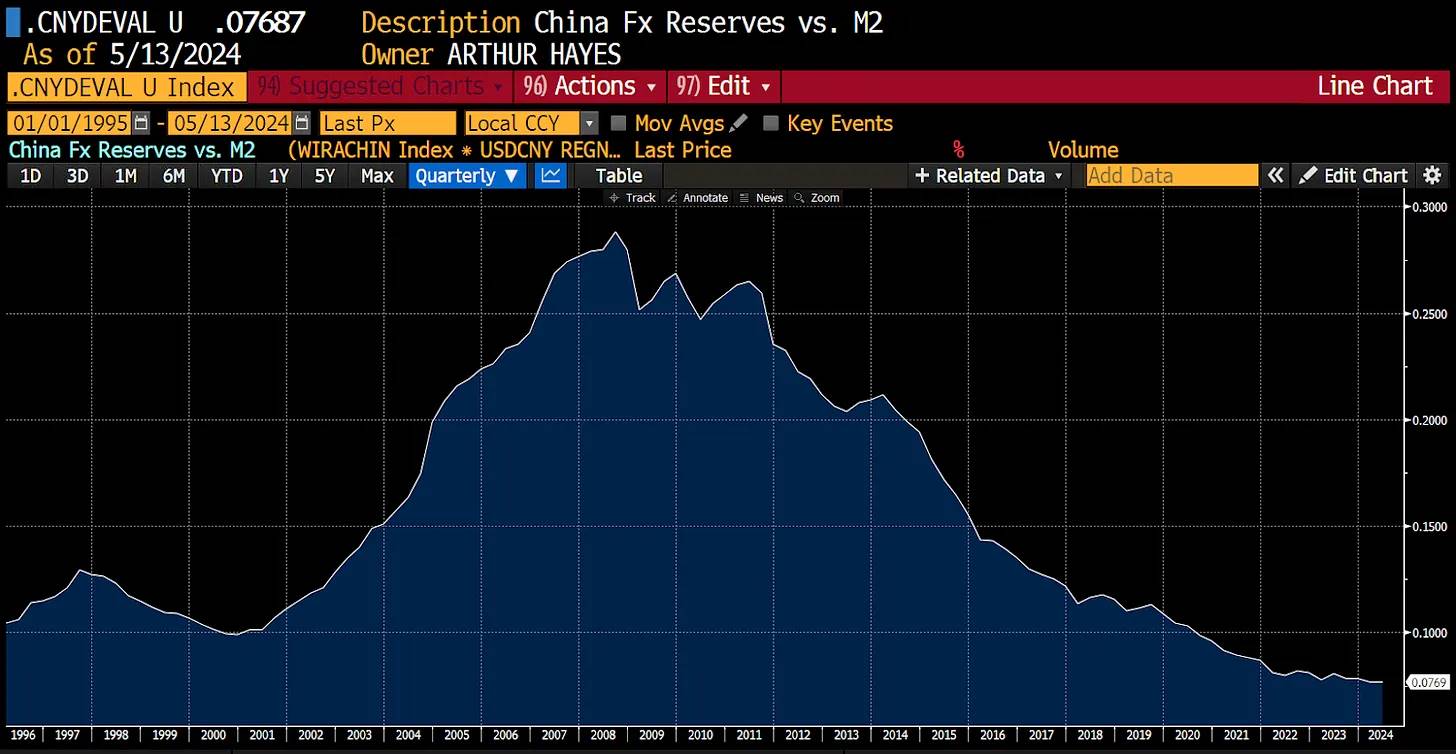
To create the above chart, I divided China’s M2 (RMB money supply) by its reported foreign exchange reserves. At the peak in 2008, RMB was backed by 30% in foreign reserves, primarily U.S. Treasuries and other dollar assets. Today, RMB is backed by only 8% in foreign reserves—the lowest level since records began.
If China ramps up credit creation, the money supply will grow further. This increases pressure on the yuan’s dirty float against the dollar. I believe, for both domestic and diplomatic political reasons, China wants to maintain stability in USD/CNY.
Domestically, China doesn’t want to exacerbate capital flight by sharply devaluing the yuan. Additionally, depreciation raises import costs. China imports food and energy. When these costs rise too quickly, social unrest follows. Any Marxist, especially a Chinese one, learns from revolutionary history that food and energy inflation must never spiral out of control.
A key concern for China is how Pax Americana will react to yuan depreciation. I’ll discuss this in detail later, but a weaker yuan makes Chinese goods cheaper, reducing the incentive for U.S. reshoring. Why build expensive factories and hire costly skilled workers (if you can find them), if your final product still can’t compete on price with Chinese goods? Unless the U.S. government offers massive corporate subsidies, American manufacturers will continue producing abroad.
Rust Belt
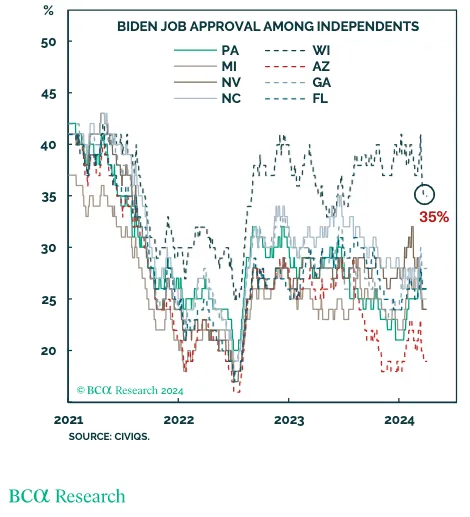
Biden has been hit hard in states that lost their manufacturing base over the past 30 years. If China devalues the yuan, jobs will keep disappearing. If Biden fails to win these states, he loses the election. Trump’s 2016 victory narrowly hinged on winning these China-skeptical Rust Belt states.
Some readers might think Biden’s team has finally gotten the message—the anti-China rhetoric and actions are coming more frequently from his administration. Indeed, Biden just announced renewed hikes in tariffs on Chinese-origin goods like electric vehicles.
My rebuttal is that Chinese goods don’t always ship directly from China. If products are cheap enough, China exports them first to a U.S.-friendly country before they enter the U.S. Then, these goods are treated as originating from another country—not China.
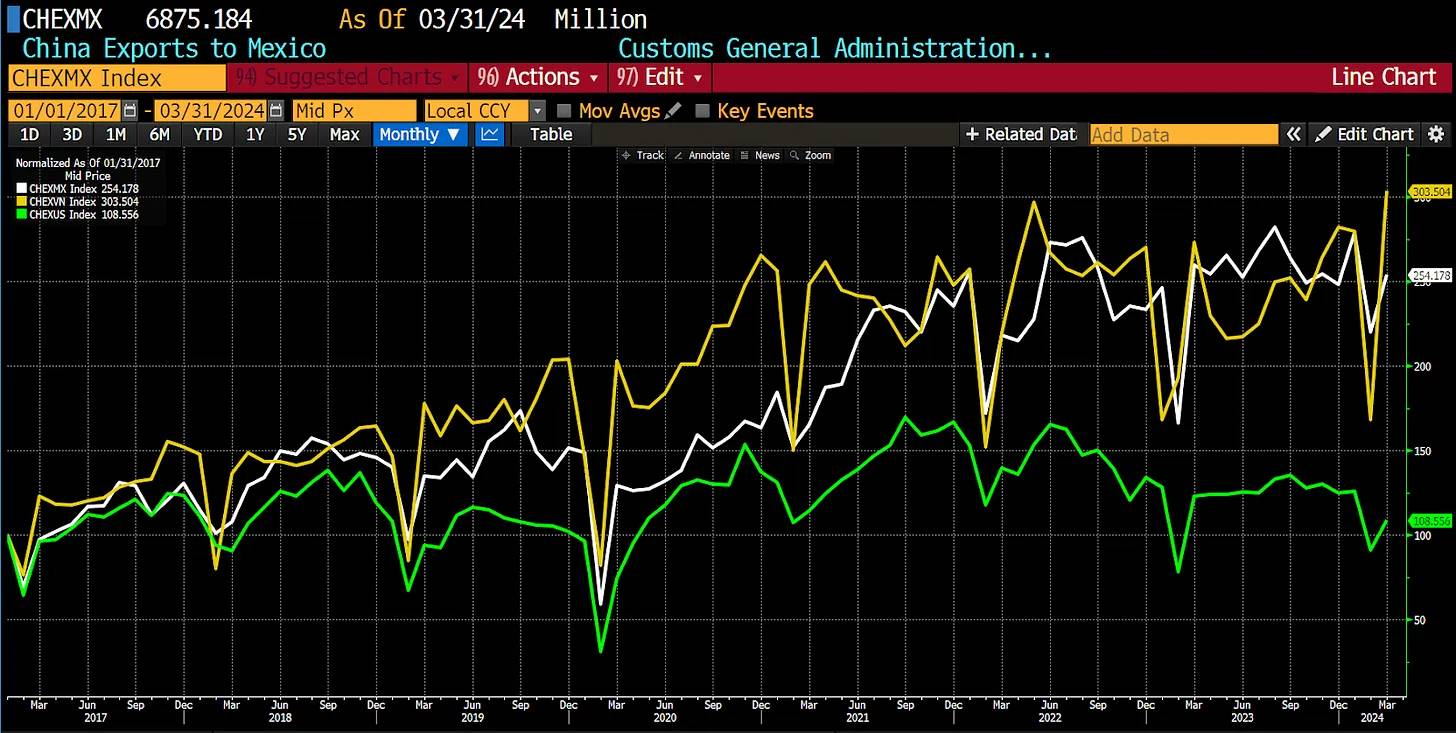
This chart shows China’s exports to Mexico (white), Vietnam (yellow), and the U.S. (green). Trump’s term began in 2017, which is the starting date for this index set at 100. Trade between China and Mexico has grown 154%, trade with Vietnam 203%, but trade with the U.S. only 8%. Clearly, the total value of trade with the U.S. far exceeds that with Mexico and Vietnam, but it’s evident that China is using these two countries as conduits to route goods into the U.S.
If a product is high quality and low priced, it enters the U.S. While politicians may loudly impose punitive tariffs on “dumped” goods, China can easily shift export destinations. Countries like Vietnam and Mexico are happy to earn small commissions by allowing goods to cross their borders into the U.S.
Biden must win these battleground states to stop Trump. He cannot afford yuan depreciation before the election. China will exploit this fear of electoral defeat to achieve its own objectives.
China’s Threat
Over the past few quarters, Secretary of State Blinken and Treasury Secretary Yellen have made multiple visits to Beijing. I imagine the real core of those talks centered around China’s threat.
If the U.S. does not let Japan strengthen the yen, China will respond by depreciating the yuan against the dollar and exporting deflation to the world. Deflation gets exported via mass-produced cheap goods.
China is also pressuring Yellen to pursue a weak dollar policy, increasing global dollar supply by any means necessary. This allows China to launch another major stimulus, as the pace of yuan credit creation would match that of the dollar on a relative basis.
In return, China will keep the dollar-yuan exchange rate stable. The yuan won’t depreciate against the dollar. Perhaps China even agrees to cap the volume of its exports to the U.S., helping American companies reshore production.
If Yellen and Blinken hesitate in the face of this threat, I propose the nuclear monetary option.
It’s estimated that China holds over 31,000 tons of gold—combining government and private holdings. Since the Party effectively owns everything in China, I sum both. At today’s prices, this gold is worth about $2.34 trillion. The yuan is implicitly backed 6% by gold—I derived this by dividing China’s reported RMB money supply by the total value of its gold.
As noted earlier, China’s forex reserves/M2 ratio is 8%. The yuan is roughly equally backed by dollars and gold.
My threat would be to announce a floating yuan-gold peg. China could achieve this by:
-
Quickly swapping U.S. Treasuries for gold. At some point, the U.S. might freeze Chinese assets or restrict China’s ability to sell its ~$1 trillion in U.S. Treasuries. But I believe China can sell hundreds of billions in Treasuries at fire-sale prices before U.S. politicians react.
-
Instructing state-owned enterprises holding U.S. stocks or Treasuries to sell and buy gold instead.
-
Announcing that the yuan will be pegged to gold at a 20% to 30% devaluation from current levels. The yuan price of gold would surge (XAUCNY rises).
-
Gold trades at a premium in Shanghai Futures Exchange (SFE) versus the LBMA fix. Traders arbitrage by delivering gold longs in London and going short on near-term SFE contracts, shipping gold from West to East.
-
As global gold prices rise and LBMA member vaults see physical withdrawals, one or more major Western financial institutions collapse due to lack of physical gold. It’s rumored that Western banks are naked short gold in paper derivatives. This would be a “GameStop moment” on steroids, potentially collapsing the entire Western financial system due to embedded leverage.
-
The Fed is forced to print to save the banking system, increasing dollar supply. This helps strengthen the yuan against the dollar.
After reading these hypothetical scenarios, readers might wonder why I think the U.S. can dictate Japan’s monetary policy. The key assumption is that by threatening the U.S., China can convince Washington to instruct Japan to strengthen the yen.
In the 1970s and 1980s, Japan frequently agreed to strengthen the yen to reduce its export competitiveness relative to the U.S. and Western Europe (mainly Germany).
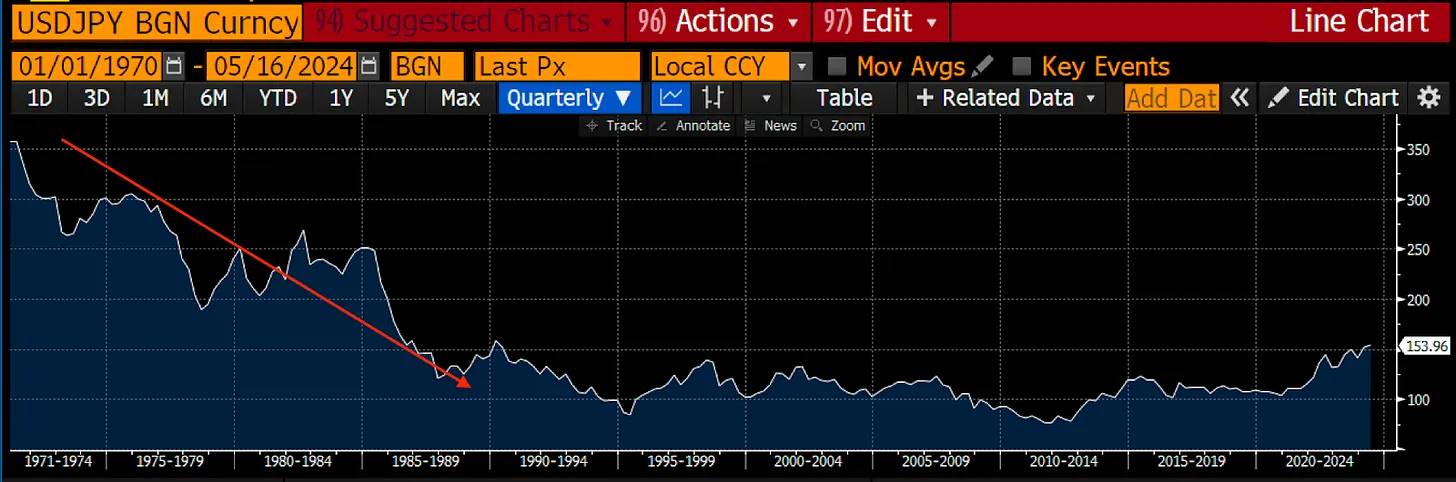
The chart above shows USD/JPY. In the early 1970s, USD/JPY was 350—imagine how cheap Japanese goods were to inflation-ridden Americans.
Yellen is fully capable of politely suggesting that Japan strengthen the yen this time to prevent Chinese retaliation.
If Japan complies, how would they do it? Let me explain why Japan cannot strengthen the yen simply by ordering the BOJ to raise rates and end quantitative easing.
Japan’s Debt Math
Let me quickly explain why the BOJ would melt down faster than Sam Bankman-Fried on the witness stand if it raised interest rates.
The BOJ owns over 50% of all outstanding JGBs. It effectively fixes the price of 10-year and shorter bonds. What really matters to them is the 10-year JGB yield, as it serves as a benchmark for many fixed-income products (corporate loans, mortgages, etc.). Assume their entire portfolio consists of 10-year JGBs.
Currently, the latest 10-year JGB #374 trades at 98.682, yielding 0.954%. Suppose the BOJ raises policy rates to match the current 10-year UST yield of 4.48%. At that point, the JGB price would be 70.951—a 28% drop (I used Bloomberg’s <YAS> bond pricing function). Assuming the BOJ holds ¥585.2 trillion in bonds and USD/JPY at 156, that’s a $1.05 trillion market value loss.
Losing that much money would fatally expose the BOJ’s fraud against yen holders. The BOJ has only $32.25 billion in equity capital. Even extreme crypto traders don’t leverage like the BOJ. Seeing these losses, what would you do if you held yen or yen-denominated assets? Sell or hedge. Either way, USD/JPY would rapidly surge beyond 200—faster than Su Zhu and Kyle Davis fleeing BVI court-appointed liquidators.
If the BOJ actually had to raise rates to narrow the USD/JPY yield gap, it would first force domestic regulated pools (banks, insurers, pensions) to buy JGBs. To do so, these entities would sell their foreign dollar assets—mainly U.S. Treasuries and U.S. equities—convert the dollars into yen, and then buy the BOJ’s high-priced, low-yielding JGBs.
From an accounting standpoint, as long as these institutions hold to maturity, they won’t mark-to-market and report huge losses. Yet their clients—the people whose money they manage—will be fiscally squeezed to save the BOJ.
From the perspective of Pax Americana, this is a terrible outcome, as Japan’s private sector would sell trillions in U.S. Treasuries and U.S. stocks.
Whatever solution Yellen recommends to strengthen the yen cannot involve requiring the BOJ to raise rates.
The Easy Button
As mentioned above, there is a way to weaken the dollar, allow China to re-stimulate its economy, and strengthen the yen without selling U.S. Treasuries. I will now discuss how unlimited USD/JPY currency swaps solve this.
To weaken the dollar, its supply must increase. Imagine Japan needs $1 trillion to strengthen the yen from 156 to 100 overnight. The Fed exchanges $1 trillion for an equivalent amount of yen. The Fed prints dollars; the BOJ prints yen. For each central bank, this costs nothing—they control their domestic printing presses.
These dollars leave the BOJ’s balance sheet as Japan’s MOF buys yen in the open market. The Fed has no use for yen, so it stays on its balance sheet. When a currency is created but kept on a central bank’s balance sheet, it’s sterilized. The Fed sterilizes the yen, but the BOJ releases $1 trillion into global markets. Thus, the dollar depreciates against all other currencies due to increased supply.
With a weaker dollar, China can create more onshore RMB credit to combat deflation. If China wishes to maintain USD/CNY at 7.22, it can create an additional 7.22 trillion RMB (1 trillion USD × 7.22 USD/CNY) in domestic credit.
The CNY/JPY exchange rate falls—this is a depreciation from China’s view, an appreciation from Japan’s. Global RMB supply increases, while JPY supply decreases due to MOF buying yen with dollars. Now, the yen is fairly valued against the yuan on a purchasing power parity basis.
Prices of all dollar-denominated assets rise. This benefits U.S. equities and the U.S. government, which taxes capital gains on profits. It benefits Japanese corporations collectively holding over $3 trillion in dollar assets. Cryptocurrencies surge as more dollar and yuan liquidity floods the system.
Domestic inflation in Japan falls because stronger yen lowers import energy costs. However, exports suffer due to a stronger currency.
Everyone gains something, some more than others, but it helps preserve the integrity of the global dollar system before the U.S. presidential election. No nation needs to make painful choices that damage their domestic political standing.
To understand the risks to the U.S. in participating in such actions, I first need to equate Yield Curve Control (YCC) with this USD/JPY swap scheme.
Same But Different
What is YCC?
It occurs when a central bank is willing to print unlimited money to buy bonds, fixing prices and yields at politically convenient levels. Under YCC, money supply increases, causing currency depreciation.
What is a USD/JPY swap arrangement?
The Fed stands ready to print unlimited dollars so the BOJ can delay raising rates and avoid selling U.S. Treasuries.
The outcomes of both policies are identical: U.S. Treasury yields remain below where they otherwise would be. Additionally, the dollar depreciates as supply increases.
The swap line is politically preferable because it operates in secret. Most civilians—and even many elites—don’t understand how these tools work or where they appear on the Fed’s balance sheet. It also doesn’t require congressional consultation, as the Fed secured this authority decades ago.
YCC is more visible and would certainly provoke public outcry and angry opposition.
Risks
The risk is excessive dollar depreciation. Once the market equates the USD/JPY swap line with YCC, the dollar could plummet to the ocean floor. When the swap is eventually unwound, it would mean the end of the dollar reserve system.
Given that it may take years for markets to force such a reversal, politicians focused on the present will support expanding the USD/JPY swap line.
Watch
How do you monitor whether I’m right or wrong?
Monitor USD/JPY more closely than Solana developers monitor uptime. In fact, watch it even more closely…
The dollar-yen yield spread issue remains unresolved. Therefore, regardless of interventions, the yen will continue weakening. After each intervention, open this page and monitor the size of the USD/JPY swap line. On Bloomberg, track the FESLTOTL index. If it begins to rise significantly—meaning by billions of dollars—then you know this is the path the elites have chosen.
At that point, add the size of the dollar swap line to your dollar liquidity index. Sit back, and watch cryptocurrencies rise in fiat terms.
Mistakes
I could be wrong in two ways.
-
The BOJ changes its weak yen policy by sharply raising interest rates—and signals it will continue. By sharply, I mean 2% or more. A mere 0.25% hike won’t close the 5.4% yield gap between dollar and yen.
-
The yen keeps weakening, and the U.S. and Japan do nothing. China retaliates by depreciating the yuan against the dollar or pegging it to gold.
If either scenario unfolds, the U.S. will eventually resort to some form of YCC—but the road to YCC will be complex. I have a theory about the sequence of events from here to there, and if necessary, I will publish a series of articles on this journey.
Timing Is Key
Markets know the yen is too weak. I believe the pace of yen depreciation will accelerate in the fall. This will pressure the U.S., Japan, and China to act. The U.S. election is the key catalyst pushing the Biden administration to find a solution.
I think a USD/JPY surge to 200 will be enough for the Chemical Brothers to play “Push the Button.”
This is the simplified version every crypto trader must monitor constantly. I believe the clown brigade running Pax Americana will choose the easy way. It’s simply the politically rational choice.
If my theory materializes, institutional investors can easily buy a U.S.-listed Bitcoin ETF. Bitcoin is the best-performing asset amid global fiat devaluation—they know this. When addressing the weak yen issue, I will model how inflows into the Bitcoin complex could push prices to $1 million or higher. Keep imagination alive, stay optimistic—now is not the time to be a coward.
Join TechFlow official community to stay tuned
Telegram:https://t.me/TechFlowDaily
X (Twitter):https://x.com/TechFlowPost
X (Twitter) EN:https://x.com/BlockFlow_News
 Arthur Hayes











