








The "Bitcoin Jesus" of yesteryear is now awaiting trial
TechFlow Selected TechFlow Selected
The "Bitcoin Jesus" of yesteryear is now awaiting trial
Roger Ver was arrested for failing to report cryptocurrency assets a decade ago, after having discovered Bitcoin when it was priced at $1.
 Navigating Web3 tides with focused insights
By Joyce
Recently, the biggest regulatory event in the crypto space has been the sentencing of Binance founder CZ to four months in prison. On the same day CZ’s verdict was announced, another figure who once had a massive impact on the crypto industry resurfaced in discussions around "crypto regulation"—yet compared to his former influence, the public conversation surrounding his arrest has been surprisingly muted.
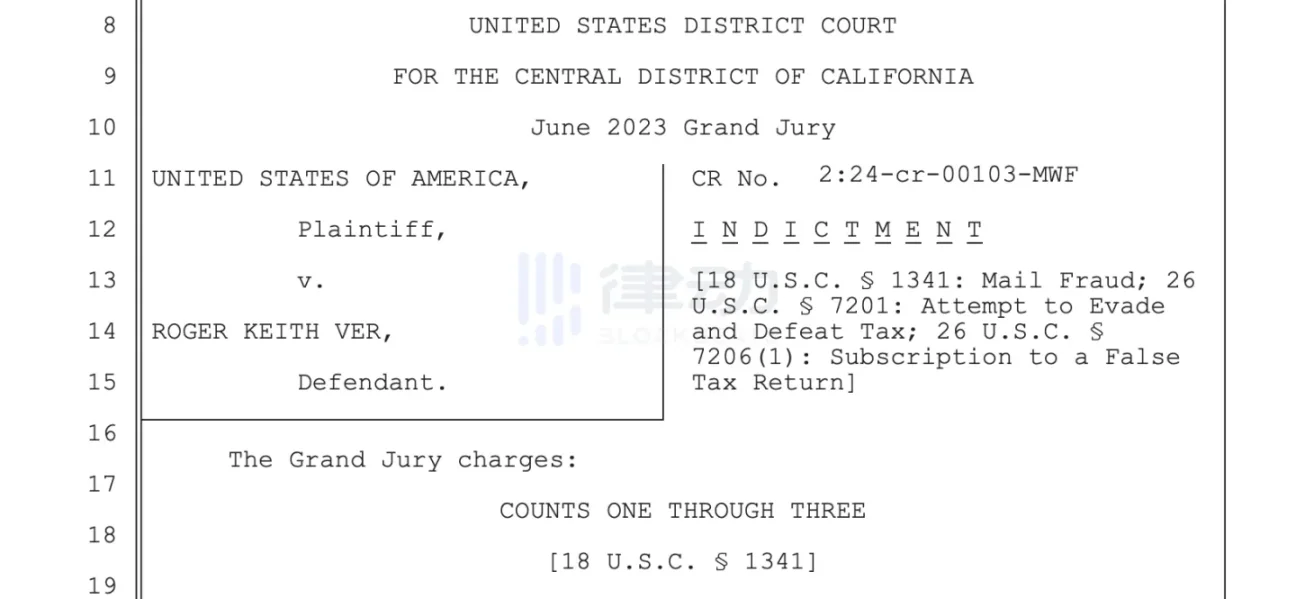
Just one week ago, the U.S. Department of Justice released a document accusing 45-year-old American-born Roger Keith Ver, a citizen of Saint Kitts and Nevis, of evading nearly $50 million in taxes, along with charges of mail fraud, tax evasion, and filing false tax returns. Since Ver was already arrested in Spain at the end of April, the U.S. is now seeking to extradite him for trial.
Roger Ver’s name may sound unfamiliar to today’s crypto community. Yet within the brief two-decade history of Bitcoin, Ver played an extraordinary role—he was once known as “Bitcoin Jesus.”
The current allegations from the U.S. Department of Justice center on Ver’s alleged large-scale tax evasion during his renunciation of U.S. citizenship in 2014, when he concealed the number of Bitcoins he held. At that time, Bitcoin was trading for just over $800, later dropping to around $300. Ver reportedly held 131,000 BTC—a massive fortune by today’s standards. Three years after leaving the U.S., he sold 70,000 Bitcoins. According to the DOJ, “Roger Ver caused total losses of at least $48 million to the Internal Revenue Service.”
“Bitcoin Jesus” With Hundreds of Thousands of BTC
Born in 1979 in Silicon Valley, Roger Ver is a well-known libertarian and anarchist. After attending a U.S. community college for only one year, he dropped out to start his own business—Memorydealers, an online retailer of electronic components. At age 21, he ran as a candidate for California State Assembly under the Libertarian Party. However, after being reported for “selling explosive materials without a license on eBay,” he was convicted by a federal court in California for illegal explosives sales and sentenced to 10 months in prison.
In 2011, Roger discovered Bitcoin and quickly became one of its most devoted believers. He integrated Bitcoin payments into his company website, allowing customers to pay with BTC. At the time, Bitcoin was worth less than $1 per coin. Through these early efforts, it’s estimated that Ver accumulated over 400,000 Bitcoins.

Over the past decade-plus, Bitcoin’s price has experienced multiple rollercoaster swings. Anyone like Roger Ver who acquired tens of thousands of BTC when prices were below $1 would naturally be seen today as a symbol of immense wealth. But this alone isn’t why he earned the title “Bitcoin Jesus.” As a true believer, Ver spent over $100,000 in the early days of Bitcoin to air advertisements about it across radio stations nationwide.
In 2012, Roger Ver co-founded the Bitcoin Foundation (bitcoinfoundation.org), dedicated to promoting Bitcoin globally. Beyond accumulating Bitcoin, he actively sought out and funded startups working to advance Bitcoin adoption—making him one of the earliest “angel investors” in the space (though he referred to himself as the “second participant” in these ventures). In the early days of Blockchain.com, Ver reached out to its then-high-school-graduate founder, providing funds so he could purchase dedicated servers instead of relying on a Mac mini at home.
Beyond Blockchain.com, Ver invested in numerous crypto projects including Kraken, purse.io, BitPay, and Ripple. After Ver’s arrest, Ripple CTO David Schwartz commented, recalling that “Ver is one of the best and most genuine people I’ve ever met; his actions stem from a deep commitment to his moral principles.”
In 2014, Roger Ver acquired control of the domain Bitcoin.com, which he first leased to Blockchain.info and later to OKCoin. By 2015, when Bitcoin rose from $1 to over $200, Ver was still urging others to buy: “It’s not too late to buy Bitcoin now—just like some people thought it was too late to get into the internet…”
Fading Halo: A $47 Million Debt
In the history of crypto development, Roger Ver hasn’t always been a purely positive figure. After earning fame and admiration in Bitcoin’s early days as “Bitcoin Jesus,” Ver’s more recent actions have sparked controversy rather than reverence.
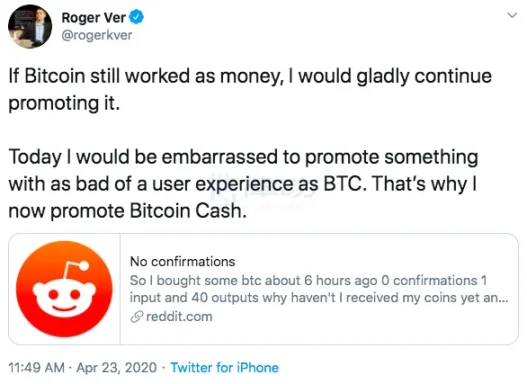
In 2017, at the crossroads of Bitcoin’s hard fork, Roger Ver sided with BCH (Bitcoin Cash), championed by Bitmain co-founder Jihan Wu. His mining pool, Bitcoin.com, played a crucial role in securing hash power for Wu during the post-fork battle. Since then, Ver has become a staunch advocate of BCH, repeatedly declaring “BCH is the real Bitcoin.” Because BCH failed to replicate Bitcoin’s historic price surge, many investors who bought heavily into BCH began calling Ver a “scammer.”
Ver is also widely known for debt disputes and the resulting online feuds. In 2022, news broke that Roger Ver sued Smart Vega, a subsidiary of Jihan Wu’s company, claiming that $8 million of his funds had been frozen. In response, Wu demanded that Ver first repay debts owed to CoinFLEX.
The debt dispute originated from massive losses Ver incurred on CoinFLEX, a crypto exchange in which he had invested, following the collapse of Luna. Jihan Wu was a creditor of CoinFLEX. According to CoinFLEX CEO Mark Lamb, Ver owed $47 million in USDC to the platform. However, Ver denied these claims on Twitter, calling them rumors, and counterclaimed that CoinFLEX actually owed him a significant sum.
Charged with Tax Fraud, Awaiting Extradition and Trial
Unlike other prominent figures in crypto who have faced criminal charges, the “illegal activities” Roger Ver is accused of by the U.S. Department of Justice trace back a decade—to the sale of tens of thousands of Bitcoins when he renounced U.S. citizenship. The official statement reads: “Ver provided false or misleading information to law firms and appraisers, concealing the true amount of Bitcoin owned by him and his companies. As a result, law firms filed fraudulent tax returns that vastly undervalued two companies and their holdings of 73,000 Bitcoins, and did not report any Bitcoin owned personally by Ver.”
After leaving the U.S., Ver sold 70,000 Bitcoins in November 2017, netting $240 million in cash. This transaction is viewed suspiciously by the DOJ: “Although Ver was no longer a U.S. citizen at the time, the law still required him to report certain distributions to the IRS and pay applicable taxes.”
From the moment Roger Ver discovered Bitcoin to today, its value has increased over 60,000-fold in 13 years. Looking back, Ver’s legendary status has little to do with investment acumen. His support for Bitcoin stemmed from his belief in financial freedom. His later choice of BCH was also driven by economic reasoning—he believed “only by increasing block size can Bitcoin acquire all the economic properties of real money and achieve mainstream adoption.” In a 2022 YouTube interview, Roger Ver stated: “Many think I’m a maximalist for BCH, but I’m not. What I truly advocate for is peer-to-peer electronic cash—the tool that enables maximum economic freedom worldwide.”
From dropping out of school to launch a business, to becoming the billionaire “Bitcoin Jesus,” then morphing into the “BCH scammer,” entangled in lawsuits and now arrested—Roger Ver’s story reflects how the stage for such crypto legends belongs only to the earliest era. Even though his main activities occurred long ago, Ver cannot escape the reach of U.S. regulatory enforcement.
With the approval of U.S. Bitcoin ETFs, many institutions believe Bitcoin will surpass $100,000 in this bull market. While the scale of capital in the crypto world continues to grow, Roger Ver’s vision of cryptocurrencies challenging traditional financial systems and advancing anarchism remains distant. Today, the total market cap of crypto exceeds $2.5 trillion, and its influence on traditional finance is growing. As a result, U.S. regulations are tightening. Regulatory crackdowns aren’t limited to present and future—they are also revisiting and settling accounts with events from the industry’s past.
Since last year, U.S. regulators have launched a wave of lawsuits targeting crypto institutions and individuals. Besides FTX’s former CEO SBF and Terra’s Do Kwon, entities sued include ConsenSys, Kraken, Gemini, Celsius Network, Ripple Labs, Uniswap, and Coinbase. With CZ sentenced to four months in prison and Roger Ver now “captured,” the crypto industry’s regulatory reckoning is far from over.
Join TechFlow official community to stay tuned
Telegram:https://t.me/TechFlowDaily
X (Twitter):https://x.com/TechFlowPost
X (Twitter) EN:https://x.com/BlockFlow_News
 BlockBeats










