Fantom is about to launch its sub-second transaction network, Sonic. Can Layer2 still hold its throne?
TechFlow Selected TechFlow Selected
Fantom is about to launch its sub-second transaction network, Sonic. Can Layer2 still hold its throne?
Legacy public chain Fantom rises again.
 Navigating Web3 tides with focused insights
Author: Daniel Li
In the current cryptocurrency market, the veteran altcoin FTM has once again captured investors' attention. Notably, FTM's price surged by 150% in March alone. Even more astonishingly, during the past week—when Bitcoin and Ethereum pulled back due to Japan’s interest rate hike and the broader market declined—FTM rose逆势 by 30%. Such remarkable performance has not only energized investors but also intensified market interest in FTM’s potential.
Several factors contribute to FTM’s resurgence. First, strong promotion from Andre Cronje (AC), a director at the Fantom Foundation, has injected new vitality and confidence into Fantom, renewing market optimism about this established project. Second, there is growing anticipation around the upcoming launch of Fantom Sonic. AC claims that Sonic will surpass "parallel EVM" technology and trigger a revolutionary transformation, further boosting investor confidence in FTM. This recent rally in FTM may just be the beginning.
01 The Resurgence of Veteran Blockchain Fantom
Fantom was initially founded in January 2018 by computer scientist Ahn Byung, later handed over to Michael Kong, an Ethereum smart contract developer. The project aimed to overcome limitations of previous-generation blockchains and achieve balance among scalability, security, and decentralization—the three core tenets of blockchain technology.
In September 2018, Andre Cronje joined Fantom as a DeFi architect and eventually became a director of the Fantom Foundation. As a leading figure in the last DeFi boom, AC created high-profile projects such as Yearn Finance and Phantom, and made prolific contributions to key initiatives like Keep3r Network, Multichain, Chainlist, Solidly, and Bribe crv Finance.
Cronje’s involvement significantly advanced Fantom’s technical development, particularly in advancing its multi-chain capabilities. Fantom utilizes Lachesis—an advanced aBFT (asynchronous Byzantine Fault Tolerant) consensus mechanism based on a modified DAG (Directed Acyclic Graph). This allows multiple blockchains to operate asynchronously without slowing down the main network. Additionally, Lachesis enables near-instant transaction finality and can withstand malicious behavior from up to one-third of network participants. These features make Fantom faster, cheaper, and more secure than prior technologies, effectively resolving the long-standing blockchain trilemma faced by many Layer 1 protocols.
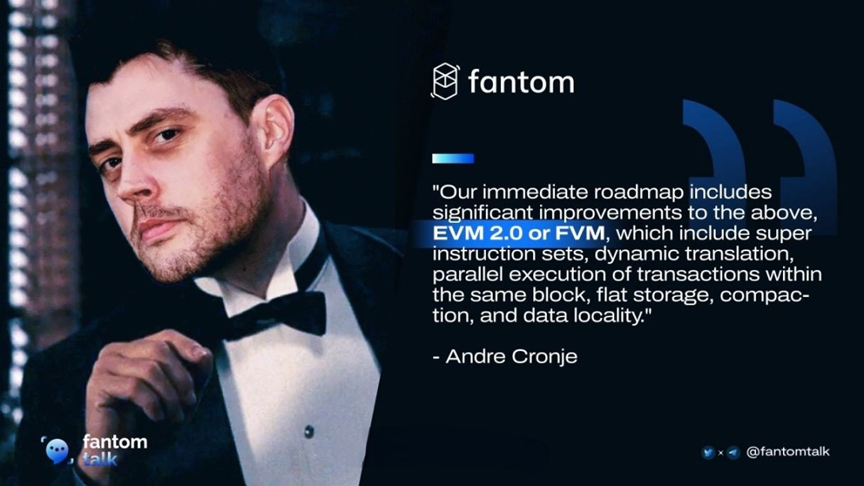
In 2019, Fantom launched its first EVM-compatible Opera mainnet, offering full smart contract support via Solidity and EVM, enabling seamless migration of any Ethereum-based DApp to Fantom. Leveraging a modular architecture, Fantom also provides fully customizable blockchains for digital assets, tailored with specific functionalities for different use cases. For a period after Opera’s launch, Fantom attracted widespread market attention and was even widely regarded as an “Ethereum killer.”
In March 2022, rumors spread that Andre Cronje and his collaborator Anton Nell would exit the DeFi industry and suspend approximately 25 applications and services, including those related to Fantom. Although the Fantom Foundation later clarified that Cronje had not completely left DeFi but shifted to providing behind-the-scenes technical support, the incident dealt a major blow to the FTM token. Combined with the broader crypto bear market, FTM’s price plummeted from a peak of $3.0 to as low as $0.19, remaining below $0.6 for nearly two years. It wasn’t until early this year, when Andre Cronje began frequently sharing updates on Fantom’s ecosystem progress, that investor enthusiasm reignited.
Since the beginning of the year, FTM has surged nearly 200%. Part of this growth stems from Andre Cronje’s active promotion—he even used memes to market Fantom, claiming that Fantom Sonic would deliver greater efficiency than parallel EVM approaches. Despite skepticism from some newer blockchains, Fantom quickly regained significant attention. Meanwhile, after two years of relative quiet, Fantom achieved substantial technical breakthroughs. The Fantom Foundation announced plans to roll out its latest technological upgrade, Fantom Sonic, which AC hails as potentially surpassing existing “parallel EVM” systems and sparking a disruptive revolution.
02 What Is Fantom Sonic?
Fantom Sonic is the latest technological upgrade to the Fantom network, designed to enhance scalability and performance. As early as October 2023, the Fantom Foundation announced the Fantom Sonic initiative, drawing wide attention and marking a long-awaited milestone for the Fantom community and its DeFi ecosystem.
Fantom Sonic introduces a suite of innovative technologies and optimizations to further strengthen the network’s performance and functionality.
1. Fantom Virtual Machine (FVM): Fantom Sonic introduces a brand-new virtual machine—FVM. Compared to the previous EVM (Ethereum Virtual Machine), FVM offers a more efficient environment for smart contract execution, significantly accelerating deployment and processing speeds. This improvement enables developers to build and deploy contracts more efficiently while allowing users to conduct transactions faster. Fantom Sonic elevates smart contract development and execution efficiency to a new level.
2. Carmen Database: Fantom Sonic enhances data storage capacity through a new solution called Carmen. With Carmen, storage requirements are reduced by 90%, cutting validator node data from 2,000 GB to 300 GB, and archive node data from over 11 TB to under 1 TB. This innovation enables the Fantom network to efficiently handle larger-scale data, offering developers and users superior data management capabilities.
3. Lachesis Consensus Mechanism: Fantom Sonic builds upon the Lachesis consensus algorithm—an asynchronous Byzantine Fault Tolerant (aBFT) mechanism without leaders—which has been further optimized in the Sonic upgrade. By reducing message redundancy and improving decision-making efficiency, Fantom Sonic accelerates transaction confirmation, increasing throughput and overall network performance. This optimization allows the network to process more transactions with lower latency while maintaining security.
4. High Throughput and Low Latency: Fantom Sonic supports a theoretical maximum of over 2,000 transactions per second (TPS), with average finality time of just one second. This enables the network to handle higher transaction volumes with rapid confirmation, delivering a smoother and more efficient user experience. High throughput and low latency represent critical performance advancements, positioning Fantom Sonic ahead of many competitors.
5. Seamless Upgrades: As the next-generation iteration of the Fantom network, Fantom Sonic maintains full compatibility with existing smart contracts, services, and tools on Fantom Opera. This means current applications and contracts can continue operating without significant modifications. This smooth upgrade path reduces risks associated with transitions and ensures better stability and compatibility for developers and users alike. The seamless upgrade mechanism also strengthens long-term ecosystem sustainability.
The launch of Sonic marks the beginning of a new chapter for Fantom. With upgrades enabling forkless updates, true parallel transaction processing, top-tier TPS and finality, along with a 90% reduction in local smart contract wallet and data storage demands, Fantom emerges as an advanced platform distinct from other Layer 1 chains.
Today, Fantom’s future is no longer merely about survival—it hinges on whether it can capture market share from other Layer 1 protocols and translate that into FTM’s price trajectory. While Fantom’s current market cap stands at just $3 billion, its future value becomes increasingly promising as Fantom Sonic rolls out.
DeFi dominates half of Fantom’s ecosystem; Sonic is set to elevate it further.
During this bull market, meme coin ecosystems have become battlegrounds for public blockchains. In the early stages, Solana revitalized its ecosystem and restored confidence among SOL holders through the explosive popularity of Bonk, fueling Solana’s real recovery. Some members of the Fantom community hope that a similar meme-driven surge could spark an ecosystem explosion. The Fantom Foundation even retweeted an introduction to the meme coin $sGOAT, which became the most widely held meme coin on Fantom within a day—boasting over 1,000 holders.
However, pushing meme coin development may not align well with Fantom’s current ecosystem needs. Meme coin booms often reflect the outcome of an already thriving ecosystem rather than a catalyst for growth. Although Fantom now hosts over 250 ecosystem projects, activity remains relatively low. According to Token Terminal data, Fantom averages around 50,000 daily active users monthly—still far behind leaders like Ethereum and Solana. Therefore, relying on memes to drive user growth isn’t realistic at this stage. Fantom must identify a development strategy suited to its own strengths.
In the “Fantom Q1 2024 Overview,” Fantom highlighted its performance advantages and compared itself directly to Solana. While Solana prioritizes speed and low fees, it has faced persistent criticism over security—having suffered multiple outages since 2021 due to severe bugs. In contrast, Fantom experienced only one network downtime, resolved within seven hours without any loss of funds.
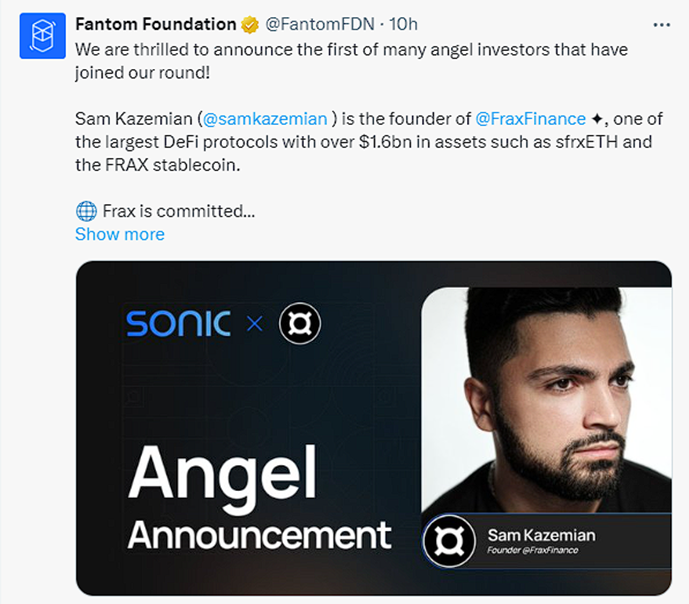
Among the 254 listed projects in Fantom’s ecosystem, 118 are DeFi-related—nearly half. Given this composition, developing the DeFi ecosystem takes precedence over promoting meme coins. On March 28, Fantom announced progress on a new funding round for Sonic, with Frax Finance founder as the first angel investor. This collaboration may open new pathways for DeFi revival on Fantom.
The Fantom Foundation places high hopes on Sonic’s role in advancing DeFi. According to The Block, Michael Kong, CEO of the Fantom Foundation, stated that Sonic will introduce several initiatives, including support for liquid staking tokens, new staking mechanisms, and more decentralized and secure cross-chain solutions, enabling users to bridge funds from Ethereum to boost DeFi activity on Fantom.
Kong said: “Sonic will be used to create a new world-class shared sequencer for L1 and L2 chains, capable of handling over 180 million transactions per day with true sub-second confirmation times, and will relaunch Fantom on a completely new, community-centric brand.”
03 Fantom Sonic Ecosystem Projects Overview
A blockchain’s success depends not only on technical superiority but also on vibrant ecosystem growth. To attract more high-quality projects, the Fantom Foundation launched Sonic Labs in December last year—a dedicated incubator providing official backing, resources, and technical support to help developers build new applications.
Recent winners of the Sonic Labs accelerator program showcase the appeal and momentum of the Fantom ecosystem. These projects span diverse innovations—including perpetual DEXs, social protocols, P2P lending platforms, green tech startups, and RPG blockchain games. Their inclusion will enrich the Fantom ecosystem, expanding application scenarios and opportunities for users.
Perpetual DEX Project: Lynx
Lynx is an advanced decentralized perpetual exchange that allows any protocol, DAO, or blockchain to easily list tokens as collateral assets. On Lynx, users can invest using various tokens without selling their holdings, enabling diversified investment strategies.
Lynx offers multiple advantages: users can trade perpetual contracts using any listed collateral token without worrying about price volatility affecting position health; trading incurs no gas fees or need to hold the chain’s native token, ensuring gas-free transactions. Furthermore, Lynx’s cross-chain system enables interaction between Lynx and perpetual exchanges on any source chain, with settlements occurring on Lynx’s engine chain. In the future, Lynx will integrate with the new Fantom Sonic mainnet, benefiting from faster block times, lower gas costs, and infrastructure perfectly aligned with perpetual trading needs.
Social Protocol: Thunder Dome
Thunder Dome is a full-stack SocialFi service built on the Fantom blockchain, enabling users to interact with communities through tradable tickets. These tickets function as social tokens, facilitating engagement within personal, group, or theme-based communities. Thunder Dome represents an evolution in SocialFi—from individual-focused models to broader community and thematic participation.

On Thunder Dome, users purchase tickets to join various communities and form connections. They can also earn income—holders of personal tickets receive 5% of transaction revenue, while group and theme ticket holders share proportionally in 5% of total trading volume. Currently running successfully on the Fantom Sonic testnet, Thunder Dome plans to launch simultaneously on the mainnet when Sonic goes live.
P2P Lending Platform: Debita
Debita is a P2P, oracle-free lending protocol on Fantom, aiming to provide decentralized lending solutions. As part of the Fantom ecosystem, Debita offers borrowing and lending functions that promote ecosystem growth.
Debita offers unique and compelling features such as fair interest rates and tokenized loan positions. Built on the Fantom blockchain, Debita ensures secure and transparent transactions while eliminating liquidation risks caused by collateral depreciation. Moreover, Debita welcomes a broad range of borrowers and lenders, simplifies access to financing options, and delivers customized solutions to meet individual user needs—offering flexibility and adaptability.
Green Tech Startup: KiriCoin
KiriCoin is a green tech startup focused on tracking and rewarding sustainable individual behaviors to combat climate change. While information about KiriCoin remains limited, its recognition by Sonic Labs underscores its credibility. By combining Fantom’s cutting-edge technology with KiriCoin’s sustainability mission, we can anticipate this project playing a significant role in building a greener, more sustainable future.
RPG Blockchain Game: Froqorion
Froqorion, incubated by Sonic Labs under the Fantom Foundation, is an innovative game within the Fantom ecosystem. Set in the ancient frog civilization of Froqorion, players assume the role of heroes. Featuring squad-based RPG gameplay, players aim to collect the four elemental powers (earth, wind, fire, water) and assemble teams to complete cooperative missions and adventures.
As part of the Fantom ecosystem, Froqorion integrates blockchain-specific features such as token incentives. Overall, Froqorion is an innovative RPG blockchain gaming project on Fantom, introducing fresh use cases and gameplay mechanics. Blending a frog civilization theme with squad-based RPG elements, it delivers a uniquely engaging player experience.
04 Conclusion
Following the Cancun upgrade, market focus has centered on Layer 2 solutions for blockchain scalability. However, the emergence of Sonic offers an alternative approach. As Fantom’s most scalable and secure blockchain technology to date, Sonic achieves true 2,000 TPS and sub-second finality—performance metrics exceeding many Layer 2 solutions. This demonstrates that Layer 1 blockchains can enhance scalability through internal technological innovation, without necessarily relying on Layer 2.
In this bull market, Fantom may not be the most spotlighted project, but it is undoubtedly one of the most anticipated. With AC’s return, the Sonic upgrade, and signs of DeFi ecosystem revival, Fantom stands poised for a comeback in this market cycle.
Join TechFlow official community to stay tuned
Telegram:https://t.me/TechFlowDaily
X (Twitter):https://x.com/TechFlowPost
X (Twitter) EN:https://x.com/BlockFlow_News