Is Bitcoin DA promising? A brief analysis of newcomer Nubit's architecture and highlights
TechFlow Selected TechFlow Selected
Is Bitcoin DA promising? A brief analysis of newcomer Nubit's architecture and highlights
Nubit can reduce transaction fees by over 95% and increase data throughput by more than 100x.
 Navigating Web3 tides with focused insights
By 1912212.eth, Foresight News
Data Availability (DA), in simple terms, means block producers publish all transaction data of a block onto the network so that validators can download it. If block producers release complete data accessible to validators, we say the data is available. The DA layer has emerged as an abstraction driven by blockchain scalability demands and heightened requirements for data availability. We’ve seen a wave of projects like Celestia, EigenLayer, NearDA, Avail, and others—each carving out their own niche, aiming to establish their reputation.
As Bitcoin's ecosystem gradually gains favor with capital, various technical approaches surrounding Bitcoin are flourishing. Layer 2 solutions, staking protocols, and DeFi projects bringing BTC into Ethereum or Solana have taken center stage, while native Bitcoin DA projects are also drawing market attention.
Recently, Nubit completed a $3 million Pre-Seed funding round, backed by dao5, OKX Ventures, Primitive Ventures, and others. The team stated they are preparing for mainnet launch.
What is Nubit?
Nubit is a scalable, Bitcoin-native DA layer secured by Bitcoin itself. It significantly expands Bitcoin’s data capacity, supporting applications such as Ordinals, Layer 2s, and oracles, thereby broadening the scope and efficiency of the Bitcoin ecosystem. It aims to fully inherit Bitcoin’s security properties, including economic security, tamper resistance, and censorship resistance.
During periods of high activity in the crypto market, Bitcoin transaction fees often become prohibitively expensive, leading to severe network congestion. Last year, surging demand for inscriptions caused over 14GB of data to be stored on Bitcoin, resulting in extremely high costs. According to data from its official website, Nubit can reduce transaction fees by more than 95% while increasing data throughput by over 100x.
Nubit Architecture
Nubit primarily consists of four core components: validators, trust-minimized bridge, full storage nodes, and light clients.
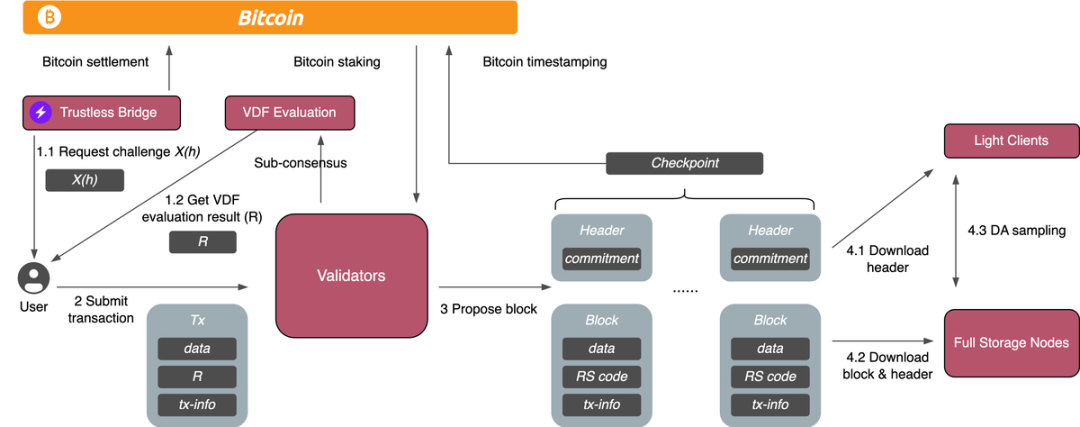
Validator nodes mainly use the Practical Byzantine Fault Tolerance (PBFT) consensus algorithm, responsible for proposing, validating, and ensuring transaction integrity. The trust-minimized bridge acts as an intermediary, collecting storage fees from users and distributing rewards to validators via payment channels. Full storage nodes receive block data from validators and are responsible for reliably storing all data. Light clients obtain blocks broadcasted by validators—including data commitments—and may randomly query full storage nodes to verify data availability.
Key Features and Innovations of Nubit
In terms of consensus mechanism, Nubit maintains a semi-synchronous network assumption and introduces NuBFT—a consensus algorithm deeply optimized for DA. NuBFT is a variant of BFT consensus that integrates Reed-Solomon (RS) coding-based data partitioning with KZG commitment generation. Even if some data nodes are compromised, RS coding enables recovery of the original data.
Moreover, KZG commitments submitted to Bitcoin ensure the validity of the original data. By integrating RS-encoded block partitioning and KZG commitment generation directly into the consensus process, data integrity, availability, and scalability are tightly coupled with consensus, significantly enhancing the "robustness" of the entire DA system.
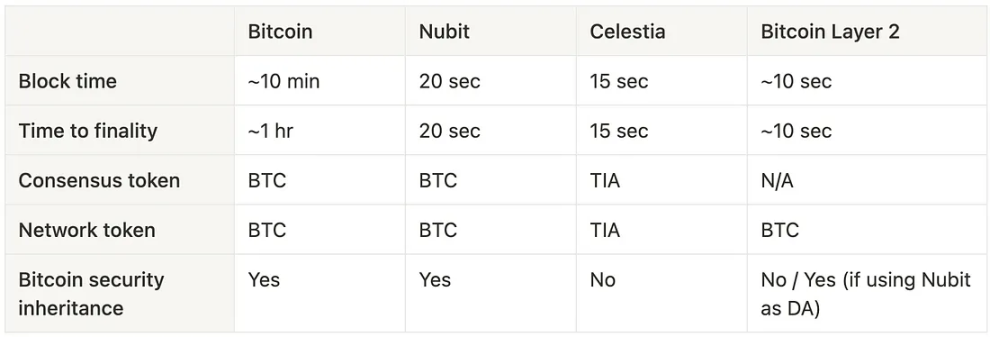
Notably, Nubit uses BTC as the primary token in its consensus protocol, inheriting Bitcoin’s economic security through native staking mechanisms such as Babylon. In contrast, general-purpose DA layers like Celestia rely on their own network tokens, introducing additional trust assumptions beyond Bitcoin.
Regarding data availability, to prevent potential network disruptions caused by node encoding errors, Nubit adopts a hybrid approach, integrating both full nodes and light nodes to ensure data integrity. First, Nubit employs KZG as validity proofs to guarantee DA, reducing memory, bandwidth, and storage overhead while maintaining efficiency. Even if the entire Nubit network fails, nodes can still recover data using full nodes and KZG commitments recorded on Bitcoin. To further enhance scalability, Nubit incorporates light nodes equipped with Data Availability Sampling (DAS). This feature allows for larger block sizes, meeting growing demands for data availability.
However, unlike other Bitcoin L2 solutions, Nubit does not include a smart contract execution layer.
Regarding trustless cross-chain bridges, traditional Bitcoin L2s often depend on centralized bridges, which introduce potential security vulnerabilities due to Bitcoin’s architectural constraints. Nubit instead leverages the Lightning Network, enabling the establishment of secure and trustless bridges within the Bitcoin ecosystem.

Nubit uses Bitcoin payment channels for network fee settlements—a key differentiator from other BTC bridging solutions. Users are not required to pre-deposit funds. Instead, transaction fees are handled directly within state channels per transaction, ensuring user fund security is directly tied to Bitcoin’s own security. Additionally, Nubit’s design supports emergency withdrawals: even if Nubit ceases operations, users can reclaim their funds by closing Bitcoin payment channels.
Conclusion
In past Bitcoin technical practices, upgrades like SegWit and Taproot enhanced Bitcoin’s data availability to varying degrees. However, Nubit arrives at an opportune moment—unlike earlier times when modular architectures and the L2 wave had yet to emerge. Now, a completely new solution stands before us. After actively collaborating with projects such as Babylon, Merlin, and BounceBit, Nubit plans to officially launch its mainnet later this year. Its future development warrants close attention.
Join TechFlow official community to stay tuned
Telegram:https://t.me/TechFlowDaily
X (Twitter):https://x.com/TechFlowPost
X (Twitter) EN:https://x.com/BlockFlow_News
 Foresight News