Launch of ARC-20 native marketplace: Explore OKX Web3's Bitcoin ecosystem development blueprint
TechFlow Selected TechFlow Selected
Launch of ARC-20 native marketplace: Explore OKX Web3's Bitcoin ecosystem development blueprint
This article takes you through a quick overview of the newly upgraded Inscription Marketplace in the OKX Web3 wallet, and outlines OKX's Bitcoin ecosystem development landscape.
 Navigating Web3 tides with focused insights
Bitcoin is entering a new era.
According to Coinglass data, the total asset management scale of Bitcoin ETFs has reached $56.113 billion. As of yesterday, data from companiesmarketcap shows that Bitcoin's market capitalization has risen to $1.398 trillion, surpassing silver and ranking as the eighth-largest asset globally by market cap.
Previously, USDT’s total market cap also hit a record high. Data from CoinGecko indicates that USDT's market cap surpassed $100 billion, currently standing at $100.5 billion. Against the backdrop of the broader crypto market trending upward, the Bitcoin halving narrative, and innovations in inscriptions driving momentum, the Bitcoin ecosystem—centered around asset issuance standards, scaling protocols, and cross-chain protocols—is flourishing comprehensively.
As an early supporter of Bitcoin ecosystem development, OKX Web3 has taken further steps in building asset issuance standards. The official team recently announced support for NFTs and ARC20 tokens under the Atomicals protocol, while upgrading its Ordinals marketplace into an Inscriptions Marketplace.
This article will guide readers through the newly upgraded Inscriptions Marketplace on OKX Web3 Wallet and outline OKX’s Bitcoin ecosystem development roadmap.
1. Upgrading the Original Ordinals Market into the Inscriptions Market: Enabling One-Stop Exploration of the Inscriptions Ecosystem
To understand ARC20, one must first grasp the Atomicals protocol.
The Atomicals protocol is built on the Bitcoin network. Using this protocol, users can mint, transfer, and upgrade digital assets (such as native digital NFTs, gaming NFTs, digital identities, domains, social networks) and create fungible tokens (tokens). In other words, the Atomicals protocol enables both non-fungible NFTs and fungible tokens to be issued on the Bitcoin network. These fungible tokens are known as ARC-20 tokens.
According to the ARC-20 protocol, each token issued requires a corresponding number of satoshis (sats) in UTXO as backing, meaning each token is tied to 1 satoshi, ensuring its value never falls below 1 sat. Additionally, when minting tokens, the ARC-20 standard adopts a mechanism similar to Bitcoin’s proof-of-work, requiring computational power to calculate a prefix, which serves as a necessary condition for minting the token. In the future, ARC-20 and Atomicals will bring new opportunities for asset management and issuance on Bitcoin.
Previously, the OKX Web3 team announced plans to integrate innovative multi-standard inscription protocols. The self-developed ARC-20 marketplace has now been integrated into the Inscriptions Market, running parallel to the Ordinals market, supporting features such as viewing and transferring related assets, as well as placing and taking orders—all accessible directly within the app interface.
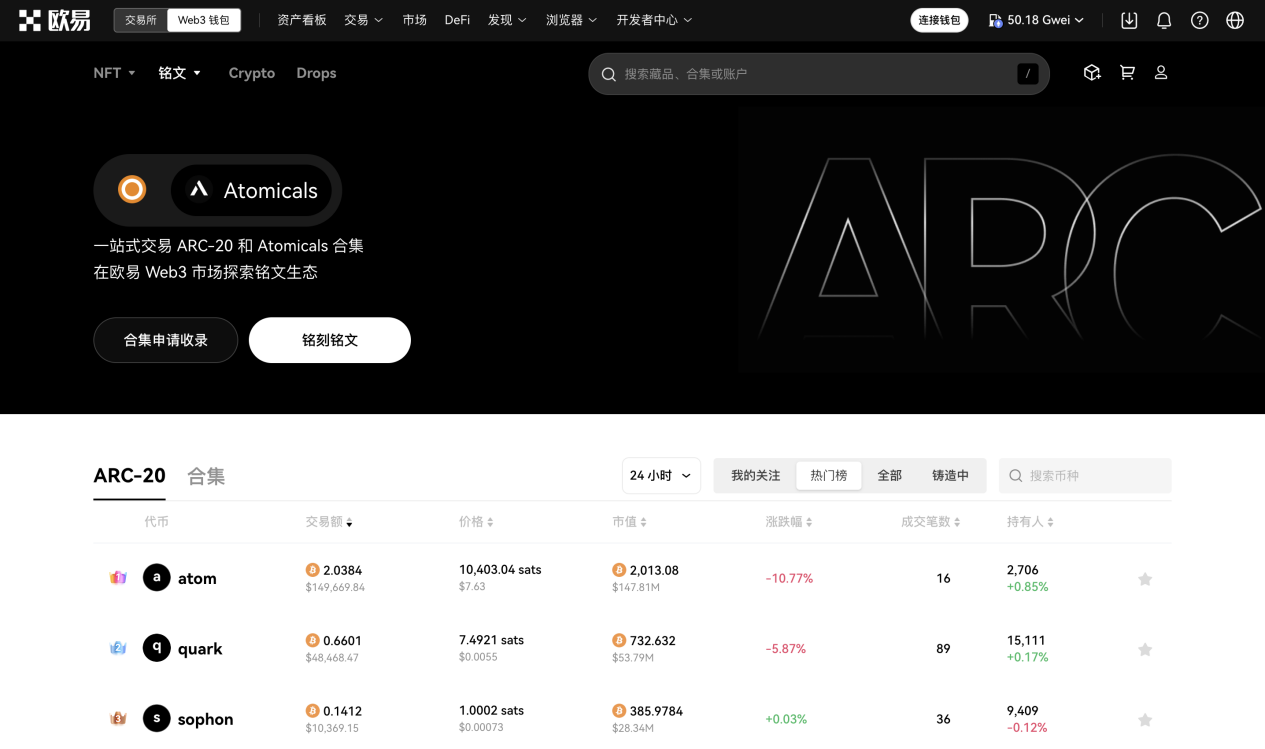
To date, OKX Web3’s inscriptions ecosystem has integrated multiple inscription protocols including BRC-20, SRC-20, ARC-20, and Rune Alpha. The Inscriptions Market supports trading of BRC-20, ARC-20 tokens, and associated NFTs. Users can leverage the OKX Web3 Wallet to seamlessly explore and engage with popular Bitcoin inscription ecosystems. A relevant official stated that going forward, they will continue monitoring market trends and user demand to further enhance the inscriptions ecosystem.
2. A Systematic Overview of OKX Web3’s Progress in Bitcoin Ecosystem Development
Historically, Bitcoin ecosystem development has been constrained by network scalability issues. Developers aiming to build applications on Bitcoin require effective scaling solutions, resulting in limited application innovation. However, starting last year, the emergence of the Ordinals protocol and the BRC-20 token standard sparked a surge in inscriptions, reigniting interest in asset issuance protocols on Bitcoin. This led to the rise of diverse asset issuance protocols such as Atomicals, Runes, BTC Stamps, and Taproot Assets, along with new token standards like ARC-20, SRC-20, and ORC-20.
At its core, the inscriptions sector has introduced a new model of fair launch, generating significant attention for the Bitcoin ecosystem and renewing broader interest in Bitcoin-based innovations.
Due to Bitcoin’s limitations in scalability and transaction confirmation times, sustainable ecosystem growth hinges on solving the scaling challenge—a critical issue all Bitcoin ecosystem developers must confront. Currently, two main approaches exist: on-chain scaling via optimization at Bitcoin Layer 1, and off-chain scaling—commonly referred to as Layer 2. Beyond asset issuance protocols and scaling solutions, infrastructure projects are increasingly emerging, including inscription-compatible wallets, decentralized indexers, cross-chain bridges, launchpads, and more, all contributing to a vibrant and expanding ecosystem.
In terms of Layer 1 asset issuance protocols and application-layer infrastructure, the OKX Web3 team has consistently pushed forward. It was among the first to support the Ordinals market, achieving notable success.
As early as July last year, OKX Web3’s Ordinals Market became the largest marketplace for BRC20 token trading by volume. With the continuous evolution of the Bitcoin ecosystem, the OKX Web3 team has steadily advanced across multiple fronts—including wallet tools, browsers, trading markets, protocol standards, cross-chain bridges, and Bitcoin Layer 2 solutions. On the cross-chain front, OKX DEX supported Bitcoin cross-chain trading early on. Regarding Layer 2 scaling solutions, OKX Web3 continues to onboard relevant projects such as Babylon, Merlin, and B².
Additionally, OKX Ventures, the investment fund under OKX, is committed to supporting innovation within the Bitcoin ecosystem. It has already invested in projects such as B² Network, Bitmap Tech, Babylon, bitSmiley, alexGo, and Portal DeFi. According to previous reports, OKX Ventures has allocated $10 million to continuously support rising entrepreneurs in the BTC ecosystem, accelerating blockchain technology advancements while offering services and resources to help partners grow together.
In fact, beyond leading infrastructure development in the Bitcoin ecosystem, OKX Web3 Wallet has also dedicated significant time and effort over the past one to two years to advancing ecosystems such as Ethereum’s EVM and Solana. While improving foundational infrastructure, it has integrated popular applications within these ecosystems, consistently working toward creating a convenient, one-stop Web3 gateway for users. As Jason Lau, OKX’s Chief Innovation Officer, previously stated: “User demand is the primary criterion guiding OKX’s value judgments, and it remains the foremost driver behind our product innovation.”
Join TechFlow official community to stay tuned
Telegram:https://t.me/TechFlowDaily
X (Twitter):https://x.com/TechFlowPost
X (Twitter) EN:https://x.com/BlockFlow_News