








2024 Potential Airdrop Opportunities Overview (Part 1)
TechFlow Selected TechFlow Selected
2024 Potential Airdrop Opportunities Overview (Part 1)
The seeds planted earlier have already blossomed—ARB, TIA, JTO... What promising airdrops await us in 2024?
 Navigating Web3 tides with focused insights
Author: Uncle Jian
Overview
2023 was a season of harvest—not only did the overall crypto market rebound, but various projects also rode the bull market wave to reward their supporters with airdrops. Airdrops from Ethereum L2 Arbitrum, modular blockchain Celestia, Solana ecosystem's Jito, gaming L3 XAI, and blockchain game Big Time—all indicate that many sectors offer airdrop opportunities.
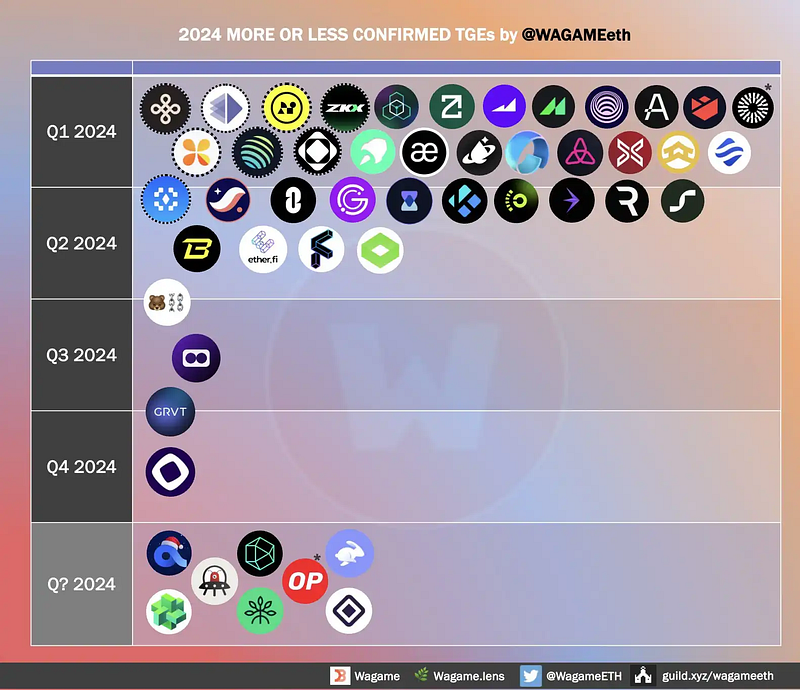
According to the chart made by @WAGAMEeth, there are numerous projects confirmed to conduct airdrops in 2024. And this is just the list of those already confirmed—more projects will likely join as the market continues recovering.
Based on this, we’ve compiled some promising sectors and key projects to help readers catch the next major airdrop.
1. Solana Ecosystem
The Solana ecosystem is undoubtedly one of the most watched opportunities for airdrop hunters. We previously published research reports detailing Solana’s resurgence and its high-potential projects, so we won’t repeat them here—only provide updates and additional insights on select projects.
Report details:
"Why Solana Can Rise Again, and How We Should Participate?"
"Solana Ecosystem Interactions | marginfi Points and Cost Test"
Marginfi
Marginfi launched its points system back in July last year, but there has been no news about an airdrop since. We speculate it may be among the earliest to airdrop.
Kamino
Kamino has officially started its Season 1 points campaign, retroactively crediting previous activity, and updated its airdrop plan on the website and documentation—announcing a genesis airdrop in April. Additionally, Solana liquidity pool Meteora announced on January 31 the launch of MET point tracking; providing liquidity in pools marked with Meteora symbols on Kamino allows users to earn points from both platforms simultaneously.
Drift
Drift’s first season points program ended on February 2. The official team stated the points campaign would run for no more than three months, and past trading activities have already been retroactively credited. An airdrop is highly likely in April. Note: retroactive points will only be distributed after the campaign ends.
Parcl
Parcl’s second season points campaign is ongoing, expected to span three seasons, with official hints suggesting an airdrop after completion. At the current pace of one-and-a-half months per season, the program is likely to conclude and trigger an airdrop in the first half of the year.
Zeta Markets
Zeta Markets’ second season points campaign began on January 10. The higher your rank on the profit leaderboard, the greater your points multiplier—making it highly attractive to traders. Recently, Zeta launched a $JUP trading event, offering triple multipliers for $JUP trades.
Magic Eden
Magic Eden launched a multi-chain wallet. Throughout February, users of the Magic Eden wallet can mint certain NFTs for free within the wallet. Additionally, Magic Eden wallet users receive a 1.25x multiplier on Liquidium points when using the Ordinal lending platform, increasing their chances of qualifying for the $MOON airdrop on Saturn.
2. Cosmos Ecosystem
In the Cosmos ecosystem, Celestia stands out as the brightest project this year—not only has its token price risen steadily, but $TIA stakers have also successively received airdrops such as $DYM and $ALT. Moreover, Cosmos ecosystem airdrops are relatively low-effort: staking not only offers potential airdrop eligibility but also generates substantial staking rewards. That said, we should remain cautious about risks like token depreciation and opportunity costs during lock-up periods.
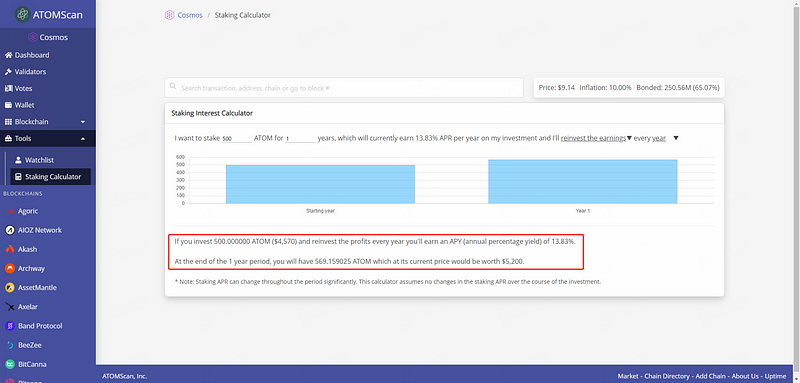
APY for staking 500 $ATOM. Data source: https://atomscan.com/tools/staking-calculator
Recommended Tokens to Stake
The main tokens worth staking are: $ATOM, $TIA, $OSMO, and $INJ.
Reasons for choosing these tokens:
-
$ATOM: As the governance token of Cosmos Hub, $ATOM is typically the first stop for Cosmos-related airdrops.
-
$TIA: Celestia is a highly anticipated modular blockchain providing DA (data availability) services to multiple other chains. Thus, $TIA stakers indirectly contribute to these ecosystems. Furthermore, Celestia’s team often collaborates with other projects to airdrop tokens to $TIA stakers as part of marketing efforts.
-
$OSMO: Osmosis serves as the DeFi gateway and liquidity hub of the Cosmos ecosystem. It has already received airdrops such as $TIA and $SEI.
-
$INJ: $INJ saw an extraordinary surge last year, rising over 40x from its lowest to highest point. However, the Injective ecosystem is only beginning—some projects have confirmed Q1 and Q2 2024 airdrops, while many others have yet to announce plans. This presents a timely entry opportunity. Projects confirmed to airdrop to $INJ stakers include Black Panther and Talis Protocol.
Staking Strategy
1. First, you need a Keplr wallet.
Download link: https://chromewebstore.google.com/detail/keplr/dmkamcknogkgcdfhhbddcghachkejeap?utm_source=ext_app_menu
2. Open the Keplr staking dashboard and select the chain corresponding to the token you wish to stake.
Staking dashboard link: https://wallet.keplr.app/?modal=staking&chain=cosmoshub-4&step_id=2
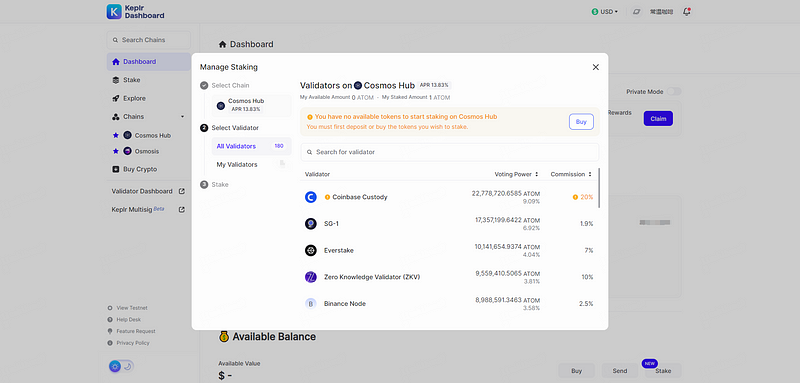
3. When selecting validators, it’s best to choose those ranked outside the top 20, as they typically charge lower fees. Also avoid CEX-affiliated validators, as they are often excluded from airdrops.
4. It’s recommended to stake at least around $100 worth, as some protocols filter out addresses with very low balances.
3. Bitcoin Ecosystem
Last year, the explosion of inscriptions brought renewed attention to the development of the Bitcoin ecosystem. However, due to Bitcoin’s lack of Turing completeness and high gas fees, it struggles to support complex dApp development and usage—highlighting the importance of Bitcoin L2 solutions. Our previous reports have covered several Bitcoin L2s, so here we’ll focus only on interaction methods. See prior report: "Five Questions to Understand Bitcoin L2".
B² Network
B² Network is a zero-knowledge proof-based BTC Rollup compatible with EVM. It currently runs two campaigns: Testnet Odyssey and Buzz deposits for points. Note: Buzz deposits cannot be withdrawn until April, similar to Blast’s mechanism.
Detailed tutorial: https://x.com/jianshubiji/status/1749355351361929597?s=20
Merlin Chain
Merlin Chain is an L2 built on Bitcoin’s native assets, founded by the BRC420 team. It is currently in testnet phase (non-incentivized). According to the official team during a Space session, Merlin Chain is expected to launch mainnet as early as February, followed by a series of incentive campaigns. On February 5, Particle Network—the partner of Merlin Chain—launched a Launchpad for Merlin Chain’s token via its inscription platform, with more staking-related activities to follow.
Detailed interaction guide: "Introduction to Merlin Chain and Testnet Interaction Tutorial"
BounceBit
BounceBit is a dual-token PoS staking chain for BTC developed by Bounce Finance. Its PoS mechanism supports both BTC and its native token. BounceBit provides staking yield opportunities for Bitcoin and its wrapped assets, thereby unlocking value from otherwise idle Bitcoin holdings.
Currently, BounceBit operates similarly to Blast, using an asset deposit model to earn points.
Official website: https://bouncebit.io/
Summary
That concludes this edition. There are plenty of opportunities—you don’t need to participate in all. Allocate based on your time and capital. In the next issue, we’ll continue exploring 2024 airdrop opportunities across Sui ecosystem, Sei ecosystem, unlaunched public chains, restaking, and more.
Join TechFlow official community to stay tuned
Telegram:https://t.me/TechFlowDaily
X (Twitter):https://x.com/TechFlowPost
X (Twitter) EN:https://x.com/BlockFlow_News
 @jianshubiji


