Analyzing the Programmable zkOracle Protocol Hyper Oracle: Enabling Seamless Integration Between On-Chain Data and Off-Chain Environments
TechFlow Selected TechFlow Selected
Analyzing the Programmable zkOracle Protocol Hyper Oracle: Enabling Seamless Integration Between On-Chain Data and Off-Chain Environments
This article will delve into HyperOracle's role in advancing AI democratization, bridging the gap between transparency and innovation, and shaping the future of decentralized applications.
 Navigating Web3 tides with focused insights
Author: Greythorn
Source: Hyper Oracle
Introduction
Currently, decentralized applications (DApps) face numerous challenges in securely organizing and processing automated off-chain data. HyperOracle introduces zkOracle, an innovative solution that seamlessly connects on-chain data with off-chain environments using zero-knowledge proof technology.
HyperOracle, as a bridge bringing machine learning onto blockchain systems, not only unlocks scalable AI capabilities but also meets the dual requirements of decentralization and data verifiability.
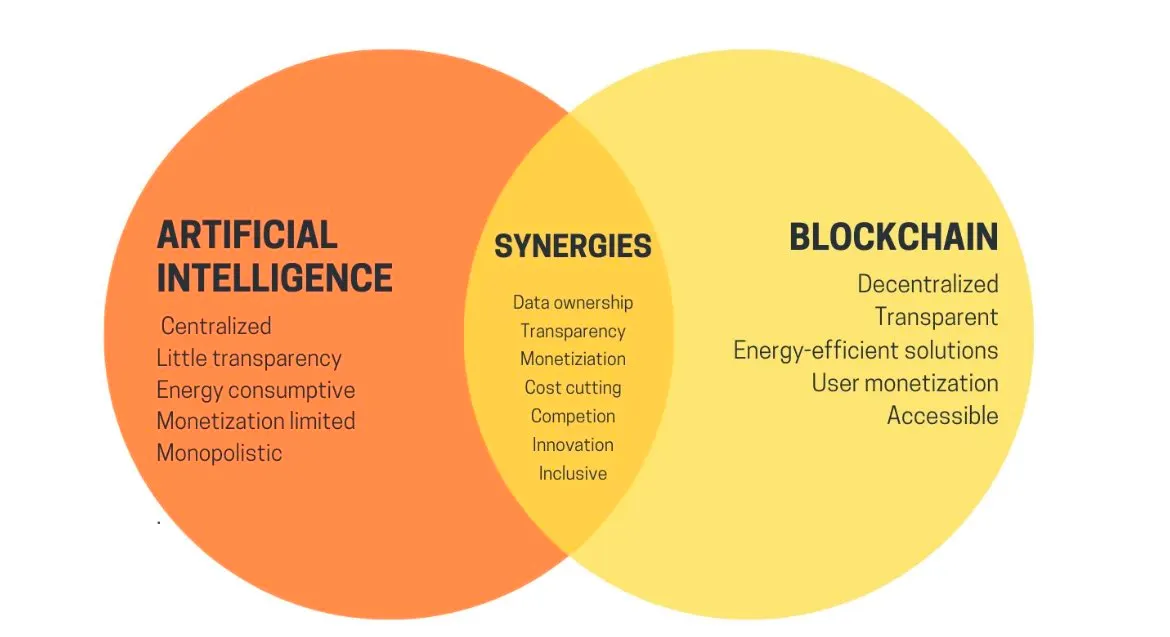
At the intersection of AI and blockchain technology, transparency is particularly crucial. While openness is continuously promised, the opacity of AI models remains a major challenge. Ethereum co-founder Vitalik Buterin believes the integration of AI and crypto holds immense potential, and blockchain's transparency can help mitigate the inherent ambiguity of AI.
Through its advanced application of Halo2 technology, HyperOracle has gained recognition from the Ethereum Foundation and made significant contributions to advancing blockchain standards and technologies, including providing technical support for Ethereum (ERC-6150, ERC-7007), Celestia, and Uniswap.
This article will delve into HyperOracle’s role in democratizing AI, bridging the gap between transparency and innovation, and shaping the future of decentralized applications.
Value Proposition
In today’s artificial intelligence (AI) and machine learning (ML) landscape, transparency has emerged as a prominent issue. Despite frequent calls for openness and open-source initiatives, understanding the specific models behind AI outputs remains challenging. Vitalik Buterin believes that integrating AI with cryptographic technology holds great potential, as cryptography’s transparent nature can counterbalance AI’s inherent opacity. HyperOracle addresses this challenge with its original solution—zkOracle.
Source: Vitalik’s article
HyperOracle aims to build a global supercomputer—a globalized network securely connecting various peer-to-peer networks. This platform enhances Ethereum’s functionality, supporting larger-scale computational demands and storage expansion. By integrating AI and ML technologies on-chain, HyperOracle leverages blockchain’s transparency to introduce intelligent functions into smart contracts, sparking an innovation revolution.
Although Ethereum offers on-chain computation capabilities, it faces limitations in fully realizing on-chain ML/AI. HyperOracle overcomes cost and performance challenges by introducing two innovative technologies—opML and zkML—enabling verification of on-chain computations. zkOracle, as a decentralized oracle network, uses zero-knowledge proofs to achieve seamless integration between on-chain data and off-chain computations, along with validation of off-chain proofs, ushering in a new era where transparency coexists with efficiency.
Ethereum acts as a consensus ledger, while the zkOracle network handles resource-intensive computing tasks, connecting different components through zero-knowledge proof technology.
opML is optimized for on-chain AI and ML, offering efficient, scalable, and decentralized solutions. Adopting this cutting-edge technology aims to unlock the full potential of AI and blockchain while maintaining transparency, security, and ethical accountability.
Project Overview
According to official documentation, HyperOracle is a programmable zkOracle protocol capable of providing smart contracts with arbitrary computational power and richer data sources. It offers comprehensive security and decentralization guarantees for trust-sensitive automation and on-chain AI/ML, enabling developers to easily build next-generation decentralized applications (dApps).
Within the HyperOracle network, multiple zkOracle nodes form a network similar to Ethereum nodes that execute computations and generate zero-knowledge proofs.
It is conceivable that the project’s technical details are quite complex. Even after thoroughly studying detailed documentation, fully grasping its mechanisms remains challenging. Next, let’s explore the revolutionary elements introduced by HyperOracle to better understand its future potential.
Zero-Knowledge Machine Learning (zkML)
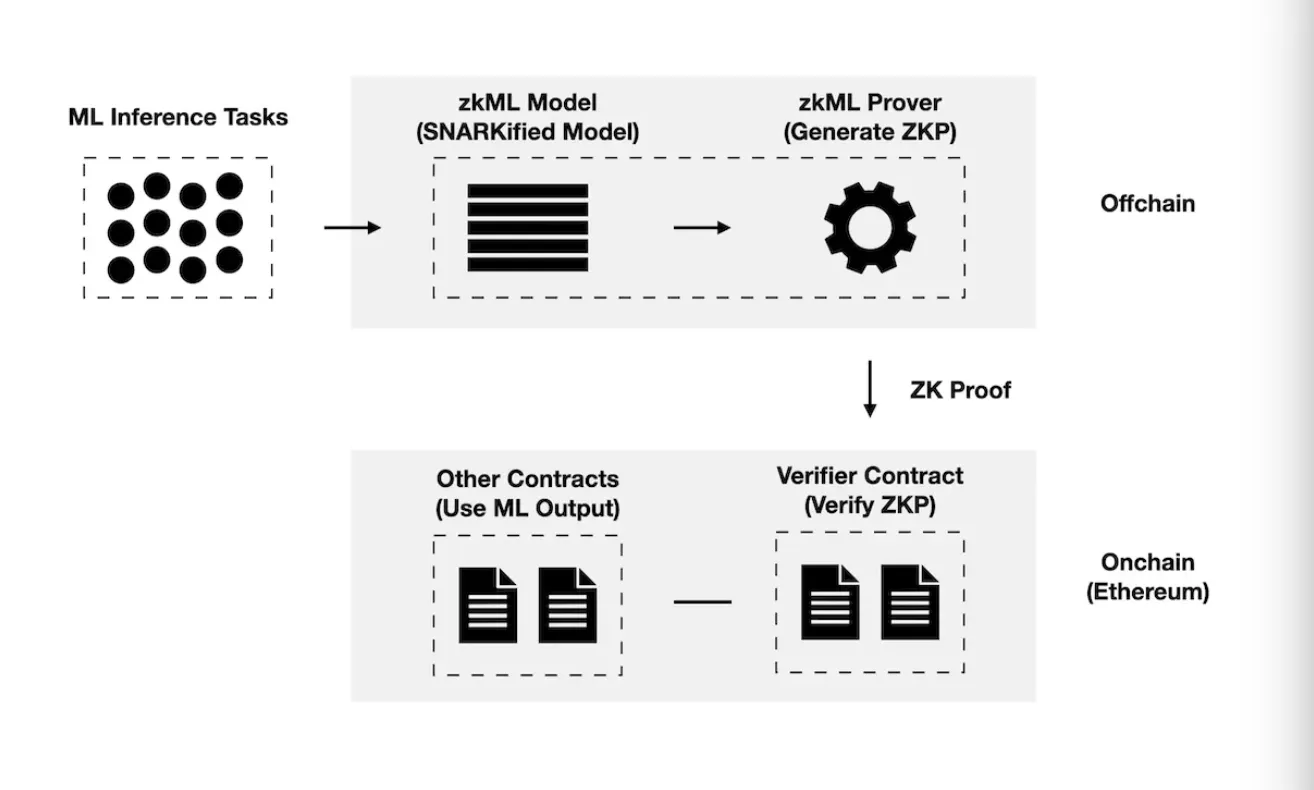
zkMLinference is HyperOracle’s trustless machine learning inference protocol based on zero-knowledge proofs. Functioning as a zkOracle Meta App similar to zkAutomation for input/output, it achieves on-chain ML inference by integrating zk machine learning frameworks and using zkGraph as a core component. Developers can use zkMLinference to build any ML-driven DApp protected by Ethereum.
zkML empowers blockchain technology with the ability to verify privacy-preserving AI models, ensuring data confidentiality throughout the process.
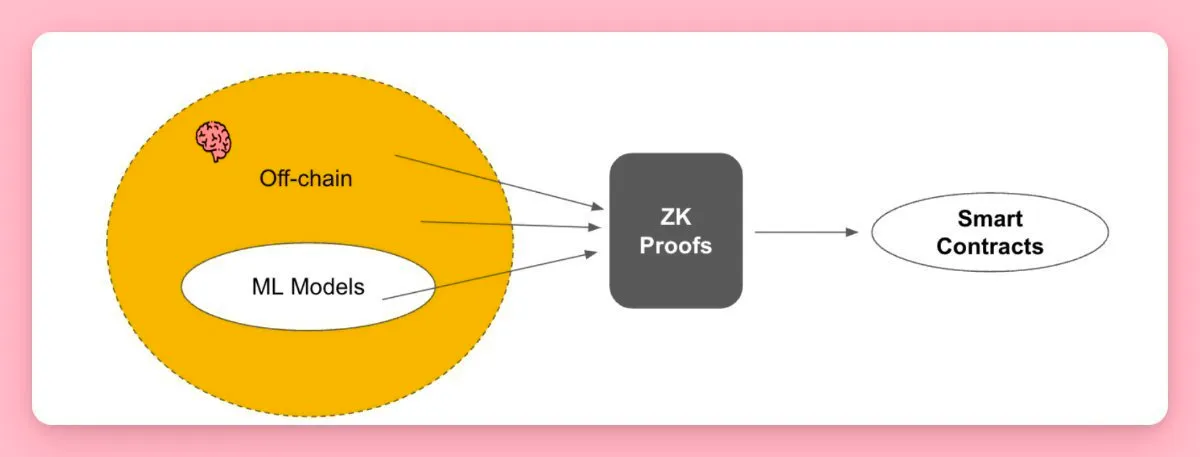
zkML shows tremendous potential at the intersection of cryptography and AI, led commercially by Modulus Labs and Giza Tech. Despite its promise, gaps remain unaddressed in the AI supply chain, especially in certification. Slow adoption of zkML frameworks stems primarily from long proof generation times and high computational costs, highlighting the need for further development in this technological domain.
Two distinct approaches have been proposed to connect zero-knowledge proofs with machine learning models:
● Specific ZK Circuits: Custom-designed ZK circuits tailored for different models to meet their specific precision requirements.
● General-purpose zkML runtime: Integrating ZK proofs with ML models via a universal runtime, analogous to how zkEVM handles EVM-compatible programs.
Source: HyperOracle
Introduction to Optimistic Machine Learning (opML)
As previously mentioned, zero-knowledge machine learning (zkML) technology has not yet reached full optimization. In this context, HyperOracle recognizes this limitation and, while actively seeking solutions, its founder has proposed a new concept called Optimistic Machine Learning (opML) as an interim solution before zkML’s official rollout.
As the creator of opML’s first open-source implementation, the HyperOracle team believes opML can promote the convergence of artificial intelligence and cryptographic technology by eliminating the additional burdens imposed by cryptography through game-theoretic principles.
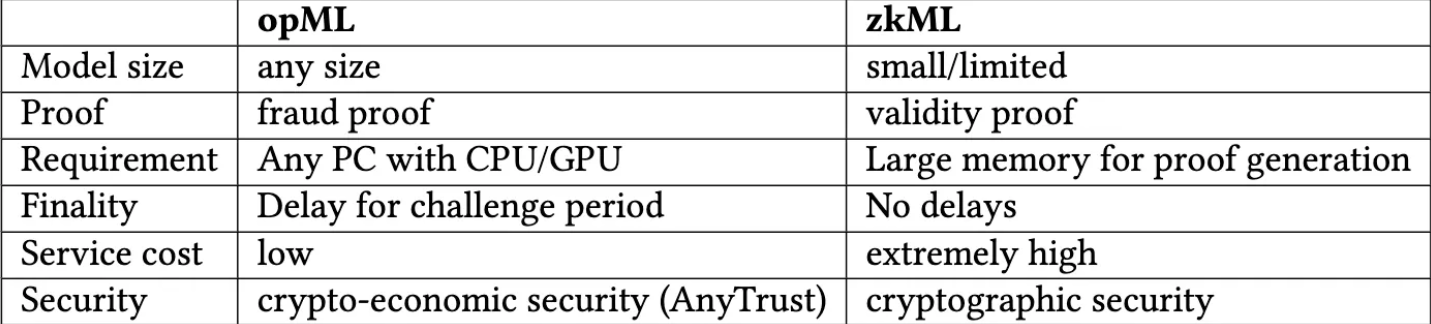
opML employs an optimistic verification mechanism to perform AI model inference and training/fine-tuning processes on-chain. Compared to zkML, opML delivers machine learning proofs at lower cost and higher efficiency. Additionally, opML has low hardware requirements, allowing large language models to run on ordinary personal computers without GPUs.
opML adopts a verification mechanism (similar to OP Rollup) to ensure decentralization and verifiability of machine learning computations.
HyperOracle pioneered the first open-source implementation of opML.
Source: HyperOracle
zkGraph Technology
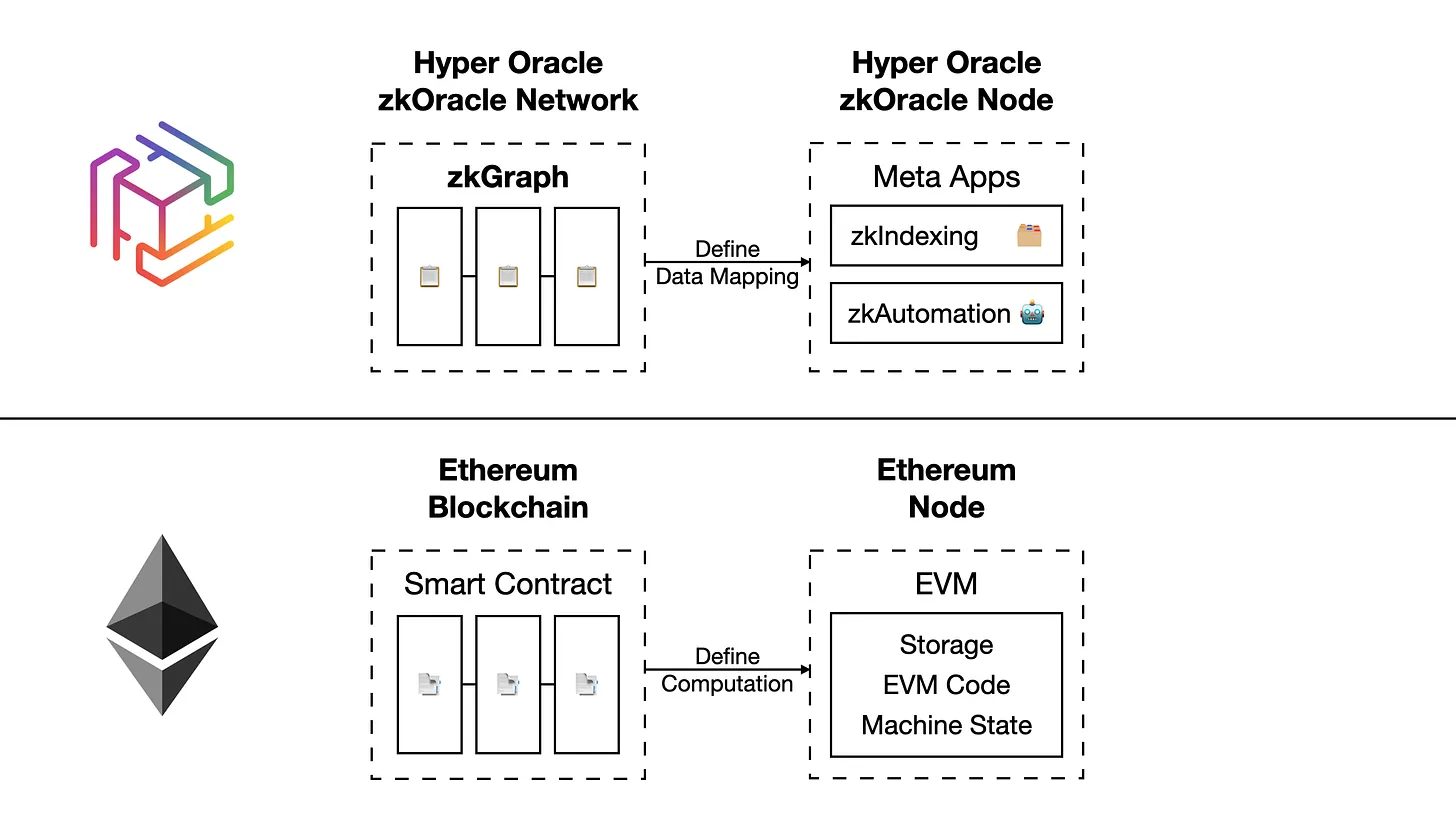
zkGraph serves as a customizable “smart contract” for HyperOracle nodes, responsible for managing data behavior and generating zero-knowledge proofs—similar to how smart contracts define computation methods for Ethereum nodes. Smart contract developers can simultaneously build both smart contracts and zkGraphs, enabling users to interact with both.
zkGraph primarily consists of three components:
● Manifest (zkgraph.yaml): Configuration information such as zkGraph standard, target blockchain network, and target smart contract.
● Mapping (mapping.ts): Converts blockchain data into other forms (off-chain computation).
● (Optional) Schema (schema.graphql): Defines data storage and access patterns.
During deployment, all zkGraph code files are stored in EthStorage, a decentralized storage extension layer supported by Ethereum ESP.
Source: Hyper Oracle
Competitive Analysis
To gain deeper insights into its direct competitors, we analyze the innovative technologies introduced by HyperOracle and their applications. HyperOracle launches a blockchain service—the zkOracle protocol—for executing complex computations within smart contracts, similar to Chainlink’s approach. It also leverages zkGraph technology for post-data-collection processing, akin to The Graph. Notably, HyperOracle is not the only project offering AI functionality on blockchains; even within the zkML space, other projects like Modulus Labs are noteworthy participants.
Oracle Comparison: Chainlink/Traditional Oracles vs. Hyper Oracle
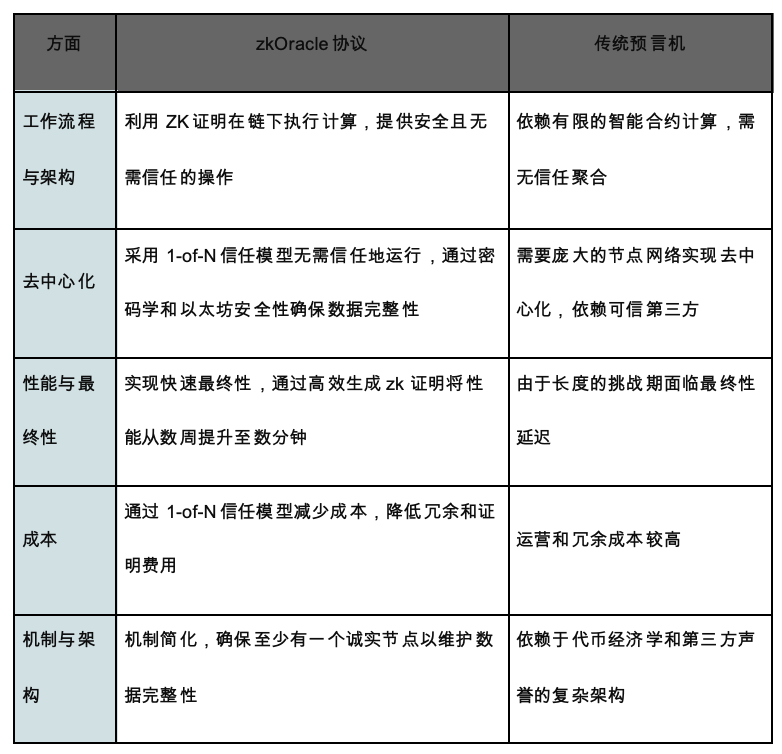
Source: Greythorn Internal
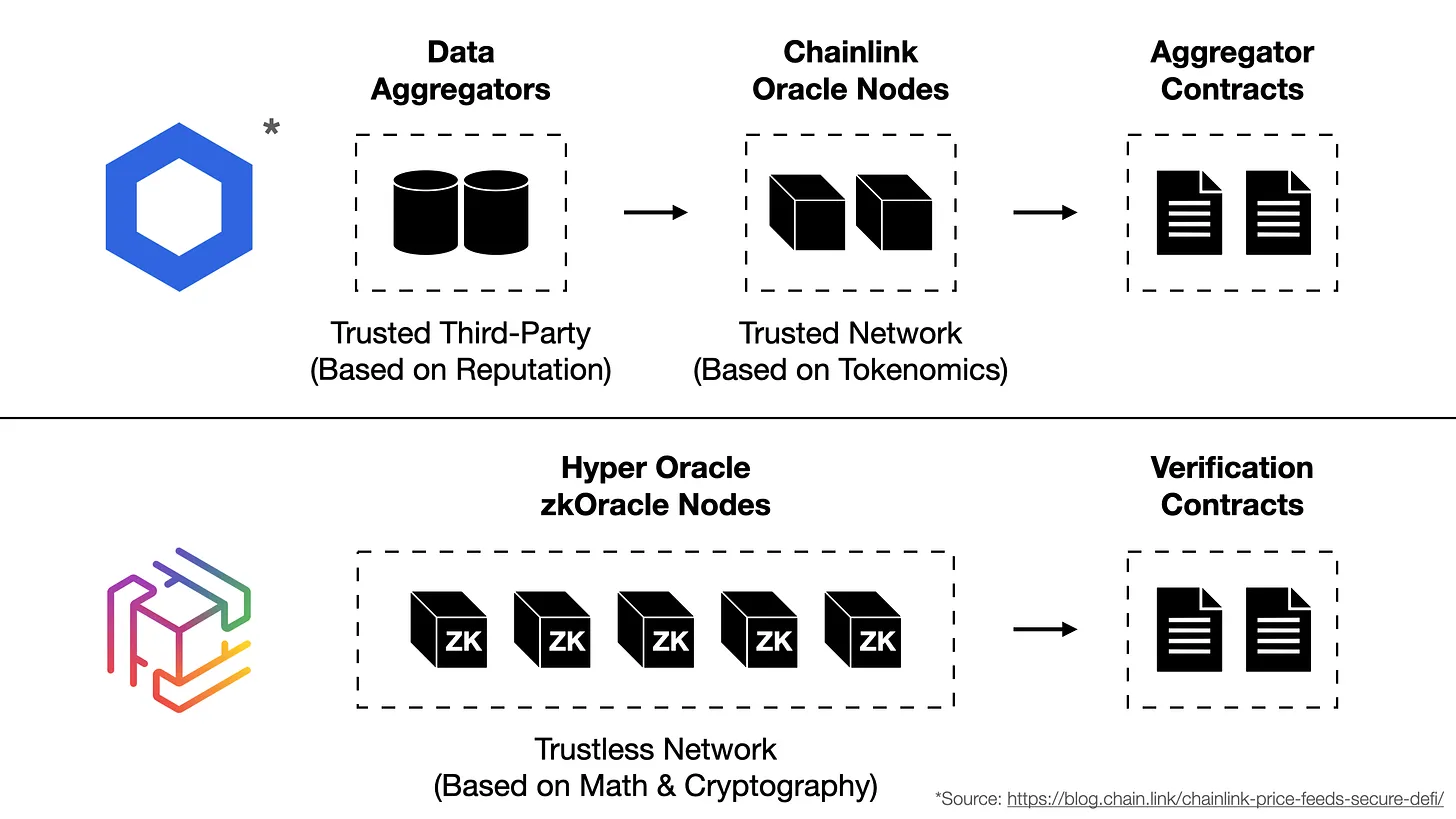
Source:Hyper Oracle
Comparison Between HyperOracle and Knowledge Graphs Technologies
By adopting zkWASM technology, HyperOracle distinguishes itself from traditional Knowledge Graphs technologies such as The Graph, offering advantages including:
● Enhanced security using zkWASM technology without sacrificing performance.
● Accelerated data requests via zero-knowledge proofs, optimizing response time while ensuring data security and verifiability.
● Secure off-chain automation enabled by programmable zkGraph technology.
● Improved system performance through trustless requests to the nearest zkOracle node.
● Increased confidence in building any decentralized application using zero-knowledge proof technology.
Compared to traditional Knowledge Graphs reliant on conventional indexing methods and lacking decentralized security, HyperOracle offers significant advantages. Traditional approaches may depend on decentralized autonomous organizations (DAOs) or legal documents, introducing uncertainty into automated processes, and often rely on multisig dispute resolution mechanisms with relatively weak security.
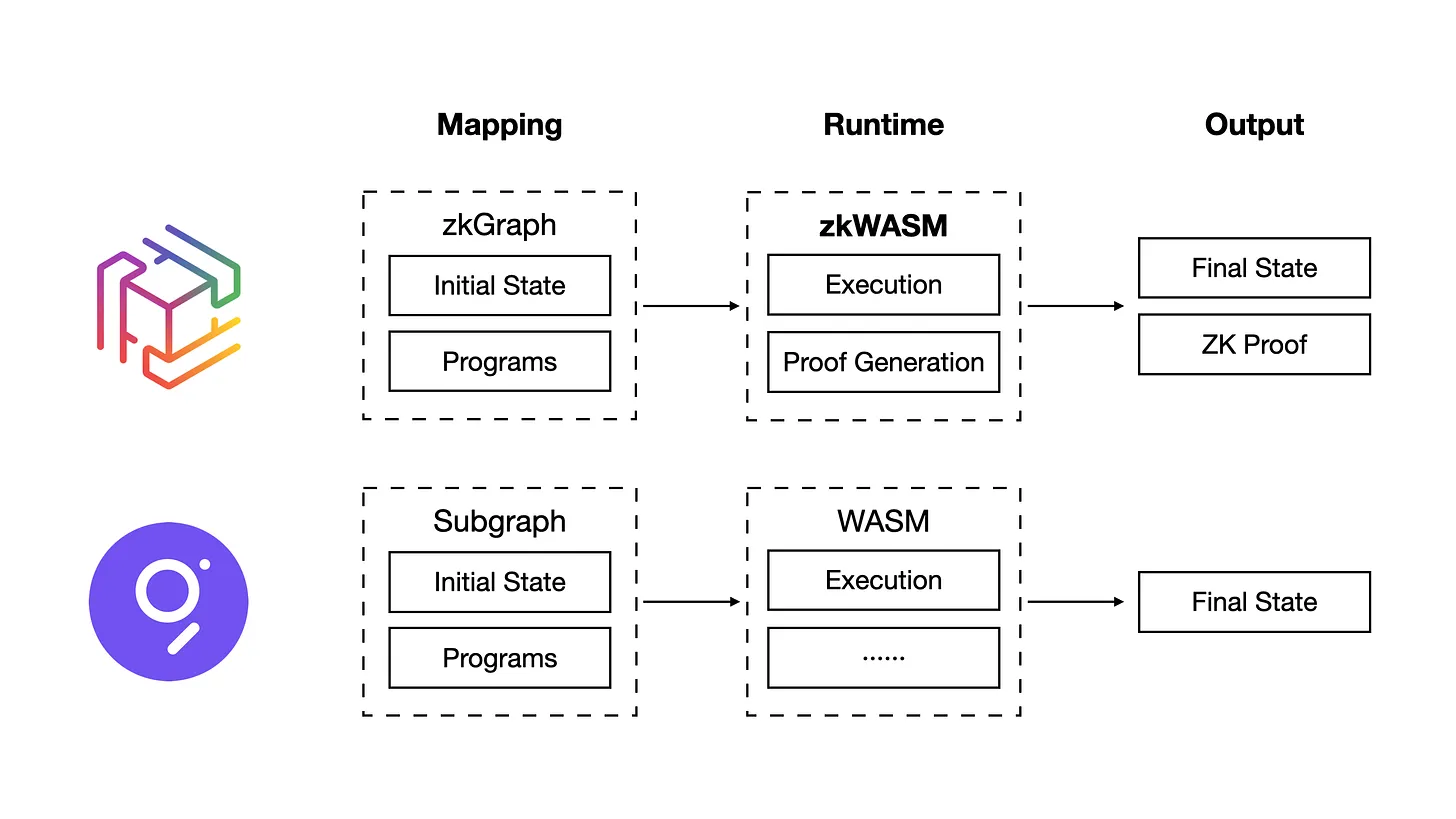
Source: Hyper Oracle
In short, Chainlink and The Graph are networks that integrate data into blockchain applications but cannot fully guarantee data accuracy. Although Chainlink uses multiple data sources and security measures, it is not infallible. These technologies rely on data aggregation and incentive mechanisms to pursue data correctness, but this does not ensure absolute data integrity. HyperOracle believes further technological innovation is required to achieve secure, trustless applications. Therefore, they are developing a network that uses mathematical proofs to rapidly verify data, offering a more reliable solution than traditional trust-based or incentive-driven approaches.
Thought: It is worth noting that the innovative features mentioned in HyperOracle’s whitepaper may face challenges in practical implementation. In contrast, traditional oracle solutions like Chainlink have proven their effectiveness over time. Whether these new features can meet or surpass previous standards remains to be tested by the market.
Comparative Analysis: HyperOracle vs. Modulus Labs
Within this emerging trend and its developing protocols, comparative analysis becomes more complex. For example, Modulus Labs is combining AI and blockchain technologies, leveraging zero-knowledge proofs and machine learning to develop transparent, verifiable AI algorithms for blockchain applications. It adopts specialized strategies, particularly regarding proof generation requirements, and promises to allow decentralized applications to integrate AI and ML technologies without compromising trust or security.
Additionally, Gensyn, another key project in this field, is a blockchain-based AI computing protocol that recently secured $43 million in Series A funding led by a16z.
Bullish Fundamental Factors
● The Hyper Oracle team suggests—though not officially confirmed—that their upcoming token might adopt a Proof-of-Work (POW) mechanism similar to those used by blockchains like Ethereum or Aleo.
● The integration of AI and ML technologies with blockchain opens up promising new frontiers for smart contracts. If Hyper Oracle successfully secures a position in this domain, its valuation could experience substantial growth.
● Technological advancements in opML and zkML show great potential in verifying on-chain computations, effectively addressing existing cost and performance challenges.
● Hyper Oracle has completed a $3 million funding round co-led by Sequoia Capital China Seed Fund and Dao5.
● The project enjoys trust from core blockchain entities such as the Ethereum Foundation, Compound, and Uniswap, possesses a solid development roadmap, and its founder has an outstanding background from Google.
Bearish Factors Analysis
● Hyper Oracle is currently still in experimental stages, lacking empirical evidence of its future effectiveness and performance.
● The efficiency and practicality of off-chain validation mechanisms pose challenges to Hyper Oracle’s opML framework.
● Key elements such as the token economic model remain undefined, making it difficult to assess the project from an investment standpoint.
● The built-in AI system of Hyper Oracle may be complex and difficult to make transparent, increasing difficulty in understanding, explaining, and trusting it.
Conclusion
Greythorn is committed to closely monitoring the latest developments in blockchain and cryptographic technologies. The convergence of AI and blockchain is particularly noteworthy. Traditional smart contracts respond to triggered events based on predefined actions, whereas AI- and ML-integrated smart contracts can make autonomous real-time decisions—an advancement that brings revolutionary expansion to blockchain capabilities.
If you’re interested in further exploration of this topic, we invite you to read our latest research on OLAS.
For more insights and future research articles, please follow us on LinkedIn, X, and Medium, or visit our website for more information.
If you find this information valuable, we welcome your engagement with this article.
Looking forward to hearing from you,
The Greythorn Team.
Join TechFlow official community to stay tuned
Telegram:https://t.me/TechFlowDaily
X (Twitter):https://x.com/TechFlowPost
X (Twitter) EN:https://x.com/BlockFlow_News
 Greythorn