








2024 Solana Chain DePIN Ecosystem Full Analysis: Which Projects Are Worth Watching?
TechFlow Selected TechFlow Selected
2024 Solana Chain DePIN Ecosystem Full Analysis: Which Projects Are Worth Watching?
Solana is undoubtedly the most suitable public blockchain for DePIN at present.
 Navigating Web3 tides with focused insights
Author: Yash Agarwal
Translation: TechFlow
Introduction
“Solana is the DePIN chain” — in other words, Solana is undoubtedly the leading public blockchain for DePIN today. This dominance story began when Helium, the largest DePIN project, migrated from its own L1 to Solana in Q2 2023.
Today, Solana hosts industry leaders like Helium, Hivemapper, and Render—imagine them as the FAANG of the DePIN world—with Solana-based DePIN projects collectively representing over $10 billion in fully diluted valuation (FDV) and more than $4 billion in market capitalization!
Solana’s comprehensive infrastructure and developer community are now attracting DePIN projects at every stage of their lifecycle. While Solana is a general-purpose chain with thriving DeFi and NFT ecosystems, its emergence as the leader in the DePIN category is particularly striking. Many view DePIN as one of the most compelling investment theses within the Solana ecosystem, thanks to its massive TAM (total addressable market) and Solana’s first-mover advantage in DePIN.
Messari estimates DePIN’s total TAM exceeds $2.2 trillion, projected to reach $3.5 trillion by 2028. This forecast assumes that much physical infrastructure will be token-incentivized, which may inflate the figures. Nonetheless, it represents one of crypto’s boldest bets.
In this article, we’ll briefly explore what DePIN is, examine why DePIN projects choose Solana, discuss key Solana-based projects, and conclude with key themes to watch in Solana and DePIN. By the end, you’ll have all the essential insights into Solana DePIN.
What is DePIN and Why It Matters
DePIN, or “Decentralized Physical Infrastructure Networks,” consists of token-incentivized networks. They use cryptoeconomics to align incentives and encourage individuals to allocate their capital or unused resources. From Bitcoin to Solana, we’ve seen tokens prove to be a powerful mechanism for coordinating large-scale human activity and fostering tribalism.
According to Messari, the DePIN ecosystem grew to over 650 projects in 2023, spanning six subcategories: computing (250), AI (200), wireless (100), sensors (50), energy (50), and services (25).
Like any network, DePIN has both supply and demand sides. We’ll explore both aspects for each project in this article.
Supply Side: Token Incentives
The supply side of DePIN is driven by crypto incentives to coordinate capital, equipment, and labor to scale global infrastructure. According to Messari, DePIN added over 600,000 nodes (supply-side) across wireless, computing, and sensor networks in 2023. For Helium, this means adding more hotspots; for Hivemapper, it means contributing more map data.
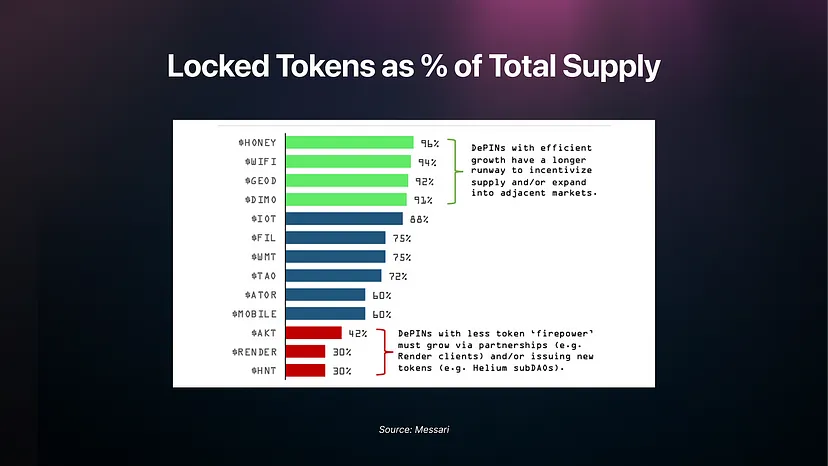
To date, DePIN has proven highly effective at scaling supply. However, capital efficiency—how many tokens are used to grow supply—will determine long-term sustainability. Tokenomics can be based on various parameters, such as:
-
Time-based: Helium undergoes a halving every two years
-
KPI-based: Hivemapper’s tokenomics are tied to the percentage of global roads mapped, with city-level multipliers and time-based KPIs, making its token model quite detailed
-
Demand-based: Based on consumer usage of the network
Clearly, tokens as a product are crucial to the functioning of any DePIN network. Since tokens can only be issued once, token issuance management becomes critical. Additionally, token price (and thus speculation) plays a significant role, making the system cyclical.
Recently, non-DePIN projects have begun using “points” instead of directly distributing tokens to drive protocol adoption—a trend that could also gain traction in DePIN (more on this later).
Demand Side: B2B vs. B2C
While supply is token-incentivized, speculation plays a big role. The demand side, however, is entirely driven by real-world utility—unaffected by cycles—and generates revenue, which in turn supports token value.
Since much of the demand is off-chain—for example, Web2 companies using Hivemapper maps—revenue generated on-chain and off-chain differs. For instance, Hivemapper customers pay in fiat, contributing to off-chain revenue, while their native token HONEY is burned, contributing to on-chain revenue.
Beyond demand, on-chain revenue is significantly influenced by buyback mechanisms (using fiat or stablecoins to purchase the native token). Are these tokens burned or locked? Is the buyback decision based on a percentage of revenue or profit?
Many DePIN projects, like Render, use a model called Burn and Mint Equilibrium (BME) to balance payments and rewards. Here’s how it works:
Customers want to pay in USD, but the network needs to distribute a fixed number of governance tokens periodically. In the BME model, customer payments in USD are converted behind the scenes into the network’s native token, e.g., $RENDER. During each cycle (called an epoch), GPU providers or node operators earn credits based on the work they complete.
At the end of each epoch, operators receive $RENDER tokens as rewards proportional to their share of total work completed on the network. The $RENDER tokens paid by customers and the credits accumulated by node operators are then “burned” (removed from circulation). New $RENDER tokens are created according to a predefined inflation schedule and distributed to node operators as income.
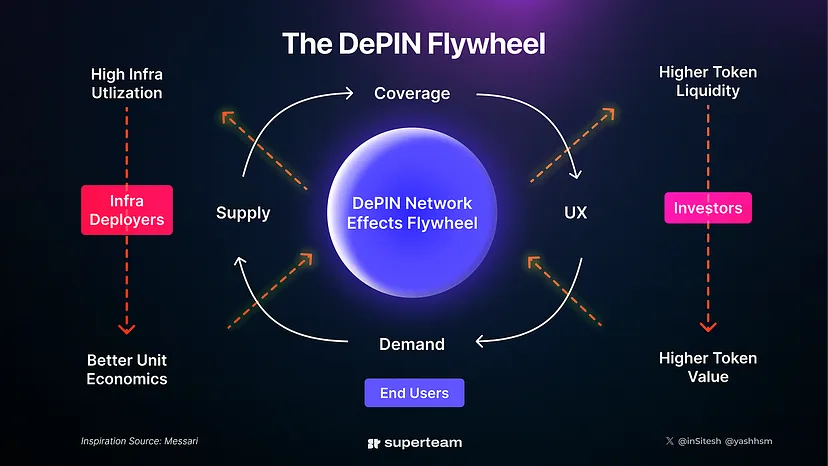
Additionally, demand can be categorized as B2B or B2C. For Hivemapper, demand is B2B—used by enterprise clients needing map data. For Helium, demand is B2C—used by consumers who need connectivity.
Why Solana Has Become the Hub for DePIN Projects
DePIN prioritizes high throughput and low fees. While I hold a bias toward Solana as the most efficient blockchain, here are several reasons why DePIN teams choose Solana:
-
Performance: Solana stands out with low transaction costs, high processing speed, and scalability—no surprise. Low fees are crucial for incentivizing mass contributors and enabling micropayments. Moreover, Firedancer, launching later in 2024, will further enhance network speed and resilience.
-
Network Effects: Helium’s migration from its native blockchain to Solana marked a pivotal moment for the Solana DePIN community. They developed open-source tools that other DePIN projects can leverage. From a business development standpoint, the presence of an existing DePIN project community is advantageous. Unlike DeFi, where capital network effects explain EVM’s dominance in TVL, DePIN projects don’t experience the same level of capital network effects—especially since most demand is generated off-chain.
-
Strong Token Standards and Ecosystem: A vibrant ecosystem with battle-tested DEXs and established standards like cNFTs (compressed NFTs), pNFTs (programmable NFTs), and Token Extensions provides DePIN projects with essential building blocks for developing and launching their on-chain products.
-
Solana Mobile: Solana’s unique ownership of its own phone highlights its commitment to mobile integration. Solana Mobile 1 already has 20,000 users, and Solana Mobile 2 has over 50,000 pre-orders. This offers DePIN projects a direct distribution channel to overcome initial user acquisition challenges. For example, Helium offered free one-month access to Solana Mobile users, and projects like Grass can launch their apps directly on Solana Mobile.
-
Solana Foundation: The Solana Foundation is a strong supporter of DePIN, providing dedicated tracks at hackathons, active grants, and more—demonstrating its commitment. Additionally, VCs like Multicoin have played a vital role in bringing DePIN projects to Solana.
Another angle to consider is the value DePIN brings to the Solana ecosystem:
-
Users: Projects like Helium significantly increase the number of active wallets. Helium alone reports over 60,000 monthly active wallets participating in activities like claiming, staking, delegating, or burning tokens, plus over 30,000 wallets using other SPL programs—highlighting Helium’s impact on Solana.
-
Legitimacy and Branding: From a regulatory perspective, DePIN demonstrates real-world applications of Solana to regulators and policymakers, enhancing its legitimacy and brand.
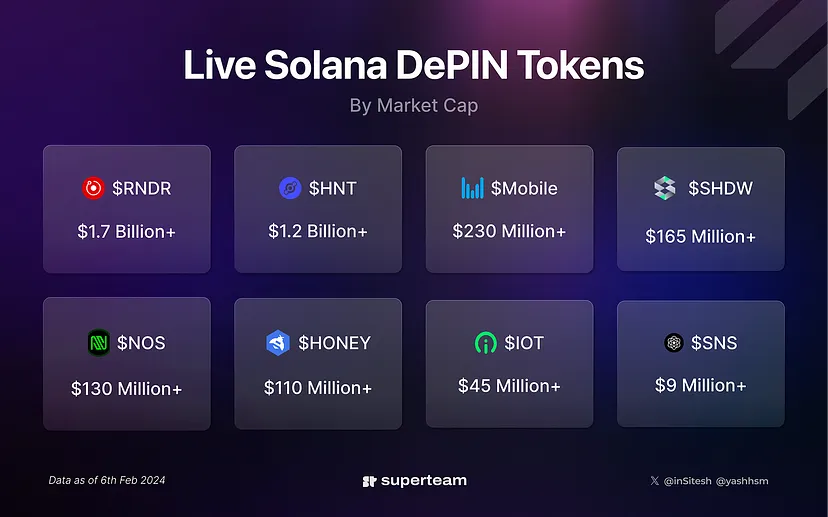
DePIN Projects on Solana
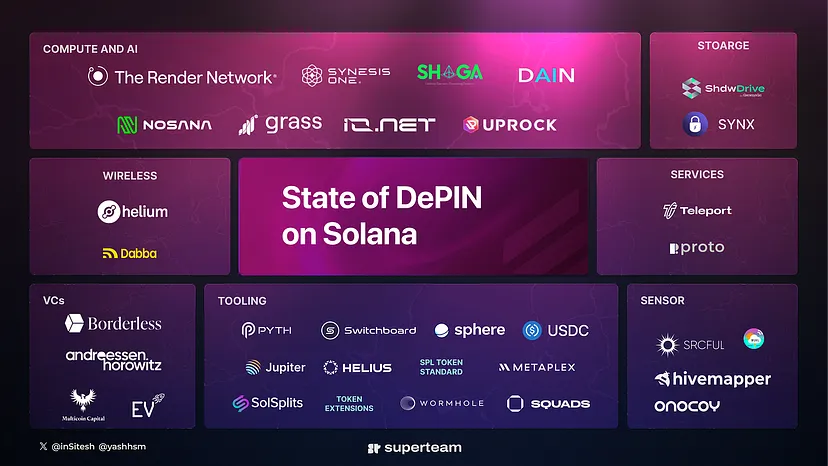
Let’s look at different DePIN projects across categories on Solana:
1. Wireless Networks
Also known as DeWi (Decentralized Wireless) networks, this approach involves setting up various types of wireless networks, such as:
-
Cellular 5G: Offers high download speeds and low latency.
-
WiFi: Provides internet connectivity for specific areas.
-
Low-Power Wide-Area Network (LoRaWAN): Enables communication for Internet of Things (IoT) devices.
-
Bluetooth: Facilitates short-range data transmission.
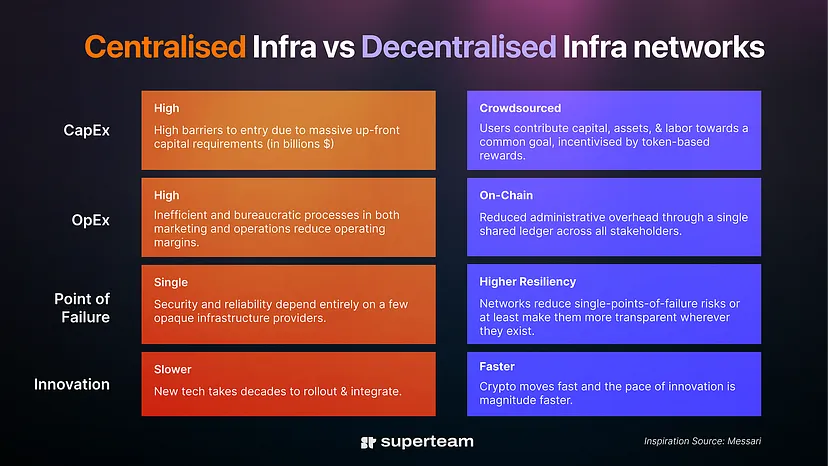
The problem it solves: Traditionally, building wireless infrastructure requires massive investment, leading to dominance by a few large telecom companies with the necessary scale and financial resources.
DeWi networks offer an alternative by allowing many independent entities or individuals to collaborate in deploying wireless infrastructure, driven by token incentives.
Helium: The Leader in DeWi
Arguably one of the first major and largest DePIN projects, its migration from its native blockchain to Solana marked a renaissance for Solana’s DePIN ecosystem. The network is governed by HNT, Helium’s native token, which plays a crucial role in facilitating network usage by being burned to obtain “Data Credits” for data transmission. Hotspot hosts can also exchange network tokens (e.g., IOT, MOBILE) for HNT.
It offers two main services:
-
Helium IoT: Launched in 2019, Helium hotspots provide wireless connectivity for IoT devices. Governed by $IOT, Helium IoT’s token is mined through data transmission revenue and Proof-of-Coverage via LoRaWAN hotspots.
-
Helium 5G Network: This network combines large-scale carriers with crowdsourced 5G hotspots. Governed by $MOBILE, Helium 5G rewards those who provide 5G wireless coverage and validation for the Helium network.
Supply Side: The crowdsourced model eliminates site acquisition costs and allows users to contribute high-bandwidth coverage. For example, operators interested in joining the network and providing cellular coverage can purchase FreedomFi Gateway hardware and earn MOBILE tokens in return.
With the recent surge in sales of Helium Mobile’s unlimited $20/month data plan—including a free 30-day subscription—the number of new hotspots added to the Helium network has increased significantly in recent months.
Demand Side: Data consumers pay using Data Credits. As more data is transmitted and more Data Credits are consumed, subnetworks (e.g., IoT network) earn more HNT tokens, rewarding and incentivizing participation.
Overall, HNT is the primary token, while IOT and MOBILE are sub-DAO tokens linked to HNT.
WiFi Dabba: Helium for WiFi in India
Similar to Helium, but focused on consumer WiFi in India. Although mobile data prices in India are relatively low, they have recently risen, creating challenges for traditional telecoms in expanding WiFi infrastructure. WiFi Dabba aims to deploy WiFi in high-density residential areas. Backed by top-tier VCs like Y-Combinator, Multicoin, and Borderless, WiFi Dabba is set to launch on Solana, offering tokens as incentives for installing WiFi hotspots.
Demand Side: Unlike most decentralized peer-to-peer networks, Dabba starts by solving demand—customers pay for the service provided.
Supply Side: Dabba will empower local cable operators (LCOs) across India. With about 150,000 LCOs nationwide, the project has already started pilot training with the top five.
2. Storage Networks
Decentralized storage systems operate on a peer-to-peer network model, allowing users to act as storage providers or miners, allocating unused resources and earning tokens as incentives.
The problem it solves: It encrypts and shards data, distributing it across the network to enhance security. The system is supported by on-chain components offering features like permanent, encrypted, and verifiable storage.
ShdwDrive by Genesys: A Better Filecoin on Solana
Shdw Drive competes with Filecoin, leveraging high-performance traditional and mobile computing to reduce enterprise-grade data center storage costs, calling this technology “D.A.G.G.E.R.” Its native token $SHDW pays for services within the ecosystem, with additional mechanisms like staking, halvings, vesting, and recycling.
Supply Side: Supported by Shdw Operators who provide storage.
Demand Side: Projects can use Shadow for cloud services such as:
-
Web hosting and content management (file storage)
-
Social media platforms (immutable logs)
-
Archival purposes (preserving valuable records)
-
Datasets (on-chain libraries accessible network-wide)
-
Personal and editable storage space (a personal alternative to Google Drive)
Synx is a private cloud storage solution supported by mobile and desktop apps, built on ShdwDrive.
3. Sensor Networks
Facilitate monitoring and data capture, such as:
-
Environmental: Weather conditions
-
Mobility: Traffic or vehicle-related data
-
Location and mapping: Street-level maps
The problem it solves: By adopting a bottom-up approach, decentralized sensor networks reduce the risk of data manipulation or censorship, enhancing reliability.
Hivemapper: Mapping and the Fastest-Growing DePIN
Hivemapper is a global mapping network that uses dashcams to collect fresh, high-resolution data (4K street-level images) in a permissionless manner. It’s governed by the $HONEY token. Over 50,000 contributors—including ride-share drivers, delivery drivers, and enthusiasts—have collectively mapped over 125 million kilometers of roads!
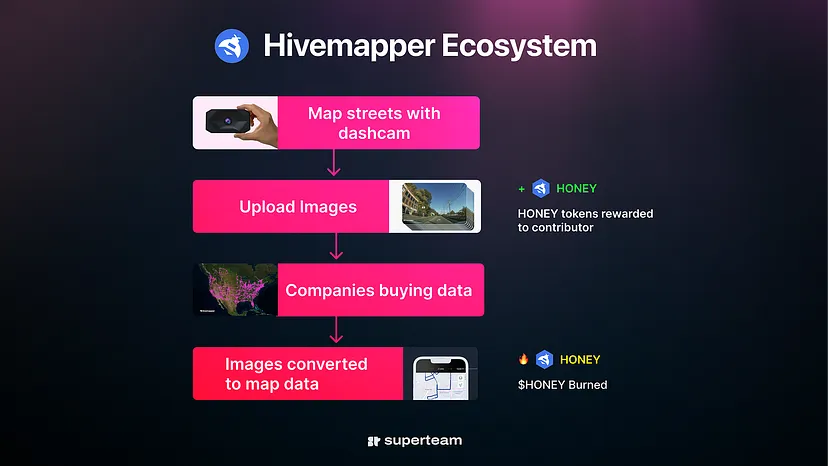
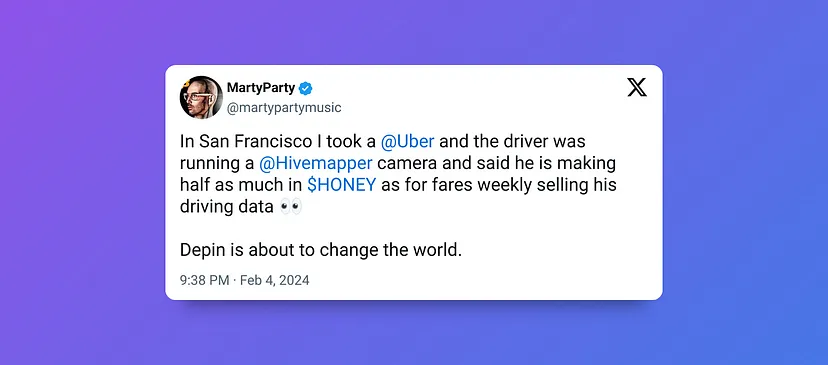
Supply Side: Hivemapper offers dashcams priced between $300 and $650, rewarding contributors with $HONEY tokens for sharing video and metadata. This model allows contributors to share in the value generated by demand for map data, incentivizing network expansion. In 2023 alone, the Hivemapper community mapped over 10% of global roads while using less than 5% of the total token supply.
Hivemapper’s AI training community adds another layer, where participants earn $HONEY by accurately classifying map features and converting them into valuable information for customers.
Demand Side: Companies pay in HONEY to access map images and data. They can also purchase existing maps or reward bulk mapping of new areas, enabling companies to request fresh data on demand. This process burns $HONEY tokens—about $250,000 worth so far.
Overall, the rapid feedback loop between map contributors incentivized by tokens and map customers is key to creating highly useful digital maps.
Onocoy: An Emerging Location-Based DePIN
GPS satellites work well for many location use cases and help determine position, but lack high precision. To improve accuracy, additional sensors like RTK (Real-Time Kinematic) use ground receivers to boost GPS precision from meter-level to millimeter-level.
Supply Side: To build robust supply and ensure wide coverage, Onocoy plans to incentivize deployment of these relatively expensive RTK receivers. Currently in beta, the project already has over 2,000 participants. New users are encouraged to identify and map uncovered areas, with an incentive structure designed to reduce rewards in areas with overly dense signals (three overlapping signals).
Demand Side: High-quality positioning data is valuable for deformation monitoring, agriculture, mining, natural disaster alerts (tsunami/earthquake), drone/robot navigation, and autonomous driving. Like others, Onocoy uses a BME model, allowing customers to pay in cash while network participants earn $ONO tokens proportional to their contribution.
WiHi: Weather and Climate Forecasting
Large-scale weather monitoring has been practiced since 1873, initiated by the founding of the International Meteorological Organization for this precise purpose. Today, weather data sharing involves a complex network of public and private entities. These organizations operate various sensor networks, develop weather models, and provide forecasts. WiHi aims to become a unified platform connecting all these entities, simplifying data sharing, improving forecast accuracy, and enhancing climate monitoring.
Supply Side: Any entity operating weather sensors can apply to contribute data to WiHi. An interesting possibility is the potential use of Solana Mobile for weather data collection. Though mobile phones are relatively low-quality sensors, their sheer numbers can compensate for this limitation.
Demand Side: Accurate weather data is highly valuable to financial firms and insurers, who benefit from precise forecasts. Additionally, WiHi aligns with the growing ReFi narrative, aiming for real-time climate change monitoring.
Another upcoming project on Solana is Srcful, aiming to enable the creation of decentralized energy networks. It allows homeowners to participate in the energy transition and get rewarded for their contributions.
Solana Mobile could be another interesting DePIN play in the future, as phones are powerful sensing machines. Other chains host projects like Silencio, which collects noise pollution data from any smartphone.
4. Computing and AI Networks
Cryptoeconomically-backed computing networks allow unique scaling up and down of compute resources on demand, without the overhead or contract lock-ins associated with centralized providers.
The problem they solve: Demand for computing power is at an all-time high—driven entirely by AI. Due to uneven distribution, users seeking compute find it hard to access machines. Here, DePIN acts as a marketplace where hardware owners lend compute power to users who want to utilize it. Akash (built on Cosmos) is the leader in this category, serving as a general-purpose CPU/GPU computing network.
Render: Airbnb for GPUs
One of the oldest computing networks, it provides a GPU network for 3D artists to render graphics for games or films. The network offers a software suite called Octane, allowing 3D artists to outsource rendering tasks to the GPU network.
Originally an Ethereum project, Render recently moved to Solana—a move widely seen by the community as a major upgrade. Additionally, Render has expanded its offerings into AI/machine learning and spatial computing, creating a highly positive narrative.
Supply Side: Miners can apply to become Render nodes and rent out idle GPU compute power.
Demand Side: Artists upload files and select rendering options. Render focuses on three areas:
-
AI: Compute clients like io.net
-
Spatial: e.g., Sphere Las Vegas projection and Vision Pro spatial computing
-
Multi-render: Integrations like Cinema4D
Io.net: GPU Aggregator
Io.net is building a network that aggregates compute power from data centers, crypto miners, and established projects like Render to serve machine learning applications, positioning itself as a “GPU aggregator.” Unlike traditional GPU aggregators that offer only single-instance access without clustering capability, io.net is pioneering the creation of clusters composed of thousands of GPUs. These clusters function as unified instances specifically designed to handle machine learning workloads.
Supply Side: As an aggregator, anyone can connect their hardware to the network and start earning.
Clients: Anyone wanting to create or run ML models or AI applications is a potential customer. Unlike competitors, launching an io.net instance takes just minutes (demo at Solana Breakpoint 2023).
Nosana: GPU Grid
Nosana is a marketplace connecting users’ provided GPU networks with consumers developing AI products.
Supply Side: Individuals with idle consumer GPUs can become nodes in the Nosana network. Within the Nosana ecosystem, the token $NOS serves as a medium of exchange, allowing consumers to pay for services with $NOS and enabling node operators to stake.
Demand Side: Developers creating AI applications can leverage Nosana’s proprietary AI interface. Integrated with Stable Diffusion and Llama 2 workloads, it offers significant cost savings. According to testnet data, developers could reduce costs by up to 85% compared to traditional cloud providers.
Nosana’s mainnet is expected in Q2 2024, including a full development toolkit for deeper experimentation within the Nosana network.
Grass: Crowdsourced Data Collection for AI
AI training involves processing large datasets, and many AI labs prefer scraping data from the internet rather than relying on manual input. However, most scraped data lacks contextual information like device location. To address this, Grass raised $3.5M in a seed round and built a “data provisioning layer” for decentralized AI.
Supply Side: Individual users can download the Grass browser extension and opt into becoming network nodes. Companies then pay to use these nodes’ idle bandwidth, paying for data access. Backed by a points system, it has grown to over 600,000 users and is rapidly expanding. It hasn’t launched a token yet!
Notably, Grass has begun supporting mobile, starting with Solana phones—a unique feature enabled by the Solana platform.
Demand Side: Web crawlers seeking reliable and verified source data.
Synesis One: Crowdsourced Data Collection for AI
Solves the problem of data for training AI models. Synesis One is a data crowdsourcing platform where anyone can earn $SNS by completing microtasks to train AI.
Supply Side: Contributors can actively choose:
-
Active: Choose a campaign and provide raw data/data labeling/data annotation.
-
Passive: Synesis’s Kanon NFT collection allows users to buy “keywords and earn from Mind AI clients.”
Demand Side: Clients like Mind AI.
UpRock: Bandwidth for AI
UpRock is a mobile-first platform that creates auto-earning wallets for users through token rewards, with additional yield from auto-staking. Beyond just earning tokens, users can redeem them for flights, call time, etc. It already serves a growing user base with 160,000 installs, adding about 10,000 users weekly and processing over 16 million transactions!
Supply Side: UpRock taps into the untapped potential of user bandwidth as a resource for AI. By contributing unused internet capacity, users earn tokens, democratizing the creation of data value. This strategy not only incentivizes participation but also supports ecosystem growth by enhancing AI agents and specialized models.
Demand Side: Demand for the UpRock network comes from companies seeking unique IP addresses to access real-time, uncensored data crucial for AI agents. More than just a wallet, UpRock is evolving into an AI agent capable of conversational support, explaining complex crypto concepts, and facilitating Web3 logins.
Hyperdrive Hackathon Winners: Shaga and DAIN
Shaga (PC lending), winner of the Solana Hyperdrive hackathon, is another project to watch as it attempts to solve cloud gaming. Historically, cloud gaming has largely underperformed due to costly services and latency issues accessing servers. Shaga better mitigates these costs and delays by trustlessly lending personal computers at a local level.
DAIN Protocol (AI agents), another upcoming project, seeks to solve autonomous agents. It builds an ecosystem and platform for anyone to create and deploy AI agents on the internet. These agents can connect to any device and conduct business securely and transparently using blockchain. Integration with Solana provides identity and reputation support for agents, supporting era scoring and reward systems to encourage high performance. Through secure agent-to-agent (A2A) communication, DAIN ensures tasks—including payments and transactions—are completed meaningfully.
5. Services
Teleport: Tokenized Uber
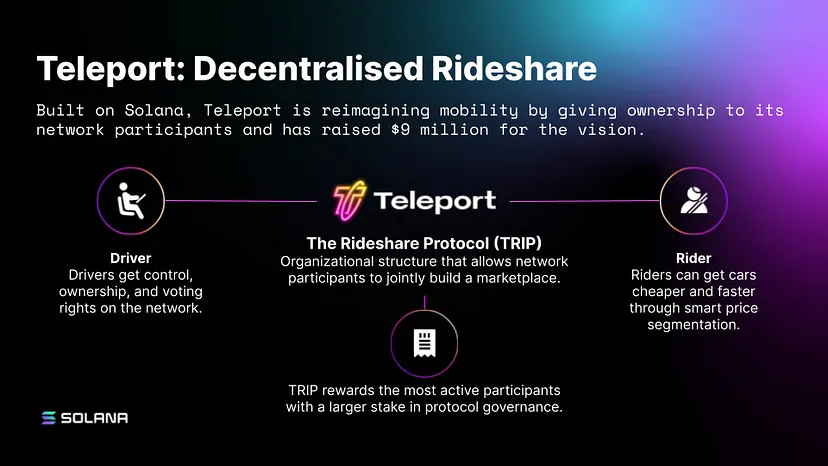
Teleport (raised $9M) resembles Uber but is driven by token incentives. Drivers and passengers are tired of Uber, lacking effective coordination mechanisms.
Teleport calculates the minimum density required to launch services in new cities, then incentivizes drivers and passengers to register before launch.
Proto:
Proto is a user-generated, token-incentivized world map that lowers barriers to entry and unit costs associated with map creation. It delivers high-quality, frequently updated data from around the globe.
Supply Side: Users contribute map data via the app to earn rewards. Currently, the project is focusing on India, especially Mumbai and Bangalore.
Demand Side: Proto SDK enables enterprises to access accurate, real-time map data for various needs, including navigation and digital marketing.
6. DePIN Infrastructure
Tools enabling DePIN on Solana:
-
Payments:
-
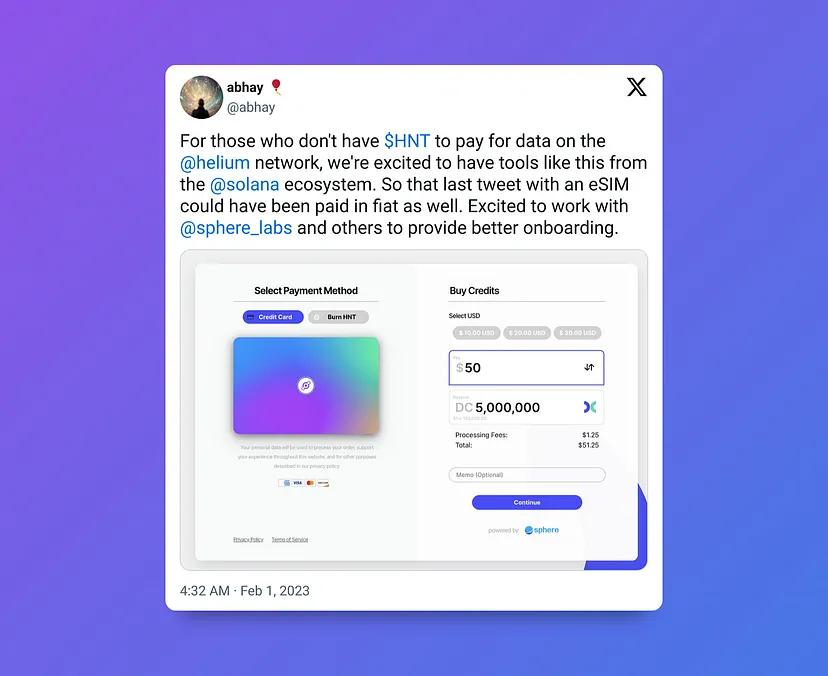
Sphere: Has become the go-to payment gateway for DePIN projects, powering top projects like Helium and ionet. For example, Helium uses Sphere to recharge DePIN compute credits.
Join TechFlow official community to stay tuned
Telegram:https://t.me/TechFlowDaily
X (Twitter):https://x.com/TechFlowPost
X (Twitter) EN:https://x.com/BlockFlow_News
 @yashhsm


