Detailed Explanation of Metis: The First Decentralized PoS Sequencer in Layer2
TechFlow Selected TechFlow Selected
Detailed Explanation of Metis: The First Decentralized PoS Sequencer in Layer2
Metis has emerged as the most talked-about layer2 dark horse, thanks to its astonishing price surge.
 Navigating Web3 tides with focused insights
By: Daniel Li
The Ethereum ecosystem has long faced scalability challenges, and the rise of Metis is bringing a fresh solution to this issue. As an emerging Layer 2 scaling solution for Ethereum, Metis has recently achieved remarkable milestones—particularly its planned launch of the first decentralized PoS sequencer in Q1 2024—which has sparked significant market attention.
Market sentiment toward Metis’s future remains largely positive, reflected clearly in its native token METIS, which also serves as the network's Gas Token. Over the past three months, METIS has surged over 800% in value. Meanwhile, Metis’s Total Value Locked (TVL) has surpassed that of comparable projects twice, establishing it as the third-largest Layer 2 network after Arbitrum and Optimism.
Metis’s rapid ascent is no accident. Beyond its decentralized PoS sequencer and Gas Token model, strategic initiatives by the project team have played a crucial role. On December 18, the MetisDAO Foundation—the development organization behind MetisDAO—announced the creation of a $110 million ecosystem development fund. This move further enhances the efficiency and transparency of the Metis network while opening new growth opportunities for its ecosystem.
01 Three-Month Surge Exceeds 8x—Metis Rises Into Spotlight
With the upcoming activation of Ethereum’s Cancun upgrade, market focus has temporarily shifted from Bitcoin spot ETFs to the Layer 2 landscape. Among the many standout Layer 2 tokens, METIS stands out due to its astonishing price surge—rising from around $15 in early October to a high of $120, marking gains exceeding 800%. It has now become one of the most watched dark horses in the current Layer 2 space.
Beyond token appreciation, Metis’s Total Value Locked (TVL) has grown rapidly, surpassing Base twice within the past two months. According to data from L2BEAT, as of January 17, Metis’s TVL exceeded $960 million, with a weekly increase of over 50%, positioning it close to becoming the third Layer 2 network to break the $1 billion TVL threshold.

Metis’s explosive growth has drawn strong market interest, but also some controversy. Just three months ago, Metis was merely an Optimistic Rollup-based Layer 2 solution, far less known than other major L2 networks like Arbitrum, Optimism, and Base—and even less prominent than zkSync, Starknet, or Linea.
As such, some investors suspect coordinated manipulation behind METIS’s rally. According to observations by an on-chain data analyst, 11 addresses have been flagged as potential market makers or whales manipulating METIS. These addresses deposited large amounts of METIS tokens, and their buying and transfer patterns closely align with fluctuations in METIS’s price. Notably, well-known market maker DWF Labs participated in trading METIS, purchasing substantial holdings at low prices and realizing significant profits as the token appreciated—further supporting suspicions of orchestrated price movements.
Despite concerns about potential manipulation, Metis—as a rising Layer 2 contender—has earned broad recognition for its innovative vision and technical strengths. The sustained price momentum reflects continued investor optimism about METIS’s future trajectory. Notably, METIS has not yet been listed on Binance, suggesting untapped potential for another breakout.
02 Metis: Pioneer of the Decentralized PoS Sequencer
Decentralized sequencers are a core concept in Layer 2 rollups, critical for enabling native DeFi and ecosystem expansion on Layer 2. While the Layer 2 space has seen tremendous progress in recent years with numerous innovative projects, advancements in decentralized sequencers have lagged. Major chains often resist change because accelerating decentralization could introduce risks and challenges to the broader Layer 2 ecosystem and directly impact project revenues. Even leading Layer 2 platforms like Arbitrum and Optimism still rely on centralized sequencers today.
However, blockchain philosophy emphasizes that decentralization is the ultimate goal. Traditional centralized sequencers batch and order transactions before submitting them to Layer 1 for confirmation, enabling high performance and low fees on Layer 2. But centralization brings unavoidable risks of single-point failure or malicious behavior. Therefore, decentralizing the Layer 2 sequencer is essential—and in this area, Metis leads all other Layer 2 blockchains.
Metis is among the first Layer 2 networks to implement a decentralized PoS sequencer, setting a precedent for future development. This framework not only achieves sequencer decentralization but also delivers a PoS-based decentralized Optimistic Rollup solution. Within this model, Metis’s decentralized PoS sequencer comprises three key roles: Admins, Sequencers, and the PoS Consensus Layer.
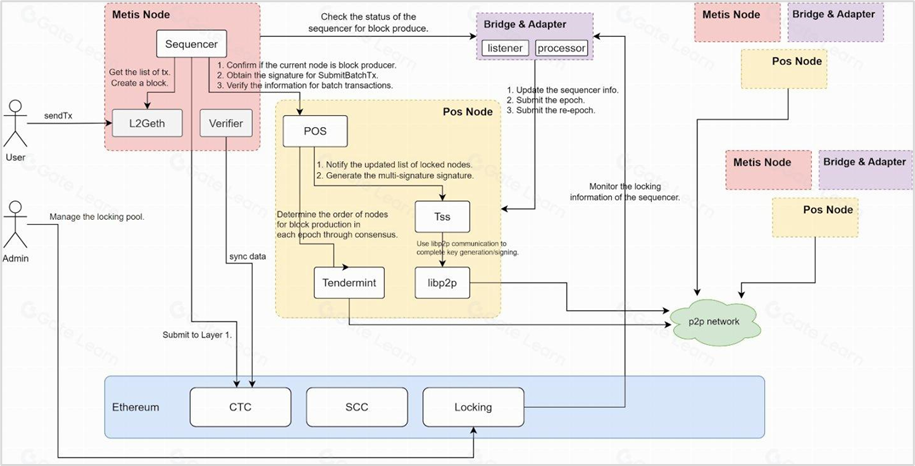
Admins act as managers of the Metis decentralized system, overseeing overall operations. They establish rules, determine which sequencers can participate in transaction ordering and processing, and control processing speed.
The Sequencer Pool forms the core of the system, consisting of a group of verified sequencers. Each sequencer handles different tasks. A key component is L2 Geth, responsible for ordering transactions and packaging them into blocks. There is also an adapter module for interaction with external systems, and a Proposer role tasked with submitting finalized transaction batches to another system.
The PoS Consensus Layer operates independently from Metis and manages signature permissions among sequencers. When a transaction batch is submitted, more than half of the sequencers must sign off to validate it. The consensus layer oversees the joining and exiting of sequencers and ensures secure redistribution of signing rights.
To ensure smooth operation, Metis employs a staking-based incentive mechanism for its decentralized PoS sequencer. Operators of the sequencer pool and nodes in the consensus layer must stake a certain amount of tokens as collateral. If a sequencer behaves dishonestly during transaction processing, others can challenge it. Upon successful challenge, the offending sequencer loses part of its stake. Additionally, to attract broader participation, the Metis ecosystem plans to launch several staking dApps designed for ordinary users who lack sufficient capital to join the sequencer pool directly. In doing so, Metis aims to build a stable, widely participatory, transparently governed, and mutually beneficial decentralized PoS sequencer execution framework.
Currently, Metis’s decentralized PoS sequencer has undergone testing on the Sepolia testnet and officially launched community testing on January 3, 2024. Participants can earn points through test dApps, Learn-to-Earn programs, and other activities. Different point tiers unlock various NFT rewards, which may qualify holders for airdrops during the community test phase. Metis actively encourages broad community involvement to better assess network stability, identify and resolve potential issues, and advance the refinement of its decentralized PoS sequencer solution.
03 Metis’s Unique Approach to Ecosystem Development
Attracting developers, fostering innovation, and growing the ecosystem are universal challenges for any public blockchain. In previous Layer 2 user acquisition battles, each project leveraged its strengths: Optimism attracted users through multiple rounds of airdrops and gradually built its "Superchain" universe using the open-source OP Stack. Arbitrum focused on integrating top-tier DeFi protocols like Uniswap, Aave, Curve, and 1inch to draw in users.
Compared to these established and well-resourced Layer 2 veterans, Metis has relied more heavily on its technological advantages and deep understanding of user psychology to attract a wave of developers and projects to its ecosystem.
First, in terms of cost, Metis leverages its HybridRollups design to deliver efficient and secure transaction experiences. It also integrates MemoLabs, a decentralized storage solution, allowing transaction fees to be dozens of times lower than those on Optimism or Arbitrum—enabling ETH transfers for under $0.01. Although transaction costs will rise slightly when Metis transitions its DA (Data Availability) layer to Ethereum mainnet, they will remain low while significantly improving transaction security.
Second, Metis excels at understanding user needs, employing various strategies to attract users and projects. It has conducted extensive airdrop campaigns and launched its decentralized PoS sequencer community test, offering generous rewards to active participants. Additionally, Metis introduced the Metis Advocates Program, rewarding community members who support its vision and possess content creation skills or social media influence.
Moreover, Metis places strong emphasis on developer experience. By retaining the Optimistic Rollup architecture and ensuring EVM equivalence, it enables seamless migration for a large number of Ethereum developers. Metis also provides comprehensive technical documentation, development tutorials, tools, and hosts dedicated developer communities to foster knowledge exchange. Through bug bounty programs and hackathons, Metis supports developers with funding, technical guidance, and marketing assistance.
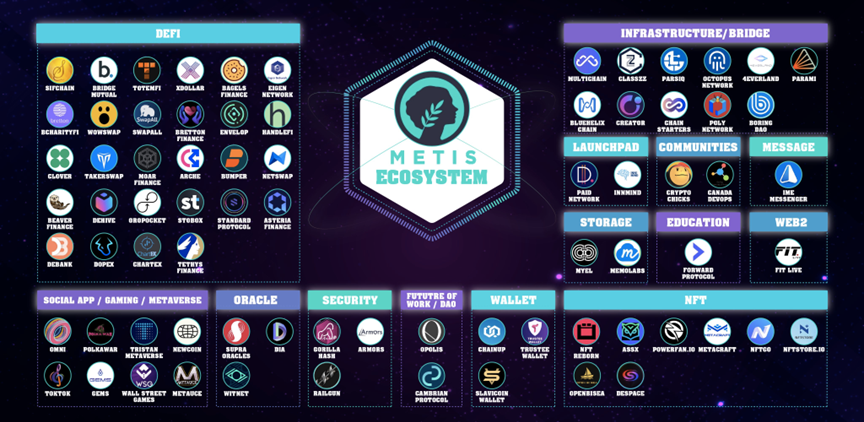
Today, the Metis ecosystem hosts over 100 applications spanning DeFi, wallets, NFTs, and more—including well-known DeFi protocols such as Aave, SushiSwap, and Stargate. From being an obscure Layer 2 chain to ranking third among Layer 2 networks just behind Arbitrum and Optimism, Metis’s rise opens a new path for the Ethereum Layer 2 sector—one long divided between OP Stack and ZK-based solutions. With a combination of technological innovation, incentive mechanisms, and a firm commitment to decentralization, Metis may well pioneer a new narrative in the coming bull market.
Join TechFlow official community to stay tuned
Telegram:https://t.me/TechFlowDaily
X (Twitter):https://x.com/TechFlowPost
X (Twitter) EN:https://x.com/BlockFlow_News