Bankless: Understand Bitcoin Layer 2 Network Stacks in Three Minutes
TechFlow Selected TechFlow Selected
Bankless: Understand Bitcoin Layer 2 Network Stacks in Three Minutes
The PoX consensus mechanism and the upcoming Nakamoto upgrade have positioned Stacks as an innovator at the forefront of Bitcoin.
 Navigating Web3 tides with focused insights
Author: Bankless
Translation: Luccy, BlockBeats
Editor's Note:
Stacks aims to create a platform for exploring more complex and sophisticated utilities denominated in bitcoin, with the ultimate goal of evolving into a true Bitcoin Layer 2 when technological conditions allow.
Bitcoin’s stable performance as a store of value, combined with broader regulatory clarity brought by the approval of BTC ETFs, has collectively increased demand for what Stacks is building: a high-performance, flexible, and secure BTC-denominated environment for developing more advanced Bitcoin applications and achieving a genuine Bitcoin Layer 2.
This vision is steadily progressing. The Stacks development team plans to complete the Nakamoto upgrade before April’s Bitcoin halving event. Bankless dives deep into Stacks’ PoX consensus mechanism and the upcoming Nakamoto upgrade—BlockBeats presents the full translation below:
Stacks is an EVM-compatible Layer 1 blockchain that enables scaling solutions by extending smart contract functionality onto Bitcoin. As such, Stacks is commonly referred to as a Bitcoin Layer 2.
How Stacks Works
The Stacks Network uses a Proof-of-Transfer (PoX) consensus mechanism tightly linked to Bitcoin, enhancing functionality without modifying Bitcoin itself.
PoX adapts the concept of proof-of-burn, involving miners transferring Bitcoin—the base cryptocurrency—to secure the Stacks blockchain and earn rewards. Through microblocks, Stacks further improves transaction efficiency; these microblocks sync with Bitcoin transactions, enabling fast settlement independent of Bitcoin’s block speed.
Notably, Stacks’ upcoming Nakamoto upgrade will introduce faster block production, further decoupling from Bitcoin’s slower block times by creating new Stacks blocks approximately every five seconds. This upgrade will also achieve 100% Bitcoin finality, meaning Stacks blocks are expected to become as irreversible as Bitcoin transactions.
The Pulse of Stacks
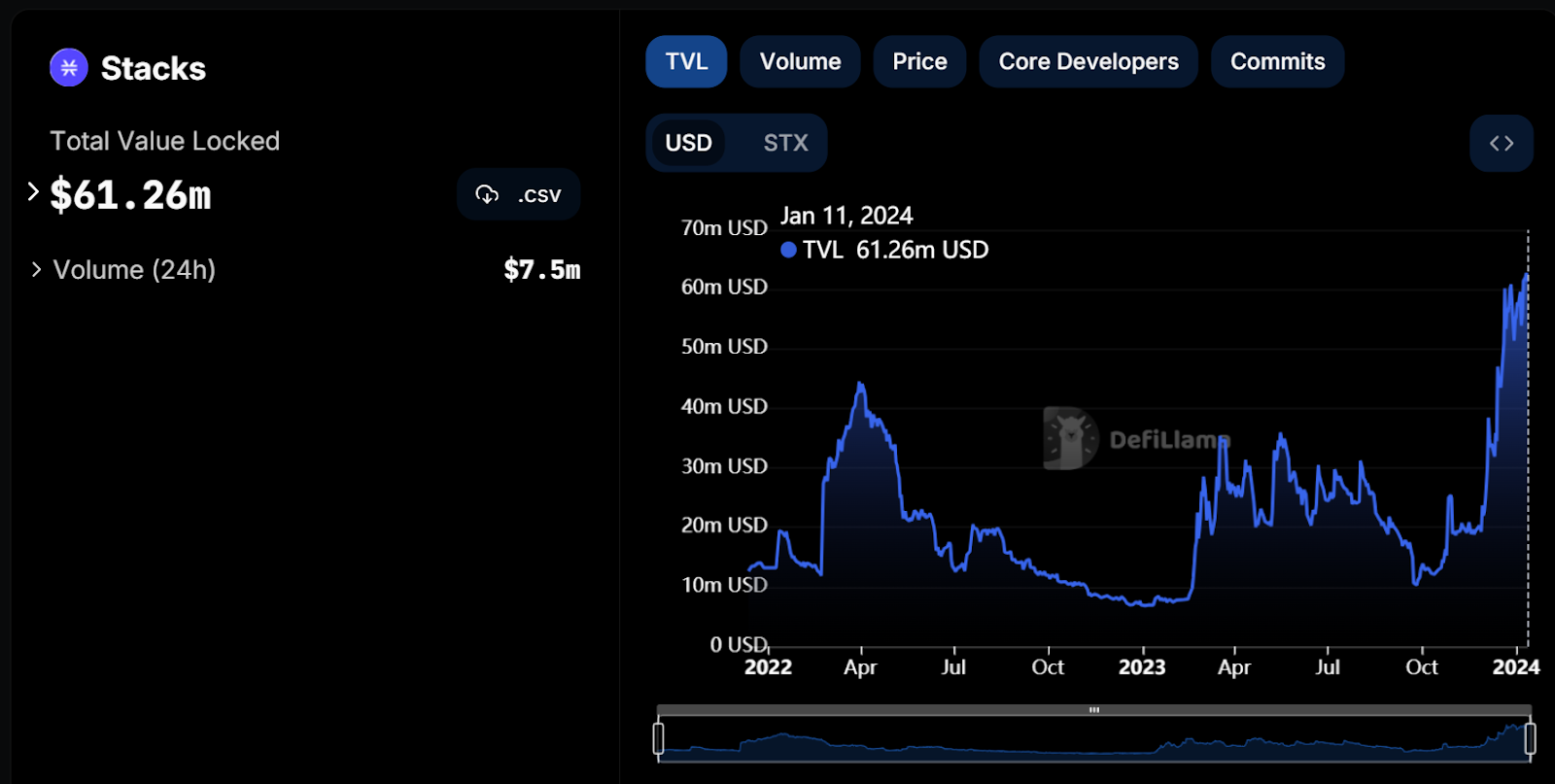
According to DeFiLlama data, Stacks currently ranks 38th in DeFi with a total value locked (TVL) of $61 million. While its use cases remain relatively limited, it includes several NFT projects and DeFi protocols across DEXs, lending, and liquid staking.
Additionally, interest in inscription-style token minting has significantly boosted Stacks activity over recent months. Looking ahead, the upcoming Nakamoto upgrade will make the network more efficient at handling future demand.
$STX Token
Stacks’ native token, $STX, is used to pay transaction fees via the network’s Clarity smart contracts. $STX holders can also participate in the network through a process called Stacking, where they lock tokens and run a full node to take part in consensus and earn Bitcoin rewards.
Regarding mining on Stacks, this process involves using Bitcoin to mine $STX tokens. Miners participate in leader elections on the Bitcoin blockchain, with leaders selected per round via a verifiable random function that gives greater weight to higher $BTC bids. In return, miners receive $STX as transaction fees, while the $BTC they bid is distributed as rewards to $STX holders participating in consensus.
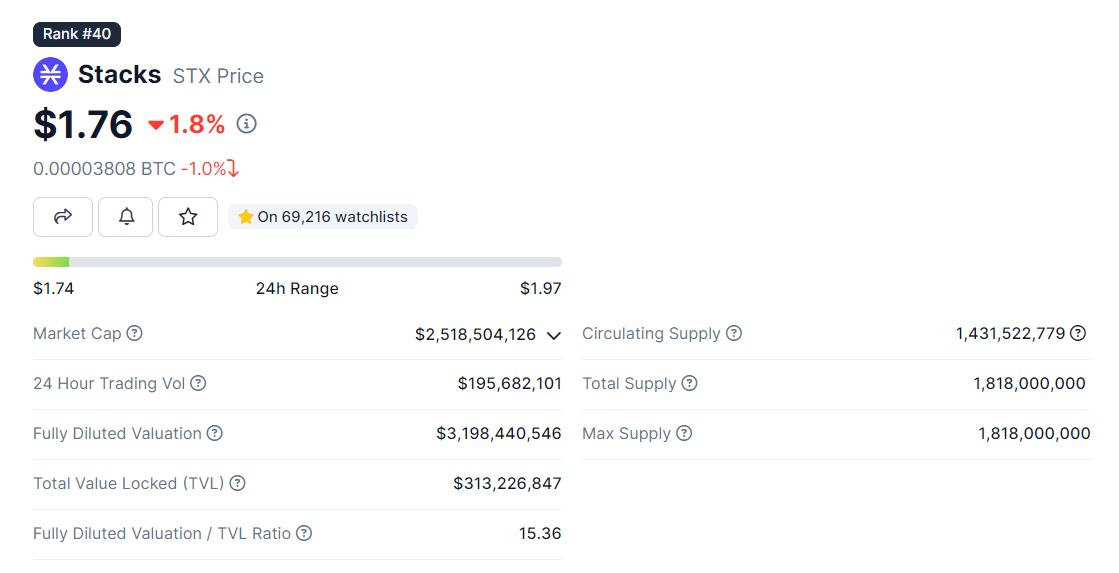
At the time of writing, $STX trades around $1.76, with a market cap reaching $2.5 billion, making it the 40th largest cryptocurrency.
Getting Started with Stacks
To dive deeper into the Stacks ecosystem, the following resources offer helpful starting points:
-
Leather and Xverse: Wallets for managing Stacks assets.
-
Stacks Docs: Official documentation for Stacks.
-
Stacks Explorer: A block explorer for analyzing Stacks data.
-
Stacks Bridges: Repository for Stacks bridging solutions.
-
Stacks Ecosystem: Database of applications built on Stacks.
-
Stacks Stacking: Collection of STX Stacking platforms.
-
STX20: Inscription-style marketplace on Stacks.
-
DefiLlama: Dashboard for Stacks DeFi statistics.
-
Gamma: NFT marketplace for Stacks.
Conclusion
Overall, Stacks is a network designed to combine Bitcoin’s robust security with the flexibility and scalability of Ethereum-like smart contracts.
Throughout its evolution, the PoX consensus mechanism and the upcoming Nakamoto upgrade have been pivotal, positioning Stacks as an innovator at the forefront of Bitcoin. While its DeFi and NFT ecosystems may still be relatively small today, as Stacks continues to grow, it is poised to become a project worth watching in the crypto space.
Join TechFlow official community to stay tuned
Telegram:https://t.me/TechFlowDaily
X (Twitter):https://x.com/TechFlowPost
X (Twitter) EN:https://x.com/BlockFlow_News
 Bankless