








With the arrival of Bitcoin spot ETFs approaching, what is the current state of compliant cryptocurrency products?
TechFlow Selected TechFlow Selected
With the arrival of Bitcoin spot ETFs approaching, what is the current state of compliant cryptocurrency products?
If the SEC approves a spot Bitcoin ETF, the market will gain access to a larger pool of capital with better acceptance.
 Navigating Web3 tides with focused insights
Author: DigiFT
ETF Expectations: The Awakening of the Crypto Market
As cryptocurrencies have gradually entered the mainstream over the past decade, starting with Grayscale's GBTC, the inflow of capital from traditional markets has become increasingly important to the crypto market. The recent market recovery is closely tied to traditional institutions: according to CoinShares’ data on digital asset flows, there has been net positive inflow for over ten consecutive weeks since early October—except for one week in December with minor outflows. Bitcoin’s price has risen from around $25,000 to over $45,000.
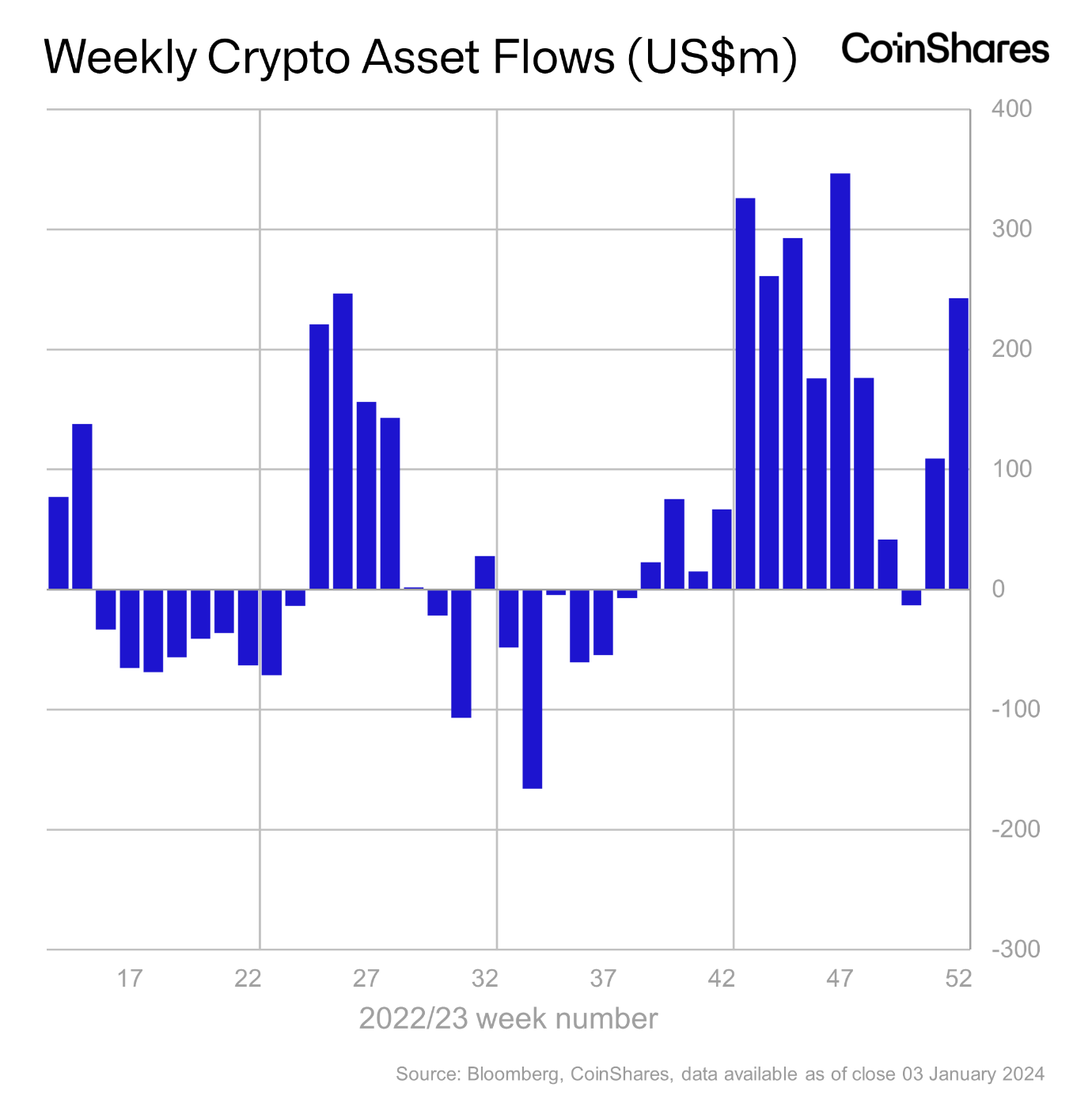
The market widely believes this reflects investor expectations that the U.S. SEC will approve multiple spot Bitcoin ETF applications filed by major traditional asset managers in January. Based on historical ETF approval timelines, the SEC has up to 240 days for final decisions. Hashdex and Ark&21 Shares, among the earliest filers of spot Bitcoin ETF applications, face a mandatory decision deadline of January 10, 2024. If this first spot Bitcoin ETF is approved, it is highly likely that subsequent applications from firms like BlackRock and Fidelity will also be approved.
Even before a U.S. spot Bitcoin ETF is approved, there are already compliant channels for capital markets to gain exposure to crypto assets. As early as 2013, Grayscale’s GBTC launched, allowing investors to purchase shares through traditional brokerage channels and thereby hold Bitcoin indirectly.
Over the past several years, Europe has seen more than a hundred crypto-related ETPs listed on traditional exchanges, enabling regional investors to access digital assets via conventional financial routes. Major asset management firms have also issued spot Bitcoin ETF products in non-U.S. markets—for example, Fidelity launched its spot Bitcoin ETF FBTC on the Toronto Stock Exchange (TSX) in 2021.
Given that access to crypto assets is already available through various channels, why is there so much focus on a U.S. spot Bitcoin ETF? How does this product differ from existing compliant investment vehicles?
Status Quo of Compliant Crypto Investment Channels
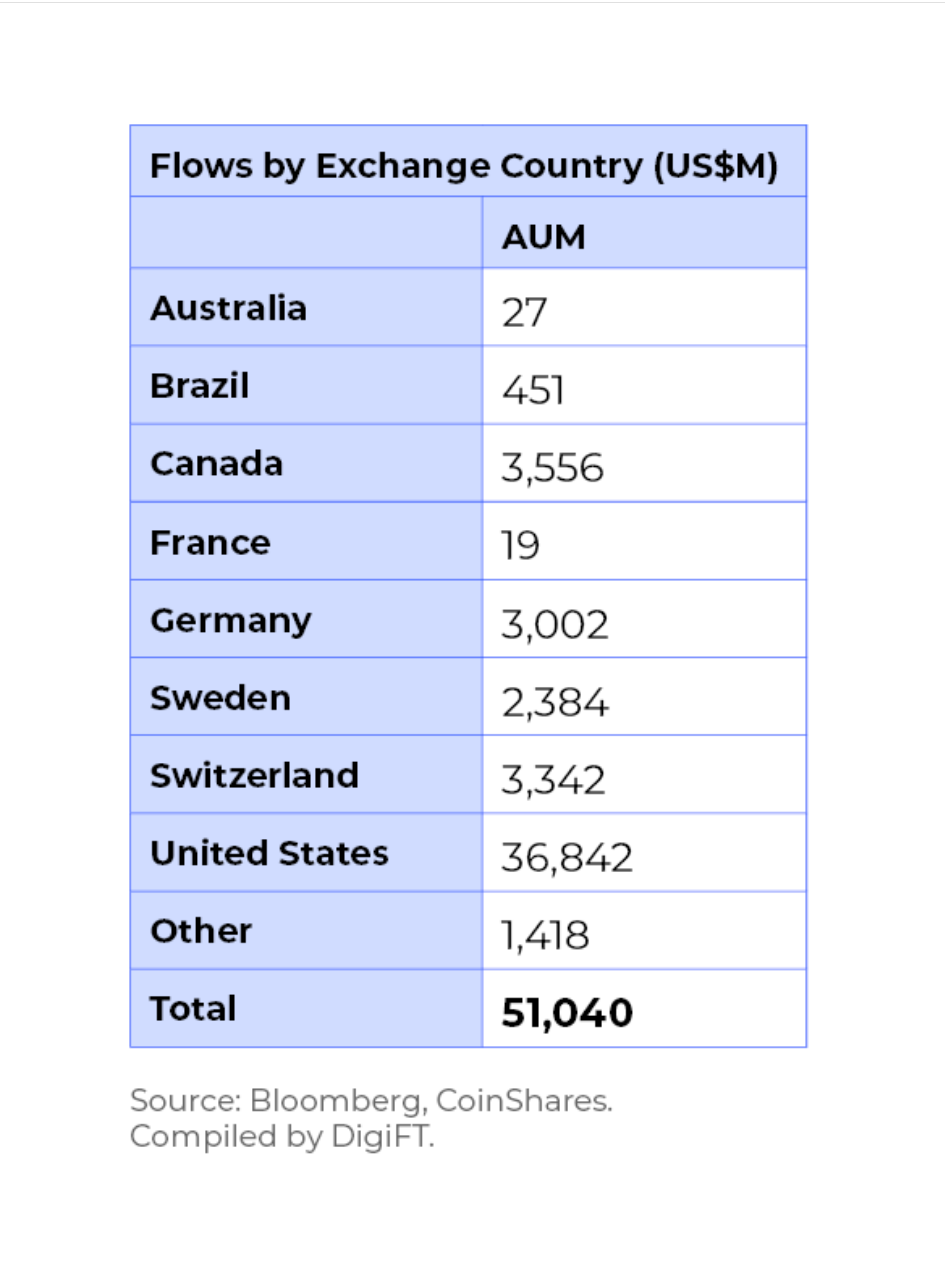
CoinShares, a digital asset issuer, publishes weekly reports tracking global flows into regulated crypto investment products across regions. These data include products offered by major institutions that invest in digital assets and trade on traditional financial platforms—including various ETPs (Exchange Traded Products) and trust instruments. This data reflects institutional and traditional finance capital flows into crypto assets. The latest report covers data up to December 31, 2023. By exchange location, asset management规模 (AUM) per region was:
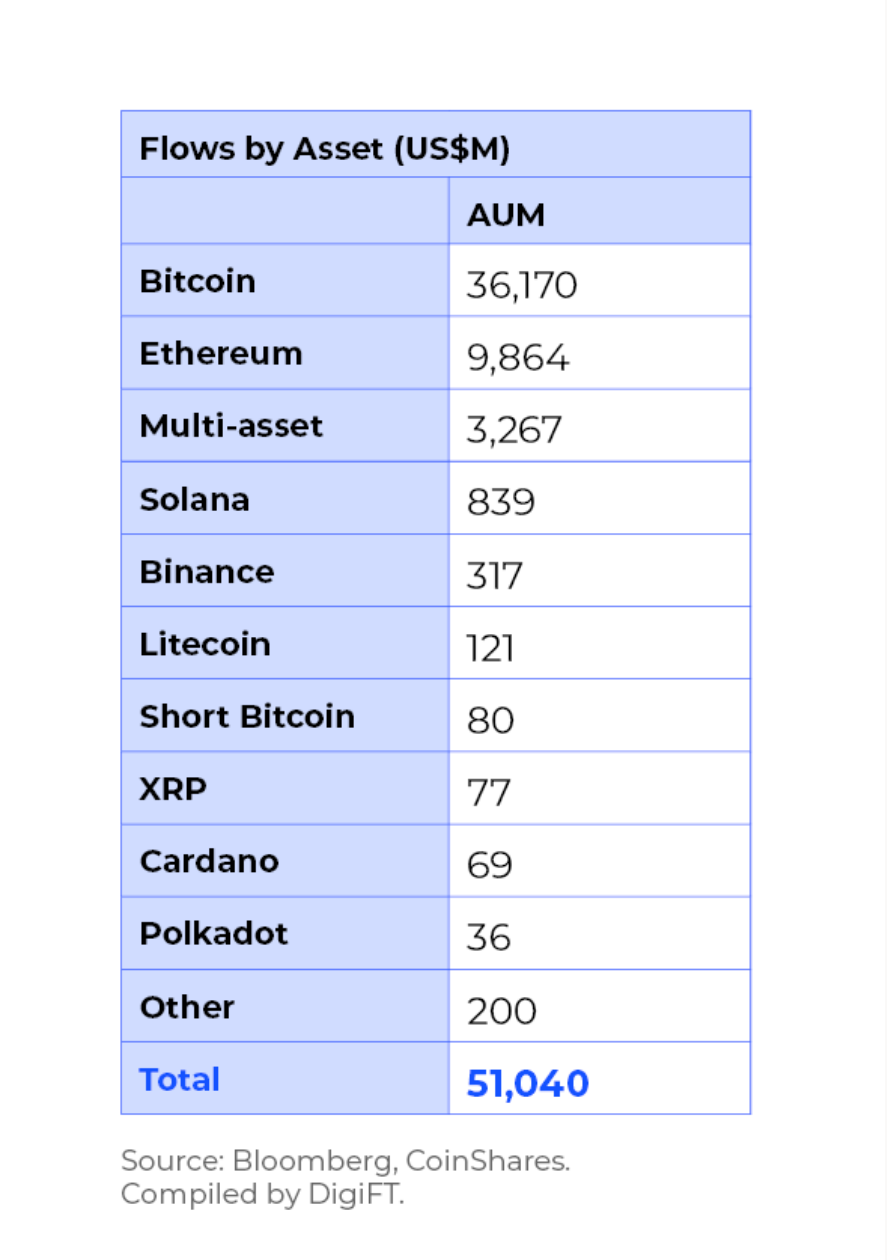
The primary underlying assets held by these products are:
Key asset providers include:
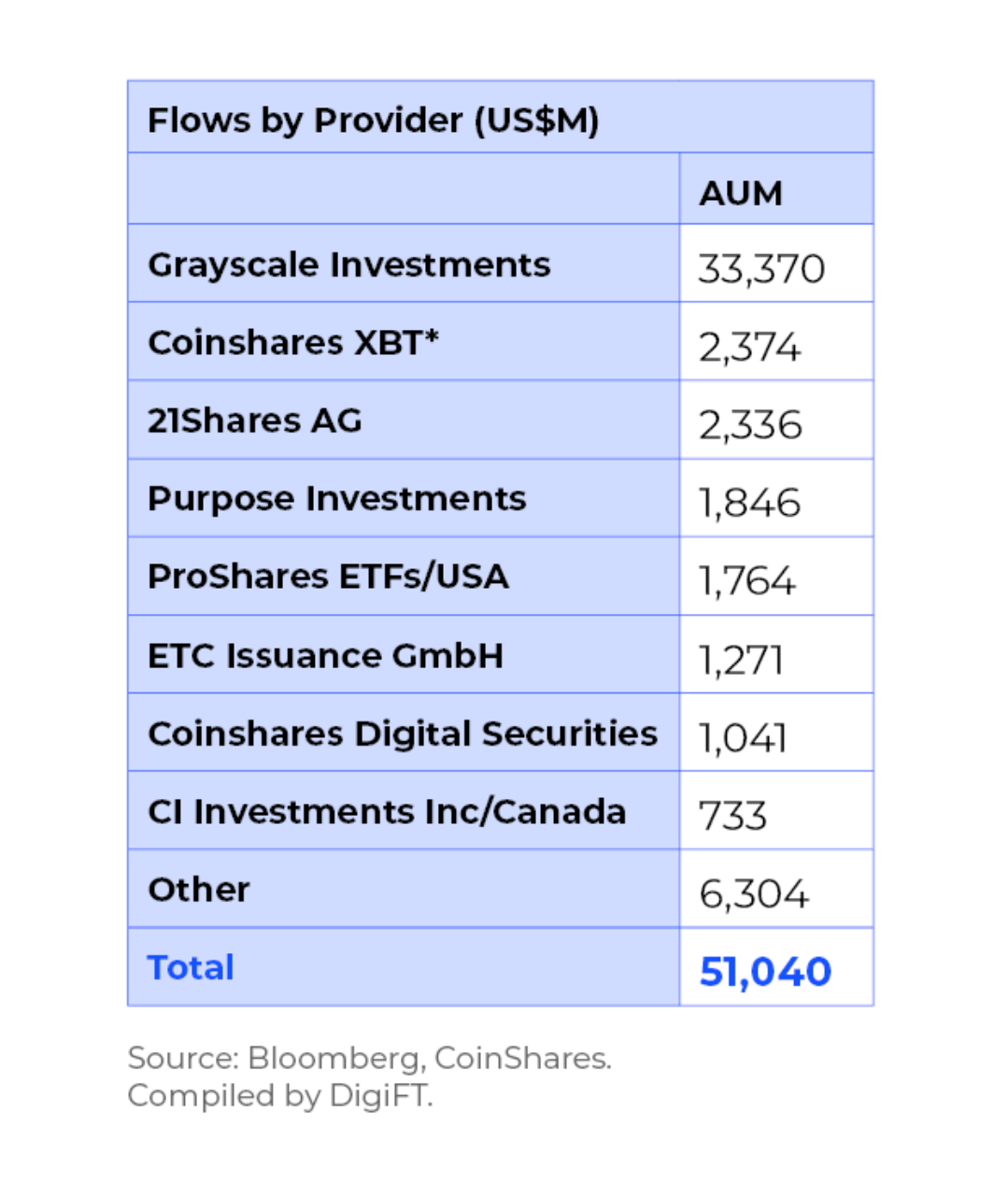
Below are details of the top five AUM issuers and their product structures:
Grayscale Investments LLC
· Overview: Grayscale Investments is a leading global cryptocurrency asset manager headquartered in the United States. Founded in 2013 as a subsidiary of Digital Currency Group, Grayscale launched its Bitcoin Trust product GBTC in the same year.
· Key Product: Grayscale Bitcoin Trust (GBTC)
· Legal Structure: Trust (physically backed)
· Fees: 2% management fee
· Trading Platform: OTCQX
· Inception Date: September 25, 2013
· Investor Eligibility: Accredited and institutional investors only
· Total Crypto AUM: $33,370 million (as of December 31, 2023)
CoinShares XBT
· Overview: CoinShares is a leader in the crypto ETP industry, offering accessible and reliable exchange-traded products (ETPs) for diversified digital assets. XBT Provider, part of CoinShares, was the first entity in Europe to offer compliant products giving investors easy access to Bitcoin and Ethereum.
· Key Product: Bitcoin Tracker One (COINXBT SS)
· Legal Structure: Tracking certificate (synthetically backed)
· Fees: 2.5% management fee
· Trading Platform: Nasdaq Stockholm
· Inception Date: May 18, 2015
· Investor Eligibility: Nordic retail investors
· Total Crypto AUM: $2,374 million (as of December 31, 2023)
21 Shares AG
· Overview: 21Shares is the world’s largest crypto exchange-traded product (ETP) issuer, founded in 2018 and headquartered in Zurich, Switzerland. Its offerings include the first physically backed Bitcoin and Ethereum ETPs.
· Key Product: 21Shares Bitcoin ETP (ABTC)
· Legal Structure: Debt-backed (physically backed)
· Fees: 1.49% management fee
· Trading Platform: SIX Swiss Exchange
· Inception Date: February 25, 2019
· Investor Eligibility: Nordic retail investors
· Total Crypto AUM: $2,336 million (as of December 31, 2023)
ProShares ETFs
· Overview: ProShares is one of the largest ETF issuers globally, managing over $65 billion in assets.
· Key Product: Bitcoin Strategy ETF (BITO)
· Legal Structure: Futures ETF (synthetically backed)
· Fees: 0.95%
· Trading Platform: NYSE Arca
· Inception Date: October 18, 2021
· Investor Eligibility: U.S. retail investors
· Total Crypto AUM: $1,846 million (as of December 31, 2023)
Purpose Investments Inc ETFs
· Overview: Purpose Investments is an asset management firm overseeing more than $18 billion in assets. It focuses relentlessly on client-centric innovation and offers a range of managed and quantitative investment solutions. Led by renowned entrepreneur Som Seif, Purpose Investments operates as part of the independent, technology-driven financial services company Purpose Financial.
· Key Product: Purpose Bitcoin ETF (BTCC)
· Legal Structure: Spot ETF (physically backed)
· Fees: 1.00%
· Trading Platform: Toronto Stock Exchange (TSX)
· Inception Date: February 25, 2021
· Target Investors: North American retail investors
· Total Crypto AUM: $1,764 million (as of December 31, 2023)
How Do These Products Differ From a Spot ETF?
Based on legal structure, current compliant crypto products fall into two main categories: ETPs (Exchange Traded Products) and trusts. ETPs can be further divided into ETNs (exchange traded notes), ETFs (exchange traded funds), and ETCs (exchange traded commodities). Among crypto-related products, ETFs and ETNs dominate.
ETFs offer better accessibility, support multi-asset investments, lower fees, and are suitable for long-term holding. However, ETFs may suffer from tracking errors—discrepancies between the value of the ETF’s holdings and its benchmark—which could lead to lower-than-expected returns. Additionally, ETFs involve higher complexity regarding taxation, subscription/redemption processes, and liquidity.
ETNs are debt instruments typically issued by financial institutions as unsecured obligations. Investors essentially buy the issuer’s credit, which carries higher risk due to counterparty exposure. Compared to ETFs, ETNs generally have poorer liquidity. However, ETNs offer greater flexibility in asset types, avoid tracking errors, and provide more tax efficiency. For instance, 21Shares’ Bitcoin ETP is a typical ETN.
Trust structures tend to be more complex and usually trade only on OTC markets. For example, Grayscale’s GBTC trades exclusively on OTCQX, a platform with limited liquidity and fewer participants—OTCQX’s total daily trading volume was just $1.3 billion as of January 2, 2024. Moreover, GBTC uses a trust structure that allows only one-way creation without redemption. Newly created shares cannot be traded on secondary markets until six months after purchase, contributing to GBTC’s premium during bull markets and discount during downturns.
Furthermore, these products can be categorized by underlying collateral into two types: physically backed and synthetically backed.
Physically Backed ETPs: These products directly purchase and hold the underlying physical asset, so their share prices track the asset’s market price. Their performance is directly linked to the underlying asset. For example, Purpose Investment’s BTCC is a spot ETF listed on the Toronto Stock Exchange, where each share corresponds to a specific amount of Bitcoin held directly by the fund manager. Custodians such as Gemini Trust Company and Coinbase Trust Company typically secure the Bitcoin.
Synthetically Backed ETPs: These use swap agreements with counterparties (usually banks) to deliver returns linked to the target asset. To ensure daily return delivery, counterparties typically post collateral—often government bonds or blue-chip stocks—held by independent custodians. The required collateral fluctuates with the value of the tracked asset. For example, ProShares’ BITO is a Bitcoin futures ETF listed on the New York Stock Exchange that invests in CME-traded Bitcoin futures contracts.
What Market Impact Will SEC Approval of a Spot Bitcoin ETF Have?
Existing crypto financial products available through traditional finance channels provide investors with one-stop access to crypto exposure, bypassing technical and regulatory hurdles associated with directly acquiring Bitcoin, Ethereum, and other digital currencies—such as private key management, tax compliance, and fiat on/off ramps—thereby attracting trillions of dollars into the crypto market.
Compared to existing products in traditional financial markets, why is SEC approval of a U.S. spot Bitcoin ETF so significant? There are two main reasons:
Access to a Broader Capital Base:
· Larger investor base: The U.S. hosts one of the world’s largest financial markets. Listing a spot Bitcoin ETF on major exchanges would allow access to accredited investors, institutions, and retail investors alike. In contrast, trust-based products like GBTC are limited to OTC markets and accredited investors only. Similar spot Bitcoin ETFs in Europe and Canada face smaller scale and lower liquidity compared to what a U.S.-listed product could achieve.
· Wider investment channels: Without a spot Bitcoin ETF, traditional asset managers—such as mutual fund managers and financial advisors—face difficulty including crypto assets in client portfolios.
Greater Acceptance:
· Products issued by institutions like BlackRock and Fidelity benefit from strong brand credibility, making them more acceptable to mainstream capital.
· Resolution of compliance concerns: These products bring greater regulatory clarity, encouraging more investment and ecosystem development around crypto assets.
As the world’s largest capital market, the U.S. approval of a spot Bitcoin ETF would have profound implications—not only unlocking vast new sources of capital but also influencing the global compliance landscape for Bitcoin network participants and altering on-chain activity patterns. We will continue monitoring how increased regulatory acceptance shapes the future of digital assets and look forward to seeing crypto help shape the next generation of capital markets.
Join TechFlow official community to stay tuned
Telegram:https://t.me/TechFlowDaily
X (Twitter):https://x.com/TechFlowPost
X (Twitter) EN:https://x.com/BlockFlow_News
 @DigiFTTech






