








Comparing Platforms Like Zealy, Galxe, Wemix, and DeGame: Uncovering New Trends in the Web3 Gaming Industry
TechFlow Selected TechFlow Selected
Comparing Platforms Like Zealy, Galxe, Wemix, and DeGame: Uncovering New Trends in the Web3 Gaming Industry
Help you discover great projects: From Zealy to DeGame, a roundup of Web3 gaming data websites.
 Navigating Web3 tides with focused insights
Author: DeMan
On the edge of the digital era, gaming worlds are no longer just destinations for fantasy and entertainment—they have become bridges for human emotions and memories. Cyberpunk 2077, a game that intricately weaves together the future and reality, bears witness to a touching story between a mother and her lost son. This mother, inheriting her son’s legacy, overcame her unfamiliarity with this unknown world and ventured deep into the virtual depths of the game. Within this universe built on code, she unexpectedly discovered her son's "cyber avatar"—a free soul liberated from the constraints of physical illness in the real world.
Her journey began with an unexpected turn at a 3D printing model shop. Originally just an ordinary store owner, after her son’s passing, she bravely took over his shop. Not only did she master the craft of model-making, but more importantly, she gradually came to understand and enter her son’s inner world. Cyberpunk 2077 became not only a continuation of their emotional bond but also her window for connecting with the world.
The magic of games lies in their ability to transcend time and space, allowing lost loved ones to be reborn in virtual realms. In this world crafted by code and creativity, every corner brims with possibilities, and every interaction becomes a celebration of life. This is the true essence of gaming—it is not merely a tool for escaping reality, but a bridge that connects hearts and continues stories.
Just as the Web3 space teems with infinite possibilities, what sparks might fly when gaming meets the more creative frontier of Web3? This intersection not only signals the fusion of technology and art but also symbolizes the convergence of personal emotion and global connectivity. Let us explore the global popularity of Web3 gaming through the following data, uncovering the forces and potential behind this emerging trend.
Record-Breaking Funding Yet High Startup Failure Rates—Has Web3 Gaming Hit a Development Bottleneck?
Since 2018, the Web3 gaming sector has experienced a capital storm, attracting a staggering total investment of $19 billion. The field peaked in investment activity in 2021 but began to stabilize by 2023. Notably, blockchain gaming-related funding reached $15 billion in just the first three quarters of 2023, with $800 million specifically allocated to Web3 game development. The United States, France, Canada, Singapore, and Hong Kong, China have emerged as epicenters of this financial wave.
However, beneath this surge of capital, the success-failure record of Web3 games remains complex. From 2018 to 2023, a total of 2,817 Web3 games were launched, yet 2,127 (75.5%) failed. As of 2023, only 223 new Web3 games have been released, a significant drop compared to 640 in 2022 and 811 in 2021. According to CoinGecko’s report, the average annual failure rate of Web3 games over these five years reached 80.8%, highlighting the challenges faced by such games on blockchain platforms.
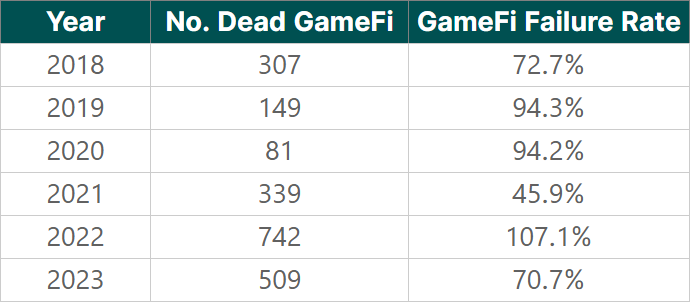
CoinGecko data: Over the past five years, 75.5% of Web3 games have failed
Particularly noteworthy is that after CryptoKitties achieved success in 2017, 422 new games emerged in 2018, but 307 of them failed. The report also notes that the bear market of 2019–2020 severely hindered GameFi’s growth, pushing the failure rate in 2019 up to 94.3%. In 2021, fueled by the booming cryptocurrency market, the Web3 game failure rate dropped to 45.9%. However, this momentum did not last into 2022, when the number of failed games hit a record high of 742, with the failure rate soaring to 107.1%. By 2023, even before year-end, 509 games had already been declared failures, with the current failure rate stabilizing at 70.7%.
These figures reveal the dual nature of the Web3 gaming landscape: on one hand, massive capital inflows underscore its vast potential; on the other, the high failure rate exposes its fragility. While the Play-to-Earn model in Web3 is attractive, achieving player success still demands high-quality gameplay experiences. Thus, finding truly immersive Web3 games remains a challenge for players. In this volatile market, the clash between hundreds of millions in investments and persistently high failure rates reflects the complexity and challenges inherent in the Web3 gaming space.
Lessons from TapTap and Steam: Models Worth Learning and Replicating for Web3 Game Developers
In the Web3 gaming space, while rapid development brings new hope and choices for players, such accelerated growth also brings information chaos and decision fatigue. This explosive information expansion is akin to placing players in a foggy maze, making it difficult for them to discover those rare gems truly worth their time. Amid this vast digital ocean, signals from quality games are drowned out by endless noise, turning the selection process into a daunting task.
To address this issue, drawing insights from mature Web2-era gaming platforms becomes crucial. For instance, mobile platform TapTap and PC platform Steam stand as industry benchmarks with well-established systems and high user satisfaction.
Launched in 2016, TapTap aims to build a high-quality mobile game community. Its mission is “to help every player discover great games, and to help every great game find its audience.” With its unique “no co-publishing” and “no revenue-sharing” business model, TapTap quickly rose to prominence in the game distribution market, becoming a go-to hub for game discussion among young users. In 2022, the platform recorded over 573 million active users, with annual downloads reaching 801 million—an increase of 32.33% year-on-year—and cumulative game pre-registrations surpassing 118 million.
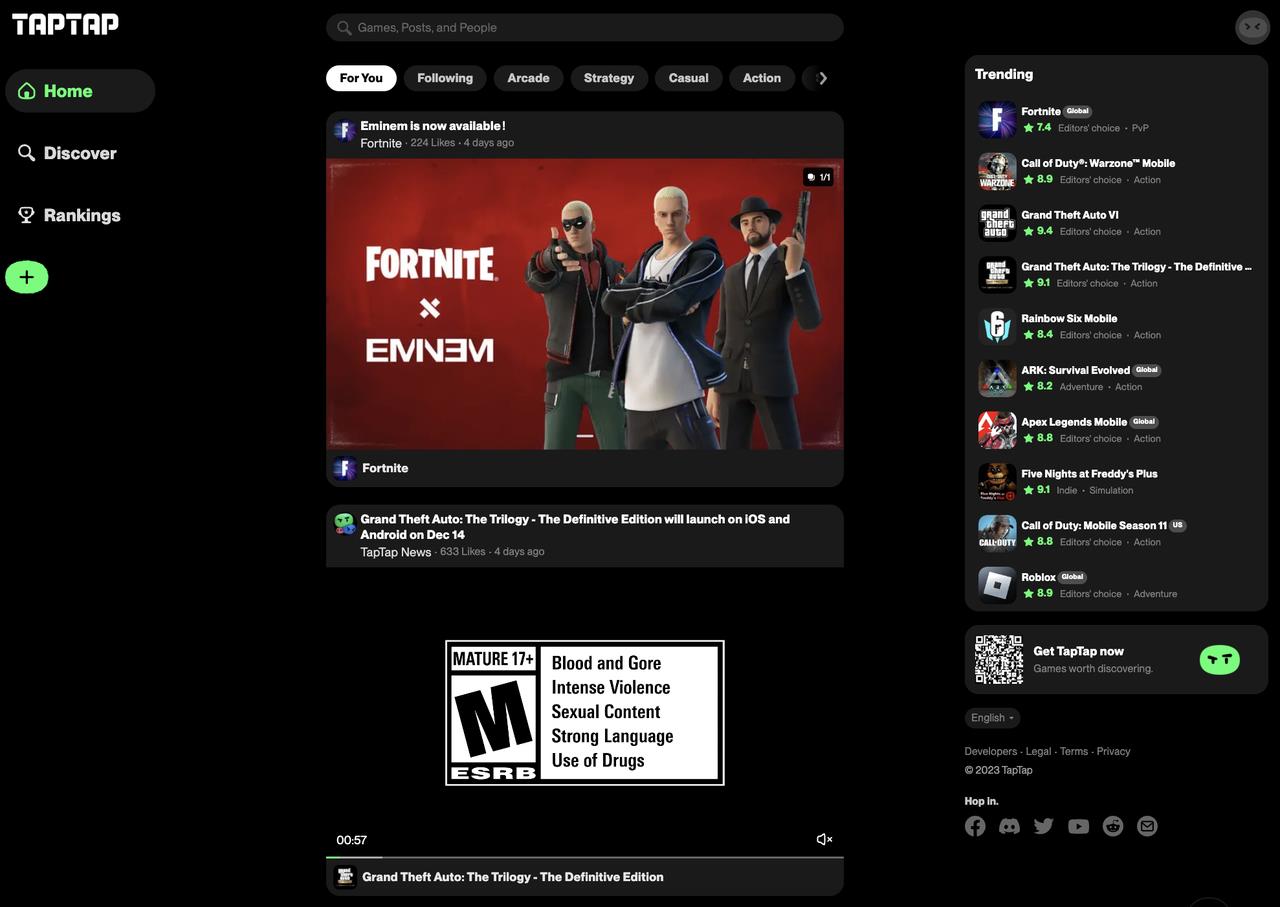
TapTap International product page
Steam, operated by Valve Corporation, is a comprehensive digital game marketplace offering players a space to purchase, review, and discuss games. Its greatest strengths lie in authentic user reviews and the Creative Workshop, which extends game replayability by enabling players to download or create their own mods. In 2021, Steam reported 132 million monthly active users, 69 million daily active users, a peak concurrent online count of 27.4 million, and a total of 38 billion hours played—marking a 21% increase from 2020.
Steam background wallpaper
The success of these two platforms demonstrates that prioritizing user experience is key to attracting players. In recent years, several promising Web3 game distribution platforms have begun to emerge, all striving to offer better services and experiences. The following section will introduce these platforms in detail, helping players navigate toward potentially high-quality Web3 games. In this age of information overload, curating quality games will become a new direction and critical factor in industry evolution.
Exploring Web3 Game Aggregator Platforms: Helping Players Quickly Identify Quality Projects in an Opaque Industry
1. Zealy: A Web3 Task Platform Deeply Integrated with Discord
Zealy, formerly known as Crew3, is a Web3 task platform focused on launching digital assets, physical and virtual events, and missions. Its standout feature is seamless integration with Discord, emphasizing social engagement and user participation. Offering diverse activity templates—such as daily check-ins, content creation, and referral tasks—Zealy provides clear categorization and a points-based ranking system. It employs various authenticity verification methods, including writing posts, submitting screenshots, and invitation tracking, to filter out bots and ensure genuine user involvement.
2. Galxe: Merging Web3 Traffic with Digital Identity
Galxe, formerly Project Galaxy, is one of the largest Web3 traffic platforms, offering project teams opportunities to issue NFTs while enabling users to participate in community activities and discover new projects. By building a digital identity solution called Galxe ID and on-chain credentials known as OATs (On-Chain Achievement Tokens), Galxe enables analysis of on-chain data and behavioral tagging of users. This approach facilitates personalized services and generates Credential sets usable across third-party applications, such as token distributions.
3. Wemix: A Global Blockchain Gaming Platform with Multi-Chain Capabilities
Wemix is a blockchain-based global gaming platform developed by Wemade Tree. It offers not only a DApp gaming platform but also integrated wallet and digital asset marketplace features. Wemix aims to build a blockchain gaming ecosystem centered around user "experience value," going beyond the traditional focus of early blockchain games solely on digital asset trading. Its core competitive advantage lies in sustainability, backed by Wemade’s two decades of experience in the global gaming industry. By adopting a hybrid multi-chain infrastructure, Wemix addresses scalability and transaction cost issues, striving to set new standards in the blockchain gaming space.
4. DeGame: A Multifunctional Platform Leading the Web3 Gaming Revolution
Since its launch in 2021, DeGame has rapidly risen as a pivotal hub in the blockchain gaming world, emerging as a leading one-stop NFT/GameFi aggregator. Known for its diverse range of blockchain gaming information, DeGame now catalogs over 2,500 games and 550 tokens across 57 different blockchain networks. The platform has successfully attracted over 200,000 users and more than 50 guilds, integrating key strengths from platforms like Galxe and Zealy. It offers rich game data, news updates, event publishing tools for developers, and airdrop opportunities for users.
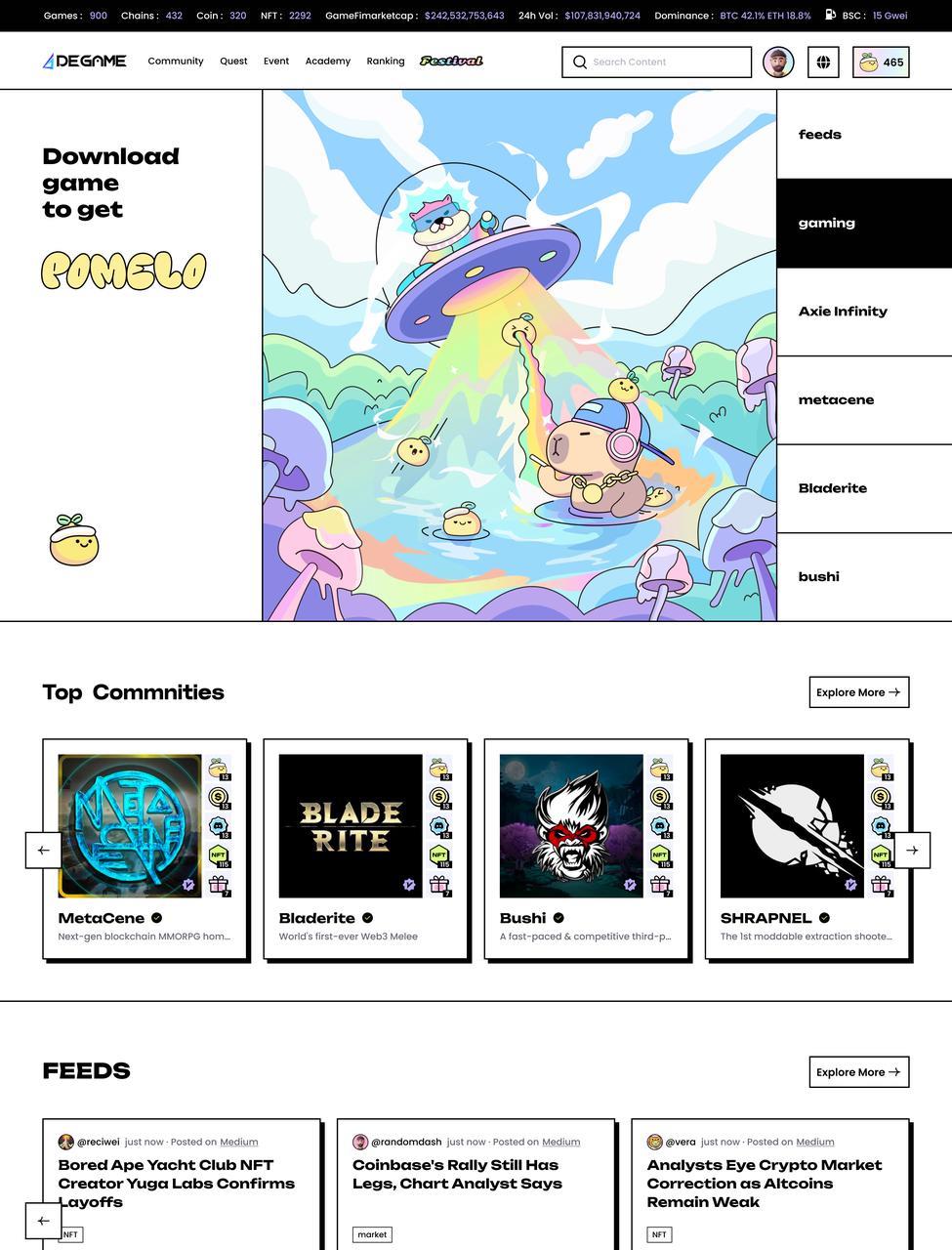
DeGame new product page
Top Communities: Aggregates over 10,000 Web3 gaming communities worldwide. Users can instantly jump to official websites, Twitter accounts, or community groups, gaining comprehensive insights into GameFi projects and interacting directly with teams or members.
Feeds: Serves as an information feed portal within the Web3 ecosystem, centralizing all industry news. Supporting both PGC and UGC models, it allows vetted high-quality creators to publish content, delivering valuable insights to users.
Quest: A fair and incentive-driven mission hub. Regular users, game teams, KOLs, and developers can post custom tasks with rewards, fostering user interaction and boosting traffic and ecosystem value.
Leader Board: Provides real-time data rankings for global Web3 games, KOLs, and gaming guilds. It also supports user ratings and reviews, enabling truly decentralized game scoring.
Gaming: Displays trending and newly launched Web3 games in real time, allowing users to download and start playing with one click.
Event: Offers a comprehensive gateway to Web3 gaming events, both online and offline. Users can freely choose to participate, and qualified players can even host their own events here.
Discover: Curates top-tier gaming videos from across the web. Video creators can upload gameplay guides, tutorials, or entertaining clips, helping users easily discover relevant content.
The Momentum of Web3 Gaming May Accelerate Further—The Industry Calls for High-Quality Aggregator Platforms
As a one-stop NFT/GameFi aggregation platform, DeGame stands out in the Web3 gaming space with its comprehensiveness and innovation. Covering a wide variety of games across multiple blockchain technologies, it attracts a broad user base and numerous gaming guilds. This diversity and integration are defining characteristics that distinguish DeGame from other platforms.
Through continuous upgrades and optimization, DeGame demonstrates a deep understanding of industry dynamics and user needs. It is not merely an information aggregator but a key driver advancing the Web3 gaming ecosystem.
Current trends suggest strong potential and a bright future for DeGame. Its upcoming new version and feature enhancements indicate that the platform will likely maintain its leadership position and could become a pivotal force shaping the future of Web3 gaming.
Considering its comprehensiveness, innovative capabilities, and adaptability to market demands, there are ample reasons to hold optimistic expectations for DeGame’s future. This platform is not only an ideal choice for Web3 gaming enthusiasts but may also emerge as a significant catalyst for broader innovation across the gaming industry.
Join TechFlow official community to stay tuned
Telegram:https://t.me/TechFlowDaily
X (Twitter):https://x.com/TechFlowPost
X (Twitter) EN:https://x.com/BlockFlow_News












