The Cosmos ecosystem sees a "talent war": Recapping the battle between Neutron and Osmosis over Mars Protocol
TechFlow Selected TechFlow Selected
The Cosmos ecosystem sees a "talent war": Recapping the battle between Neutron and Osmosis over Mars Protocol
Craving for traffic remains the eternal rhythm of Web3 project development.
 Navigating Web3 tides with focused insights
Author: TechFlow
In the world of crypto, competition often exists between different ecosystems, but rivalry within the same ecosystem can be even more intense.
For example, a recent "battle for talent" within the Cosmos ecosystem over where the decentralized lending protocol Mars Protocol should deploy its v2 has highlighted how infrastructure projects in the same sector are deeply eager to attract applications.
A proposal regarding whether Mars Protocol's v2 should be deployed on Neutron or Osmosis sparked widespread discussion in the global crypto community. Both platforms hope that Mars will choose their platform and have each extended invitations to Mars.
Below, TechFlow summarizes the event's progression and various perspectives, offering readers a detailed understanding of the situation.
Event Overview
On December 4, Mars Protocol, a decentralized lending protocol on Cosmos, officially announced that Mars Hub would deploy Mars v2 onto Neutron (a smart contract platform in the Cosmos ecosystem).
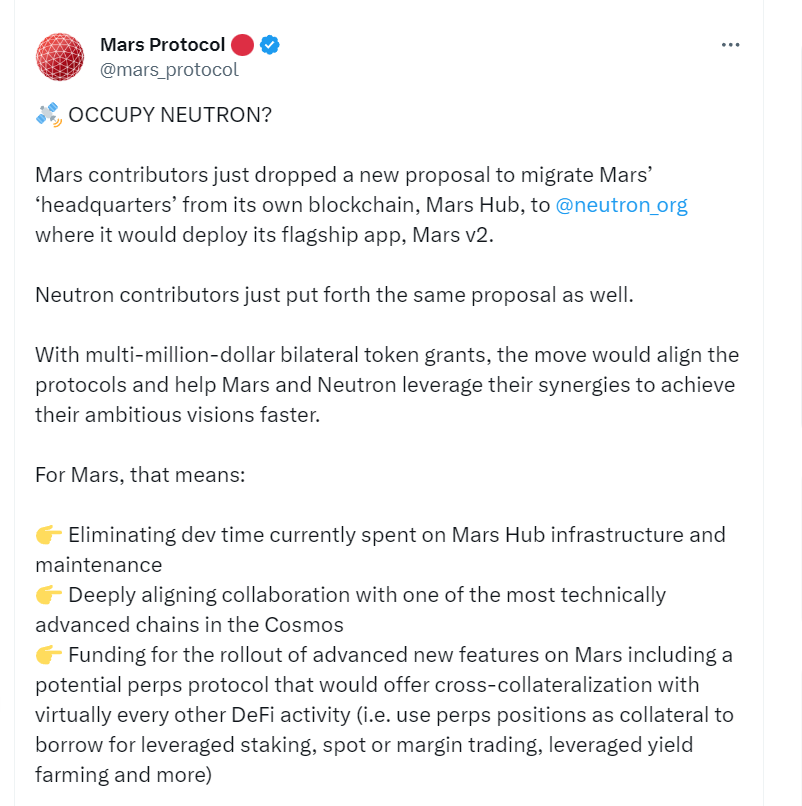
Official announcement
On December 6, the situation shifted when Mars Protocol published a new proposal on its official website, asking whether Mars v2 should be deployed on Neutron or Osmosis.
In response, both Neutron and Osmosis issued statements expressing their hopes that Mars Protocol would deploy Mars v2 on their respective platforms.
Project and Proposal Details
Mars Protocol
Project Introduction
Originally a decentralized lending protocol on Terra, Mars Protocol moved to the Cosmos ecosystem following Terra's collapse. On January 31, 2023, Mars Protocol announced the mainnet launch of Mars Hub, its application-specific blockchain on Cosmos.
Currently, Mars is a decentralized lending protocol in the Cosmos ecosystem. Mars v2 introduces a framework enabling users to go long or short on assets, borrow, lend, and participate in yield farming.
The native token is $MARS, with a market cap of $10.95M and a current price of $0.12.
Official website: https://marsprotocol.io/
Official Twitter: https://twitter.com/mars_protocol
Website screenshot
Origin of the Event
In September 2022, Mars Protocol published a paper explaining why Cosmos provides the best architecture for building DeFi products. Specifically, Mars believes that Cosmos chains offer inherent advantages that position them well for long-term success in the crypto space.
However, since then, the competitive landscape for appchain infrastructure has evolved. Notably, the Ethereum ecosystem has developed attractive alternatives for those seeking customization, such as OP Stack, ZK Stack, and Polygon Supernets.
Mars believes that to remain competitive, greater integration, collaboration, and coordination are needed within Cosmos. Therefore, for long-term growth, Mars aims to restructure itself.
Initially, Mars favored deploying v2 on Neutron and even published a related proposal on December 4.
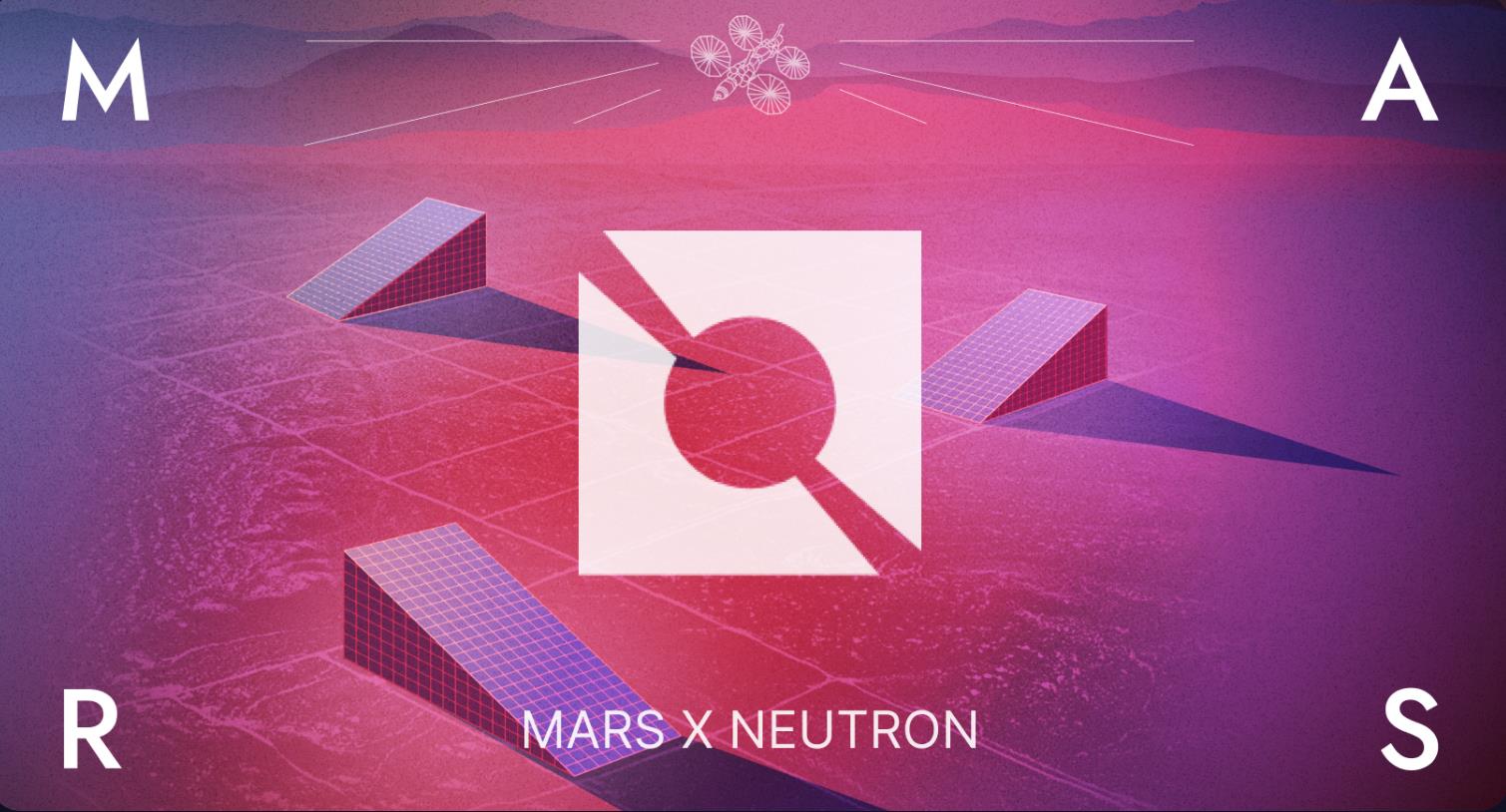
Then, on December 6, Mars opened a three-week discussion on its website about whether to deploy v2 on Osmosis or Neutron.
Both Osmosis and Neutron want Mars Protocol to deploy v2 on their platform—details follow.
Osmosis
Project Introduction
Osmosis is a cross-chain DEX built on a sovereign Layer 1 blockchain within the Cosmos ecosystem. The chain supports developers designing and deploying customized AMMs using its modular framework and on-chain governance system.
The native token is $OSMO, with a circulating market cap of $370M and a current price of $0.75.
Official website: https://osmosis.zone/
Official Twitter: https://twitter.com/osmosiszone
Osmosis website screenshot
Osmosis' Proposal
On December 4, Osmosis released a proposal urging Mars Protocol to migrate to Osmosis.
The proposal outlines several reasons why migrating to Osmosis would benefit Mars Protocol:
-
First, since Mars relaunched in February 2023, the relationship between Mars and Osmosis has been close. To support Mars’ market entry, Osmosis generously granted 310K OSMO to boost liquidity for the Mars token. Additionally, Osmosis approved MARS tokens for regular OSMO incentive programs.
-
Second, most of Mars’ TVL and token liquidity reside on Osmosis. According to DeFiLlama data, over 95% of Mars’ TVL is on Osmosis. Although MARS tokens are listed on both Osmosis and Neutron, over 95% of MARS liquidity and trading volume occurs on Osmosis.
-
Third, Osmosis has the highest IBC transaction volume. Since Mars is an interchain protocol with outposts across multiple Cosmos chains, it makes sense for Mars Hub to be at the center of the IBC network.
-
The proposal to move Mars Hub to Osmosis contains no exclusivity clauses, whereas moving to Neutron initially included exclusivity restrictions (though Neutron removed these exclusivity terms on December 7).
Neutron
Project Introduction
Neutron is a permissionless smart contract platform built using the Cosmos SDK. Developers can deploy applications once and scale across the entire IBC network of interconnected blockchains without needing to maintain multiple custom versions of their protocol.
The native token is $NTRN, with a circulating market cap of $147M and a current price of $0.65.
Official website: https://neutron.org/
Official Twitter: https://twitter.com/Neutron_org
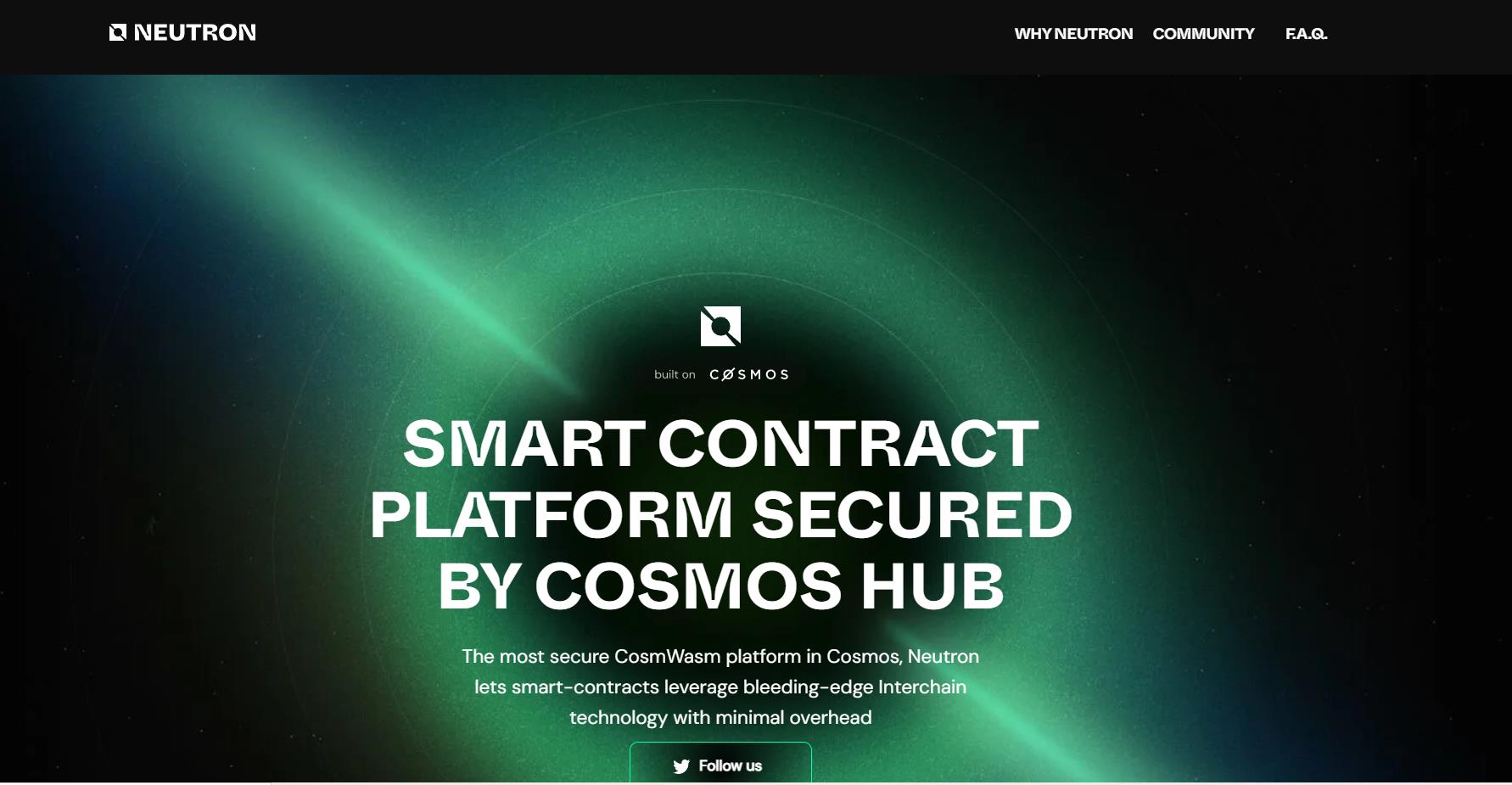
Neutron website screenshot
Neutron's Proposal
On December 4, Neutron released a proposal encouraging Mars Protocol to migrate to Neutron.
Key points from the proposal include:
-
The Neutron Foundation will allocate $3 million USDC per quarter to the Mars Protocol Foundation over two years to fund development and growth.
-
The Mars Protocol Foundation will grant 60,000,000 MARS tokens to the Neutron Foundation. These tokens will unlock linearly over six years, and may be used for governance during the vesting period.
-
The Mars and Neutron Foundations will work together to ensure the granted MARS tokens benefit both protocols.
-
The Mars Protocol Foundation commits to proposing and supporting the migration of Mars Hub to Neutron, subject to final approval by the Mars Council, including the following goals:
-
Deploy Mars v2 on Neutron by the end of Q3 2024.
-
Migrate Mars governance and the MARS token to Neutron by the end of Q4 2024.
-
Starting January 1, 2024, major protocol upgrades will first launch on Neutron.
-
For ten years, 10% of Mars Protocol DAO revenue will be allocated toward shared benefits for both Mars and Neutron protocols.
-
Market Perspectives
The potential migration of Mars Protocol has triggered significant discussion within the communities of Mars, Neutron, and Osmosis. TechFlow compiles some popular market views for reference.
Generally, the community acknowledges that both Osmosis and Neutron have unique strengths and weaknesses.
Advantages of Moving to Osmosis
-
No exclusivity clause (though Neutron also removed its exclusivity term, leveling the playing field)
-
If Mars plans to build perps (perpetual contracts), they could launch faster since Mars v2 is already deployed on Osmosis
-
Osmosis has a larger and more active community compared to Neutron
-
Osmosis is the DeFi hub of Cosmos
Disadvantages of Moving to Osmosis
-
Osmosis innovates rapidly, which benefits its own DEX but might harm Osmosis L1 and Mars stability
-
Most of Osmosis’ development efforts focus on its own products rather than tools and services to help other apps build on Osmosis
-
Osmosis and Mars are potential competitors
Advantages of Moving to Neutron
-
If Mars develops successfully, it could become Neutron’s flagship DeFi product
-
Neutron offers a neutral platform where Mars can build v2 without competing against native projects
-
Neutron’s team comes from P2P (same team behind Lido), experienced builders
-
Compared to Osmosis, Neutron functions more like a general-purpose chain, aligning better with Mars’ long-term goals
Disadvantages of Moving to Neutron
-
Compared to Osmosis, Neutron has fewer users, lower activity, fewer applications, and a smaller community
-
From January 1, 2024, major protocol upgrades will be exclusively launched on Neutron for three months—a delay that could disadvantage Mars
Overall, the debate over whether Mars Protocol v2 should deploy on Neutron or Osmosis has ignited extensive discussions across all three communities. This intense debate is expected to continue for another three weeks, with Mars Protocol planning to release a governance proposal on-chain around December 26 for voting.
It should be clarified that neither proposal requires Mars Protocol to abandon either “Osmosis” or “Neutron.” Mars intends strategic deployments on both appchains. How things unfold remains to be seen.
Nevertheless, as the market recovers, competition among ecosystem infrastructures for users and TVL intensifies. It’s unlikely this will be the last time an application receives such broad interest.
The pursuit of traffic remains an unchanging theme in Web3 project development.
Join TechFlow official community to stay tuned
Telegram:https://t.me/TechFlowDaily
X (Twitter):https://x.com/TechFlowPost
X (Twitter) EN:https://x.com/BlockFlow_News
 深潮TechFlow