








Pyth Network: Spotify of the Crypto World
TechFlow Selected TechFlow Selected
Pyth Network: Spotify of the Crypto World
The music industry's shift from Napster to Spotify provides a framework for addressing current challenges in the cryptocurrency and DeFi space.
 Navigating Web3 tides with focused insights
At the end of the 1990s, a revolution took place in the music industry: it brought free music to everyone.
Napster disrupted the entire music industry by creating a platform where listeners could freely share digital music files without regard for intellectual property rights. Suddenly, anyone could download songs from any album—for free.
However, this peer-to-peer (P2P) model of music file sharing couldn't last forever. Eventually, Napster was replaced by Spotify, which transformed the music landscape so that both music consumers and intellectual property owners could benefit.
Today, the Web3 world is undergoing a similar transformation led by Pyth Network. In this article, we'll explore why Pyth Network is becoming the "Spotify of crypto and DeFi."
The Dawn of Digital Music
In the early days of the internet, the concept of digital music was a cutting-edge and exciting new idea. When you bought a CD, it was widely accepted that you were free to do whatever you liked with the digital files you had purchased.
Under these conditions, anyone who bought a CD and shared it online essentially became a "Napster node," providing free music to everyone!
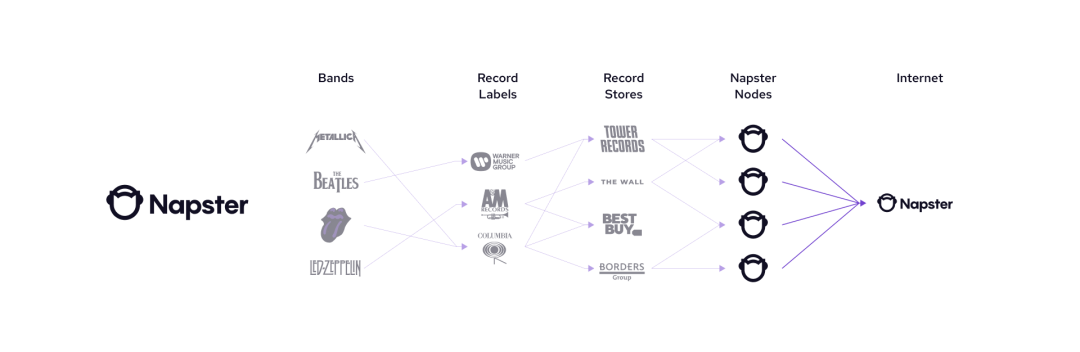
Yet, this unrestricted freedom gradually became a major challenge. Intellectual property owners—primarily artists—were not receiving fair compensation.
If artists couldn't profit from their creations due to these "Napster nodes," why would they continue making music?
The outcome was predictable: Napster faced a series of lawsuits and even spam attacks from record labels trying to “protect their world.” Eventually, Napster was forced to shut down.
Welcome to the Spotify era. Instead of acting as middlemen like record stores or Napster users, Spotify introduced a direct media service where users could access nearly every song by paying a nominal fee.
This model drastically reduced distribution costs and triggered an explosion in music production. The key difference between the two outcomes lies in the fact that Spotify recognized and rewarded intellectual property owners.

Parallel Events in the Crypto World
There's a similar scenario unfolding in the crypto industry: traditional oracles operate much like Napster.
They assume all data on the internet is freely available, and the main job of traditional oracles is to incentivize node operators to bring this data onto blockchains.
However, there’s a fundamental flaw with this approach: not all data is free.
Take financial market data, for example: in 2023, this data was worth over $6 billion. Traditional financial markets typically require expensive subscription fees to access price feeds for assets like stocks, forex, and commodities.

Crypto markets are unique because CEX order book data is usually free and easily accessible. However, this state won’t last forever.
For instance, Coinbase began charging for market data last year. Historically, traditional exchanges didn’t start charging for market data until about 15 years ago, when they realized it was a profitable revenue stream.
Today, it constitutes a significant portion of traditional exchange revenues, as data can be customized and packaged to meet customer needs. Crypto data will inevitably follow the same path.
Yet, we see traditional oracles still “freely” scraping financial market data from the internet. This raises concerns: either the data is illegally scraped or outdated, resulting in insufficiently timely updates.
In either case, when considering the economic value of market data, such business models become questionable.
Pyth Network: Lessons Learned from Spotify
This is where Pyth Network comes in, adopting a strategy similar to Spotify. Pyth introduces a direct data feed model, eliminating intermediary networks for accessing financial data.
Pyth’s network design removes unnecessary intermediaries while ensuring that actual content creators—the data publishers—receive fair compensation.
This approach not only ensures data quality but also offers traders—the creators and owners of this unique, valuable financial data—a new opportunity to participate in the economics of data distribution.
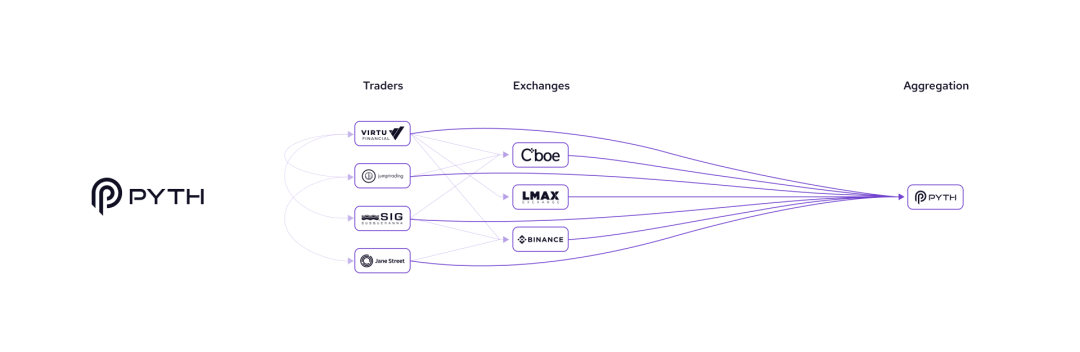
Our data publishers share a common vision with the broader Pyth Network community and the wider DeFi ecosystem: to fully and scalably solve the oracle problem for the advancement of Web3 and DeFi.
These data publishers recognize that pre-Pyth oracle solutions were incomplete and unlikely to scale to support more assets.
Moreover, the Pyth oracle solution enables these data publishers—exchanges and market participants in both digital and traditional assets—to explore Web3 use cases at their own pace and direction.
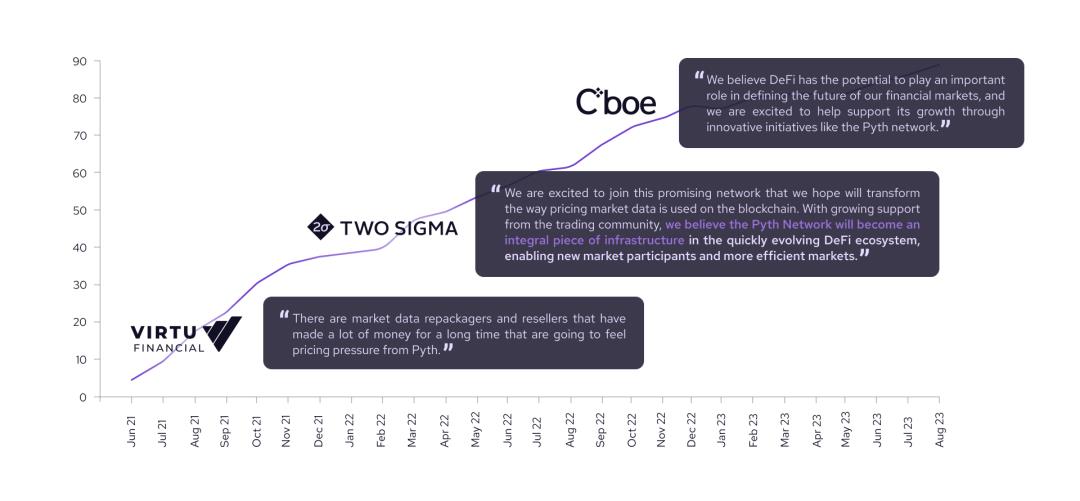
Since its inception, Pyth Network has been growing steadily. On average, three new data publishers join the network each month.
To date, Pyth has over 85 data publishers, including some of the most renowned names in the industry: Binance, Bybit, Wintermute, Cboe Global Markets, Optiver, and LMAX.
These are just a fraction of this ecosystem. On the other end of the network, over 200 applications are integrating Pyth’s price feeds, securing billions of dollars in smart contract value and trading volume.

History doesn't repeat itself, but it often rhymes. The music industry’s shift from Napster to Spotify provides a framework for addressing current challenges in crypto and DeFi.
With its innovative first-party data model, Pyth Network is making significant progress in transforming how high-throughput DeFi protocols access and utilize financial data.
For data creators and application users alike, this is the melody they’ve been waiting to hear.

Join TechFlow official community to stay tuned
Telegram:https://t.me/TechFlowDaily
X (Twitter):https://x.com/TechFlowPost
X (Twitter) EN:https://x.com/BlockFlow_News
 @PythNetwork






