Behind Huawei Mate60's "domestically produced chip": SMIC as the manufacturing partner, cryptocurrency mining chip experience proves crucial
TechFlow Selected TechFlow Selected
Behind Huawei Mate60's "domestically produced chip": SMIC as the manufacturing partner, cryptocurrency mining chip experience proves crucial
Orders from mining machine companies once occupied 95% of SMIC's N+1 capacity.
 Navigating Web3 tides with focused insights
Author: TechFlow Repair Technician
Yesterday, the most explosive market news came from Huawei. During a casual browse through WeChat groups, I noticed that communities discussing cryptocurrency, stocks, and real estate were all simultaneously talking about the Huawei Mate 60. Without any prior teaser, announcement, or marketing campaign, Huawei suddenly launched its new flagship smartphone, the Mate 60 Pro, on its official online store under the name "Pioneer Program."
The biggest question on everyone's mind is about the chip—where did this chip come from?
Since being placed on the U.S. government’s Entity List on May 16, 2019, Huawei has faced comprehensive technological restrictions. On September 14, 2020, TSMC completely cut off chip supplies to Huawei, leaving the company without access to advanced chips—a situation that has now lasted 1,081 days.
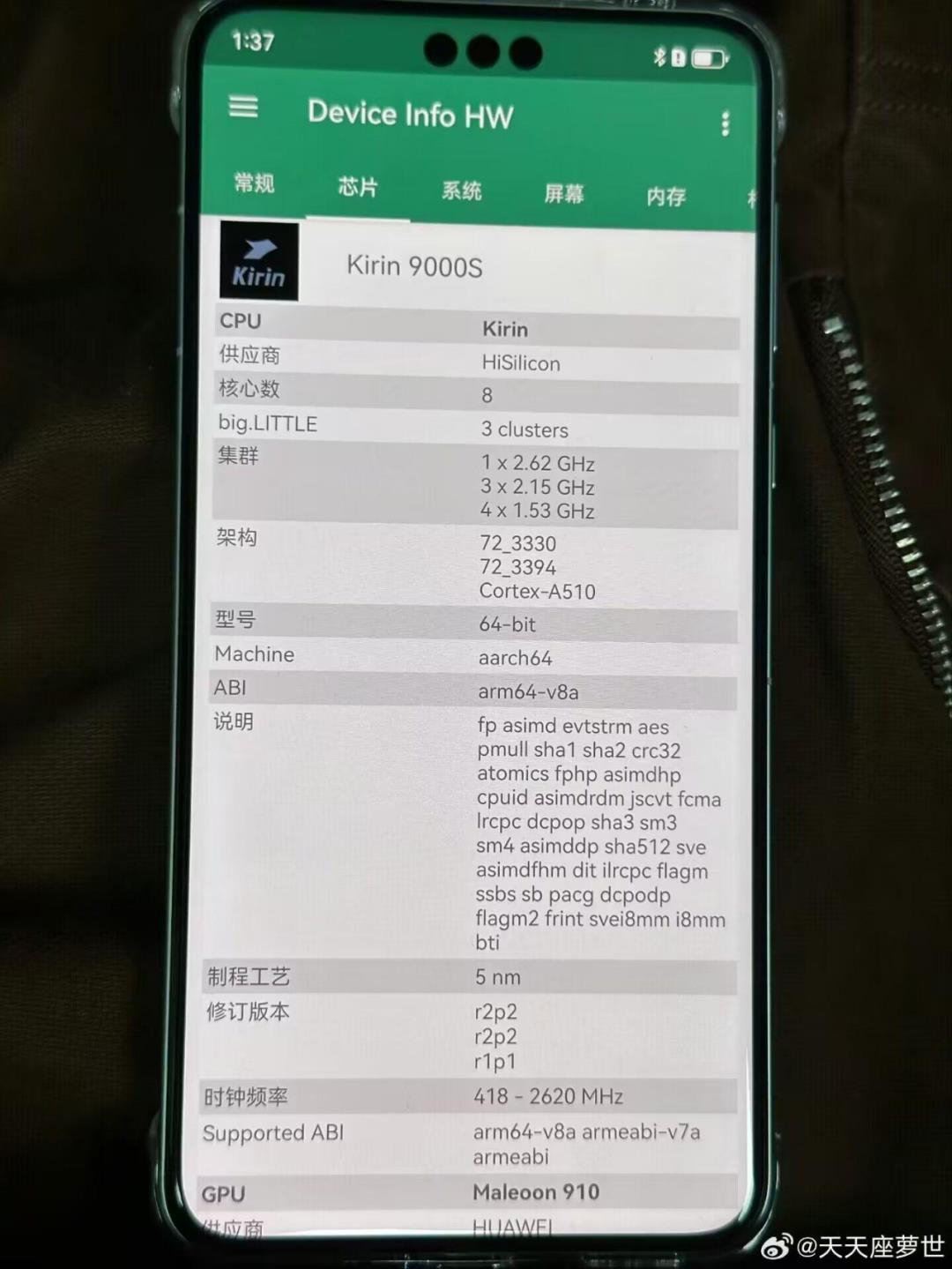
Now, it has been confirmed that the Huawei Mate 60 Pro uses Huawei HiSilicon’s self-developed Kirin 9000s chip, featuring eight cores (four large and four small), with a maximum clock speed of 2150MHz. The GPU is the Maleoon 910.
Who manufactured this chip? Shenzhen’s Huaqiangbei acted swiftly—mobile phone repair streamers began live-streaming disassemblies and discovered that the CPU of the Mate 60 Pro bears the serial number 2035-CN, where “CN” indicates production in mainland China, unlike previous TSMC-made chips labeled “TW.”
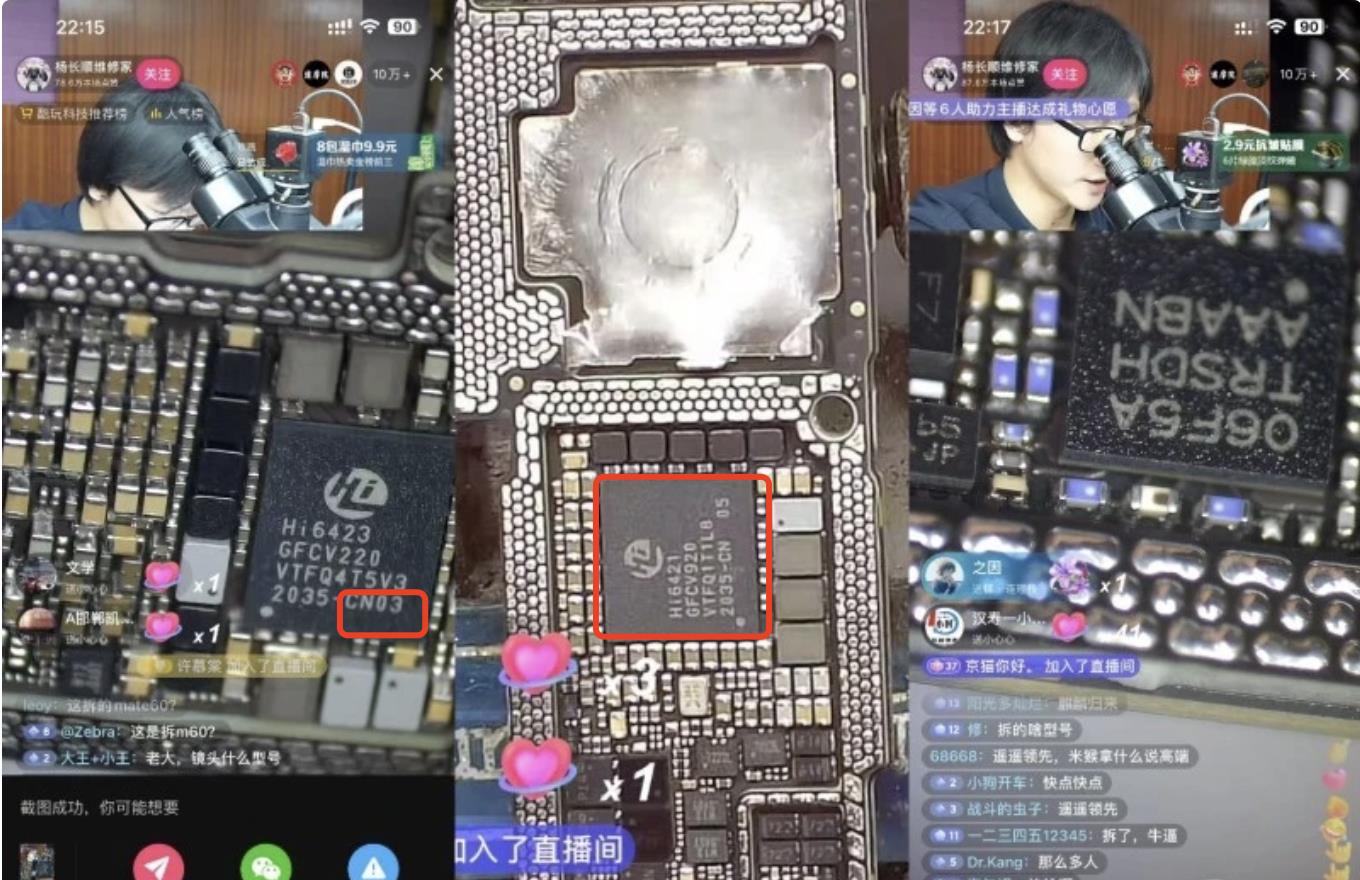
The answer is revealed: the Kirin 9000s chip inside the Mate 60 Pro is manufactured by Semiconductor Manufacturing International Corporation (SMIC).
According to screenshots shared online, the Kirin chip is labeled as using a 5nm process. However, most technical experts believe the 9000S is not actually built on a true 5nm process, but rather on SMIC’s N+2 process.
SMIC is currently the only Chinese company capable of mass-producing 14nm FinFET chips. Both the N+1 and N+2 processes are improvements based on the 14nm FinFET technology, achieved using DUV lithography machines, thereby circumventing U.S. export restrictions. (The most advanced nodes currently require EUV lithography equipment.)
SMIC has never officially claimed that N+1 or N+2 are equivalent to 7nm processes, but within the semiconductor industry, it is widely believed that the N+1 process corresponds roughly to 7nm LPE (low-power) technology, while N+2 aligns with 7nm LPP (high-performance) technology.
The rollout of the Mate 60 Pro appears to publicly confirm that SMIC’s N+2 process has reached maturity for mass production. Yet many insiders aren’t surprised—SMIC had already begun manufacturing N+1 7nm chips two years ago, with one of their key clients being Bitcoin mining companies.
In July 2022, renowned reverse-engineering analysis firm TechInsights released a report dissecting an ASIC chip used in mining hardware made by MinerVa Semiconductor. Their analysis confirmed that the chip was manufactured by SMIC using a 7nm process.
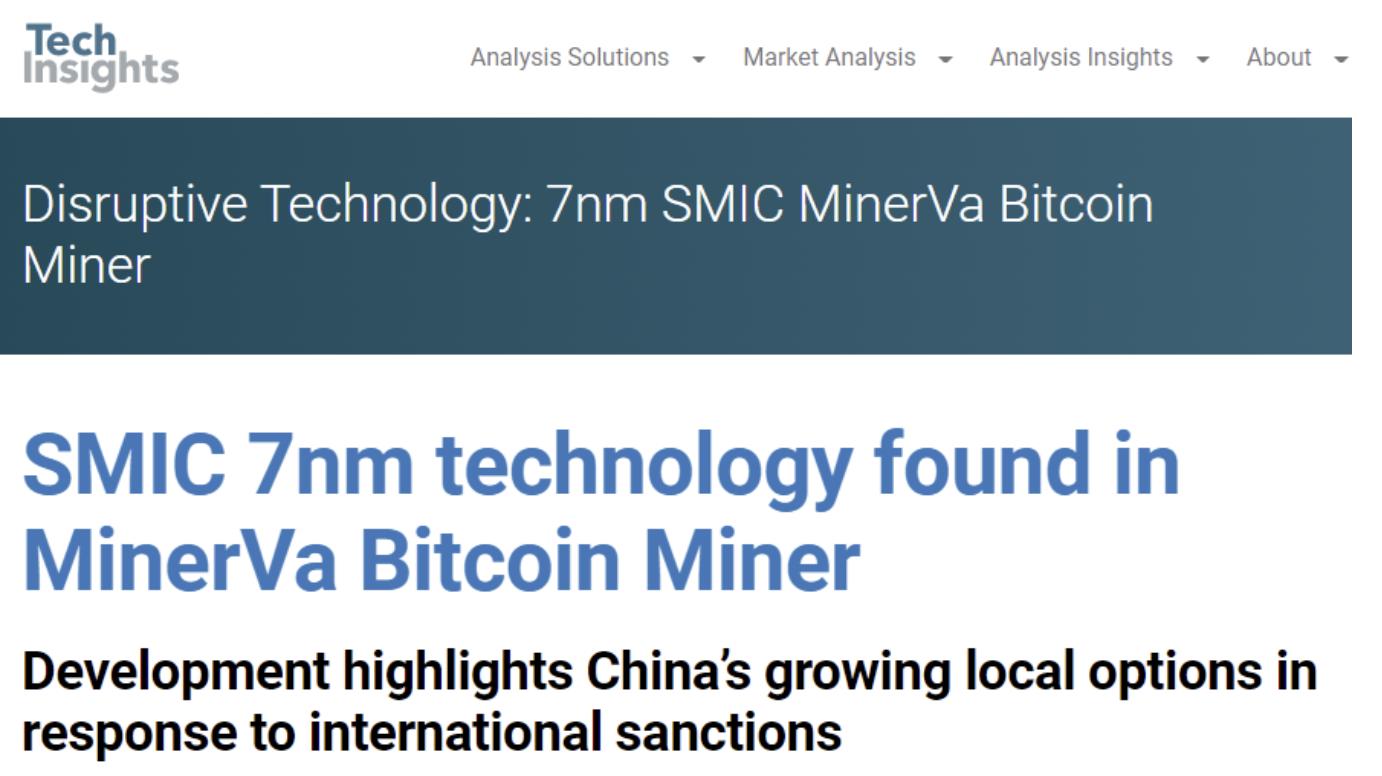
According to MinerVa Semiconductor’s website, this IC began shipping as early as July 2021, suggesting that SMIC likely had the capability to mass-produce 7nm chips by early 2021.
Industry sources told TechFlow that Innosilicon, a leading Chinese full-service IP and custom chip design company—and also a major designer of mining chips—was among the first customers on SMIC’s N+1 process, successfully completing trial production at the end of 2020. It is highly likely that Innosilicon designed the mining IC used by MinerVa Semiconductor.
In the early stages of a new process node, yields are typically low. For foundries, improving yield requires iterative learning through production runs, which in turn demands customer orders—but attracting customers requires proven high yields, creating a classic chicken-and-egg problem.
Apple provided significant support during TSMC’s development of the 5nm process. In return, Apple secured 50% of TSMC’s 5nm production capacity.
SMIC lacks TSMC’s global influence, but it was fortunate to find what could be called a “budget version of Apple”—mining hardware firms like Canaan Creative and Innosilicon.
Mining chip companies provided SMIC not only with crucial orders (and revenue), but also invaluable opportunities to refine its manufacturing process and improve yields.
According to the transcript of a 2021 conference call by mining company Canaan Creative, the company began collaborating with SMIC as early as 2019, co-developing 14nm mining chips, and at one point SMIC allocated up to 95% of its N+1 capacity to Canaan.

Canaan Creative Conference Call Transcript 20210301
Mining companies naturally demand cutting-edge process technologies, but that doesn’t mean foundries are eager to allocate advanced capacity to them.
For example, TSMC faces no shortage of buyers—smartphone giants line up to place orders—so they may not prioritize mining firms. Bitmain, the largest mining company at the time, once had to pay upfront in full just to secure TSMC’s capacity.
Samsung, having secured major contracts from NVIDIA and Qualcomm, announced at the end of 2020 that it would no longer accept blockchain-related orders.
Mining firms need access to advanced nodes, and SMIC’s new processes needed customers—making them a perfect match.
As for yield rates—often a critical concern for other chipmakers—it matters less to mining companies.
According to industry experts, mining-specific ICs have relatively simple architectures and small RAM sizes, meaning yields tend to be higher than for many other types of chips when produced on a newly developed process node.
Typically, a mining chip packs dozens or even hundreds of cores into a single die. These cores operate in parallel and independently. While a defect might render a general-purpose chip unusable, in a mining chip only the affected core fails—the rest continue functioning normally.
Different chips will have varying numbers of defective cores, resulting in different overall computational performance. This variance is managed through binning—higher-performing chips are assembled into premium miners, while lower-performing ones go into budget models.
A single mining rig integrates dozens or even hundreds of chips. Even if one or two chips fail completely, the impact on overall operation is minimal—hence, mining chips can tolerate much lower yields.
In short, just when SMIC needed customers to test and mature its latest N+1 and N+2 processes, mining chips stepped up—laying the foundation for today’s launch of the Huawei Mate 60 Pro.
As one official remarked during an inspection visit to a mining company: ASIC chips are chips too.
Join TechFlow official community to stay tuned
Telegram:https://t.me/TechFlowDaily
X (Twitter):https://x.com/TechFlowPost
X (Twitter) EN:https://x.com/BlockFlow_News
 深潮TechFlow